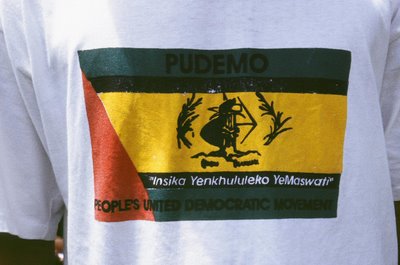

People’s United Democratic Movement
Basic conditions for a legitimate and acceptable constitutional solution to the crisis in the country
2004
Introduction
‘In keeping with this noble resolve, we welcome any genuine invitation to all organised formations, registered and unregistered, to a properly constituted and representative constitutional forum that will be mandated to work the wayforward for Swaziland. However, to safeguard against a repeat of the political blackmail and socio-economic evils of the tinkhundla legacy, there are important pre-conditions that should be satisfied.” (PUDEMO document on the wayforward towards a constituent assembly through a negotiated settlement issued in 1992.)
Since its formation in 1983, PUDEMO has always been willing and ready to engage the tinkhundla regime in a serious process of negotiations for change in Swaziland. Even in this year of its 20th anniversary, it still remains willing and ready to engage the tinkhundla regime and all stakeholders in a serious process of negotiations.
In this regard, PUDEMO has consistently stated that for the process of constitutional change to be legitimate and broadly acceptable, it must be broad based, all-inclusive and free, in order to guarantee the full and effective participation of all the people of Swaziland in a process they should own and drive.
This means that the process is as important to the outcome as is the content itself. What the constitution says about the future Swaziland and how it will look like and in whose interest it will be shaped, is as much important as how was it made, by who and for who.
This requires that the regime must demonstrate beyond doubt its commitment to the peaceful transition to democracy in Swaziland. Further, the terms of reference and related processes, such as conflict resolution mechanisms and methods of operation must be clarified and adopted with the full participation of all stakeholders.
The king’s constitution and the future of Swaziland
Consistently, PUDEMO has maintained that it is committed to the creation of a political system based on the universal principles of multiparty democracy. In our historic document, the People’s manifesto, which has been the guiding document of the movement since its formation in 1983, we affirmed in no uncertain terms that the participation of all the people in the running of the country’s affairs is central to real progress towards change in Swaziland.
The king is about to announce the constitution that he commissioned in 1996. The basis upon which this constitution was founded included, amongst other things;
Hostile political environment; arrests, detentions, torture and systematic persecution of innocent people for their belief in democracy
Lack of basic freedoms to _expression, assembly, organisation and the general state of fear and reign of terror enforced by the 1973 king’s decree
Systematic and organised offensive against any semblance of judicial independence, media criticism, worker’s organised power and all the institutions that work to protect the interest of the people, in the absence of formal political space in the form of political parties
Continued dominance of the political stage by members of the royal family and their friends, hence the overwhelming dominance of princes, chiefs, princesses and hangers-on of the system in the constitutional team and related commissions.
Systematic propaganda demonising multiparty democratic as evil, foreign and divisive in order to instil a sense of loyalty to the tinkhundla system. This was made possible by the regime’s limitless access to the media which became the key instrument of character assassination against the progressive movement which enjoys no access to the media.
Political parties and political space in general remain closed, such that free political debate has not been possible to ensure the mass involvement of the majority of the people of Swaziland
These and many others reasons led to the principled stand and position of the progressive movement in general, PUDEMO in particular, which said that the process cannot deliver the real solution to the serious political and constitutional problems of the country. The overwhelming majority of the people of Swaziland in their organised and unorganised forums expressed their unequivocal rejection of the process, as a window-dressing mechanism of the system to renew, rather than abolish the system of royal oppression.
This position was supported by the whole international community of civilised and peace-loving humanity which reaffirmed it support for a process underpinned by the pre-conditions laid out in the PUDEMO document, the Wayforward towards a constituent assembly through a negotiated settlement.
Therefore, it is clear that the expected outcome from the king’s royal projects has no legitimacy and is not viewed by the majority of the people of Swaziland as the solution to the situation of their country, particularly because it excluded them in this important exercise.
PUDEMO calls upon the people of Swaziland and the international community to remain firm in their position that a legitimate constitution for Swaziland can only be a product of full and effective participation of the mass of the people and their organised representations. This can be the only basis for a real and serious alternative for Swaziland.
This should lay basis for immediate advance towards a multiparty
democratic dispensation for Swaziland. This means that a democratically elected constituent assembly rather than handpicked royal stooges can draft a legitimate constitution for the country, which could enjoy the overwhelming support of the majority of the people of Swaziland. An imposed constitution under the barrel of a gun and draconian laws, will not serve the purpose, instead it will short-circuit the process or even
abort it, much to the detriment of the country’s future.
What PUDEMO demands and what it expects from the king on Saturday
The real solution lies with, first of all, accepting that the real problem in Swaziland is political and that the people cannot be excluded forever in the resolution of the country’s problems.
In this regard, PUDEMO expects that the king’s announcement on Saturday should have the following key elements of commitment;
Time-frames and clear processes for a national forum of all stakeholders in Swaziland to discuss the future of the country; political parties, trade unions, women and youth organisations, religious and faith-based organisations, business, professional and academic institutions, etc;
Time-frames for the removal of all laws that militate against democratic change, in particular the most problematic elements of the 1973 king’s decree;
Time-frames for a transitional authority in Swaziland to oversee the smooth process of change;
Immediate guarantee of the most basic rights for all; free expression,
free assembly, free organisation, etc;
Our call to the international community
PUDEMO in its recent conference held in Piet Retief committed itself to the continental initiatives; the African Union (AU) and the New Partnership for Africa’s development (NEPAD). These initiatives, particularly the African Peer Review mechanism is very central to the process of democratisation and upholding of high standards of governance in Africa. PUDEMO supports these initiatives out of the common belief that they can take the continent forward and have been supported by the whole
international community as a good basis for the renewal of our continent.
Therefore, our support for NEPAD is a support for universally accepted standards of democracy. It is a commitment to the most civilised traditions of governance. In the words of NEPAD itself, “Africa undertakes to respect the global standards of democracy, the core components of which include; political pluralism, allowing for the existence of several political parties and worker’s unions, and fair, open and democratic
elections periodically organised to enable people to choose their leaders freely”. (NEPAD, democracy and political governance initiative, pp 17)
Therefore, the democratisation of Swaziland shall be both a local expression of a changing world and part of a struggle for renewed effortsaimed at international peace, justice and democracy. It is our own contribution to the worldwide effort for human dignity, democracy and peace.
This means that the international community is morally and politically obliged to be part of this historical effort and contribution. It is called upon by the people of Swaziland to play its part in defending the ideals laid out in the AU constitutive act and NEPAD for the creation of democratic and good governance in Africa.
At this hour of darkness, the people of Swaziland need your support in their efforts. They have demonstrated their unequivocal determination to make Swaziland a democratic and prosperous society among other nations of this emerging continent.
These standards that have been proven to represent the best traditions of human development must be upheld and defended everywhere, and that time is now in Swaziland.
Conclusion
“Today, the people of Swaziland stand on the threshold of a critical strategic rubicon. Those who remain addicted to tinkhundla experiments such as the proposed constitution apparatus that the regime intends to parade, will invariably fall by the wayside. We therefore, call upon his majesty the king to abandon the tinkhundla dinosaur, to rise to the
occasion and provide the quality leadership and political wisdom required at this time of great challenge.”
PUDEMO document on the wayforward towards a constituent assembly through a negotiated settlement published in 1992.
The document continues to elaborate on PUDEMO’s long standing commitment to a political situation in Swaziland. But it is PUDEMO’s belief that the regime’s present initiative of cosmetic reforms is buying time and space for continued tinkhundla rule.
In essence, the question of whether there is serious and meaningful dialogue or not depends on the attitude of the tinkhundla regime, not on PUDEMO. If the regime is serious about dialogue it would create a climate for talks, so that the people in their representative organs can decide the future of their country.
Finally, PUDEMO insists that only a sovereign legitimate body can draw up a new constitution for Swaziland. This will have to involve all Swazis participating in the actual formulation and work of the sovereign constituent assembly.
Sunday, May 30, 2004

Sunday, April 27, 2003
PUDEMO CONFERENCE RESOLUTIONS
PUDEMO CONFERENCE RESOLUTIONS
As adopted at the Annual National Conference held on the 25th – 27th April 2003, at Piet Retief in the Republic of South Africa.
Year of the People’s manifesto:
20 years of popular struggles for democracy, social justice and people’s power in Swaziland
“In any struggle it is important to recognise the critical moment, the time when decisive action can propel the struggle into a new phase…and when the moment of revolution arrives, only a political organisation which has been with the people through all their earlier experiences can hope to command their support”
PUDEMO President, Cde Mario Masuku - Political Report to the Conference
Preamble
We, the popular assembly of the struggling masses of Swaziland, committed to the liberation of the oppressed people of Swaziland, hereby adopt these resolutions, as a practical elaboration of the People’s manifesto and pledge to work together, using our organised strength to implement them
and guarantee our ultimate victory. In doing so, we are inspired by the following background:
Our people want freedom now. The want to govern and decide the future of their country today and not tomorrow. They have lost all patience with the ideas that their liberation can be postponed for any reason whatsoever. To them, life means dignity and happiness, and for that, they are prepared to sacrifice.
For 20 years now, PUDEMO has been in the forefront of organised resistance against; poverty, violence against women and children, the abuse of Swazi culture for narrow selfish royal interests, HIV and AIDS pandemic, landlesness, unemployment, expensive education and health fees, poor working conditions, in one word; the permanent crisis of the tinkhundla regime. In doing so, PUDEMO has been correctly expressing the will of the
poor and struggling masses of Swaziland, as the leader of their movement for change.
In this regard, we who are gathered here are the trusted sons and daughters of these heroic masses, the vanguard of the broad movement for democracy in Swaziland. We are assembled to launch a People’s offensive against 30 years of royal slavery and tinkhundla oppression in Swaziland.
“The eyes of the people and the rest of the world, both friend and enemy, are focussed on this movement. That is so because the crime of tinkhundla has persisted for far too long. Almost everywhere people are convinced that this marks the beginning of the end of tinkhundla. Everyone recognises that the pioneer of the Swazi revolution, PUDEMO, is and will be at the centre of the process which will result in the overthrow of tinkhundla and the elimination of the crime of royal supremacy”
(6th General Congress declaration of SWAYOCO)
Table of contents:
Political Resolutions
Organisation-building Resolutions
Resolutions on Finance and resource-mobilisation
International Resolutions
Special Resolution on the War in Iraq
By-elections of the National Executive Committee
Political Resolutions
Noting that;
The tinkhundla regime is facing a deep and permanent crisis forcing the royal regime to attempt to overhaul the system
The crisis of the system gives rise to on-going struggle and expose the contradictions of the regime The tinkhundla regime has a well-oiled machinery in financial and political terms, owing to their control of the state apparatus, particularly the security forces, civil service, key sectors of the economy and a traditional base of loyalists The land crisis have deepened in the country and the mass of the rural poor and working people of Swaziland are united in their struggle to resist the onslaught;
Mass action inspired by workers, youth, communities, as well as civic and political organisations has made it clear that the people cannot be excluded from deciding the future of their country;
The political balance of forces have never been so favourable in the country, which opens space for intensified mass action and organisation of the people.
Further noting that;
The forces of democracy, political and otherwise, are not yet in a position to seriously challenge for power although large sections of our people clearly see the tinkhundla regime as having no legitimacy. We are therefore near, yet so far form our goal of democracy Major forces internationally and regionally are seeking a way in which to effect a compromise between the contending forces, which might not necessarily be favourable to the long-term interests of the poor masses The tinkhundla regime is daily accepting that it can not rule in the old way anymore as the people demand what rightfully belongs to them.
Believing that;
The decisive moment is upon Swaziland and the need for quality leadership of the forces of struggle is critical There is an urgent need to co-ordinate all the massive efforts of the
struggling people of Swaziland into a single major movement for
fundamental change and democracy, by uniting all these struggles into one movement.
Therefore resolved;
To organise as matter of priority, all the masses into forums and structures of mass resistance, for effective participation in the national struggle for democracy;
To simplify and distribute our documents, particularly by translating them into Siswati, for effective understanding by the mass of the rural and working people of our country;
To develop immediately, Propaganda units in all structures to co-ordinate the work of communication and information to and from the masses. This shall ensure that PUDEMO really speak on behalf of, and for the overwhelming majority of our people;
To intensify the Land to the People - Umhlaba awubuyele kubantfu Campaign of the movement in order to mobilise the mass of the rural people around their own interests and issues of central importance to their own lives;
To build the public image of PUDEMO and to profile its leadership and documents as the real alternative, understood and accepted by the majority of the people of Swaziland
To ensure the full and effective understanding of the fundamental elements of our political vision as;
Building PUDEMO’s political capacity to lead the masses
Mass mobilisation and a culture of democracy in our society
Gender equality and land reform as central elements of social
transformation Development through growth and redistribution of the economy International solidarity for democracy in Swaziland, sovereign development in Africa and justice in global governance.
To mandate the NEC to ensure that the office of the President, within a month from now, establish a Liberation Council, to develop a clear, practical and time-framed liberation programme, ensuring the effective and full implementation of the four pillars of our struggle;
To mandate the NEC to ensure that the SDA is built as a political front for the democratisation of Swaziland, through convening an urgent forum of all stakeholders to deliberate seriously about the future of the SDA and the whole struggle of Swaziland;
To mandate the NEC to urgently meet with the leadership of the SFTU, to iron out a few issues concerning the pace, direction and future of the Swazi struggle, particularly the contribution that these two organisations can and must make, in close co-operation with all structures of the mass democratic movement organised under the auspices of the SDA;
To ensure a Political education manual is finalised and ready for use by the end of June for the organisation of standardised political education classes
To ensure the NEC, RECs, BECs and the leagues of PUDEMO organise and co-ordinate a sustained movement for political education, within and outside PUDEMO structures, in order to organise for the mass rejection of tinkhundla through mass awareness of issues;
To organise Induction classes for all new and non-inducted members of PUDEMO, monthly in all structures, so as to instill a clear understanding of the objectives of PUDEMO and the Swazi struggle in general, as well as to ensure a cadreship rooted in traditions of discipline and political maturity;
To facilitate the work of building a socio-economic justice and civic movement, so as to organise the mass of the people around their own issues in communities and in their places of work, learning, entertainment and general occupation, as sites of struggle. Central to this movement are issues of; poverty and the struggle for dignity of rural people, unemployment and social security for all, health and access to treatment for all, gender and women’s struggles, land and agrarian reform, etc.
Further resolved;
To re-affirm our fundamental perspectives and commitment to a
democratically elected Constituent Assembly, preceded by a national Convention of all stakeholders and supported by the international community, as a pre-condition for the resolution of the Political and Constitutional crisis in the country;
To re-affirm our rejection of the royal-supervised tinkhundla elections and call for multiparty democracy as the foundation for any serious and legitimate electoral process in Swaziland;
To demand the unbanning of political parties and the full participation of civil society in any process as the basic yardstick for real advance to democracy in Swaziland.
To re-commit ourselves to the basic thrust of a transformation process in Swaziland underpinned by the perspectives as outlined in the Strategy and tactics document of PUDEMO adopted in 2001, under the topic; “the character of the transitional period in Swaziland”, as well as the historical document of PUDEMO entitled, “the wayforward towards a Constituent assembly through a negotiated settlement”;
To convene a PUDEMO Constitutional workshop to finalise the process started by the organisation in the early nineties and to consolidate its progressive perspective, particularly after the scenario analysis made at the Conference by delegates, and then popularise these perspectives;
Organisation-building Resolutions
Noting that;
PUDEMO is commemorating its 20th anniversary this year and that the movement has passed the test of time, with its cadres having been through the trials and tribulations in the forefront of the Swazi people’s struggle;
This year should be dedicated to the memory of our fallen heroes and heroines, for their remarkable sacrifices till the end;
20 years of struggle presents both opportunities and challenges to PUDEMO, as the struggle of the people has heightened to its peak and requires even firmer and bold leadership
PUDEMO’s capacity to lead the masses in frontline trenches of struggle has been stretched, thus requiring serious organisation-building work;
The re-launch of the Women’s league of PUDEMO as a significant step in the history of the struggle for the liberation of women and all efforts must be made to strengthen and support the work done
Further noting that;
Communication remains a serious problem within PUDEMO structures, between the organisation and the mass of the people of Swaziland, as well as with the international community;
There is no respect for organisational culture and activities of PUDEMO by some of its members and structures, which promotes a culture of non-compliance and lack of effective participation in the daily work of PUDEMO Leaders and structures are no accountable and do not report-back to proper structures on their activities Discipline is a still a very serious matter that needs particular attention in PUDEMO structures at all levels, which is linked to the issue of building a new and politically mature cadre, inspiring confidence and representing the future society we are in the process of building;
Gender relations within the organisation require serious improvement, so that women comrades can feel at home in PUDEMO, personally and politically, as PUDEMO must work to champion their interests and fight sexism and discrimination in all its forms, in the organisation and society as whole;
Branches and regions of PUDEMO are still very weak and an aggressive effort is required to change this unacceptable scenario through an aggressive effort and vigorous organisational strategy
Believing that;
PUDEMO still remains the most credible and viable political vehicle for change in Swaziland, enjoying the overwhelming support of the struggling masses of the country, as well as unequalled international recognition PUDEMO has the most extensive network of political structures in and outside Swaziland, therefore capable of marshalling the widest possible
support for the cause of democracy and change in Swaziland, through proper co-ordination and boldness of leadership
PUDEMO has started a very intensive process of organisational renewal, led by the office of the Secretary General, which has, up to so far, yielded enormous fruits and has been able to position the movement properly in the unfolding situation in the country, not without its own limitations, of course.
Therefore resolved;
To organise popular commemoration events for the 20th anniversary of PUDEMO throughout all structures of the movement, in and outside the country, which shall culminate into the 6th July activities which mark the actual day of PUDEMO’s birth.
To ensure the involvement of the mass of the people in the activities organised for this day, in recognition of the fact that this is not just about the history of PUDEMO as an organisation, but really about the history of struggle and resistance against royal slavery and tinkhundla tyranny by the masses themselves under the heroic leadership of PUDEMO, as
their vanguard;
To further ensure that in recognition and celebration of these 20 years of steadfast and consistent struggles, PUDEMO must fast track the process of organisational renewal and cadreship development at all levels for quality leadership;
To establish a National General Council (NGC) as an upgraded model of the former Inter-regional forum, which shall continue to exist and operate in the office of NOS, as an organising body, while the National General Council shall meet every six months and be constituted by the NEC, all RECs, two delegates per BEC, the leagues (SWAYOCO & the WL), sector representatives for special interests (rural, academic, sports, religious,
business, etc), deployees of the movement and selected cadres of PUDEMO operating in different sites of struggles, as shall be determined by the NEC.
To ensure that the NGC is tasked with the responsibility of promoting regular reporting by NEC members on progress relating to their specific and individual departments, as well as the progress of the NEC as a collective.
To effect the policy of PUDEMO as stated by the constitution of PUDEMO which outlines clearly that any member of the NEC or subsidiary structure of the movement, who miss three consecutive meetings without offering a valid excuse, shall forfeit his position. Therefore, the problem of people missing important meetings and not prioritising the work of PUDEMO should be dealt with in accordance with the documents of the movement;
To promote the election of leadership into PUDEMO positions through a proper process of screening and that certain basic principles apply, amongst them; regularity in PUDEMO activities, consistent participation in the work of the organisation, branch membership, up-to-date subscription records and respect for PUDEMO tasks and policies;
To ensure that PUDEMO-SWAYOCO-Women’s League structures meet regularly, in the Form of a Leadership Forum or Summit quarterly, to assess progress and co-ordinate work amongst these structures, so as to build support and co-operation amongst them.
Further resolved;
To organise vibrant debates on political and policy matters within and outside structures of the organisation, so that policy outcomes are a real _expression of the full participation of all our members and the people of Swaziland as a whole, in deciding the future of their country and people.
To promote tolerance and differing views, whilst sticking to fundamental principles central to the interests of the poor, which also includes respect for each other and unity in diversity;
To finalise the organisation’s code of conduct in order to establish standard norms and acceptable behaviour in our organisation and society in general;
To ensure all RECs organise induction workshops before the Policy Conference in September, to ensure systematic leadership building and shared vision of the organisation by all its members and society as a whole;
To ensure every member of PUDEMO, particularly leaders, must have a traceable base and branch, to which s/he account for his/her daily contribution to PUDEMO and the struggle as a whole;
To ensure PUDEMO NEC develop a Gender manual to guide structures of the movement on the work of gender development and social consciousness in general, with the women’s league being central to its development;
To ensure that all structures of PUDEMO; NEC, RECs, and BECs must have effective communication centres and strategy for the effective distribution of information to all members of PUDEMO regularly and on time;
To mandate the Office of the President to establish a Presidential Forum, comprising of all regional chairpersons and their deputies to formulate strategies of effective leadership and cohesion in the organisation.
Presidents and deputies of the leagues should also form part of this structure;
To mandate the office of the Secretary General to establish a Secretariat Forum, which involves all regional secretaries and their Deputies, to work out a strategy of organisation-building, communication and co-ordination of work. Secretaries General of the Leagues and their deputies should also form part of this body;
To ensure that all the other departments of PUDEMO develop such
structures and Forums, so as to allow for the proper co-ordination of all activities and accountability of all structures on progress;
To ensure that all structures of PUDEMO support the work of the women’s league and actively participate in the mobilisation of women, particularly the recruitment of working class women, as the most central pillar of this movement;
To ensure that all RECs of PUDEMO should have annual calendar of
activities to guarantee proper planning and organised work;
To any member of PUDEMO, SWAYOCO, the Women’s League and the Swazis who are in the SSN, who is disciplined by one of these structures shall cease to enjoy participation or any benefit in all of the structures. In this regard, a disciplinary process in one of these organisations has the same effect in any of these others;
To encourage members of PUDEMO to belong to, and actively participate in civil society structures and community organisations, particularly churches, cultural organisations, social and civic movements, educational and academic bodies, residents associations, youth and students organisations, co-operatives and women’s organisations, trade unions, etc;
To ensure that all branches of PUDEMO conduct monthly political education classes and induction courses for new members on amongst other things;
The history of PUDEMO and the struggle for democracy in Swaziland,
The colours and emblem of PUDEMO and what they stand for,
Theory of organisation-building and mass mobilisation,
The political economy of Swaziland,
Social issues and campaigns (HIV/AIDS, poverty, land ownership patterns in
Swaziland, free education campaign, access to health and treatment),
Working class struggle, trade union theory and the history of may day,
Gender equality and the struggle for women’s emancipation,
Culture, the development of ideas and social consciousness, and,
International solidarity.
To refer constitutional amendments to the Policy Conference in September, 2003. All structures; RECs, SWAYOCO, Women’s league, etc are expected to prepare, in writing, their inputs, which must reflect their discussions and preparedness. They should submit to the office of the Secretary General as soon as possible.
To ensure that all regions of PUDEMO have the capacity to carry out programmes and campaigns of the movement, while also ensuring that implementation of these resolutions is consistent.
To convene a national implementation Workshop on these resolutions for the internalisation of these outcomes by regions and branches, as well as the leagues of PUDEMO. Regions and branches shall also ensure the same in their own spheres of work.
To ensure that by July, 2003 PUDEMO should have developed an
Implementation strategy, which shall outline clearly the targets, time-frames and monitoring, as well as evaluation mechanisms.
Resolutions on Finance and the mobilisation of resources
Noting that;
PUDEMO use a hand-to-mouth or survivalist strategy to finance programmes, such that it does not have a clearly co-ordinated and coherent fundraising programme, with clear time-frames and targets;
The process of accountability needs further improvement and proper accounting, recording and management systems be put in place soonest;
Programmes of the movement are frustrated by lack of resources, hence the slow progress in the implementation of PUDEMO programmes on the ground;
PUDEMO structures, particularly the Lubombo region, played an outstanding role in the sustenance of the Masuku family during the difficult times when the President – Cde Mario Masuku was in jail, which must be acknowledged and dearly appreciated, as well as other individual comrades, in and outside the country who made remarkable contributions;
There is a need to ensure that all financial contributions are given to appropriate structures for proper recording and to avoid undermining structures dealing with such matters, in the future;
Believing that;
PUDEMO must be financially independent and self-sufficient, if it is to be able to assert its political and organisational independence;
PUDEMO must rely, first and foremost, on internal capacity building to harness the massive resource potential within the organisation, in order to build a strong base for further fundraising and capacity building towards effective resource management and organisational development;
Resources play a critical role in determining both the pace and direction of struggle, such that the urgency of their mobilisation has reached a crisis point.
Further believing that;
For PUDEMO, resources means more than just money, but everything that is useful or add value to the work of the organisation, be it; human, financial, material or natural.
Therefore resolved:
To mandate the NEC, through the office of the Treasurer, to develop a well co-ordinated and time-framed finance and fundraising policy of PUDEMO;
To organise a FINANCE workshop with all regions and leagues of PUDEMO, not later than July this year, for purposes of developing a well co-ordinated machinery at all levels;
To ensure that the National Finance Policy that must be developed should clarify amongst others; proper accounting procedures, targets, time-frames, periodic auditing of PUDEMO accounts, management and finance systems, capacity building, internal collections and subscriptions, investment and fundraising mechanisms, etc.
To establish a Finance Committee (FINCOM) to lead the processes of fundraising and finance management in the organisation. It may have the two divisions namely;
Investment and long-term projects
Fundraising and short-term projects for immediate and on-going needs of PUDEMO
To ensure properly audited statements are presented in the next Financial Reports of the Treasurer, clearly outlining the income and expenditure breakdowns;
To ensure PUDEMO has annual budgets, particularly at National and Regional Levels, indicating; plans of the year, available resources, potential and real sources of funding, as well as plans to make up for the unavailable resources;
Further resolved that;
The task of fundraising and finance mobilisation is a political
responsibility and must be given the serious attention it deserves by all cadres and structures of PUDEMO.
International Resolutions
Noting that;
International work is a pillar of our struggle and very central to our victory;
The international mission of PUDEMO has grown from strength to strength and by leaps and bounds, which has put our struggle at an unprecedented level of recognition internationally;
Our South African allies, particularly the ANC, SACP, COSATU and all structures of the mass democratic movement, have displayed outstanding internationalism in support of our cause, which has inspired us to intensify our struggle in the home front;
The international balance of forces have never been so favourable to our struggle, which opens space for more advances, whilst also presenting dangers for PUDEMO and the democratic movement in general, as regards the dominance of neo-liberalism and the advocating of political democracy without economic content, which may compromise our fundamental principles
Matters of discipline and proper representation need to be emphasised to our international ambassadors, as well as the need for effective regulation and monitoring of work performance, which requires that such matters receive priority status in the structures of the movement.
Recognise the tremendous achievements of the PUDEMO mission to Europe led by President Mario Masuku at the end of last year, and work to take forward the successes and programmes arising from that mission.
SWAYOCO’s effective utilisation of its international affiliations and associations to advance the struggle of Swaziland.
Further noting,
The African continent is undergoing a serious process of fundamental transformation and democratisation, hence the continental initiatives; the African Union (AU) and the New Partnership for Africa’s Development (NEPAD), particularly the peer review mechanism, as instruments and space
for the advancement of the agenda for democracy and development in Africa.
Believing that;
For us as PUDEMO, international solidarity is more than just the active mobilisation of people to support the Swazi cause, but fundamentally, it is about working together with our allies all over the world to build a better world, and to bring to an end the suffering of people everywhere.
The international solidarity mission of PUDEMO must play a central role in the mobilisation of resources for the struggle at this juncture.
The International mission of PUDEMO and the Swaziland Solidarity Network have played an important role in the active mobilisation of support for PUDEMO and the Swazi struggle in general
Exemplary discipline is required of all PUDEMO members, inside and outside the country and appropriate steps should be taken firmly and timeously to intervene in areas where such standards are not satisfactory.
The Socialist International (SI) is the most representative international body of progressive organisations, whose affiliations include; ANC, SWAPO, FRELIMO and a host of other progressive organisations in Africa and beyond.
Therefore resolved;
To develop an International Policy framework, to act as a guide for PUDEMO in its approaches to international matters, outlining its principles and objectives regarding international work, as well as guiding the work of our international representatives in terms of correct political associations and code of acceptable behaviour as ambassadors of the democracy-loving people of Swaziland;
To join the SI as an expression of our commitment to the task of building a just and democratic world, as well as to work closer with our international allies, particularly in the Southern African region, who are part of this movement;
To arrange several briefing missions of PUDEMO to other parts of the world, not least in Europe, USA and throughout the African continent, with Southern Africa as a our priority area of operation;
To mandate the NEC of PUDEMO, in liaison with appropriate structures of the movement outside the country and the SSN, to work on the issue of proper discipline of all cadres and structures of the movement, particularly outside the country;
To actively make full use of the platform and space provided by the continental initiatives; AU and NEPAD for the advancement of the Swazi struggle for democracy. We also seek to mobilise the mass of the people of Swaziland to actively participate in the movement for Africa’s renewal;
To call on all multilateral institutions and organisations to support the cause of the people of Swaziland for democracy by suspending Swaziland and isolating the tinkhundla regime, as well as to expose the double standards governing world affairs. In particular to expose the hypocritic role of such countries as; Britain, Israel and Taiwan in the affairs of Swaziland,
as well as the commonwealth, which support the agenda of the tinkhundla system for the renewal of oppression against the people of Swaziland;
To ensure that comrades who are forced to leave Swaziland, because of the brutality of the state and a threat to their lives, are regulated by the NEC and are properly accredited to become exiles in their countries of refuge, with the full assistance of PUDEMO international mission and allies. In this regard, no comrade who holds citizenship of another ountry should be accredited as an exile, subject to specific
considerations by the NEC;
To encourage more international bodies and institutions to send
fact-finding missions to Swaziland to expose the reality of the situation and brutality of the tinkhundla regime to the world, and to work on systematic information dissemination to international role players;
To prepare a case against the Swazi regime to be filed in international bodies, particularly the African Commission on Human and People’s Rights (ACPHR) in conjunction with local and international institutions;
To support the struggles of fellow oppressed people in Western Sahara, Sudan, Palestine and other parts of the world for self-determination, democracy and human dignity;
To support the worldwide movement against women and children abuse, as well as the struggle for social justice in global affairs. In this regard, the ILO conventions and other UN instruments must be enforced to protect the dignity of women and children, not least in Swaziland;
To call on the UN to enforce the effective adherence of Israel to UN resolutions, particularly concerning the withdrawal from the occupied territories and the ultimate advance towards the creation of an independent Palestinian state.
To support the call for the cancellation of the third world debt and the socio-economic justice movement against the unfair trade and economic practices;
To support the global efforts for environmental justice and the commitment to the preservation and protection of our natural heritage;
To support the call for pharmaceutical companies, governments and all role players to share the responsibility of fighting the HIV and AIDS pandemic. In this regard, the HIV and AIDS issue is more than just a health issue, but a political and economic issue which requires a deeper understanding of the link between general health and political issues in the world;
To support all international efforts against the arming of space, proliferation of nuclear weapons and degradation of the environment and call upon all democratic forces of the world to unite against all such threats to humanity;
To support the efforts aimed at bringing peace, democracy and development in Africa, in particular, the Great lakes region and call upon the UN to act speedily in support of the AU efforts for peace-keeping in the DRC;
To call for the implementation of the World Summit on Sustainable Development (WSSD) outcomes and to make available the requisite resources for development, particularly in the poor countries of the world, which are largely found in the Sub-Sahara region, whilst at the same time ensuring that corrupt elites are not in a position to access and abuse these resources, meant for the poor;
To organise a NEPAD workshop for PUDEMO members and leaders, so that the processes unfolding can be properly understood by the movement and all the people of Swaziland;
To formalise the establishment of an international affairs office in PUDEMO structures, to effectively harness all the international activities of PUDEMO.
Conclusion
“Who can deny that the decisive moment is upon Swaziland, that moment which in every revolution must be seized with firmness by the forces of revolution to carry out the task of ultimately liquidating the system of oppression, and in its place beginning the protracted battle of building a new and democratic society.”
Cde Mario Masuku
Special Resolution on the US-led war against Iraq
Noting,
The unilateral and uni-polar world order founded on the basis of forced compliance with the powers that be and the rule of the mighty.
Believing,
That the world order must be changed to become democratic, just and driven by the principles of; multilateralism, respect for territorial integrity and sovereignty of all states, particularly small countries, without forfeiting the responsibility to ensure democracy and respect for human
rights within these states.
Therefore, resolved
To support the worldwide peace and democracy movement and the call for a halt to the sharply increasing military expenditures, so as to spend more resources on the needs of the people in all countries of the world.
To condemn the use of force in resolving international disputes and the unilateralism of powerful countries to the detriment of legitimate international bodies such as the UN multilateral processes.
To condemn the war in Iraq as an _expression of imperialism, which has nothing to do with democracy and enforcement of UN resolutions.
To call for the application of same standards in the call for democracy in the world, so that the pressure for democracy in Swaziland is as much as that in Zimbabwe, the pressure for democracy in Saudi Arabia and Pakistan is as much as that in Iraq, and other such examples, which have become the main centres of gravity on the international political stage.
To call for the demonstration of seriousness on the part of all players in the middle east crisis, particularly the powers of the world must demonstrate more will to resolve seriously the question of bringing about peace and reprimanding the sub-imperialist aggression of Israel in that region.
To call for the standard definition of terrorism and the application of fair standards in the course of the war against terrorism, and not its use as a weapon to hunt down regimes that are not in good standing with the powers of the world.
By-elections of the vacant NEC positions
One of the tasks of this Conference was to fill-in the vacant positions in the National Executive Committee (NEC). Therefore, the following were filled as follows:
Deputy President – Cde Jabulane Arafat Matsebula
National Organising Secretary – Cde Dumsile Mavuso
Treasurer General – The Deputy Treasurer, Cde Dumezweni Dlamini shall continue to act as Treasurer of the organisation.
Therefore, the National Executive Committee (NEC) of PUDEMO stands as follows:
President – Cde Mario Masuku
Deputy President – Cde Jabulane Matsebula
Secretary General – Cde IB Dlamini
Deputy Secretary General – Cde Kislon Shongwe
Deputy Treasurer and acting Treasurer General – Cde Dumezweni Dlamini
National Organising Secretary – Cde Dumsile Mavuso
Plus the ex-officio members:
SWAYOCO President
SWAYOCO Secretary General
Women’s League President
Women’s league Secretary General
Chairpersons of all four regions
NB: Since the constitutional amendments were referred to the September Policy Conference, the positions relating to the specific portfolios could not be finalised.
Forward to the Year of the People’s offensive for democracy!
EMBILI MASWATI!!
As adopted at the Annual National Conference held on the 25th – 27th April 2003, at Piet Retief in the Republic of South Africa.
Year of the People’s manifesto:
20 years of popular struggles for democracy, social justice and people’s power in Swaziland
“In any struggle it is important to recognise the critical moment, the time when decisive action can propel the struggle into a new phase…and when the moment of revolution arrives, only a political organisation which has been with the people through all their earlier experiences can hope to command their support”
PUDEMO President, Cde Mario Masuku - Political Report to the Conference
Preamble
We, the popular assembly of the struggling masses of Swaziland, committed to the liberation of the oppressed people of Swaziland, hereby adopt these resolutions, as a practical elaboration of the People’s manifesto and pledge to work together, using our organised strength to implement them
and guarantee our ultimate victory. In doing so, we are inspired by the following background:
Our people want freedom now. The want to govern and decide the future of their country today and not tomorrow. They have lost all patience with the ideas that their liberation can be postponed for any reason whatsoever. To them, life means dignity and happiness, and for that, they are prepared to sacrifice.
For 20 years now, PUDEMO has been in the forefront of organised resistance against; poverty, violence against women and children, the abuse of Swazi culture for narrow selfish royal interests, HIV and AIDS pandemic, landlesness, unemployment, expensive education and health fees, poor working conditions, in one word; the permanent crisis of the tinkhundla regime. In doing so, PUDEMO has been correctly expressing the will of the
poor and struggling masses of Swaziland, as the leader of their movement for change.
In this regard, we who are gathered here are the trusted sons and daughters of these heroic masses, the vanguard of the broad movement for democracy in Swaziland. We are assembled to launch a People’s offensive against 30 years of royal slavery and tinkhundla oppression in Swaziland.
“The eyes of the people and the rest of the world, both friend and enemy, are focussed on this movement. That is so because the crime of tinkhundla has persisted for far too long. Almost everywhere people are convinced that this marks the beginning of the end of tinkhundla. Everyone recognises that the pioneer of the Swazi revolution, PUDEMO, is and will be at the centre of the process which will result in the overthrow of tinkhundla and the elimination of the crime of royal supremacy”
(6th General Congress declaration of SWAYOCO)
Table of contents:
Political Resolutions
Organisation-building Resolutions
Resolutions on Finance and resource-mobilisation
International Resolutions
Special Resolution on the War in Iraq
By-elections of the National Executive Committee
Political Resolutions
Noting that;
The tinkhundla regime is facing a deep and permanent crisis forcing the royal regime to attempt to overhaul the system
The crisis of the system gives rise to on-going struggle and expose the contradictions of the regime The tinkhundla regime has a well-oiled machinery in financial and political terms, owing to their control of the state apparatus, particularly the security forces, civil service, key sectors of the economy and a traditional base of loyalists The land crisis have deepened in the country and the mass of the rural poor and working people of Swaziland are united in their struggle to resist the onslaught;
Mass action inspired by workers, youth, communities, as well as civic and political organisations has made it clear that the people cannot be excluded from deciding the future of their country;
The political balance of forces have never been so favourable in the country, which opens space for intensified mass action and organisation of the people.
Further noting that;
The forces of democracy, political and otherwise, are not yet in a position to seriously challenge for power although large sections of our people clearly see the tinkhundla regime as having no legitimacy. We are therefore near, yet so far form our goal of democracy Major forces internationally and regionally are seeking a way in which to effect a compromise between the contending forces, which might not necessarily be favourable to the long-term interests of the poor masses The tinkhundla regime is daily accepting that it can not rule in the old way anymore as the people demand what rightfully belongs to them.
Believing that;
The decisive moment is upon Swaziland and the need for quality leadership of the forces of struggle is critical There is an urgent need to co-ordinate all the massive efforts of the
struggling people of Swaziland into a single major movement for
fundamental change and democracy, by uniting all these struggles into one movement.
Therefore resolved;
To organise as matter of priority, all the masses into forums and structures of mass resistance, for effective participation in the national struggle for democracy;
To simplify and distribute our documents, particularly by translating them into Siswati, for effective understanding by the mass of the rural and working people of our country;
To develop immediately, Propaganda units in all structures to co-ordinate the work of communication and information to and from the masses. This shall ensure that PUDEMO really speak on behalf of, and for the overwhelming majority of our people;
To intensify the Land to the People - Umhlaba awubuyele kubantfu Campaign of the movement in order to mobilise the mass of the rural people around their own interests and issues of central importance to their own lives;
To build the public image of PUDEMO and to profile its leadership and documents as the real alternative, understood and accepted by the majority of the people of Swaziland
To ensure the full and effective understanding of the fundamental elements of our political vision as;
Building PUDEMO’s political capacity to lead the masses
Mass mobilisation and a culture of democracy in our society
Gender equality and land reform as central elements of social
transformation Development through growth and redistribution of the economy International solidarity for democracy in Swaziland, sovereign development in Africa and justice in global governance.
To mandate the NEC to ensure that the office of the President, within a month from now, establish a Liberation Council, to develop a clear, practical and time-framed liberation programme, ensuring the effective and full implementation of the four pillars of our struggle;
To mandate the NEC to ensure that the SDA is built as a political front for the democratisation of Swaziland, through convening an urgent forum of all stakeholders to deliberate seriously about the future of the SDA and the whole struggle of Swaziland;
To mandate the NEC to urgently meet with the leadership of the SFTU, to iron out a few issues concerning the pace, direction and future of the Swazi struggle, particularly the contribution that these two organisations can and must make, in close co-operation with all structures of the mass democratic movement organised under the auspices of the SDA;
To ensure a Political education manual is finalised and ready for use by the end of June for the organisation of standardised political education classes
To ensure the NEC, RECs, BECs and the leagues of PUDEMO organise and co-ordinate a sustained movement for political education, within and outside PUDEMO structures, in order to organise for the mass rejection of tinkhundla through mass awareness of issues;
To organise Induction classes for all new and non-inducted members of PUDEMO, monthly in all structures, so as to instill a clear understanding of the objectives of PUDEMO and the Swazi struggle in general, as well as to ensure a cadreship rooted in traditions of discipline and political maturity;
To facilitate the work of building a socio-economic justice and civic movement, so as to organise the mass of the people around their own issues in communities and in their places of work, learning, entertainment and general occupation, as sites of struggle. Central to this movement are issues of; poverty and the struggle for dignity of rural people, unemployment and social security for all, health and access to treatment for all, gender and women’s struggles, land and agrarian reform, etc.
Further resolved;
To re-affirm our fundamental perspectives and commitment to a
democratically elected Constituent Assembly, preceded by a national Convention of all stakeholders and supported by the international community, as a pre-condition for the resolution of the Political and Constitutional crisis in the country;
To re-affirm our rejection of the royal-supervised tinkhundla elections and call for multiparty democracy as the foundation for any serious and legitimate electoral process in Swaziland;
To demand the unbanning of political parties and the full participation of civil society in any process as the basic yardstick for real advance to democracy in Swaziland.
To re-commit ourselves to the basic thrust of a transformation process in Swaziland underpinned by the perspectives as outlined in the Strategy and tactics document of PUDEMO adopted in 2001, under the topic; “the character of the transitional period in Swaziland”, as well as the historical document of PUDEMO entitled, “the wayforward towards a Constituent assembly through a negotiated settlement”;
To convene a PUDEMO Constitutional workshop to finalise the process started by the organisation in the early nineties and to consolidate its progressive perspective, particularly after the scenario analysis made at the Conference by delegates, and then popularise these perspectives;
Organisation-building Resolutions
Noting that;
PUDEMO is commemorating its 20th anniversary this year and that the movement has passed the test of time, with its cadres having been through the trials and tribulations in the forefront of the Swazi people’s struggle;
This year should be dedicated to the memory of our fallen heroes and heroines, for their remarkable sacrifices till the end;
20 years of struggle presents both opportunities and challenges to PUDEMO, as the struggle of the people has heightened to its peak and requires even firmer and bold leadership
PUDEMO’s capacity to lead the masses in frontline trenches of struggle has been stretched, thus requiring serious organisation-building work;
The re-launch of the Women’s league of PUDEMO as a significant step in the history of the struggle for the liberation of women and all efforts must be made to strengthen and support the work done
Further noting that;
Communication remains a serious problem within PUDEMO structures, between the organisation and the mass of the people of Swaziland, as well as with the international community;
There is no respect for organisational culture and activities of PUDEMO by some of its members and structures, which promotes a culture of non-compliance and lack of effective participation in the daily work of PUDEMO Leaders and structures are no accountable and do not report-back to proper structures on their activities Discipline is a still a very serious matter that needs particular attention in PUDEMO structures at all levels, which is linked to the issue of building a new and politically mature cadre, inspiring confidence and representing the future society we are in the process of building;
Gender relations within the organisation require serious improvement, so that women comrades can feel at home in PUDEMO, personally and politically, as PUDEMO must work to champion their interests and fight sexism and discrimination in all its forms, in the organisation and society as whole;
Branches and regions of PUDEMO are still very weak and an aggressive effort is required to change this unacceptable scenario through an aggressive effort and vigorous organisational strategy
Believing that;
PUDEMO still remains the most credible and viable political vehicle for change in Swaziland, enjoying the overwhelming support of the struggling masses of the country, as well as unequalled international recognition PUDEMO has the most extensive network of political structures in and outside Swaziland, therefore capable of marshalling the widest possible
support for the cause of democracy and change in Swaziland, through proper co-ordination and boldness of leadership
PUDEMO has started a very intensive process of organisational renewal, led by the office of the Secretary General, which has, up to so far, yielded enormous fruits and has been able to position the movement properly in the unfolding situation in the country, not without its own limitations, of course.
Therefore resolved;
To organise popular commemoration events for the 20th anniversary of PUDEMO throughout all structures of the movement, in and outside the country, which shall culminate into the 6th July activities which mark the actual day of PUDEMO’s birth.
To ensure the involvement of the mass of the people in the activities organised for this day, in recognition of the fact that this is not just about the history of PUDEMO as an organisation, but really about the history of struggle and resistance against royal slavery and tinkhundla tyranny by the masses themselves under the heroic leadership of PUDEMO, as
their vanguard;
To further ensure that in recognition and celebration of these 20 years of steadfast and consistent struggles, PUDEMO must fast track the process of organisational renewal and cadreship development at all levels for quality leadership;
To establish a National General Council (NGC) as an upgraded model of the former Inter-regional forum, which shall continue to exist and operate in the office of NOS, as an organising body, while the National General Council shall meet every six months and be constituted by the NEC, all RECs, two delegates per BEC, the leagues (SWAYOCO & the WL), sector representatives for special interests (rural, academic, sports, religious,
business, etc), deployees of the movement and selected cadres of PUDEMO operating in different sites of struggles, as shall be determined by the NEC.
To ensure that the NGC is tasked with the responsibility of promoting regular reporting by NEC members on progress relating to their specific and individual departments, as well as the progress of the NEC as a collective.
To effect the policy of PUDEMO as stated by the constitution of PUDEMO which outlines clearly that any member of the NEC or subsidiary structure of the movement, who miss three consecutive meetings without offering a valid excuse, shall forfeit his position. Therefore, the problem of people missing important meetings and not prioritising the work of PUDEMO should be dealt with in accordance with the documents of the movement;
To promote the election of leadership into PUDEMO positions through a proper process of screening and that certain basic principles apply, amongst them; regularity in PUDEMO activities, consistent participation in the work of the organisation, branch membership, up-to-date subscription records and respect for PUDEMO tasks and policies;
To ensure that PUDEMO-SWAYOCO-Women’s League structures meet regularly, in the Form of a Leadership Forum or Summit quarterly, to assess progress and co-ordinate work amongst these structures, so as to build support and co-operation amongst them.
Further resolved;
To organise vibrant debates on political and policy matters within and outside structures of the organisation, so that policy outcomes are a real _expression of the full participation of all our members and the people of Swaziland as a whole, in deciding the future of their country and people.
To promote tolerance and differing views, whilst sticking to fundamental principles central to the interests of the poor, which also includes respect for each other and unity in diversity;
To finalise the organisation’s code of conduct in order to establish standard norms and acceptable behaviour in our organisation and society in general;
To ensure all RECs organise induction workshops before the Policy Conference in September, to ensure systematic leadership building and shared vision of the organisation by all its members and society as a whole;
To ensure every member of PUDEMO, particularly leaders, must have a traceable base and branch, to which s/he account for his/her daily contribution to PUDEMO and the struggle as a whole;
To ensure PUDEMO NEC develop a Gender manual to guide structures of the movement on the work of gender development and social consciousness in general, with the women’s league being central to its development;
To ensure that all structures of PUDEMO; NEC, RECs, and BECs must have effective communication centres and strategy for the effective distribution of information to all members of PUDEMO regularly and on time;
To mandate the Office of the President to establish a Presidential Forum, comprising of all regional chairpersons and their deputies to formulate strategies of effective leadership and cohesion in the organisation.
Presidents and deputies of the leagues should also form part of this structure;
To mandate the office of the Secretary General to establish a Secretariat Forum, which involves all regional secretaries and their Deputies, to work out a strategy of organisation-building, communication and co-ordination of work. Secretaries General of the Leagues and their deputies should also form part of this body;
To ensure that all the other departments of PUDEMO develop such
structures and Forums, so as to allow for the proper co-ordination of all activities and accountability of all structures on progress;
To ensure that all structures of PUDEMO support the work of the women’s league and actively participate in the mobilisation of women, particularly the recruitment of working class women, as the most central pillar of this movement;
To ensure that all RECs of PUDEMO should have annual calendar of
activities to guarantee proper planning and organised work;
To any member of PUDEMO, SWAYOCO, the Women’s League and the Swazis who are in the SSN, who is disciplined by one of these structures shall cease to enjoy participation or any benefit in all of the structures. In this regard, a disciplinary process in one of these organisations has the same effect in any of these others;
To encourage members of PUDEMO to belong to, and actively participate in civil society structures and community organisations, particularly churches, cultural organisations, social and civic movements, educational and academic bodies, residents associations, youth and students organisations, co-operatives and women’s organisations, trade unions, etc;
To ensure that all branches of PUDEMO conduct monthly political education classes and induction courses for new members on amongst other things;
The history of PUDEMO and the struggle for democracy in Swaziland,
The colours and emblem of PUDEMO and what they stand for,
Theory of organisation-building and mass mobilisation,
The political economy of Swaziland,
Social issues and campaigns (HIV/AIDS, poverty, land ownership patterns in
Swaziland, free education campaign, access to health and treatment),
Working class struggle, trade union theory and the history of may day,
Gender equality and the struggle for women’s emancipation,
Culture, the development of ideas and social consciousness, and,
International solidarity.
To refer constitutional amendments to the Policy Conference in September, 2003. All structures; RECs, SWAYOCO, Women’s league, etc are expected to prepare, in writing, their inputs, which must reflect their discussions and preparedness. They should submit to the office of the Secretary General as soon as possible.
To ensure that all regions of PUDEMO have the capacity to carry out programmes and campaigns of the movement, while also ensuring that implementation of these resolutions is consistent.
To convene a national implementation Workshop on these resolutions for the internalisation of these outcomes by regions and branches, as well as the leagues of PUDEMO. Regions and branches shall also ensure the same in their own spheres of work.
To ensure that by July, 2003 PUDEMO should have developed an
Implementation strategy, which shall outline clearly the targets, time-frames and monitoring, as well as evaluation mechanisms.
Resolutions on Finance and the mobilisation of resources
Noting that;
PUDEMO use a hand-to-mouth or survivalist strategy to finance programmes, such that it does not have a clearly co-ordinated and coherent fundraising programme, with clear time-frames and targets;
The process of accountability needs further improvement and proper accounting, recording and management systems be put in place soonest;
Programmes of the movement are frustrated by lack of resources, hence the slow progress in the implementation of PUDEMO programmes on the ground;
PUDEMO structures, particularly the Lubombo region, played an outstanding role in the sustenance of the Masuku family during the difficult times when the President – Cde Mario Masuku was in jail, which must be acknowledged and dearly appreciated, as well as other individual comrades, in and outside the country who made remarkable contributions;
There is a need to ensure that all financial contributions are given to appropriate structures for proper recording and to avoid undermining structures dealing with such matters, in the future;
Believing that;
PUDEMO must be financially independent and self-sufficient, if it is to be able to assert its political and organisational independence;
PUDEMO must rely, first and foremost, on internal capacity building to harness the massive resource potential within the organisation, in order to build a strong base for further fundraising and capacity building towards effective resource management and organisational development;
Resources play a critical role in determining both the pace and direction of struggle, such that the urgency of their mobilisation has reached a crisis point.
Further believing that;
For PUDEMO, resources means more than just money, but everything that is useful or add value to the work of the organisation, be it; human, financial, material or natural.
Therefore resolved:
To mandate the NEC, through the office of the Treasurer, to develop a well co-ordinated and time-framed finance and fundraising policy of PUDEMO;
To organise a FINANCE workshop with all regions and leagues of PUDEMO, not later than July this year, for purposes of developing a well co-ordinated machinery at all levels;
To ensure that the National Finance Policy that must be developed should clarify amongst others; proper accounting procedures, targets, time-frames, periodic auditing of PUDEMO accounts, management and finance systems, capacity building, internal collections and subscriptions, investment and fundraising mechanisms, etc.
To establish a Finance Committee (FINCOM) to lead the processes of fundraising and finance management in the organisation. It may have the two divisions namely;
Investment and long-term projects
Fundraising and short-term projects for immediate and on-going needs of PUDEMO
To ensure properly audited statements are presented in the next Financial Reports of the Treasurer, clearly outlining the income and expenditure breakdowns;
To ensure PUDEMO has annual budgets, particularly at National and Regional Levels, indicating; plans of the year, available resources, potential and real sources of funding, as well as plans to make up for the unavailable resources;
Further resolved that;
The task of fundraising and finance mobilisation is a political
responsibility and must be given the serious attention it deserves by all cadres and structures of PUDEMO.
International Resolutions
Noting that;
International work is a pillar of our struggle and very central to our victory;
The international mission of PUDEMO has grown from strength to strength and by leaps and bounds, which has put our struggle at an unprecedented level of recognition internationally;
Our South African allies, particularly the ANC, SACP, COSATU and all structures of the mass democratic movement, have displayed outstanding internationalism in support of our cause, which has inspired us to intensify our struggle in the home front;
The international balance of forces have never been so favourable to our struggle, which opens space for more advances, whilst also presenting dangers for PUDEMO and the democratic movement in general, as regards the dominance of neo-liberalism and the advocating of political democracy without economic content, which may compromise our fundamental principles
Matters of discipline and proper representation need to be emphasised to our international ambassadors, as well as the need for effective regulation and monitoring of work performance, which requires that such matters receive priority status in the structures of the movement.
Recognise the tremendous achievements of the PUDEMO mission to Europe led by President Mario Masuku at the end of last year, and work to take forward the successes and programmes arising from that mission.
SWAYOCO’s effective utilisation of its international affiliations and associations to advance the struggle of Swaziland.
Further noting,
The African continent is undergoing a serious process of fundamental transformation and democratisation, hence the continental initiatives; the African Union (AU) and the New Partnership for Africa’s Development (NEPAD), particularly the peer review mechanism, as instruments and space
for the advancement of the agenda for democracy and development in Africa.
Believing that;
For us as PUDEMO, international solidarity is more than just the active mobilisation of people to support the Swazi cause, but fundamentally, it is about working together with our allies all over the world to build a better world, and to bring to an end the suffering of people everywhere.
The international solidarity mission of PUDEMO must play a central role in the mobilisation of resources for the struggle at this juncture.
The International mission of PUDEMO and the Swaziland Solidarity Network have played an important role in the active mobilisation of support for PUDEMO and the Swazi struggle in general
Exemplary discipline is required of all PUDEMO members, inside and outside the country and appropriate steps should be taken firmly and timeously to intervene in areas where such standards are not satisfactory.
The Socialist International (SI) is the most representative international body of progressive organisations, whose affiliations include; ANC, SWAPO, FRELIMO and a host of other progressive organisations in Africa and beyond.
Therefore resolved;
To develop an International Policy framework, to act as a guide for PUDEMO in its approaches to international matters, outlining its principles and objectives regarding international work, as well as guiding the work of our international representatives in terms of correct political associations and code of acceptable behaviour as ambassadors of the democracy-loving people of Swaziland;
To join the SI as an expression of our commitment to the task of building a just and democratic world, as well as to work closer with our international allies, particularly in the Southern African region, who are part of this movement;
To arrange several briefing missions of PUDEMO to other parts of the world, not least in Europe, USA and throughout the African continent, with Southern Africa as a our priority area of operation;
To mandate the NEC of PUDEMO, in liaison with appropriate structures of the movement outside the country and the SSN, to work on the issue of proper discipline of all cadres and structures of the movement, particularly outside the country;
To actively make full use of the platform and space provided by the continental initiatives; AU and NEPAD for the advancement of the Swazi struggle for democracy. We also seek to mobilise the mass of the people of Swaziland to actively participate in the movement for Africa’s renewal;
To call on all multilateral institutions and organisations to support the cause of the people of Swaziland for democracy by suspending Swaziland and isolating the tinkhundla regime, as well as to expose the double standards governing world affairs. In particular to expose the hypocritic role of such countries as; Britain, Israel and Taiwan in the affairs of Swaziland,
as well as the commonwealth, which support the agenda of the tinkhundla system for the renewal of oppression against the people of Swaziland;
To ensure that comrades who are forced to leave Swaziland, because of the brutality of the state and a threat to their lives, are regulated by the NEC and are properly accredited to become exiles in their countries of refuge, with the full assistance of PUDEMO international mission and allies. In this regard, no comrade who holds citizenship of another ountry should be accredited as an exile, subject to specific
considerations by the NEC;
To encourage more international bodies and institutions to send
fact-finding missions to Swaziland to expose the reality of the situation and brutality of the tinkhundla regime to the world, and to work on systematic information dissemination to international role players;
To prepare a case against the Swazi regime to be filed in international bodies, particularly the African Commission on Human and People’s Rights (ACPHR) in conjunction with local and international institutions;
To support the struggles of fellow oppressed people in Western Sahara, Sudan, Palestine and other parts of the world for self-determination, democracy and human dignity;
To support the worldwide movement against women and children abuse, as well as the struggle for social justice in global affairs. In this regard, the ILO conventions and other UN instruments must be enforced to protect the dignity of women and children, not least in Swaziland;
To call on the UN to enforce the effective adherence of Israel to UN resolutions, particularly concerning the withdrawal from the occupied territories and the ultimate advance towards the creation of an independent Palestinian state.
To support the call for the cancellation of the third world debt and the socio-economic justice movement against the unfair trade and economic practices;
To support the global efforts for environmental justice and the commitment to the preservation and protection of our natural heritage;
To support the call for pharmaceutical companies, governments and all role players to share the responsibility of fighting the HIV and AIDS pandemic. In this regard, the HIV and AIDS issue is more than just a health issue, but a political and economic issue which requires a deeper understanding of the link between general health and political issues in the world;
To support all international efforts against the arming of space, proliferation of nuclear weapons and degradation of the environment and call upon all democratic forces of the world to unite against all such threats to humanity;
To support the efforts aimed at bringing peace, democracy and development in Africa, in particular, the Great lakes region and call upon the UN to act speedily in support of the AU efforts for peace-keeping in the DRC;
To call for the implementation of the World Summit on Sustainable Development (WSSD) outcomes and to make available the requisite resources for development, particularly in the poor countries of the world, which are largely found in the Sub-Sahara region, whilst at the same time ensuring that corrupt elites are not in a position to access and abuse these resources, meant for the poor;
To organise a NEPAD workshop for PUDEMO members and leaders, so that the processes unfolding can be properly understood by the movement and all the people of Swaziland;
To formalise the establishment of an international affairs office in PUDEMO structures, to effectively harness all the international activities of PUDEMO.
Conclusion
“Who can deny that the decisive moment is upon Swaziland, that moment which in every revolution must be seized with firmness by the forces of revolution to carry out the task of ultimately liquidating the system of oppression, and in its place beginning the protracted battle of building a new and democratic society.”
Cde Mario Masuku
Special Resolution on the US-led war against Iraq
Noting,
The unilateral and uni-polar world order founded on the basis of forced compliance with the powers that be and the rule of the mighty.
Believing,
That the world order must be changed to become democratic, just and driven by the principles of; multilateralism, respect for territorial integrity and sovereignty of all states, particularly small countries, without forfeiting the responsibility to ensure democracy and respect for human
rights within these states.
Therefore, resolved
To support the worldwide peace and democracy movement and the call for a halt to the sharply increasing military expenditures, so as to spend more resources on the needs of the people in all countries of the world.
To condemn the use of force in resolving international disputes and the unilateralism of powerful countries to the detriment of legitimate international bodies such as the UN multilateral processes.
To condemn the war in Iraq as an _expression of imperialism, which has nothing to do with democracy and enforcement of UN resolutions.
To call for the application of same standards in the call for democracy in the world, so that the pressure for democracy in Swaziland is as much as that in Zimbabwe, the pressure for democracy in Saudi Arabia and Pakistan is as much as that in Iraq, and other such examples, which have become the main centres of gravity on the international political stage.
To call for the demonstration of seriousness on the part of all players in the middle east crisis, particularly the powers of the world must demonstrate more will to resolve seriously the question of bringing about peace and reprimanding the sub-imperialist aggression of Israel in that region.
To call for the standard definition of terrorism and the application of fair standards in the course of the war against terrorism, and not its use as a weapon to hunt down regimes that are not in good standing with the powers of the world.
By-elections of the vacant NEC positions
One of the tasks of this Conference was to fill-in the vacant positions in the National Executive Committee (NEC). Therefore, the following were filled as follows:
Deputy President – Cde Jabulane Arafat Matsebula
National Organising Secretary – Cde Dumsile Mavuso
Treasurer General – The Deputy Treasurer, Cde Dumezweni Dlamini shall continue to act as Treasurer of the organisation.
Therefore, the National Executive Committee (NEC) of PUDEMO stands as follows:
President – Cde Mario Masuku
Deputy President – Cde Jabulane Matsebula
Secretary General – Cde IB Dlamini
Deputy Secretary General – Cde Kislon Shongwe
Deputy Treasurer and acting Treasurer General – Cde Dumezweni Dlamini
National Organising Secretary – Cde Dumsile Mavuso
Plus the ex-officio members:
SWAYOCO President
SWAYOCO Secretary General
Women’s League President
Women’s league Secretary General
Chairpersons of all four regions
NB: Since the constitutional amendments were referred to the September Policy Conference, the positions relating to the specific portfolios could not be finalised.
Forward to the Year of the People’s offensive for democracy!
EMBILI MASWATI!!
Sunday, March 30, 2003
Ermelo Declaration
People’s United Democratic Movement
Ermelo Declaration: March 2003
30 years of royal slavery and tinkhundla oppression is enough
-The moment of decisive action is NOW!
We, the leadership of the movement; PUDEMO NEC, SWAYOCO NEC, Women’s league NEC and the international mission of the movement gathered here in the Ermelo town of the Mpumalanga province of the Republic of South Africa, on this date of the 22nd March, 2003, hereby declare for all members of our movement, the mass of the people of Swaziland and the world to know that;
Our commitment to the revolutionary struggle for fundamental change remains unwavered, central to which are the interests of the poor and oppressed masses of our country. This we pledge fully aware of the fact that;
·The global challenges of an unjust world order threaten world peace and development and result in wars of aggression; huge inequalities between and among countries of the south and the north, as well as between people; the globalisation of poverty and the generalised crisis of neo-liberal regimes throughout the world;
·The tinkhundla regime is in a deep-seated and permanent crisis, confusion and division over how best to concede minor reforms, without compromising the foundation of tinkhundla oppression;
·PUDEMO has remained the most consistent force for revolutionary change in Swaziland and has grown to be the embodiment of the hopes of all the suffering masses of Swaziland;
·The tinkhundla regime uses a mystifying ideology to confuse the people and make their struggle even more difficult;
·The international community is now throwing its full weight behind the democratic cause in Swaziland, but;
·In the midst of all these, the people of Swaziland have demonstrated their full determination to liberate themselves from the royal bondage of tinkhundla slavery through self-organisation and militant struggles.
Therefore,
This assembly of the movement’s leadership commit itself to intensifying the light of revolutionary fires through; militant struggles, building strong PUDEMO structures on the ground, providing principled leadership to the raging struggles of the people and in the process, deepening the progressive hegemony of our movement throughout all corners of Swazi society.
We are convinced that the days of tinkhundla oppression are nearing their end, which calls for maximum unity in our ranks. This, however requires principled unity as opposed to artificial unity, so that we can engage in open, honest and vigorous debates about the direction and pace of our struggle. We must not fear open criticising each other for fear of divisions, because that compromises progress in the organisation, on the ground as well.
We are also aware of the great strides and advances PUDEMO and all its components have made in mobilising the mass of the people of Swaziland to act as their own liberators
In fact, PUDEMO is committed to asserting its historic role as the political vanguard of all these masses, leading and representing their aspirations from the frontline, through selflessness, sacrifice and discipline.
In this regard, therefore, we seek to build PUDEMO to equal the tasks of the current phase of our struggle, so as to regain the confidence of the overwhelming majority of the people of Swaziland and the whole world as the true leader of the Swazi struggle in actual battles.
Finally, the movement has correctly declared the Year of the People’s manifesto as the principal site of struggle, because it presents a critical and watershed moment in the course of the Swazi people’s forward march to freedom; an inevitable destiny thrust upon us by the history of human development and social progress.
·Mobilise against the tinkhundla elections and build people’s power;
·Convene a people’s council of war against tinkhundla oppression, which the Annual National Conference of PUDEMO, to be held on the 25th – 27th April, 2003, is meant to be;
·Organise a successful 20th anniversary of PUDEMO, highlighting the historic achievements and advances of the movement in the mission to liberate the oppressed masses of Swaziland;
·Raise the profile of our struggle; both to the people of Swaziland and to the world, in order to win the support of all the people;
·Build PUDEMO’s unequalled capacity to lead the struggle through; superior organisational methods, advanced political capacity, theoretical clarity and frontline involvement in the practical battles of the people.
In this regard, the Public launch Rally of our Anti-elections Campaign shall be held at Lavumisa in the Southern part of the country on the 12th April, 2003. It shall mark the historical moment of the 30th anniversary of the 1973 king’s decree, a true indicator of 30 years of royal slavery and tinkhundla oppression in Swaziland. A task team shall be established to comprise largely of Cdes from the Lubombo and Shiselweni regions of PUDEMO, SWAYOCO and the Women’s league.
All structures of PUDEMO and the mass democratic movement as a whole are called upon to intensively mobilise in readiness for this day, during which a show of strength to the enemy, as well as to all supporters of the movement should demonstrate the state of seriousness PUDEMO has reached regarding mass mobilisation and political organisation of the people.
The Inter-regional Forum shall finalise all related logistics for this day, which shall coincide with the 12 April picket at the Swazi consulate in Johannesburg, RSA.
We commit ourselves to act in unity until final victory and to triumph over forces of division, opportunism and collaboration that threaten to disrupt the movement of the people in its consistently rapid advance to a new and truly democratic Swaziland.
Work has begun – let us intensify practical activism on the ground
A call to all our cadres to occupy the frontlines in defence of our people
On the question of leadership, it was noted that there is a great deal of work to be done in ensuring that all leaders of the movement; in all the components, layers and sites of struggle take the work of PUDEMO seriously. These shall include regular evaluation and monitoring mechanisms, strengthening internal democracy and accountability systems, building the political capacity and ideological clarity of cadres, as well as organising a strong and mass based PUDEMO on the ground.
The masses cannever be liberated until their consciousness has been transformed through effective propaganda and agitational methods, to fight against the ideas of tinkhundla backwardness and royal supremacy. Therefore, central to PUDEMO’s tasks in the current phase is the strengthening of its communication system with the masses, as well as its own members.
The on-coming Annual National Conference of PUDEMO should clarify a lot of key issues that are confusing the masses of the people regarding PUDEMO’s political approaches, pace and direction of struggle, amongst others; the question of the full application of the four pillars of struggle, the question of alliances, the transitional phase of our struggle, the issue of revolutionary leadership and a whole array of issues arising out of the concrete realities of our struggle.
The task of political education and cadreship development is a priority matter for the continuation and success of our struggle, it stands out unequalled among priorities, both within PUDEMO structures and also among the mass of the people as a whole.
Therefore, the office of the Deputy Secretary General shall lead an offensive for intensive political education, beginning with PUDEMO educators or commissars. Specific targets and deadlines were outlined as follows;
·National Induction day for all PUDEMO branches – 3 May, 2003
·Finalisation of a Political Education manual of PUDEMO – End of April
·Establishment of a Political education Task team (to include PUDEMO, SWAYOCO and the Women’s league) – Mid- April
We reaffirm our commitment to the tasks set out in the Sikhawini declaration on building a people’s movement rooted in the concrete conditions of Swazi society.
All regional and branch structures must be assisted to establish their own political education structures and programmes by the NEC immediately.
PUDEMO, SWAYOCO and the Women’s league are an inseparable part of a whole movement. There can be no PUDEMO without SWAYOCO and the Women’s league and there can be no SWAYOCO without PUDEMO and the Women’s league. Therefore, no structure of the movement can exist in isolation and the process of building the movement’s components must be mutual and central to the work of all structures and leaders.
The task of leadership is primary in any revolution. Therefore, the on-coming Annual National Conference of PUDEMO poses serious challenges for us, particularly in view of the leadership situation within our movement and in society as a whole. What kind of leadership is required by PUDEMO at this crucial moment in the history of our struggle. Certainly, the most minimum requirements of revolutionary leadership include that;
►Every leader must have a traceable mass base; community structures (Residents associations, etc), mass democratic structures (trade unions, students orgs, etc), components of the movement (SWAYOCO, Women’s league), and branch of PUDEMO.
►Every leader of PUDEMO must unconditionally carry out the mandate given by Congress, failing which he must be made to account and steps taken to deal with that.
►Every leader must have a branch from which he operates and regularly participates for mass rooted ness
►The issue of discipline in the movement requires firmness and decisiveness on the part of leadership, if the movement is to be taken seriously.
Finally, emphasis is being laid on the need to intensify the pace of work on the ground and inspire confidence in the people for radical action. This requires a firm and committed leadership; armed with advanced political skills, ideological clarity and practical involvement in the frontlines of the people’s battles against oppression.
The next session of the summit is scheduled for 31st May, 2003 to assess progress made, review outcomes of the Conference and define a clear wayforward.
All Power to the People !!
Ermelo Declaration: March 2003
30 years of royal slavery and tinkhundla oppression is enough
-The moment of decisive action is NOW!
We, the leadership of the movement; PUDEMO NEC, SWAYOCO NEC, Women’s league NEC and the international mission of the movement gathered here in the Ermelo town of the Mpumalanga province of the Republic of South Africa, on this date of the 22nd March, 2003, hereby declare for all members of our movement, the mass of the people of Swaziland and the world to know that;
Our commitment to the revolutionary struggle for fundamental change remains unwavered, central to which are the interests of the poor and oppressed masses of our country. This we pledge fully aware of the fact that;
·The global challenges of an unjust world order threaten world peace and development and result in wars of aggression; huge inequalities between and among countries of the south and the north, as well as between people; the globalisation of poverty and the generalised crisis of neo-liberal regimes throughout the world;
·The tinkhundla regime is in a deep-seated and permanent crisis, confusion and division over how best to concede minor reforms, without compromising the foundation of tinkhundla oppression;
·PUDEMO has remained the most consistent force for revolutionary change in Swaziland and has grown to be the embodiment of the hopes of all the suffering masses of Swaziland;
·The tinkhundla regime uses a mystifying ideology to confuse the people and make their struggle even more difficult;
·The international community is now throwing its full weight behind the democratic cause in Swaziland, but;
·In the midst of all these, the people of Swaziland have demonstrated their full determination to liberate themselves from the royal bondage of tinkhundla slavery through self-organisation and militant struggles.
Therefore,
This assembly of the movement’s leadership commit itself to intensifying the light of revolutionary fires through; militant struggles, building strong PUDEMO structures on the ground, providing principled leadership to the raging struggles of the people and in the process, deepening the progressive hegemony of our movement throughout all corners of Swazi society.
We are convinced that the days of tinkhundla oppression are nearing their end, which calls for maximum unity in our ranks. This, however requires principled unity as opposed to artificial unity, so that we can engage in open, honest and vigorous debates about the direction and pace of our struggle. We must not fear open criticising each other for fear of divisions, because that compromises progress in the organisation, on the ground as well.
We are also aware of the great strides and advances PUDEMO and all its components have made in mobilising the mass of the people of Swaziland to act as their own liberators
In fact, PUDEMO is committed to asserting its historic role as the political vanguard of all these masses, leading and representing their aspirations from the frontline, through selflessness, sacrifice and discipline.
In this regard, therefore, we seek to build PUDEMO to equal the tasks of the current phase of our struggle, so as to regain the confidence of the overwhelming majority of the people of Swaziland and the whole world as the true leader of the Swazi struggle in actual battles.
Finally, the movement has correctly declared the Year of the People’s manifesto as the principal site of struggle, because it presents a critical and watershed moment in the course of the Swazi people’s forward march to freedom; an inevitable destiny thrust upon us by the history of human development and social progress.
=
=Year of the People’s manifesto
- a site of struggle
Tasks of PUDEMO in 2003
·Mobilise against the tinkhundla elections and build people’s power;
·Convene a people’s council of war against tinkhundla oppression, which the Annual National Conference of PUDEMO, to be held on the 25th – 27th April, 2003, is meant to be;
·Organise a successful 20th anniversary of PUDEMO, highlighting the historic achievements and advances of the movement in the mission to liberate the oppressed masses of Swaziland;
·Raise the profile of our struggle; both to the people of Swaziland and to the world, in order to win the support of all the people;
·Build PUDEMO’s unequalled capacity to lead the struggle through; superior organisational methods, advanced political capacity, theoretical clarity and frontline involvement in the practical battles of the people.
In this regard, the Public launch Rally of our Anti-elections Campaign shall be held at Lavumisa in the Southern part of the country on the 12th April, 2003. It shall mark the historical moment of the 30th anniversary of the 1973 king’s decree, a true indicator of 30 years of royal slavery and tinkhundla oppression in Swaziland. A task team shall be established to comprise largely of Cdes from the Lubombo and Shiselweni regions of PUDEMO, SWAYOCO and the Women’s league.
All structures of PUDEMO and the mass democratic movement as a whole are called upon to intensively mobilise in readiness for this day, during which a show of strength to the enemy, as well as to all supporters of the movement should demonstrate the state of seriousness PUDEMO has reached regarding mass mobilisation and political organisation of the people.
The Inter-regional Forum shall finalise all related logistics for this day, which shall coincide with the 12 April picket at the Swazi consulate in Johannesburg, RSA.
We commit ourselves to act in unity until final victory and to triumph over forces of division, opportunism and collaboration that threaten to disrupt the movement of the people in its consistently rapid advance to a new and truly democratic Swaziland.
Work has begun – let us intensify practical activism on the ground
A call to all our cadres to occupy the frontlines in defence of our people
On the question of leadership, it was noted that there is a great deal of work to be done in ensuring that all leaders of the movement; in all the components, layers and sites of struggle take the work of PUDEMO seriously. These shall include regular evaluation and monitoring mechanisms, strengthening internal democracy and accountability systems, building the political capacity and ideological clarity of cadres, as well as organising a strong and mass based PUDEMO on the ground.
The masses cannever be liberated until their consciousness has been transformed through effective propaganda and agitational methods, to fight against the ideas of tinkhundla backwardness and royal supremacy. Therefore, central to PUDEMO’s tasks in the current phase is the strengthening of its communication system with the masses, as well as its own members.
The on-coming Annual National Conference of PUDEMO should clarify a lot of key issues that are confusing the masses of the people regarding PUDEMO’s political approaches, pace and direction of struggle, amongst others; the question of the full application of the four pillars of struggle, the question of alliances, the transitional phase of our struggle, the issue of revolutionary leadership and a whole array of issues arising out of the concrete realities of our struggle.
The task of political education and cadreship development is a priority matter for the continuation and success of our struggle, it stands out unequalled among priorities, both within PUDEMO structures and also among the mass of the people as a whole.
Therefore, the office of the Deputy Secretary General shall lead an offensive for intensive political education, beginning with PUDEMO educators or commissars. Specific targets and deadlines were outlined as follows;
·National Induction day for all PUDEMO branches – 3 May, 2003
·Finalisation of a Political Education manual of PUDEMO – End of April
·Establishment of a Political education Task team (to include PUDEMO, SWAYOCO and the Women’s league) – Mid- April
We reaffirm our commitment to the tasks set out in the Sikhawini declaration on building a people’s movement rooted in the concrete conditions of Swazi society.
All regional and branch structures must be assisted to establish their own political education structures and programmes by the NEC immediately.
PUDEMO, SWAYOCO and the Women’s league are an inseparable part of a whole movement. There can be no PUDEMO without SWAYOCO and the Women’s league and there can be no SWAYOCO without PUDEMO and the Women’s league. Therefore, no structure of the movement can exist in isolation and the process of building the movement’s components must be mutual and central to the work of all structures and leaders.
The task of leadership is primary in any revolution. Therefore, the on-coming Annual National Conference of PUDEMO poses serious challenges for us, particularly in view of the leadership situation within our movement and in society as a whole. What kind of leadership is required by PUDEMO at this crucial moment in the history of our struggle. Certainly, the most minimum requirements of revolutionary leadership include that;
►Every leader must have a traceable mass base; community structures (Residents associations, etc), mass democratic structures (trade unions, students orgs, etc), components of the movement (SWAYOCO, Women’s league), and branch of PUDEMO.
►Every leader of PUDEMO must unconditionally carry out the mandate given by Congress, failing which he must be made to account and steps taken to deal with that.
►Every leader must have a branch from which he operates and regularly participates for mass rooted ness
►The issue of discipline in the movement requires firmness and decisiveness on the part of leadership, if the movement is to be taken seriously.
Finally, emphasis is being laid on the need to intensify the pace of work on the ground and inspire confidence in the people for radical action. This requires a firm and committed leadership; armed with advanced political skills, ideological clarity and practical involvement in the frontlines of the people’s battles against oppression.
The next session of the summit is scheduled for 31st May, 2003 to assess progress made, review outcomes of the Conference and define a clear wayforward.
All Power to the People !!
Monday, November 4, 2002
President's address at EU-SADC Conference
Rights and freedoms are threatened by Privatisation and economic injustice: the case of Swaziland
A paper presented by the President of PUDEMO – Cde Mario Masuku in Denmark Copenhagen at the EU-SADC Conference, held on the 4th November, 2002 to the 11th November, 2002.
Issues in this paper:
Background to the situation in Swaziland and the structure of the economy
==What is Privatisation
Concept of privatisationEffects of privatisation on the people
The way out
Conclusion
Background to the situation in Swaziland and the structure of the economy
66% of the people of Swaziland live below the poverty line, according to the budget speech of 2000. Also, Swaziland is facing serious crisis of food shortage and starvation of the rural and urban majority, but the regime still goes ahead and secure a special jet for the king, which has already been leased from Canada at an expense of about 450million(about 40% of the GDP of Swaziland).
Swaziland was a British colony until 1968 when the British colonialists handed over power to an equally exploitative regime, called the tinkhundla neo-colonial regime, led by the monarchy. This regime never worked to reverse the colonial effects of the colonial past, but intensified the situation, thus creating a new black elite collaborating with the colonial masters in the continued exploitation of the poor majority.
In this regard, Swaziland is a country with high income-inequalities than in most developed countries and high by standards of the developing world according to a study by the UNDP for 2002. The situation is made worse by the fact that the economy of the country is going through a deep-seated structural crisis, resulting in the lack of growth, which is indicated by the fact that economic growth dropped to 1.5% in 2002, compared to 2.5% for 2000 and 3.7% in 1999, according to a central bank report for 2002. The gross corruption, poor management, political crisis and the general bleeding of the economy as a result of royal abuse, all account for this state of affairs.
The GNP per capita of $1360 (1999) classify Swaziland as a middle income country, disregarding the huge inequalities so obvious in the country.
The colonial regime and its creation, the tinkhundla regime, have pursued discriminatory social, political and economic policies which; amongst other things have led to; extreme levels of poverty and disease in the rural areas; the creation of urban ghettoes where people have been denied even the most basic means of survival as a result of severely limited access to decent homes, electricity, water-borne sewerage, tarred roads, and recreational facilities; an education system preparing the majority for the lives of inferiority and low wage jobs; a social security geared almost entirely to fulfilling the needs of the royal minority and their friends; a health system that has neglected the well-being of most Swazis; the social and political marginalisation of the majority of the people, through their exclusion, economic benefit and decision-making, as well as the distortion and abuse of culture by the ruling royal minority.
Gender discrimination and abuse against women has either excluded or subordinated women’s participation in all socio-economic and political institutions. Combined with tinkhundla patriarchy, this has resulted in women, rural women in particular, being the most exploited and poverty-stricken section of the Swazi population.
The alienation of land from the indigenous people and the denial of the majority of our people’s rights to land and political power are ultimately connected. These problems have led to the arbitrary eviction of people from their land, unemployment and a serious decline in the standards of living.
Both the political system and the pattern of economic development in our country, have been responsible for these developments. The royal minority and their friends have used their exclusive access to political and economic power to promote their own interests at the expense of the poor and suffering majority of Swazis and the country’s natural resources.
What is privatisation?
Privatisation is when government hands over the management or assets of government services to private interests, it takes many forms but these forms have one thing in common i.e turning over the government’s functions to private owners or managers. In the process, privatisation undermines the ability of the state to deliver basic services, like water or sanitation. It often leads to higher costs and worse quality services for the poor, and causes job losses.
The Concept of privatisation: why privatisation?
Privatization should be broadly conceptualized as a process of abolishing the social wage, state owned enterprises and other public sector – driven activities through their commodification and private ownership. This means they cease to serve the broader interests of society, but begin to serve the narrow interests of the rich few in society, who have the means to access expensive services.
The resources in society are plenty, but they need a certain control for them to be distributed. Thus, the low incomes, the absence of the wage work people fighting to survive and maintain a decent standard of living, block the people from participating in the broad democratic processes in any country or environment. This, thus, becomes a fundamental factor in blocking the people’s rights and freedoms towards any progressive dispensation. Survival will only be opened to a few privileged who have access to the resources.
Effects of privatisation on the poor.
Priovatised services do not provide well for the people, who cannot pay, because private interests must make profit. Government says it will ensure the people get good services through contracts and regulations. But, government does not have the capacity to enforce them.
Privatisation makes it harder to maintain cross subsidies. Cross subsidies mean rich communities or industry pay more so that poor households can pay less. Getting rid of cross subsidies tends to make the prices for services for the poor to go up.
Privatised companies do not take the broader economic needs of the country into account, for instance by buying goods locally as away to create jobs, and providing affordable services in remote regions.
Government just pushes for privatisation of all sorts, across the board, without a policy frame work to ensure restructuring meets broader developmental goals. Government just pushes for privatisation of all sorts, across the board, without a policy framework to ensure restructuring meets broader developmental goals. Privatised services lead to huge retrenchments which dramatically increase the amount of unwaged work we have to do in order to survive, which might involve a lot of controversies.
Workers power is weakened as a result of restructuring of the workplace.
So the people need to have access to the basic human needs like food, shelter, clothing, water, education, healthcare. So, as Maslow once said that in order to satisfy a higher need the lower needs should have been satisfied. Therefore, if such a process robs the people of their basic human needs, thus the higher needs of rights and freedom becomes a far cry and a far sight. People’s participation and association can never be in the near future and it has a tendency of hampering development. Therefore, poverty in itself prevents economic growth and development.
Privatisation blocks participation in a democratic state, the people give a mandate for what goods and services the state should provide for them through elections. Any provision of goods and services should always remain a political decision not one which lies with private interests or even narrow bureaucratic interests. Community participation should be sought in the provision of goods and services in the society.
The resources in society are plenty, but they need a certain control for them to be distributed.
Thus, the low incomes, the absence of the wage work, people fighting to survive and maintain a decent life blocks the people from participating in the broad democratic processes in any country or environment. This, thus, becomes a fundamental factor in blocking the people’s rights and freedoms towards any progressive dispensation. Survival will only be opened to a privileged who have access to the resources.
The way out in Swaziland:
In looking for an effective way we have to look at the present structure and character of the Swazi economy. Swaziland is a country with high income – inequalities than in most developed countries and high by standards of the developing world according to a study by the UNDP for 2000.
There are two major causes of the persistent inequalities in Swaziland;
First, the deliberate policy of the tinkhundla royal regime to monopolise national resources and allocate these in favour of their own narrow selfish interests, to the total exclusion of the suffering masses of Swaziland. Secondly, the economy has experienced growth that has not been translated into development and benefit for the majority of the people of Swaziland.
The key features of the Swazi economy, as indicated by the study of the UNDP include:
High levels of poverty
Agro-based economy
Land remains in the hands of a few
The economy is no longer expanding, thus it is destroying jobs and not creating new ones, which also make it fail to absorb new job seekers.
Ultimately, the economy is going through a deep-seated structured crisis.
The kind of state required to lead people centered development and guarantee the rights and freedoms of all people, particularly the poor in Swaziland;
In order for the agenda of meaningful development to take place, there must be a democratic and developmental state to actively intervene and put in place the necessary mechanisms for the empowerment of the poor. The features of that state include;
-Providing an adequate social wage for all poor people. This means services that a democratic and developmental government should provide like health, education, welfare grants, electricity, water and housing.
-It must establish a new growth path for the economy. This growth path requires that the state actively intervenes in the economy, to defend the interests of the poor by promoting production for the needs of the majority and not for w few.
-It must also ensure more equitable distribution of resources. This means more investment in poor people’s needs and areas, to advance reverse the legacy of unequal development and skewed distribution of resources.
-Finally, it must ensure greater democracy in the economy and the state itself. Privatisation of basic services turn people into mere customers, where benefit depends on their buying power. Therefore, participation in public and economic life becomes a privilege and a preserve for a minority at the expense of the poor majority.
Such a state of affairs presented by this kind of state will lead to people-centred development, thus pushing forward the frontiers of democracy, freedom and justice for all, particularly the poor.
Conclusion
The Swazi government has committed itself to neo-liberalism and structural adjustment programmes as shown by its recent policy statements and its recently released development framework called the National Development Strategy (NDS) and its macro-economic framework called the Public Sector Management Programme (PSMP), which is already time-framed through its implementation plan, the Economic and Social Review Agenda (ESRA). The effects of these are already being felt throughout the country. For instance, in the fiscal year 1999/2000, there were 33494 workers employed in the public service. Of these, 28 094 were regular staff. A further 5400 workers were employed as non-regular staff. This included daily paid workers, casuals and temporary teachers. The workforce is spread over 31 agencies, consisting of 16 ministries, specialised departments and commissions, the police and parliament. Women make up roughly 40% of the total workforce.
In this regard, the struggle for economic justice in Swaziland is a struggle for an alternative economic system in the country, as opposed to the current chaos of the tinkhundla regime. Further, the struggle for an alternative economic system is a struggle for a new political system, hence the struggle for change in which we, as PUDEMO, together with our allies in the whole SDA are waging, is a struggle to the end. We continue to champion the fundamental interests of the oppressed masses of our country for a new and just society.
Forward to the Year of the People’s manifesto for a democratic alternative in Swaziland
Sunday, December 1, 1996
THE PEOPLES MANIFESTO
PUDEMO
“Insika Yenkhululeko YeMaswati”
PEOPLE’S UNITED DEMOCRATIC MOVEMENT
(THE PEOPLES MANIFESTO)
(Amended as per resolutions of the 4th General Congress, 1996)
We declare to the world that Swaziland belongs to all its citizens regardless of race, colour, sex, religion or social status and that the People’s United Democratic Movement is our true representative. We dedicate ourselves to struggling together in unity until final victory.
MISSION
We are a political Movement committed to the creation, protection and promotion of a constitutional multi party democracy, a transparent and accountable government, an environment conducive to economic growth, and economic empowerment and to the development of a culturally vibrant and tolerant society based on maximum participation and the respect of the will of the people.
GOALS
1. To create a constitutional Multi-party democracy.
Swaziland shall be governed by a written constitution whose system of governance shall be based on the universal principles of multi-party democracy.
The country’s constitution shall be the supreme law of the land.
2. To create a government based on majority will.
There shall be an elected and accountable government based on the will of the majority. All eligible citizens shall have the right to vote or stand for elections as candidates without regard to race, colour, sex, religion or social status.
The people shall through their representative organs influence and enjoy effective participation in the running of the country.
3. To promote economic growth, development and the empowerment of citizens
The country’s production relations shall be based on the principles of a mixed market economy. There shall be a healthy environment for economic growth and development.
Effective interventions shall be implemented to promote the economic empowerment of the people and uproot the evils of poverty and backwardness.
The national wealth and natural resources shall be utilised for the benefit of all the people.
4. To promote and protect access to land and security of tenure.
Land, as an important asset for development shall be used for the benefit of all. It shall fall under the direct administration of the central government.
Access to available land and security of tenure shall be promoted and protected to avoid landless and squatting.
There shall be no arbitrary removal of people from the land.
5. To promote job creation and high levels of employment
Effective measures shall be implemented to promote job creation and high levels of employment.
Government shall at all times promote the development and maintenance of sound and equitable tripartite relations between the state, labour and capital.
Men and women shall receive equal pay for equal work of equal value.
There shall be an end to the use of child labour.
All workers shall enjoy the freedom of association, expression and bargaining.
A Workers’ development fund shall be established to promote the economic empowerment of workers and provide for their social security needs.
6. To protect the right to education and promote the sustenance of high levels of relevant education.
As a basic human right education shall be compulsory and universal.
For all children in public schools primary education shall be free and / or subsidised.
Education shall mean, amongst other things, teaching the young to love and respect their people, their culture, environment, liberty and international peace.
Adult education shall promote through a countrywide scheme.
7. To promote the right to life.
Every person shall have the right to life.
8. To promote good public health and improve the quality of life for all.
To promote the ideals of a healthy and productive nation, primary health care shall be free or subsidised by the state.
Every person shall have access to affordable tertiary health care at public hospitals and health centres.
The right to shelter shall be respected and housing needs for all shall be given top priority.
Effective measures will be taken to cater for the disadvantaged, the youth, aged, orphaned and disabled with regard to social and economic up-liftment, welfare benefits, housing and security.
9. To promote and develop the rich heritage of Swazi culture.
Cultural institutions shall be open to all and there shall be a free exchange of literature and ideas.
Swazi law and custom shall be codified and published for the general information of the public.
Customs and practices that are contrary to basic human rights shall be prohibited
10. To promote the observance and protection of basic Human Rights.
All Human Rights as enshrined in the United Nations Universal Declaration of Human Rights, the All Africa Charter on Human and People Rights and other international conventions shall be respected and protected by law.
There shall be equality between men and women in all respects of social, economic and political life.
The right to worship, organise and assemble shall be protected by law.
There shall be an end to detention and deportation without trial in a court of law.
The law, police and army shall serve and protect the people. They shall cease to be used as instruments of repression.
Prisons shall not be used as institutions of revenge but for re-education and rehabilitation.
Values.
We discharge our responsibilities and duties to our fellow members, the people of Swaziland and Society with honesty and integrity.
To the international community we declare that;
We shall work towards maintaining peace in our region, in Africa and the world at large and that we believe in the settlement of both domestic and international disputes by peaceful negotiations.
We identify ourselves with all democratic forces in the world which are struggling against oppression of all forms,
We recognise and support the right of all peoples of the world to independence, sovereignty and self-determination,
We shall subscribe to the United Nations, the Organisation of African Unity, the Southern African Development Community (SADC),
We strongly condemn the degradation of the environmental, the proliferation of nuclear weapons, the arming of space and we call upon all the democratic forces of the world to unite against all such threats to human existence.
“Insika Yenkhululeko YeMaswati”
PEOPLE’S UNITED DEMOCRATIC MOVEMENT
(THE PEOPLES MANIFESTO)
(Amended as per resolutions of the 4th General Congress, 1996)
Preamble
We the people of Swaziland met on the 6th day of July 1983 to form the Peoples United Democratic Movement, to represent fully the people of Swaziland and to unite them against undemocratic governance, oppression, exploitation, unfair discrimination, corruption, nepotism, and favouritism.We declare to the world that Swaziland belongs to all its citizens regardless of race, colour, sex, religion or social status and that the People’s United Democratic Movement is our true representative. We dedicate ourselves to struggling together in unity until final victory.
MISSION
We are a political Movement committed to the creation, protection and promotion of a constitutional multi party democracy, a transparent and accountable government, an environment conducive to economic growth, and economic empowerment and to the development of a culturally vibrant and tolerant society based on maximum participation and the respect of the will of the people.
GOALS
1. To create a constitutional Multi-party democracy.
Swaziland shall be governed by a written constitution whose system of governance shall be based on the universal principles of multi-party democracy.
The country’s constitution shall be the supreme law of the land.
2. To create a government based on majority will.
There shall be an elected and accountable government based on the will of the majority. All eligible citizens shall have the right to vote or stand for elections as candidates without regard to race, colour, sex, religion or social status.
The people shall through their representative organs influence and enjoy effective participation in the running of the country.
3. To promote economic growth, development and the empowerment of citizens
The country’s production relations shall be based on the principles of a mixed market economy. There shall be a healthy environment for economic growth and development.
Effective interventions shall be implemented to promote the economic empowerment of the people and uproot the evils of poverty and backwardness.
The national wealth and natural resources shall be utilised for the benefit of all the people.
4. To promote and protect access to land and security of tenure.
Land, as an important asset for development shall be used for the benefit of all. It shall fall under the direct administration of the central government.
Access to available land and security of tenure shall be promoted and protected to avoid landless and squatting.
There shall be no arbitrary removal of people from the land.
5. To promote job creation and high levels of employment
Effective measures shall be implemented to promote job creation and high levels of employment.
Government shall at all times promote the development and maintenance of sound and equitable tripartite relations between the state, labour and capital.
Men and women shall receive equal pay for equal work of equal value.
There shall be an end to the use of child labour.
All workers shall enjoy the freedom of association, expression and bargaining.
A Workers’ development fund shall be established to promote the economic empowerment of workers and provide for their social security needs.
6. To protect the right to education and promote the sustenance of high levels of relevant education.
As a basic human right education shall be compulsory and universal.
For all children in public schools primary education shall be free and / or subsidised.
Education shall mean, amongst other things, teaching the young to love and respect their people, their culture, environment, liberty and international peace.
Adult education shall promote through a countrywide scheme.
7. To promote the right to life.
Every person shall have the right to life.
8. To promote good public health and improve the quality of life for all.
To promote the ideals of a healthy and productive nation, primary health care shall be free or subsidised by the state.
Every person shall have access to affordable tertiary health care at public hospitals and health centres.
The right to shelter shall be respected and housing needs for all shall be given top priority.
Effective measures will be taken to cater for the disadvantaged, the youth, aged, orphaned and disabled with regard to social and economic up-liftment, welfare benefits, housing and security.
9. To promote and develop the rich heritage of Swazi culture.
Cultural institutions shall be open to all and there shall be a free exchange of literature and ideas.
Swazi law and custom shall be codified and published for the general information of the public.
Customs and practices that are contrary to basic human rights shall be prohibited
10. To promote the observance and protection of basic Human Rights.
All Human Rights as enshrined in the United Nations Universal Declaration of Human Rights, the All Africa Charter on Human and People Rights and other international conventions shall be respected and protected by law.
There shall be equality between men and women in all respects of social, economic and political life.
The right to worship, organise and assemble shall be protected by law.
There shall be an end to detention and deportation without trial in a court of law.
The law, police and army shall serve and protect the people. They shall cease to be used as instruments of repression.
Prisons shall not be used as institutions of revenge but for re-education and rehabilitation.
Values.
We discharge our responsibilities and duties to our fellow members, the people of Swaziland and Society with honesty and integrity.
To the international community we declare that;
We shall work towards maintaining peace in our region, in Africa and the world at large and that we believe in the settlement of both domestic and international disputes by peaceful negotiations.
We identify ourselves with all democratic forces in the world which are struggling against oppression of all forms,
We recognise and support the right of all peoples of the world to independence, sovereignty and self-determination,
We shall subscribe to the United Nations, the Organisation of African Unity, the Southern African Development Community (SADC),
We strongly condemn the degradation of the environmental, the proliferation of nuclear weapons, the arming of space and we call upon all the democratic forces of the world to unite against all such threats to human existence.
“OUR UNITY IN DIVERSITY IS OUR STRENGTH”
EMBILI NE-NSIKA YENKHULULEKO YEMASWATI ¡!
Thursday, July 18, 1996
THE WAY FORWARD
THE ESTABLISHMENT OF A NATIONAL CONSTITUTIONAL FORUM:
"THE WAY FORWARD"
Issued by
The National Executive Committee of
The People's United Democratic Movement (PUDEMO)
Swaziland - 18 July 1996
PREAMBLE
Conscious of our people's struggle to end over 23 years of undemocratic rule and to terminate 18 long years of the costly Tinkhundla experiment that has bred economic decay, autocratic domination, corruption and a breakdown of the social and cultural fabric of Swazi society;
Mindful of the resolute desire of our people to march forward, no matter what the odds, to the creation of political dispensation that guarantees lasting peace, justice, good government, progress and the welfare of all;
We reaffirm our profound conviction that real solutions to the challenges facing our country will come from a peaceful, genuine negotiation process based on real, and effective participation by the people.
Democracy is not the preserve of the select few; it is by its very nature a process guided by the principles of freedom, co-determination and shared responsibility. Essentially, therefore, we must engage all the various interests in our country in a process that will efficiently address the political, economic and socio-cultural dynamics at play in Swaziland.
Nothing short of this broadbrush approach will address the fundamental fears, concerns and aspirations of the vast majority of our people.In keeping with this noble resolve, we welcome any genuine invitation to all organised civic formations, registered and unregistered, to a properly constituted and representative Constitutional Forum that would be mandated to chart the way forward for Swaziland.
FUNDAMENTAL PRE-CONDITIONS FOR EFFECTIVE BROAD BASED PARTICIPATION
In the light of our history, particularly since 1973, coupled with the forest of unfriendly political practices prevalent in our country today, it is deceitful to suggest that we are ready as a nation to engage in the process of democratisation and real change. The fact that as recently as July 1996 some ordinary Swazis have lost their employment simply because they are members of a political organisation, casts a serious doubt on the bona fides of the present national leadership. To ensure full and genuine participation by the vast majority of our people, the ground must be level and to achieve this the following fundamental pre-conditions must be met;
- His Majesty King Mswati III must openly and unconditionally commit himself and the Government of Swaziland to the peaceful transition to democracy and change.
- There must be an unconditional repeal of Decrees 2, 11, 12 and 13 of the King's Proclamation of April 12, 1973.To grow in stature and take his rightful place amongst the leaders of the world, our King must resist the temptation to lead a nation in shackles to a "democracy" designed by only those who thrive on the status quo.
- The constitution making process must be a broad based, all-inclusive process involving Government, Traditional Authorities, political organisations, organised labour, business, the Youth, Women's Organisations, the church and other civic formations. However, it must not be turned into a social-fun club without any clear political identity and objective.
- The independence of the judiciary must be upheld.
- There must be clear terms of reference defining the purpose, objectives and the modus operandi of the forum, including;
a) appointment of an independent Chairperson.
b) dispute/conflict resolution mechanisms.
c) there must be freedom of the press and all parties must enjoy equal access.
d) the process itself must be transparent and open to the press and public.
THE MAIN STEPS IN THE PROCESS
As the nation sets out to cut its own niche in history, it is of paramount importance to have a clear view of the road ahead. This demands much more than good intentions. To ensure that the process is properly focused and directed, we should identify the distinct steps to be covered and adopt an appropriate approach and time frame for each step. These are summarised in the "Three Principal Steps to Democracy" enshrined in PUDEMO's guiding document. Namely:
1. The Preliminary Negotiation Process: Talks About Talks
The first step in the creation and implementation of a preliminary negotiation process whose main objective will be to remove all impediments and create a conducive climate for popular political participation. The main product of this exercise will include the following;
a) a Memorandum of Intent whereby His Majesty King Mswati III as the Ngwenyama and head of state openly and unconditionally commits himself and the Government to a peaceful and properly constituted negotiation process towards the democratisation of Swaziland
b) the unconditional repeal of decrees no. 2, 11, 12 and 13 of the King's Proclamation of 12th April, 1973
c) the setting out of an agenda for the negotiations
d) the identification of an independent chairperson
e) setting up of a conflict/dispute settlement mechanism
f) time frame covering the various stages in the process
g) any other matters that the parties may deem necessary for the success of the process
2. The National Convention
The National Convention shall be an all inclusive forum covering all the principal stakeholders - the government, traditional authorities, political parties, organised labour, organised business, the youth, the churches and other civic groups. Its principal objectives will include, amongst other things;
a) to conduct the negotiations and seek common solutions that shall accommodate all fundamental concerns and interests. Unlike the Tinkhundla models, this forum will deal with the real issues and arrive at real bona fide solutions.
b) to establish an interim authority that will see to the affair of state and government during the period of transition to democracy.
c) to negotiate and agree on an interim constitution for the land.NOTE: Whether or not to re-instate the 1968 Independence Constitution will be debated at this forum. However, knowing that the constitution making process is very involved, requiring thorough consultation with the government, it would be foolhardy to expect such a forum to draw up a final constitution. Only people who harbour ulterior motives would engage the nation in such blackmail.
d) to prepare the country for a general election under the new interim constitution.
3. The Constituent Assembly
The Constituent Assembly can only be formed once a new government and Parliament has been elected in terms of the interim constitution. It is a body that will be elected by the people for purposes of drawing up the Final Democratic Constitution for Swaziland.The main product of the Constituent Assembly will include the following:
a) setting time frames for the final constitution making process
b) setting up mechanisms for public debate and education
c) setting up of a committee to gather views from the people as input into the democratic constitution
d) setting up technical teams comprising experts in the fielde) drawing up and arranging adoption of the constitution as the supreme law of the land.
TIME FRAMES
Although it remains our firm conviction that the setting up of time frames for the process is not the prerogative of any particular party, we believe that the first two stages should be completed without undue delay. Six months is adequate for these preliminary steps in the process. The third and last stage of drawing up of the final constitution will require some time. However, critical as it may be, a period of 12 months is reasonable for completion of this final mile.
CONCLUSION
Today, the people of Swaziland stand on the threshold of a critical strategic rubicon. Those who remain addicted to Tinkhundla style experiments such as the proposed constitutional forum that the regime intends to parade, will invariably fall by the wayside. We, therefore, call upon His Majesty the King to abandon the Tinkhundla dinosaur, to rise to the occasion and provide the quality leadership and political wisdom required at this time of great challenge.
"FORWARD TO PEACEFUL NEGOTIATIONS"
M. T. Masuku, President
I.B. Dlamini, Secretary General
Saturday, March 2, 1996
The Kwaluseni Declaration
The Kwaluseni Declaration
Kwaluseni, Swaziland
March 2, 1996
Endorsed by political and non-political organisations representing the churches, students, unions, employers, farm dwellers, street vendors, political parties, human rights, education, and many more.
SWAZILAND DEMOCRATIC ALLIANCE
UMSHUCO WENKHULULEKO YEMASWATI
On Saturday 02 March 1996, different civic formations, political and non-political, met at the University of Swaziland to discuss the current political situation and have agreed to form the above democratic alliance and adopted the KWALUSENI DECLARATION.
The formations were motivated by the failure of the Tinkhundla system to be responsible to the needs of the people in particular the down trodden which has encouraged a system of governance which takes care of the chosen few at the expense of the entire taxpayers.
The system lacks accountability, transparency, democracy and all the elements of good governance. It has become a beehive of corruption and has got no vision of the future and lacks in competition for investor confidence.
Since the establishment of this alliance a lot of civic formations both political and non-political are continually joining the alliance. They are all motivated by the need to participate in the determination of their destination.
All formations have been asked to submit two names to participate in a national co-ordination committee. Contact persons are Cde Jerry Nxumalo and Tom Dlamini.
THE KWALUSENI DECLARATION
The Preamble
We, the representatives mandated by the following political organisations and civic formations and groupings: The People's United Democratic Movement (PUDEMO), The Swaziland Youth Congress (SWAYOCO), The Swaziland Federation of Trade Unions (SFTU), The Swaziland Association of Students (SAS), The Swaziland National Ex-Miners Co-operative Union, Forward to the Future Forum (FFF), Institute of Democracy and Leadership (IDEAL), Human Rights Association of Swaziland (HUMARAS), Church Organisations, Indigenous Business, Atibuye Emasisweni National Forum, Butimba Bemaswati and concerned citizens. Inspired by the love, responsibility and patriotism towards our country and people, and recognising that Swaziland belongs to all citizens regardless of race, colour, creed or gender, resolved the following:
To these end therefore, conscious of our dilemma in which our country finds itself, and mindful of duties and responsibilities as citizens of our beloved country, and determined to achieve peace, justice, freedom and the pursuit of happiness have decided to unite all our efforts, resources and energies to ensure that:
(a) a peaceful solution is found to resolve the crisis regarding our political future;
(b) whilst not interfering with the independence and separate identities of the affiliating organisations, to combine our efforts to ensure that;
(i) our King is not left at the hands of greedy and selfish cabals during this process of change;
(ii) the majority of the citizens participate and cast their views without fear or intimidation in the debate on the democratisation of the country;
(iii) the democratisation process becomes non-reversible and is understood, protected by the people of Swaziland and the international community;
(iv) freedom of speech and assembly is immediately guaranteed with the removal of the King's Decree of 1973 and the concurrent removal of press restrictions;
(v) the constitutional conference or commission is as representative and participative as possible and has in built mechanisms for feedback to the political and non-political organisations, formations and groups represented.
Further, all parties in this forum have equal status and power. The forum resolves issues by consensus and compromise;
(vi) The constitution drawn up by this forum can only be an interim arrangement to enable the first democratic elections to be conducted.
Kwaluseni, Swaziland
March 2, 1996
Endorsed by political and non-political organisations representing the churches, students, unions, employers, farm dwellers, street vendors, political parties, human rights, education, and many more.
SWAZILAND DEMOCRATIC ALLIANCE
UMSHUCO WENKHULULEKO YEMASWATI
On Saturday 02 March 1996, different civic formations, political and non-political, met at the University of Swaziland to discuss the current political situation and have agreed to form the above democratic alliance and adopted the KWALUSENI DECLARATION.
The formations were motivated by the failure of the Tinkhundla system to be responsible to the needs of the people in particular the down trodden which has encouraged a system of governance which takes care of the chosen few at the expense of the entire taxpayers.
The system lacks accountability, transparency, democracy and all the elements of good governance. It has become a beehive of corruption and has got no vision of the future and lacks in competition for investor confidence.
Since the establishment of this alliance a lot of civic formations both political and non-political are continually joining the alliance. They are all motivated by the need to participate in the determination of their destination.
All formations have been asked to submit two names to participate in a national co-ordination committee. Contact persons are Cde Jerry Nxumalo and Tom Dlamini.
THE KWALUSENI DECLARATION
The Preamble
We, the representatives mandated by the following political organisations and civic formations and groupings: The People's United Democratic Movement (PUDEMO), The Swaziland Youth Congress (SWAYOCO), The Swaziland Federation of Trade Unions (SFTU), The Swaziland Association of Students (SAS), The Swaziland National Ex-Miners Co-operative Union, Forward to the Future Forum (FFF), Institute of Democracy and Leadership (IDEAL), Human Rights Association of Swaziland (HUMARAS), Church Organisations, Indigenous Business, Atibuye Emasisweni National Forum, Butimba Bemaswati and concerned citizens. Inspired by the love, responsibility and patriotism towards our country and people, and recognising that Swaziland belongs to all citizens regardless of race, colour, creed or gender, resolved the following:
- That the shaping of our socio-political future, constitutional content and economic direction, is not the exclusive domain of any single family but a responsibility of all citizens of our country regardless of their station in life.
- And has succeeded to breed corruption, social divisions, inefficiency in the operation of government, power struggles between the formal government in Mbabane, informal one in Lobamba, created a powerful clique of princesses and other shadowy groups and individuals who are not only draining the economy of the country in the name of the King but are also selfish. That the Tinkhundla system or model of government has failed dismally pushing our king and country in a direction of civil war and economic destitution just to protect their own interests.
- That the institution of the Monarch, revered and respected by the majority of Swazis, should be protected and every effort should be employed to save and rescue it from the hands of cabals and be elevated to a sovereignty position that is above party politics.
- That the king and the queen mother should be placed above corruption, politics and the general performances of any government or individuals and should serve as a national symbol of unity and nationhood.
- That the destiny of Swaziland, its constitutional, political system, general international relations, economic development should be shaped (open to) all its citizens and their political or non-political organisations, formations and groups.
- That the revocation of the 1973 King's Decree is fundamental to the normalisation of the situation and empowering of individuals and political and non political organisations, formations and groups to participate in all the facets of our political, constitutional and economical life without fear or intimidation.
- That the restoration of the fundamental Bill of Rights and the independence of the judiciary are an important element of assuring freedom of speech and assembly, freedom to organise, freedom to choose to belong or not to belong to any political or non political organisation, formation or group. These rights are also important in the development and maintenance of a strong, vibrant, transparent, accountable and participative government.
To these end therefore, conscious of our dilemma in which our country finds itself, and mindful of duties and responsibilities as citizens of our beloved country, and determined to achieve peace, justice, freedom and the pursuit of happiness have decided to unite all our efforts, resources and energies to ensure that:
(a) a peaceful solution is found to resolve the crisis regarding our political future;
(b) whilst not interfering with the independence and separate identities of the affiliating organisations, to combine our efforts to ensure that;
(i) our King is not left at the hands of greedy and selfish cabals during this process of change;
(ii) the majority of the citizens participate and cast their views without fear or intimidation in the debate on the democratisation of the country;
(iii) the democratisation process becomes non-reversible and is understood, protected by the people of Swaziland and the international community;
(iv) freedom of speech and assembly is immediately guaranteed with the removal of the King's Decree of 1973 and the concurrent removal of press restrictions;
(v) the constitutional conference or commission is as representative and participative as possible and has in built mechanisms for feedback to the political and non-political organisations, formations and groups represented.
Further, all parties in this forum have equal status and power. The forum resolves issues by consensus and compromise;
(vi) The constitution drawn up by this forum can only be an interim arrangement to enable the first democratic elections to be conducted.
Subscribe to:
Posts (Atom)