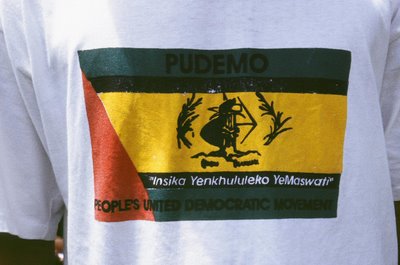

The People's United Democratic Movement of Swaziland
PUDEMO International Office
Australia, Asian and the Pacific Region
E-mail: pudemo@yahoo.co.uk
February 13, 2006
Smoking Gun or a Replica?
The Government of Swaziland parades “state witness” against political prisoners
On February 7, 2006, the office of the Director of Public Prosecution (DPP) unexpectedly brought the high treason case against Mduduzi Dlamini for trial. Mduduzi is one of the 16 pro-democracy activists arrested between December 2005 and January 2006 when the Royal Swaziland Police pounced on members of The People’s United Democratic Movement (PUDEMO) and its youth wing The Swaziland Youth Congress (SWAYOCO). The pro-democracy
activists were charged with a string of offences ranging from arson to high treason. They are accused of petrol bombing state buildings and private property belonging to members of the ruling regime. Some of the detainees, including Mduduzi, are due to appear before the High Court for a hearing on their bail applications on March 7, 2005.
The case against Mduduzi was heard by a single judge, Justice Mbutfo Mamba. Mduduzi pleaded guilty to the charge of treason and was sentenced to two years in prison with an option of E10 000 (approximately $US1, 600). Half of the sentence was suspended and the High Court deferred payment of the fine (approximately US$800) to March 31, 2006. After the
brief trial, Mduduzi was released pending payment of the fine by the due date. This was an extremely lenient sentence and generous conditions of payment, given the seriousness of the charge which carries a possible death penalty or life imprisonment.
In a surprising twist, the DPP did not oppose the lenient sentence. Earlier, the DPP strongly opposed applications for bail arguing that the public is frightened of the detainees and that “they will endanger the maintenance of Law and Order and national security” (see The Swazi Observer, January 1, 2006). On January 17, 2006, the acting Director in the DPP’s office, Mumsy Dlamini, again opposed applications for bail and pleaded with the High Court not to release the detainees including Mduduzi. The reason for this change of heart is obvious – the DPP will now use Mduduzi as its trump card and an example of the existence of the “bomber”.
We don’t know what prompted Mduduzi to plead guilty to the charge of high treason and to implicate PUDEMO but we have reason to believe that he might have been coerced. According to local media reports (see The Times of Swaziland and The Swazi Observer, February 8, 2006), Mduduzi told the Court that he was acting with other PUDEMO members under orders from the organisation’s leadership to attack state infrastructure. In his plea of guilty, Dlamini asserted that he:
…unlawfully engaged in conduct with the intent to overthrow the Kingdom and/or coerce the Kingdom by violence into certain actions. I acted with hostile intent against the government. I am a sympathiser of The People's United Democratic Movement (PUDEMO). At a PUDEMO meeting in March 2005, with senior members of the organisation, I decided to embark on a campaign of bombing government structures in order to overthrow the
Kingdom or coerce it into accepting political change. On the evening of August 6, 2005 I met with members of PUDEMO in Mbabane.
We travelled to Sidzakeni in a vehicle of which the registration plates had been removed. Our intent was to throw a petrol bomb at the Sandleni Inkhundla, a government structure, in furtherance of our hostile intent.
In the late hours of the same day we arrived at our destination. I opened the gate and the vehicle entered. I followed in foot. An accomplice and myself spilled petrol on the door and the accomplice set the petrol alight by means of a petrol saturated cloth. We left the scene while the doors were still burning” (The Swazi Observer, February 8, 2006)
There are a number of anomalies in this statement, particularly the last paragraph. Firstly, parts of the first and second paragraphs read as if they are directly lifted from the charge sheet which reads:
The accused persons each or both of them acting jointly in furtherance of a common purpose did, unlawfully and with hostile intent against the kingdom to overthrow or coerce the government of the kingdom.
Secondly, a vehicle travelling at night with its registration plates removed would obviously arouse suspicion and attract police attention. Oddly, Dlamini is claiming to have deliberately acted in a manner which would attract the attention of the police, at the very time that he was also engaged in clandestine activity for which the penalty may be death.
Furthermore, the entry of the vehicle into the premises of the Sandleni Inkhundla constituency would have undoubtedly alerted the security guard.
Mduduzi states that he opened the gate and gives the impression that the gate was unlocked at the time. As Tinkhundla constituency premises are used for storing valuable material for community development projects, it is normal practice to secure these premises with a fenced structure, a lockable gate and the services of a security guard. It is therefore not clear why a gate of a secured facility was unlocked at the time of the
alleged attack.
Thirdly, it has been alleged by the police, the DPP and the media that the accused persons used explosive devices to commit the offences. At no time have these institutions publicly explained what, in their view constitutes an explosive device. The terms “bomb”and “explosive device/charge” have been widely used to generate public fear and give credibility to state
allegations of terrorist threats.
Mduduzi’s statement exposes the abuse of these terms. There is nothing in his statement that suggests that a bomb or an explosive device/charge was used to set fire to the Sandleni Tinkhundla constituency. For example, he indicates that the building was set alight by spilling petrol and setting
it alight with a petrol-saturated piece of cloth. The Worldreference.com English Dictionary defines explosive device as “device that bursts with sudden violence from internal energy”. Explosive charge is defined as “quantity of explosive to be set off at one time.”
Yet the Honourable Justice Mamba appears to be labouring under the belief that Mduduzi did use an explosive device. Thus, the honourable Judge erred in law by failing to closely examine the defendant’s statement. It appears that he convicted Mduduzi not on the evidence of the accused and his accusers but on the advice of the defendant’s lawyer. In his judgement, as
reported in The Swazi Observer (February 8, 2006), Justice Mamba
commented:
Your lawyer has advised me that you are a sympathiser of the People's United Democratic Movement (PUDEMO) though I have not been told its ideals and the change that you wanted.
What I have been told is that you wanted to destroy government structures and overthrow the Kingdom. I have not been told that you wanted change, whether for the better or worst.
Your lawyer has further informed me that you were in the company of others you conspired with to destroy the Sandleni constituency by throwing an explosive charge. It was submitted that the door to the structure was damaged, but I was not told to what extent. According to the Times of Swaziland (February 8, 2006), the defence lawyer also advised the Judge that “the accused was coerced in the participation of the offence.” However, this allegation does not appear in Mduduzi’s statement as it is given in The Swazi Observer (February 8, 2006).
Justice Mamba’s statement raises important questions about the defence lawyer’s advice to the court and as a consequence, about the authenticity of the defendant’s plea of guilty. For example, was the defendant in the right state of mind to make the decision? Did he have adequate knowledge of the charge and the DPP’s evidence against him? Did he receive proper legal advice about the implications of incriminating himself in a charge
of this nature? Did Mduduzi jump or was he pushed? Did the legal system provide adequate protection to Mduduzi against compulsory
self-incrimination?
PUDEMO leadership is treating the events relating to this hearing with extreme caution and a high degree of suspicion. We are waiting for a copy of the court transcript to determine the full nature of this case. Given the regime’s reputation of torture, we have reason to believe that the plea of guilty was made under duress. In the 1990 treason trial against
PUDEMO members, the state coerced two people to give false testimonies in court. This backfired when the two confessed in court that the testimonies were made under extreme duress.
It is puzzling that Mduduzi was brought in for trial before his
application for bail was heard. As noted earlier in this document, Mduduzi was among the detainees awaiting the hearing of their bail application in the High Court on March 7, 2006. It is not yet clear when this pending hearing was removed from the registrar.
Furthermore, like the other detainees, Mduduzi was charged with a string of offences including high treason, sedition, attempted murder and malicious damage to property. However, he was tried and convicted on one charge - high treason. Again, it is not yet clear whether or not the other charges have been withdrawn or the DPP is keeping them as a dagger in its back pocket.
Combined, the events associated with this trial arouse curiosity about the intentions of the state. For a while now we have harboured suspicions that the state was working hard to turn Mduduzi into a state witness. Since his arrest in December 2005, he has been completely isolated from the rest of the detainees and PUDEMO officials were prohibited from making contacts
with him. Unlike the rest of the detainees, Mduduzi instructed his own legal representative making it extremely difficult for PUDEMO to access information about the case. At the time of the trial, PUDEMO had made arrangement to get power of attorney from Mduduzi to transfer the case to lawyers instructed by the organisation to represent the detainees. The state pre-empted this arrangement and conspired with Mduduzi’s legal
representative to secretly bring the case to court without due public notice. There was no hint whatsoever that a high profile case such as this one was scheduled for hearing. In anyone’s imagination, this was speedy trial which is uncharacteristic of the speed at which courts in the country deal with cases.
The plea of guilty is not the smoking gun the government is hoping to use to generate public fear and tarnish the good name of PUDEMO but a replica which presents no threat to our reputation as a peaceful movement for democracy. It is a throw away line from a regime desperate to salvage its badly damaged political image. Corruption, misuse of public monies, poor
economic performance and neglect of basic public services have badly damaged the government’s credibility to govern. The government is now trying desperately to hide behind an illusion of a terrorist threat to avoid dealing with these issues. The government can keep looking for the smoking gun but it won’t find one because there isn’t one. Through this plea of guilty, the state hopes to make the terrorist illusion stick to the public psyche. We will fight this act of political bastardry by
exposing the true intention behind the Mduduzi case.
We have confidence in the people of Swaziland that they will view this latest development for what it is – a cheap shot and crude plot against political parties and those who represent progress in Swaziland. In 1973, the monarchy government under the leadership of King Sobhuza II lied and conspired against the Ngwane National Liberation Congress (NNLC). Today they are abusing the judicial system to concoct lies about PUDEMO in an
attempt to resuscitate the 1973 discourse about political parties as destructive and disruptive.
There is not an ounce of truth and credibility in Mduduzi’s statement that senior PUDEMO officials discussed and approved a policy of violence to coerce the state. From the 1990s to date, PUDEMO has publicly defended accusations from the local media, the police and government officials that it is responsible for petrol bomb attacks against state infrastructure. Unlike the government, we have a clear policy of resolving the political
crisis at a non-violent political level. We have invited the government for talks but it has refused to open dialogue with PUDEMO and the broader movement for multi-party democracy.
As stated previously, the government has no strategy other than violence and innuendoes to engage with political parties at a political level. Under the 1973 King’s Proclamation, the state violently suppressed political parties wishing they would go away. Realising that political parties would never go away and are now an integral part of Swazi society, the regime invented a lie about terrorism to justify the exclusion of party politics from the Constitution.
The Commonwealth Secretariat, a recent major player in Swaziland politics, also ignored PUDEMO’s call for a collective peaceful approach to the political crisis. Instead, the Commonwealth under the leadership of Don McKinnon, advised the Government of Swaziland to shut out political parties from the constitution making process. Consequently, the process delivered a constitution which bans democracy and political parties. On
February 10, 2006, McKinnon was in Swaziland to celebrate the death of democracy at the inauguration of the Constitution.
Let it be known that PUDEMO is a disciplined and transparent organisation with a clear political direction and policies guiding our action. We collectively pledge to liberate the people of Swaziland from the absolute monarchy repression through peaceful means. This policy has not changed and remains the mainstay of our struggle for multi-party democracy and
responsible governance. As a disciplined organisation, PUDEMO has rules and all members abide by these rules. Those who decide to deviate from these rules and engage in activities that are contrary to our policies effectively remove themselves from the organisation. PUDEMO and SWAYOCO are therefore NOT GUILTY, your Honour !
Dr. Jabulane Matsebula
PUDEMO Representative
Australia, Asia and the Pacific Region
Monday, February 13, 2006

Thursday, February 9, 2006
MEMORANDUM: PUDEMO’s RESPONSE TO MEDIA REPORTS
MEMORANDUM: PUDEMO’s RESPONSE TO MEDIA REPORTS.
SUBJECT:‘BOMB SUSPECT ADMITS TO HAVE TAKEN PART IN BOMBING OF INKHUNDLA’.
DATE: 9th FEBRUARY 2006.
1.0. Introduction.
The current state of affairs in Swaziland comes in the backdrop of a situation where Comrade Mduduzi Dlamini, one of the suspects in the bombing case that has drawn local and international attraction, was arrested and incarcerated ALONE for long periods at the remote Nhlangano Prison. It comes from the scenario of constant harassment, torture,
insults, beatings of suspects, intimidation and the threat to evictions by traditional authorities of families and relatives of the suspects. The wife to Mduduzi Mamba, one of the suspects sadly died of trauma immediately following interrogation by the royal Swaziland police (who admitted in their response to inquiries that she had been uncooperative during the interrogation).
The state fails to establish a reasonably prosecutable case against any of the suspects, save only to bundle up their investigations and please the Mswati regime who had instructed the police to arrest as many PUDEMO and SWAYOCO members as possible before the end of 2005. We have proof that more than four of our members have been coerced by Khethokwakhe Ndlangamandla and others into making self-incriminating statements and to ‘volunteer’ to be state witnesses. Most of these comrades have rejected the offers with the contempt they deserve. Comrade Mduduzi Dlamini may not have had that opportunity to withstand that pressure.
Even though political party affiliation is prohibited by law in Swaziland, Mduduzi Dlamini has a right to enjoy his fundamental freedoms, including those of association, expression and assembly and, therefore, his membership or not to the People’s United Democratic Movement (PUDEMO).
2.0. The State Of the Suspects.
The comrades in Mbabane, Matsapha Central, Nhlangano and Manzini prisons are strong and principled members of the organization, and we do not doubt their allegiance and commitment to the organization’s objectives. We stand by them, and are in contact with them and their families whenever possible. In spite of continued attempts to by the state, and other people who claim to be messiahs, to manipulate the comrades’ lack of legal
understanding, the suspects are consistent on their principles.
3.0. The Justice Course.
PUDEMO acknowledges that the members currently in custody are innocent until proven guilty, and the onus lies on the crown to prove their guilt. We have no reason to doubt the capability of the presiding judicial officers in this case and believe that they are honorable enough to uphold the principles of an independent justice in an environment respecting the rule of law.
We, however, have strong reservations on the manner comrade Mduduzi Dlamini was secretly hauled into the High Court for a confession when he (and the rest) were still to argue for bail, let alone plead. The statements that he allegedly made are so clear that he was spoon-fed to not only incriminate him but the other co-accused. This practice is
common in undemocratic states as previously seen in Mozambique, Zimbabwe and The Republic Of South Africa recently.
We also find it strange that a suspect charged for high treason together with 15 others, is eventually singled out and ‘tried’ separately. We also note that the comrade did not make these admissions under oath, and still, they were admissible in court. Our observations here are not with intentions against Mduduzi Dlamini, but on the commissions and omissions by the prosecution and the judicial processes which all raise doubts about
the ‘trial’.
4.0. PUDEMO and Its Position.
We reiterate that at this moment the issue is not and should not be who is responsible for the attacks, but what their root cause is. The country is in such deep crisis due to the arrogance and intransigence of the royal tinkhundla regime, and this crisis gives birth to the people’s actions in quest for their freedoms. The people in Swaziland are angry for many reasons; from the rapid job losses, abject poverty, education system, evictions, declining standard of living, independence of the three arms of government, violation of the fundamental human rights and the overall lack of good governance. For these core demands, PUDEMO believes that people will vent their anger in any way at their disposal, and history teaches us that constructive dialogue and negotiation help avoid such situations.
In 1992, PUDEMO issued a document entitled The Way Forward To A Constituent Assembly Through A Negotiated Settlement as a proven mechanism for a sustainable people-driven, all-inclusive and owned transition to a democratic Swaziland. The royalist regime arrogantly rejected this peaceful program, and opted for a unilateral Mswati driven reform process sponsored by the Commonwealth Of Nations, the European Commission,
cessationist Taiwan and other proponents of repression and custodians of perpetual suffering of the poor African masses. PUDEMO is ready for any round table negotiations for a peaceful settlement in spite of the constant violent response on our unarmed members during peaceful marches and rallies.
We reaffirm our position on the current constitution that irrespective of whatever reforms that may have been unilaterally done in exclusion of representative stake-holders, the process MUST go back to the people through democratic processes of a national forum up to a constituent assembly stage for the people’s full ownership. Anything short thereof is nothing but cosmetic and will only be to the benefit of the monarchy and its surrogates. We call on the local and international community to see and view this position, and also the royal tinkhundla regime visa vis the conventions it is signatory to eg; the NEPAD and its APRM, the Harare Declaration, the African Charter and People’s Rights, the ACP/EU Cotonou Protocol the only way it is – dictatorial.
5.0. Conclusion.
The arrests and recent admission by Mduduzi Dlamini are nothing else but attempts by the regime to silence the voice of opposition in Swaziland, in particular, PUDEMO and its youth league, SWAYOCO. We are not shaken by these clandestine moves, but they only strengthen our resolve to have a constitutional multi-party democracy in Swaziland. We are ready for talks towards this goal, but time is not on our side, and time comes when people say enough is enough and when time for such dialogue wanes.
We are waiting!
Official Statement Of PUDEMO
From the President’s Office.
09th February 2006. Ref.PR17/06PO
SWAZILAND CANNOT BE AN ISLAND OF DICTATORSHIP AND REPRESSION IN A SEA OF DEMOCRACY.
SUBJECT:‘BOMB SUSPECT ADMITS TO HAVE TAKEN PART IN BOMBING OF INKHUNDLA’.
DATE: 9th FEBRUARY 2006.
1.0. Introduction.
The current state of affairs in Swaziland comes in the backdrop of a situation where Comrade Mduduzi Dlamini, one of the suspects in the bombing case that has drawn local and international attraction, was arrested and incarcerated ALONE for long periods at the remote Nhlangano Prison. It comes from the scenario of constant harassment, torture,
insults, beatings of suspects, intimidation and the threat to evictions by traditional authorities of families and relatives of the suspects. The wife to Mduduzi Mamba, one of the suspects sadly died of trauma immediately following interrogation by the royal Swaziland police (who admitted in their response to inquiries that she had been uncooperative during the interrogation).
The state fails to establish a reasonably prosecutable case against any of the suspects, save only to bundle up their investigations and please the Mswati regime who had instructed the police to arrest as many PUDEMO and SWAYOCO members as possible before the end of 2005. We have proof that more than four of our members have been coerced by Khethokwakhe Ndlangamandla and others into making self-incriminating statements and to ‘volunteer’ to be state witnesses. Most of these comrades have rejected the offers with the contempt they deserve. Comrade Mduduzi Dlamini may not have had that opportunity to withstand that pressure.
Even though political party affiliation is prohibited by law in Swaziland, Mduduzi Dlamini has a right to enjoy his fundamental freedoms, including those of association, expression and assembly and, therefore, his membership or not to the People’s United Democratic Movement (PUDEMO).
2.0. The State Of the Suspects.
The comrades in Mbabane, Matsapha Central, Nhlangano and Manzini prisons are strong and principled members of the organization, and we do not doubt their allegiance and commitment to the organization’s objectives. We stand by them, and are in contact with them and their families whenever possible. In spite of continued attempts to by the state, and other people who claim to be messiahs, to manipulate the comrades’ lack of legal
understanding, the suspects are consistent on their principles.
3.0. The Justice Course.
PUDEMO acknowledges that the members currently in custody are innocent until proven guilty, and the onus lies on the crown to prove their guilt. We have no reason to doubt the capability of the presiding judicial officers in this case and believe that they are honorable enough to uphold the principles of an independent justice in an environment respecting the rule of law.
We, however, have strong reservations on the manner comrade Mduduzi Dlamini was secretly hauled into the High Court for a confession when he (and the rest) were still to argue for bail, let alone plead. The statements that he allegedly made are so clear that he was spoon-fed to not only incriminate him but the other co-accused. This practice is
common in undemocratic states as previously seen in Mozambique, Zimbabwe and The Republic Of South Africa recently.
We also find it strange that a suspect charged for high treason together with 15 others, is eventually singled out and ‘tried’ separately. We also note that the comrade did not make these admissions under oath, and still, they were admissible in court. Our observations here are not with intentions against Mduduzi Dlamini, but on the commissions and omissions by the prosecution and the judicial processes which all raise doubts about
the ‘trial’.
4.0. PUDEMO and Its Position.
We reiterate that at this moment the issue is not and should not be who is responsible for the attacks, but what their root cause is. The country is in such deep crisis due to the arrogance and intransigence of the royal tinkhundla regime, and this crisis gives birth to the people’s actions in quest for their freedoms. The people in Swaziland are angry for many reasons; from the rapid job losses, abject poverty, education system, evictions, declining standard of living, independence of the three arms of government, violation of the fundamental human rights and the overall lack of good governance. For these core demands, PUDEMO believes that people will vent their anger in any way at their disposal, and history teaches us that constructive dialogue and negotiation help avoid such situations.
In 1992, PUDEMO issued a document entitled The Way Forward To A Constituent Assembly Through A Negotiated Settlement as a proven mechanism for a sustainable people-driven, all-inclusive and owned transition to a democratic Swaziland. The royalist regime arrogantly rejected this peaceful program, and opted for a unilateral Mswati driven reform process sponsored by the Commonwealth Of Nations, the European Commission,
cessationist Taiwan and other proponents of repression and custodians of perpetual suffering of the poor African masses. PUDEMO is ready for any round table negotiations for a peaceful settlement in spite of the constant violent response on our unarmed members during peaceful marches and rallies.
We reaffirm our position on the current constitution that irrespective of whatever reforms that may have been unilaterally done in exclusion of representative stake-holders, the process MUST go back to the people through democratic processes of a national forum up to a constituent assembly stage for the people’s full ownership. Anything short thereof is nothing but cosmetic and will only be to the benefit of the monarchy and its surrogates. We call on the local and international community to see and view this position, and also the royal tinkhundla regime visa vis the conventions it is signatory to eg; the NEPAD and its APRM, the Harare Declaration, the African Charter and People’s Rights, the ACP/EU Cotonou Protocol the only way it is – dictatorial.
5.0. Conclusion.
The arrests and recent admission by Mduduzi Dlamini are nothing else but attempts by the regime to silence the voice of opposition in Swaziland, in particular, PUDEMO and its youth league, SWAYOCO. We are not shaken by these clandestine moves, but they only strengthen our resolve to have a constitutional multi-party democracy in Swaziland. We are ready for talks towards this goal, but time is not on our side, and time comes when people say enough is enough and when time for such dialogue wanes.
We are waiting!
Official Statement Of PUDEMO
From the President’s Office.
09th February 2006. Ref.PR17/06PO
SWAZILAND CANNOT BE AN ISLAND OF DICTATORSHIP AND REPRESSION IN A SEA OF DEMOCRACY.
Monday, January 30, 2006
Justice delayed, justice denied
The People's United Democratic Movement of Swaziland
On January 20, 2006, the office of the Director of Public Prosecution (DPP) succeeded in delaying the bail hearing for the sixteen political activists facing high treason charges in Swaziland. The hearing was rescheduled for March 7, 2006 after the DPP argued that it was unable to proceed because the South African-based prosecution team was not ready.
This is the first stage of the DPP's plan to use its South African prosecutors to do the regime's dirty work. In this instance, the DPP is hiding behind the hired prosecutors to deny justice to the sixteen detainees. We regard the DPP's argument as a time-buying exercise, which has three objectives.
Firstly , the DPP has not thus far come up with a credible explanation to support its opposition to the bail application. We believe that the DPP has no credible explanation and is playing for time in the hope that it, or the South African lawyers it has employed, will come up with something which will not be laughed out in court. The rescheduling of the bail hearing allows the DPP time to cast about for some credible argument. In the interim, the state will continue to use the media to create a powerful public image of the detainees as serious threats with an established local and external network. As shown in numerous official statements, the intention is to convince the public that the danger is real and there are still "bombers" out there who are intent on continuing the "bombing".
The recent petrol bombing of two public schools (see The Times of Swaziland, January 24, 2006) presents an opportunity for the state to strengthen this image and justify more arrests and the continued detention of the sixteen pro-democracy activists. In every society schools are important symbols of nation building and they are places used by children. In Swaziland, ordinary families largely fund public schools and it is they who will be required to pay for the damage. Many of these families are poverty stricken and will be hard hit by these unexpected costs. Occurring just a few days before the beginning of the new term, the recent incidents are highly likely to generate anger and panic in the community. The nightmare spectre of further petrol bombings will haunt many parents. The state is hoping to use the recent incidents to generate maximum public panic by portraying them as an attack against progress, the community and most importantly as an attack and threat against the vulnerable - children.
The school attacks are likely to achieve the state's objective to generate mass public panic. Swazis are now being told that there are "bombers" who are threatening the country and who have even targeted their children. On the other hand, their government is committing torture and arresting more and more people without having to justify these arrests under law. It is well-known that the aim of torture and mass arrest is primarily to subdue and oppress the mass population. By subjecting a few pro-democracy activists to inhumane conditions, the majority is frightened into submission. As the regime plays out its show, the population will become more and more frightened and traumatised - threatened both by the spectre of the "bombers" on one side and state terrorism on the other.
Any population experiencing this kind of fear is vulnerable to manipulation and increased control by the ruling regime. People will often agree to government actions that they would have previously resisted - they will pay almost any price if they think that it will buy them safety from the threats. We expect that the regime will exploit this vulnerability to the full.
Secondly , the new date for the bail application case is of particular interest to political observers. The date for the rescheduled hearing falls after the official opening of parliament in February 10, 2006. At this ceremony, the King delivers his annual state of the nation address. Undoubtedly, the "bombings" and the detention of the sixteen people will be on the King's agenda as he lays the ground for declaring a state of emergency. It is expected that the King will validate dominant official discourses that the "bombings" and the detainees present a real threat to the public.
It would have not been in the state's interest to allow the case to proceed because the government is anxious to maintain the current conditions until the official opening of parliament. If it had allowed the bail application to be heard as scheduled, the state would have taken enormous risks tantamount to playing Russian roulette. The prosecution's case is extremely weak and a decision in favour of the bail applicants would have seriously damaged the credibility of state propaganda and this in turn would have threatened the rule of law. Since the first arrests, the state has been relentless in its attempt to create and validate an image of the detainees as a danger to the public. If the detainees were released on bail, the state's credibility, particularly the argument that the public is fearful of the detainees, would have suffered a severe blow.
The 2-year judicial crisis, which ran from 2002 to 2004, demonstrated that the state has no respect for the rule of law and does not accept the jurisdiction of the courts to rule on the regime's actions. Thus, it is probable that the regime would have disobeyed the decision of the High Court and refused to release the detainees. This would have created another rule of law crisis.
The regime learned a bitter lesson during the 2002-4 crisis - that overt interference in the administration of justice is a bad strategy. During this crisis, the government wobbled under sustained local and international criticism and demand to restore the rule of law. In 2004, it was ultimately rescued by the Commonwealth Secretariat, which created the impression that it had helped solve the crisis. This is far from the truth as the government never agreed to respect the 2002 rulings of the Court of Appeal. For example, the Commissioner of Police and the Ubombo Regional Police Commander were never committed to prison for contempt of court as per the ruling of the Court of Appeal. In relation to the 200 families and their two chiefs who were evicted from their homes by royal order, the Court of Appeal ruled that they be allowed to return without conditions. Some of the families who returned after the Commonwealth intervention did not do so under the terms of the Court of Appeal ruling but under terms prescribed by the royal family. For example, they had to apologise to the King for supposedly bringing the "good" name of the monarchy into disrepute. The Commonwealth Secretariat made much of its partial success in persuading the Government of Swaziland to repeal the controversial Non-Bailable Order, which partially contributed to the 2002/4 rule of law crises. Under this law, people held for offences such as high treason, murder or attempted murder were denied the right to apply for bail.
It is obvious that the regime has no more respect for the rule of law in 2006 than it did in previous years. It has simply learned to be a little more covert and devious in its repression because it has learned that overt intimidation of the judiciary has costs. Thus, although the Non Bailable Order was repealed, the regime has simply used new tactics to achieve the same goal. Currently, the regime's tactic is to abuse established legal procedures in order to detain suspects for prolonged periods without the inconvenience of having to justify these detentions in court. This is clearly illustrated in the current case, where the regime's capacity to delay the bail hearings without good cause has achieved the same outcome as the Non-Bailable law. The bail hearing is scheduled for March and by that time, some of the detainees will have been in prison for 3 months.
The regime has thus sought to indirectly bypass and emasculate the judicial process rather than direct interference. Whereas the regime has previously sought to control the judiciary by direct physical intimidation, now it seeks control through abuse of legal processes and its power as an employer. Most senior judicial officers, particularly judges of the High Court, serve under short-term contract arrangements. These conditions are counter-productive to the ethos of the independence of the judiciary and have placed members of the judiciary on a tight leash. Consequently, judicial activism in Swaziland is virtually nonexistent and the courts are helpless in protecting their integrity and Swazi citizens against state abuse. Whether by the Non-Bailable Order or by the current tactics, the outcome is that sixteen people are being tortured in prison without even hearing a detailed account of the charges against them.
Thirdly , as argued in our previous analysis of the arrests, the prolonged detentions constitute severe punishment against citizens who as yet have been convicted of no crime. By delaying the case, the state is abusing the court process to inflict as much pain as possible on the detainees. The detainees are held in degrading conditions with appalling sanitation facilities. At the Big Bend Remand Centre , where PUDEMO's Secretary-General is held, 70 prisoners share one toilet which is often blocked because of overuse. Buckets are then used in overcrowded holding cells as alternatives. There are also reports of continued beatings in detention. PUDEMO Treasurer-General, Vusi Mnisi, was granted a rare visit to the Big Bend Remand Centre. Detainees there told him that they have no clean drinking water, they are being denied access to medical services and are exposed to life-threatening diseases such as malaria. Some of them have injuries sustained during torture and have not been taken to a doctor for more than a month. Prison officers have refused offers from relatives and friends to bring clean drinking water and food to the detainees. By delaying the bail hearing, the government is able to force the detainees to serve another month in inhumane conditions.
Lawyers representing well-known PUDEMO activist, Mphandlana Shongwe, complained at the Manzini Magistrate Court during a remand hearing that their client is being held in solitary confinement at the Matsapa Maximum Security Prison (see Swazi Observer, January 26, 2006). They expressed serious concerns about Shongwe's health and requested the Court to issue an order to have him removed from solitary confinement. The prosecution pretended to be ignorant and used the usual delaying tactic by requesting more time to investigate this issue. Magistrate, Nondumiso Simelane, ruled in favour of the prosecution and rescheduled the matter to 2nd February. Meanwhile Shongwe remains in complete solitary confinement in a very small holding cell. According to The Swazi Observer (Ibid), prison authorities claim that Shongwe is a security risk because they suspect that he might incite a prison revolt.
In essence, the regime is carrying out a sentence on the detainees without ever having the case heard in court. Furthermore, we believe that the detainees are suffering psychological torture in many respects, including the indefinite nature of the detentions and the way in which the regime is able to abuse the judicial system with apparent ease. Denying detainees access to medical services, clean drinking water, exposing them to health hazards and holding a person in solitary confinement is inhuman. It is premeditated cruelty and degrading treatment intended to punish the detainees. All these amounts to physical and psychological torture. Article 1(1) of The UN Convention Against Torture and Other Cruel, Inhuman or Degrading Treatment or Punishment defines torture as:
…any act by which severe pain or suffering, whether physical or mental, is intentionally inflicted on a person for such purposes as obtaining from him or a third person information or a confession, punishing him for an act he or a third person has committed or is suspected of having committed, or intimidating or coercing him or a third person, or for any reason based on discrimination of any kind, when such pain or suffering is inflicted by or at the instigation of or with the consent or acquiescence of a public official or other person acting in an official capacity.
In his speech marking the International Human Rights Day on December 10, 2005, Commonwealth Secretary-General Don McKinnon, called for collective action against torture:
wherever it rears its ugly head, and to champion the cause of protecting and aiding those who fall victim to torture…We must remember and champion the rights of any person facing persecution, torture and other human rights abuses. We must acknowledge, too, that inexcusable human rights abuses continue to occur and we must use every resource available to bring such practices to an end.
However, under the leadership of Don McKinnon, the Commonwealth Secretariat has stood in the way of the pro-democracy movement in Swaziland and provided unwavering support to a regime that practices torture. Many international organisations have raised concerns about the detention of pro-democracy activists and the practice of torture in Swaziland. It is astounding that the Commonwealth Secretariat has never questioned gross violations of human rights in Swaziland including the recent torture to death of an innocent woman married to one of the detained pro-democracy activists. The Commonwealth seems unconcerned as it shockingly continues to promote the regime as a symbol of democracy. On its website, the Commonwealth Secretariat displays a caption of King Mswati III presenting the Draft Constitution in 2003 to promote the organisation's ideal of democracy and good governance.
On the other hand, the Commonwealth refuses to work with the pro-democracy movement and actively frustrates efforts by the broader Swazi community to bring about meaningful democratic changes in Swaziland. From 1996 to 2005, the Commonwealth supported and defended a royal family stage-managed constitution making exercise that discriminated against the pro-democracy movement and all civic groups. From its inception, the exercise suffered massive legitimacy problems as the majority of Swazis rejected the discriminatory practices and lack of direction associated with this exercise.
As evidenced in recent developments, this crisis and lack of direction have deepened. When King Mswati III signed the Constitution Bill of 2005 into law, he told the public that the Constitution would come into effect after six months without giving a specific date. However, no legal instrument was ever published to stay the operation of the Constitution to a specific date. The phrase "after six months" is incredibly vague and the public was left to assume that the Constitution would take effect a day after the end of the six month period. Even the Prime Minister made this assumption and embarrassed himself when he told the President of Tanzania that the Constitution would come into effect on January 26, 2005 (see The Swazi Observer, January 24, 2006). After his return from the African Union summit in Sudan, the Prime Minister, Themba Dlamini, was made to eat humble pie when he was hauled in to the royal palace for disciplinary action. The king is the only person who has the final say over the date on which the Constitution will come into effect and he, incredibly, is silent.
This is just another example of how King Mswati III holds the Swazi nation in contempt. It shows that he has ownership of the constitution, not the people. On January 26, 2006, civic and pro-democracy organisations led by the trade union movement presented a petition to communicate just that - that the Swazi nation renounces the constitution. Combined, these formations represent a significant section of the population. From previous experience, it is certain that the government will ignore this because it is not accountable to the public. Even if this petition does not result in immediate action by the government, it is a critical development because it has delegitimised the Constitution and recorded for posterity the Swazi people's resistance and refusal to be silenced. The current regime will not stand in the face of gathering local and international exasperation with the regime's lack of genuine change. The so-called "constitution-making exercise" has been a smokescreen for the regime for 8 years but it no longer has this to hide behind. Its fraudulent pretence at change is becoming painfully obvious to even the most reluctant observers and the Swazi people must know that change will come.
While the regime is in power, it may feel to the Swazi people and to members of the regime that it is going to last forever. But this is not the case and history tells us that even the most oppressive regimes eventually fall. And when they do fall, those who have participated in crimes against humanity, those who have tortured and oppressed their fellow citizens, will be eventually held to account. PUDEMO and other pro-democracy organisations are strong and growing in strength. We WILL bring new governance to Swaziland and provide a system based on law and humanitarian values. Swazis must look forward to that time and although sorely oppressed at this time, can prepare for the changes ahead. Victims and families of victims can keep records of crimes against humanity, of oppression and injustice. These records can include dates, times, places, people and the nature of the crimes. In a functioning democracy, all levels of government are accountable for their actions. This includes the head of government, the police commanders and others in authority who order and permit crimes against humanity as well as those who commit those crimes. There will be no individuals who are untouchable. All are accountable and will be held accountable under the rule of law. All around the world, in Africa and Europe, those who commit such heinous crimes are eventually brought to account.
It is scandalous that the regime continues to find comfort from international organisations such as the Commonwealth. This is one factor helping to delay the inevitable changes ahead for Swaziland. On several occasions, we have challenged the Commonwealth Secretariat to justify and explain its continued support of this evil empire. However, like the regime in Swaziland, the Commonwealth has refused to open dialogue with the pro-democracy movement.
PUDEMO and SWAYOCO appeal to international human rights and humanitarian organisations to write to the Commonwealth and condemn its behaviour in relation to Swaziland. Please also write to the Government of Swaziland demanding that it must, as a matter of urgency, remove Mphandlana Shongwe from solitary confinement and allow all the detainees immediate access to medical services, clean drinking water, food and sanitation.
Address your concerns to:
Mr Don McKinnon
The Commonwealth Secretary-General
Commonwealth Secretariat
Marlborough House, Pall Mall
London SW1Y 5HX
UK
E-mail: info@commonwealth.int
Rabab Fatima
Head of Human Rights Unit
Commonwealth Secretariat
Marlborough House, Pall Mall
London SW1Y 5HX
UK
E-mail: r.fatima@commonwealth.int
Phone: +44 (0)20 7747 6500
Fax: +44(0)20 7930 0827
Letters demanding action for Mphandlana Shongwe and urgent access to medical services clean drinking water, food and sanitation should be addressed to:
Mr Absalom Themba Dlamini
The Prime Minister of Swaziland
Hospital Hill
P.O. Box 395 Mbabane
Swaziland
Southern Africa
E-mail: (Secretary to Cabinet): sec-tocab@realnet.co.sz
OR
msppcu@realnet.co.sz
Phone: +268 404 2251/3
Fax: +268 404 3943
Signed:
Dr. Jabulane Matsebula
PUDEMO Representative
Australia, Asia and the Pacific Region.
For more information contact
Kislon P. Shongwe
Deputy Secretary General PUDEMO based in Swaziland
Cell: 268-611-2351
In South African Contact
Dr Gabriel Mkhumane
PUDEMO representative in Africa based in Johannesburg
Cell: 27-82-707-8384 or 27-72-040-8484
Justice delayed, justice denied
On January 20, 2006, the office of the Director of Public Prosecution (DPP) succeeded in delaying the bail hearing for the sixteen political activists facing high treason charges in Swaziland. The hearing was rescheduled for March 7, 2006 after the DPP argued that it was unable to proceed because the South African-based prosecution team was not ready.
This is the first stage of the DPP's plan to use its South African prosecutors to do the regime's dirty work. In this instance, the DPP is hiding behind the hired prosecutors to deny justice to the sixteen detainees. We regard the DPP's argument as a time-buying exercise, which has three objectives.
Firstly , the DPP has not thus far come up with a credible explanation to support its opposition to the bail application. We believe that the DPP has no credible explanation and is playing for time in the hope that it, or the South African lawyers it has employed, will come up with something which will not be laughed out in court. The rescheduling of the bail hearing allows the DPP time to cast about for some credible argument. In the interim, the state will continue to use the media to create a powerful public image of the detainees as serious threats with an established local and external network. As shown in numerous official statements, the intention is to convince the public that the danger is real and there are still "bombers" out there who are intent on continuing the "bombing".
The recent petrol bombing of two public schools (see The Times of Swaziland, January 24, 2006) presents an opportunity for the state to strengthen this image and justify more arrests and the continued detention of the sixteen pro-democracy activists. In every society schools are important symbols of nation building and they are places used by children. In Swaziland, ordinary families largely fund public schools and it is they who will be required to pay for the damage. Many of these families are poverty stricken and will be hard hit by these unexpected costs. Occurring just a few days before the beginning of the new term, the recent incidents are highly likely to generate anger and panic in the community. The nightmare spectre of further petrol bombings will haunt many parents. The state is hoping to use the recent incidents to generate maximum public panic by portraying them as an attack against progress, the community and most importantly as an attack and threat against the vulnerable - children.
The school attacks are likely to achieve the state's objective to generate mass public panic. Swazis are now being told that there are "bombers" who are threatening the country and who have even targeted their children. On the other hand, their government is committing torture and arresting more and more people without having to justify these arrests under law. It is well-known that the aim of torture and mass arrest is primarily to subdue and oppress the mass population. By subjecting a few pro-democracy activists to inhumane conditions, the majority is frightened into submission. As the regime plays out its show, the population will become more and more frightened and traumatised - threatened both by the spectre of the "bombers" on one side and state terrorism on the other.
Any population experiencing this kind of fear is vulnerable to manipulation and increased control by the ruling regime. People will often agree to government actions that they would have previously resisted - they will pay almost any price if they think that it will buy them safety from the threats. We expect that the regime will exploit this vulnerability to the full.
Secondly , the new date for the bail application case is of particular interest to political observers. The date for the rescheduled hearing falls after the official opening of parliament in February 10, 2006. At this ceremony, the King delivers his annual state of the nation address. Undoubtedly, the "bombings" and the detention of the sixteen people will be on the King's agenda as he lays the ground for declaring a state of emergency. It is expected that the King will validate dominant official discourses that the "bombings" and the detainees present a real threat to the public.
It would have not been in the state's interest to allow the case to proceed because the government is anxious to maintain the current conditions until the official opening of parliament. If it had allowed the bail application to be heard as scheduled, the state would have taken enormous risks tantamount to playing Russian roulette. The prosecution's case is extremely weak and a decision in favour of the bail applicants would have seriously damaged the credibility of state propaganda and this in turn would have threatened the rule of law. Since the first arrests, the state has been relentless in its attempt to create and validate an image of the detainees as a danger to the public. If the detainees were released on bail, the state's credibility, particularly the argument that the public is fearful of the detainees, would have suffered a severe blow.
The 2-year judicial crisis, which ran from 2002 to 2004, demonstrated that the state has no respect for the rule of law and does not accept the jurisdiction of the courts to rule on the regime's actions. Thus, it is probable that the regime would have disobeyed the decision of the High Court and refused to release the detainees. This would have created another rule of law crisis.
The regime learned a bitter lesson during the 2002-4 crisis - that overt interference in the administration of justice is a bad strategy. During this crisis, the government wobbled under sustained local and international criticism and demand to restore the rule of law. In 2004, it was ultimately rescued by the Commonwealth Secretariat, which created the impression that it had helped solve the crisis. This is far from the truth as the government never agreed to respect the 2002 rulings of the Court of Appeal. For example, the Commissioner of Police and the Ubombo Regional Police Commander were never committed to prison for contempt of court as per the ruling of the Court of Appeal. In relation to the 200 families and their two chiefs who were evicted from their homes by royal order, the Court of Appeal ruled that they be allowed to return without conditions. Some of the families who returned after the Commonwealth intervention did not do so under the terms of the Court of Appeal ruling but under terms prescribed by the royal family. For example, they had to apologise to the King for supposedly bringing the "good" name of the monarchy into disrepute. The Commonwealth Secretariat made much of its partial success in persuading the Government of Swaziland to repeal the controversial Non-Bailable Order, which partially contributed to the 2002/4 rule of law crises. Under this law, people held for offences such as high treason, murder or attempted murder were denied the right to apply for bail.
It is obvious that the regime has no more respect for the rule of law in 2006 than it did in previous years. It has simply learned to be a little more covert and devious in its repression because it has learned that overt intimidation of the judiciary has costs. Thus, although the Non Bailable Order was repealed, the regime has simply used new tactics to achieve the same goal. Currently, the regime's tactic is to abuse established legal procedures in order to detain suspects for prolonged periods without the inconvenience of having to justify these detentions in court. This is clearly illustrated in the current case, where the regime's capacity to delay the bail hearings without good cause has achieved the same outcome as the Non-Bailable law. The bail hearing is scheduled for March and by that time, some of the detainees will have been in prison for 3 months.
The regime has thus sought to indirectly bypass and emasculate the judicial process rather than direct interference. Whereas the regime has previously sought to control the judiciary by direct physical intimidation, now it seeks control through abuse of legal processes and its power as an employer. Most senior judicial officers, particularly judges of the High Court, serve under short-term contract arrangements. These conditions are counter-productive to the ethos of the independence of the judiciary and have placed members of the judiciary on a tight leash. Consequently, judicial activism in Swaziland is virtually nonexistent and the courts are helpless in protecting their integrity and Swazi citizens against state abuse. Whether by the Non-Bailable Order or by the current tactics, the outcome is that sixteen people are being tortured in prison without even hearing a detailed account of the charges against them.
Thirdly , as argued in our previous analysis of the arrests, the prolonged detentions constitute severe punishment against citizens who as yet have been convicted of no crime. By delaying the case, the state is abusing the court process to inflict as much pain as possible on the detainees. The detainees are held in degrading conditions with appalling sanitation facilities. At the Big Bend Remand Centre , where PUDEMO's Secretary-General is held, 70 prisoners share one toilet which is often blocked because of overuse. Buckets are then used in overcrowded holding cells as alternatives. There are also reports of continued beatings in detention. PUDEMO Treasurer-General, Vusi Mnisi, was granted a rare visit to the Big Bend Remand Centre. Detainees there told him that they have no clean drinking water, they are being denied access to medical services and are exposed to life-threatening diseases such as malaria. Some of them have injuries sustained during torture and have not been taken to a doctor for more than a month. Prison officers have refused offers from relatives and friends to bring clean drinking water and food to the detainees. By delaying the bail hearing, the government is able to force the detainees to serve another month in inhumane conditions.
Lawyers representing well-known PUDEMO activist, Mphandlana Shongwe, complained at the Manzini Magistrate Court during a remand hearing that their client is being held in solitary confinement at the Matsapa Maximum Security Prison (see Swazi Observer, January 26, 2006). They expressed serious concerns about Shongwe's health and requested the Court to issue an order to have him removed from solitary confinement. The prosecution pretended to be ignorant and used the usual delaying tactic by requesting more time to investigate this issue. Magistrate, Nondumiso Simelane, ruled in favour of the prosecution and rescheduled the matter to 2nd February. Meanwhile Shongwe remains in complete solitary confinement in a very small holding cell. According to The Swazi Observer (Ibid), prison authorities claim that Shongwe is a security risk because they suspect that he might incite a prison revolt.
In essence, the regime is carrying out a sentence on the detainees without ever having the case heard in court. Furthermore, we believe that the detainees are suffering psychological torture in many respects, including the indefinite nature of the detentions and the way in which the regime is able to abuse the judicial system with apparent ease. Denying detainees access to medical services, clean drinking water, exposing them to health hazards and holding a person in solitary confinement is inhuman. It is premeditated cruelty and degrading treatment intended to punish the detainees. All these amounts to physical and psychological torture. Article 1(1) of The UN Convention Against Torture and Other Cruel, Inhuman or Degrading Treatment or Punishment defines torture as:
…any act by which severe pain or suffering, whether physical or mental, is intentionally inflicted on a person for such purposes as obtaining from him or a third person information or a confession, punishing him for an act he or a third person has committed or is suspected of having committed, or intimidating or coercing him or a third person, or for any reason based on discrimination of any kind, when such pain or suffering is inflicted by or at the instigation of or with the consent or acquiescence of a public official or other person acting in an official capacity.
In his speech marking the International Human Rights Day on December 10, 2005, Commonwealth Secretary-General Don McKinnon, called for collective action against torture:
wherever it rears its ugly head, and to champion the cause of protecting and aiding those who fall victim to torture…We must remember and champion the rights of any person facing persecution, torture and other human rights abuses. We must acknowledge, too, that inexcusable human rights abuses continue to occur and we must use every resource available to bring such practices to an end.
However, under the leadership of Don McKinnon, the Commonwealth Secretariat has stood in the way of the pro-democracy movement in Swaziland and provided unwavering support to a regime that practices torture. Many international organisations have raised concerns about the detention of pro-democracy activists and the practice of torture in Swaziland. It is astounding that the Commonwealth Secretariat has never questioned gross violations of human rights in Swaziland including the recent torture to death of an innocent woman married to one of the detained pro-democracy activists. The Commonwealth seems unconcerned as it shockingly continues to promote the regime as a symbol of democracy. On its website, the Commonwealth Secretariat displays a caption of King Mswati III presenting the Draft Constitution in 2003 to promote the organisation's ideal of democracy and good governance.
On the other hand, the Commonwealth refuses to work with the pro-democracy movement and actively frustrates efforts by the broader Swazi community to bring about meaningful democratic changes in Swaziland. From 1996 to 2005, the Commonwealth supported and defended a royal family stage-managed constitution making exercise that discriminated against the pro-democracy movement and all civic groups. From its inception, the exercise suffered massive legitimacy problems as the majority of Swazis rejected the discriminatory practices and lack of direction associated with this exercise.
As evidenced in recent developments, this crisis and lack of direction have deepened. When King Mswati III signed the Constitution Bill of 2005 into law, he told the public that the Constitution would come into effect after six months without giving a specific date. However, no legal instrument was ever published to stay the operation of the Constitution to a specific date. The phrase "after six months" is incredibly vague and the public was left to assume that the Constitution would take effect a day after the end of the six month period. Even the Prime Minister made this assumption and embarrassed himself when he told the President of Tanzania that the Constitution would come into effect on January 26, 2005 (see The Swazi Observer, January 24, 2006). After his return from the African Union summit in Sudan, the Prime Minister, Themba Dlamini, was made to eat humble pie when he was hauled in to the royal palace for disciplinary action. The king is the only person who has the final say over the date on which the Constitution will come into effect and he, incredibly, is silent.
This is just another example of how King Mswati III holds the Swazi nation in contempt. It shows that he has ownership of the constitution, not the people. On January 26, 2006, civic and pro-democracy organisations led by the trade union movement presented a petition to communicate just that - that the Swazi nation renounces the constitution. Combined, these formations represent a significant section of the population. From previous experience, it is certain that the government will ignore this because it is not accountable to the public. Even if this petition does not result in immediate action by the government, it is a critical development because it has delegitimised the Constitution and recorded for posterity the Swazi people's resistance and refusal to be silenced. The current regime will not stand in the face of gathering local and international exasperation with the regime's lack of genuine change. The so-called "constitution-making exercise" has been a smokescreen for the regime for 8 years but it no longer has this to hide behind. Its fraudulent pretence at change is becoming painfully obvious to even the most reluctant observers and the Swazi people must know that change will come.
While the regime is in power, it may feel to the Swazi people and to members of the regime that it is going to last forever. But this is not the case and history tells us that even the most oppressive regimes eventually fall. And when they do fall, those who have participated in crimes against humanity, those who have tortured and oppressed their fellow citizens, will be eventually held to account. PUDEMO and other pro-democracy organisations are strong and growing in strength. We WILL bring new governance to Swaziland and provide a system based on law and humanitarian values. Swazis must look forward to that time and although sorely oppressed at this time, can prepare for the changes ahead. Victims and families of victims can keep records of crimes against humanity, of oppression and injustice. These records can include dates, times, places, people and the nature of the crimes. In a functioning democracy, all levels of government are accountable for their actions. This includes the head of government, the police commanders and others in authority who order and permit crimes against humanity as well as those who commit those crimes. There will be no individuals who are untouchable. All are accountable and will be held accountable under the rule of law. All around the world, in Africa and Europe, those who commit such heinous crimes are eventually brought to account.
It is scandalous that the regime continues to find comfort from international organisations such as the Commonwealth. This is one factor helping to delay the inevitable changes ahead for Swaziland. On several occasions, we have challenged the Commonwealth Secretariat to justify and explain its continued support of this evil empire. However, like the regime in Swaziland, the Commonwealth has refused to open dialogue with the pro-democracy movement.
PUDEMO and SWAYOCO appeal to international human rights and humanitarian organisations to write to the Commonwealth and condemn its behaviour in relation to Swaziland. Please also write to the Government of Swaziland demanding that it must, as a matter of urgency, remove Mphandlana Shongwe from solitary confinement and allow all the detainees immediate access to medical services, clean drinking water, food and sanitation.
Address your concerns to:
Mr Don McKinnon
The Commonwealth Secretary-General
Commonwealth Secretariat
Marlborough House, Pall Mall
London SW1Y 5HX
UK
E-mail: info@commonwealth.int
Rabab Fatima
Head of Human Rights Unit
Commonwealth Secretariat
Marlborough House, Pall Mall
London SW1Y 5HX
UK
E-mail: r.fatima@commonwealth.int
Phone: +44 (0)20 7747 6500
Fax: +44(0)20 7930 0827
Letters demanding action for Mphandlana Shongwe and urgent access to medical services clean drinking water, food and sanitation should be addressed to:
Mr Absalom Themba Dlamini
The Prime Minister of Swaziland
Hospital Hill
P.O. Box 395 Mbabane
Swaziland
Southern Africa
E-mail: (Secretary to Cabinet): sec-tocab@realnet.co.sz
OR
msppcu@realnet.co.sz
Phone: +268 404 2251/3
Fax: +268 404 3943
Signed:
Dr. Jabulane Matsebula
PUDEMO Representative
Australia, Asia and the Pacific Region.
For more information contact
Kislon P. Shongwe
Deputy Secretary General PUDEMO based in Swaziland
Cell: 268-611-2351
In South African Contact
Dr Gabriel Mkhumane
PUDEMO representative in Africa based in Johannesburg
Cell: 27-82-707-8384 or 27-72-040-8484
Sunday, January 1, 2006
Swazi political activists face death
The People's United Democratic Movement of Swaziland
Australia, Asian and the Pacific Region
E-mail: pudemo@yahoo.co.uk
January 1, 2006
Holding the bastards accountable
Two weeks before Christmas, Swaziland police arrested thirteen PUDEMO and SWAYOCO members on various trumped-up charges ranging from arson to attempted murder. These charges have now been upgraded to High Treason which carries a possible sentence of death or life imprisonment. The original charges have been upgraded for no apparently good reason. We challenge the government to explain what it is the activists are alleged to have done and how this can possibly be regarded as treason.
The Director of Public Prosecution, Mumsy Dlamini, has now sought the services of a South African lawyer to prosecute the charges because she knows that these are trumped up charges and she would find it extremely difficult to prove the case against the thirteen. The DDP’s decision also reflects the inefficiency, incompetence and irresponsible spending of this government. Why should taxpayers pay a South African lawyer to do the DDP’s dirty work? There is no justification whatsoever for this spending of public funds which will run into hundreds of thousands of dollars.
This recent development is tragic and sends an unambiguous message to the Swazi nation of the regime’s intent to ruthlessly suppress the movement for democracy. It ends a year in which the Swazi nation witnessed the arrogant imposition of the Commonwealth-sponsored Constitution of the Kingdom of Swaziland Act, 2005. The enactment of this Constitution occurred against the backdrop of massive public disenchantment with the constitution making exercise, particularly the exclusion of political and civic organisations from the process, the absence of public education on constitutional matters and the failure to embrace democracy.
With absolute control over the constitution making exercise and undivided support from the Commonwealth Secretariat, the royal family government was able to enshrine its ruthless policies in the new Constitution. These include the death penalty for treason and violent suppression of political dissent. Section 15(c) of The Constitution of the Kingdom of Swaziland Act, 2005 gives authority to state security forces to kill Swazis “for the purpose of suppressing a riot”. Many people would be horrified to know that the Commonwealth Secretariat helped to develop and gave its seal of approval to a constitution that enshrines the death penalty and gives power to security forces to murder Swazis. The Constitution of the Kingdom of Swaziland Act, 2005 casts serious doubts over the Commonwealth’s claim that it is genuinely committed to the principles of democracy and human rights.
At the 2005 Commonwealth Heads of Government (CHOGM) in Malta, the Commonwealth Secretary General, Don McKinnon, let the cat out of the bag in his infamous statement in which he claimed that “…people are beginning to ask…whether building a democracy is really the road to prosperity. Does democracy put food on our tables, clothe our children, put roofs over our heads and give us a future?” (November 25, 2005). It not clear to which people the Secretary General was referring because the call for democracy, a framework for good governance, socio-economic progress and respect for human rights, is a common theme throughout the world. McKinnon is a politician renown for his conservative views in his home country New Zealand, and it is obvious that on this occasion, he was speaking on behalf of tyrants. His statement is a coup against the Commonwealth Harare Declaration of 1991 which places primary emphasis on democracy. It gives comfort to tyrannical regimes within the Commonwealth club which can now confidently use the cliché “people can’t eat democracy” to justify crimes against their people.
As demonstrated in the recent arrests of pro-democracy activists in Swaziland, the Commonwealth-sponsored Constitution has given strength to the government’s violent rage. We are extremely concerned about the thirteen political prisoners and the support the Commonwealth continues to render to this murderous regime. This support has contributed enormously to the destabilisation of our society. Supporting tyrants never creates stability and it does not make sense morally and politically to continue insulating this cruel regime. Through this support, the Commonwealth Secretariat has effectively declared itself an enemy of democracy and a defacto oppressor of our nation. As a liberation movement, we hold the Commonwealth responsible for the arrest and torture of the pro-democracy activists and the continued repression of our people. PUDEMO and SWAYOCO will fight the Commonwealth by intensifying the international campaign to expose the organisation’s agenda to aid repression in Swaziland.
We appeal to the broader international community to condemn and express disgust at the Commonwealth’s support of the repressive regime in Swaziland. The Commonwealth must shape up or ship out of Swaziland if it is not willing to help build democracy by enforcing compliance with the Commonwealth Harare Declaration of 1991. The recent political arrests and the enactment of an anti-democratic constitution seriously undermines the fundamental principles of the Harare Declaration against political persecution, torture, repressive governance and neglect.
Events in the past year indicate that repression in Swaziland and neglect of political responsibility will continue into 2006 and beyond. Swaziland is a failing state with a track-record of years of social, political and economic neglect. Corruption is rife and embedded in most economic and political sectors. Private companies collude with government departments and individuals to plunder the economy through fictitious services and exorbitant costings. Recently, we saw a consultant accounting company collude with the government to award politicians an exorbitant pay rise. There is escalating HIV/AIDS infection with no effective intervention strategy in sight. More than 40% of the population of just over a million people is HIV positive and about 70 000 children are now orphans because of the epidemic. The responsibility for responding to this epidemic has been left to inadequately resourced non-government organisations. Healthcare services in public facilities have declined to an alarming level with patients sharing wards with rats. All the authorities could say is that they are planning to do something about the rat plague at the Mbabane Government Hospital (see The Times of Swaziland December 28, 2005). The rate of poverty continues to rise and there is no long-term strategic plan to reduce the deficit and encourage growth in the economy apart from reducing the public sector workforce by 10,000. This strategy is not visionary for two reasons. Firstly, it is highly possible that the redundancy programme would mostly affect low paid employees and exacerbate the problem of poverty and unemployment. Secondly, the decision ignores the key areas responsible for the deficit and negative economic growth – the current political system, lack of leadership and irresponsible spending by politicians and the royal family household.
This is not our vision for Swaziland. It is our strong belief that the current political system is at the core of the currently disastrous state of the nation. Fixing the political system and building a strong system of responsible governance is PUDEMO’s priority. Unlike the Commonwealth, we strongly believe that democracy can bring social, economic and political prosperity. Swaziland has enormous potential to grow economically but this has been suppressed by bad governance, self-interest and the absence of a bigger vision among generations of politicians. Hence, Swaziland has not been able to aggressively diversify the economy and continues to rely on highly fluid economic industries such as agriculture and textiles. The recent collapse of the world sugar price and closure of a number of local textile industries are testimony to the instability of these investments. Diversification of the economy, eg., expanding from traditional investments such as agriculture to new areas of economic activity remains an elusive vision in Swaziland. The intellectual potential of the nation has not been adequately explored as an economic resource as there has been little investment in technology and other areas of intellectual activity. Furthermore, lack of state leadership has resulted in the failure to develop a culture of efficiency and accountability. Brain drain from Swaziland is a huge problem. Professionals leave Swaziland in large numbers because the political system suppresses intellectual development and freedom. Through fear of reprimand, many intellectuals who stay in Swaziland are trapped in their small cocoons and rarely venture out to express alternative visions for Swaziland.
The arrests of the thirteen pro-democracy activists are an important part of the total strategy to suppress intellectual freedom. In their daily activities in the pro-democracy movement, the thirteen political prisoners have contributed valuable intellectual material to the progress of our nation. We honour and respect this contribution. Their incarceration is a tragic end to a bad year and another step backwards for social, political and economic development. These charges have no basis and we will fight them all the way to the Court of Appeal.
As a liberation movement with strong conviction to act for the good of our nation, we will continue to pursue the royal family government and hold it accountable for its actions. The incarceration of our members is an act of bastardisation and will not defeat our resolve to overthrow this illegitimate regime and make a difference to Swaziland.
Signed:
Dr Jabulane Matsebula
PUDEMO Representative
Australia, Asia and the Pacific Region.
PUDEMO
International OfficeAustralia, Asian and the Pacific Region
E-mail: pudemo@yahoo.co.uk
January 1, 2006
Holding the bastards accountable
Two weeks before Christmas, Swaziland police arrested thirteen PUDEMO and SWAYOCO members on various trumped-up charges ranging from arson to attempted murder. These charges have now been upgraded to High Treason which carries a possible sentence of death or life imprisonment. The original charges have been upgraded for no apparently good reason. We challenge the government to explain what it is the activists are alleged to have done and how this can possibly be regarded as treason.
The Director of Public Prosecution, Mumsy Dlamini, has now sought the services of a South African lawyer to prosecute the charges because she knows that these are trumped up charges and she would find it extremely difficult to prove the case against the thirteen. The DDP’s decision also reflects the inefficiency, incompetence and irresponsible spending of this government. Why should taxpayers pay a South African lawyer to do the DDP’s dirty work? There is no justification whatsoever for this spending of public funds which will run into hundreds of thousands of dollars.
This recent development is tragic and sends an unambiguous message to the Swazi nation of the regime’s intent to ruthlessly suppress the movement for democracy. It ends a year in which the Swazi nation witnessed the arrogant imposition of the Commonwealth-sponsored Constitution of the Kingdom of Swaziland Act, 2005. The enactment of this Constitution occurred against the backdrop of massive public disenchantment with the constitution making exercise, particularly the exclusion of political and civic organisations from the process, the absence of public education on constitutional matters and the failure to embrace democracy.
With absolute control over the constitution making exercise and undivided support from the Commonwealth Secretariat, the royal family government was able to enshrine its ruthless policies in the new Constitution. These include the death penalty for treason and violent suppression of political dissent. Section 15(c) of The Constitution of the Kingdom of Swaziland Act, 2005 gives authority to state security forces to kill Swazis “for the purpose of suppressing a riot”. Many people would be horrified to know that the Commonwealth Secretariat helped to develop and gave its seal of approval to a constitution that enshrines the death penalty and gives power to security forces to murder Swazis. The Constitution of the Kingdom of Swaziland Act, 2005 casts serious doubts over the Commonwealth’s claim that it is genuinely committed to the principles of democracy and human rights.
At the 2005 Commonwealth Heads of Government (CHOGM) in Malta, the Commonwealth Secretary General, Don McKinnon, let the cat out of the bag in his infamous statement in which he claimed that “…people are beginning to ask…whether building a democracy is really the road to prosperity. Does democracy put food on our tables, clothe our children, put roofs over our heads and give us a future?” (November 25, 2005). It not clear to which people the Secretary General was referring because the call for democracy, a framework for good governance, socio-economic progress and respect for human rights, is a common theme throughout the world. McKinnon is a politician renown for his conservative views in his home country New Zealand, and it is obvious that on this occasion, he was speaking on behalf of tyrants. His statement is a coup against the Commonwealth Harare Declaration of 1991 which places primary emphasis on democracy. It gives comfort to tyrannical regimes within the Commonwealth club which can now confidently use the cliché “people can’t eat democracy” to justify crimes against their people.
As demonstrated in the recent arrests of pro-democracy activists in Swaziland, the Commonwealth-sponsored Constitution has given strength to the government’s violent rage. We are extremely concerned about the thirteen political prisoners and the support the Commonwealth continues to render to this murderous regime. This support has contributed enormously to the destabilisation of our society. Supporting tyrants never creates stability and it does not make sense morally and politically to continue insulating this cruel regime. Through this support, the Commonwealth Secretariat has effectively declared itself an enemy of democracy and a defacto oppressor of our nation. As a liberation movement, we hold the Commonwealth responsible for the arrest and torture of the pro-democracy activists and the continued repression of our people. PUDEMO and SWAYOCO will fight the Commonwealth by intensifying the international campaign to expose the organisation’s agenda to aid repression in Swaziland.
We appeal to the broader international community to condemn and express disgust at the Commonwealth’s support of the repressive regime in Swaziland. The Commonwealth must shape up or ship out of Swaziland if it is not willing to help build democracy by enforcing compliance with the Commonwealth Harare Declaration of 1991. The recent political arrests and the enactment of an anti-democratic constitution seriously undermines the fundamental principles of the Harare Declaration against political persecution, torture, repressive governance and neglect.
Events in the past year indicate that repression in Swaziland and neglect of political responsibility will continue into 2006 and beyond. Swaziland is a failing state with a track-record of years of social, political and economic neglect. Corruption is rife and embedded in most economic and political sectors. Private companies collude with government departments and individuals to plunder the economy through fictitious services and exorbitant costings. Recently, we saw a consultant accounting company collude with the government to award politicians an exorbitant pay rise. There is escalating HIV/AIDS infection with no effective intervention strategy in sight. More than 40% of the population of just over a million people is HIV positive and about 70 000 children are now orphans because of the epidemic. The responsibility for responding to this epidemic has been left to inadequately resourced non-government organisations. Healthcare services in public facilities have declined to an alarming level with patients sharing wards with rats. All the authorities could say is that they are planning to do something about the rat plague at the Mbabane Government Hospital (see The Times of Swaziland December 28, 2005). The rate of poverty continues to rise and there is no long-term strategic plan to reduce the deficit and encourage growth in the economy apart from reducing the public sector workforce by 10,000. This strategy is not visionary for two reasons. Firstly, it is highly possible that the redundancy programme would mostly affect low paid employees and exacerbate the problem of poverty and unemployment. Secondly, the decision ignores the key areas responsible for the deficit and negative economic growth – the current political system, lack of leadership and irresponsible spending by politicians and the royal family household.
This is not our vision for Swaziland. It is our strong belief that the current political system is at the core of the currently disastrous state of the nation. Fixing the political system and building a strong system of responsible governance is PUDEMO’s priority. Unlike the Commonwealth, we strongly believe that democracy can bring social, economic and political prosperity. Swaziland has enormous potential to grow economically but this has been suppressed by bad governance, self-interest and the absence of a bigger vision among generations of politicians. Hence, Swaziland has not been able to aggressively diversify the economy and continues to rely on highly fluid economic industries such as agriculture and textiles. The recent collapse of the world sugar price and closure of a number of local textile industries are testimony to the instability of these investments. Diversification of the economy, eg., expanding from traditional investments such as agriculture to new areas of economic activity remains an elusive vision in Swaziland. The intellectual potential of the nation has not been adequately explored as an economic resource as there has been little investment in technology and other areas of intellectual activity. Furthermore, lack of state leadership has resulted in the failure to develop a culture of efficiency and accountability. Brain drain from Swaziland is a huge problem. Professionals leave Swaziland in large numbers because the political system suppresses intellectual development and freedom. Through fear of reprimand, many intellectuals who stay in Swaziland are trapped in their small cocoons and rarely venture out to express alternative visions for Swaziland.
The arrests of the thirteen pro-democracy activists are an important part of the total strategy to suppress intellectual freedom. In their daily activities in the pro-democracy movement, the thirteen political prisoners have contributed valuable intellectual material to the progress of our nation. We honour and respect this contribution. Their incarceration is a tragic end to a bad year and another step backwards for social, political and economic development. These charges have no basis and we will fight them all the way to the Court of Appeal.
As a liberation movement with strong conviction to act for the good of our nation, we will continue to pursue the royal family government and hold it accountable for its actions. The incarceration of our members is an act of bastardisation and will not defeat our resolve to overthrow this illegitimate regime and make a difference to Swaziland.
Signed:
Dr Jabulane Matsebula
PUDEMO Representative
Australia, Asia and the Pacific Region.
Friday, December 23, 2005
Political Arrests December 2005
The People's United Democratic Movement of Swaziland
Australia, Asian and the Pacific Region
E-mail: pudemo@yahoo.co.uk
December 23, 2005
The Government of Swaziland takes political prisoners to avert public criticism against the huge pay rise for politicians
Few days after it was made public that the Government of Swaziland has awarded politicians a three-fold pay rise, twelve members of PUDEMO and its youth wing SWAYOCO were taken prisoners. The charges against the twelve range from manufacturing petrol bombs to arson and attempted murder. These trumped up charges are part of a broader witch-hunt and conspiracy against the pro-democracy movement. They are a way of expressing gratitude to King Mswati III for the huge pay rise. The police explanation of the allegations against the twelve has no credibility and, as it stands, will not see the light of day in court.
Firstly, over the years PUDEMO and SWAYOCO have consistently led direct political challenges to the monarchy repression. Persecution, harassment, imprisonment and violence against the membership of these organisations are a daily occurrence. Consistent with the government policy to depoliticise political issues, the witch-hunt against pro-democracy activists is often disguised as a law and order issue. Over the years, the police and state prosecutors have manufactured evidence against our membership. In most cases charges are dropped before they proceed to court after weeks of torture and interrogation in police lock ups. Cases that have proceeded to court have collapsed because they have failed to provide credible evidence.
However, securing convictions is not the priority of the police and the Director of Public Prosecution. Their objective is to use the criminal investigation provision to inflict as much pain as possible on the general membership of the pro-democracy movement. Swaziland uses and condones torture. At the remand hearings for the current cases, the defence council revealed that some of the twelve suspects were tortured in police lock ups. Before the remand appearance, all twelve suspects were held in secret locations. Some were taken away at night without the knowledge of their families. We expect that the prosecution will lose the case in court but the police have already achieved their objective of punishing pro-democracy activists. In 2002, we saw the collapse of the rule of law for several months as the police and government refused to obey legitimate orders of the judiciary. Now we see the legal process in Swaziland being misused as a political tool, to disguise the punishment of state critics.
Secondly, the current policy which depoliticises political issues and prohibits party politics means that the government is unable to engage with the pro-democracy movement at a political level. As evidenced by the ongoing persecution of our membership, the only way the government can engage with the movement is violence. PUDEMO and SWAYOCO peaceful public protests are always brutally suppressed. For years, the government has made numerous attempts to draw PUDEMO and SWAYOCO into violent confrontation because it has no strategy or will to deal with the political crisis peacefully.
Through the royal family-owned print media The Swazi Observer, the government tried unsuccessfully to link PUDEMO and SWAYOCO with bombing and arson attacks against state infrastructure. Recently, The Swazi Observer was quick to link fresh sporadic arson incidents to PUDEMO. These incidents are highly suspicious and we regard them as yet another attempt by the government and The Swazi Observer to construct PUDEMO and SWAYOCO as violent organisations. We have always maintained our commitment to peaceful political dialogue. We have no interest in this Mickey-Mouse arson activity and it in no way represents our political strategy. Over the years, PUDEMO and SWAYOCO have developed the capacity to crush the regime at a political level. The regime is fearful of this, hence the violent witch-hunt against our membership.
Thirdly, the arrests are designed to ward off public and international criticism against the huge pay rise recently granted to politicians. The pay rise is morally wrong and has generated massive public outcry and disenchantment with the system. By producing political activists as scapegoats for the so-called bomb attacks, the government hopes to sleep well over the Christmas season. However, we have the obligation to make sure that this does not happen and our members are not used as pawns for bad state decision-making. We will pursue the regime for wasting public resources and for the wrongful imprisonment of our members.
We call upon pro-democracy and human rights movements throughout the world to condemn the arrest and torture of the twelve political activists. Please support democracy in Swaziland and demand the immediate release of the twelve. Tell the Government of Swaziland that political persecution and torture have no place in the modern world.
Signed:
Dr Jabulane Matsebula
PUDEMO Representative
Australia, Asia and the Pacific Region
PUDEMO
International OfficeAustralia, Asian and the Pacific Region
E-mail: pudemo@yahoo.co.uk
December 23, 2005
The Government of Swaziland takes political prisoners to avert public criticism against the huge pay rise for politicians
Few days after it was made public that the Government of Swaziland has awarded politicians a three-fold pay rise, twelve members of PUDEMO and its youth wing SWAYOCO were taken prisoners. The charges against the twelve range from manufacturing petrol bombs to arson and attempted murder. These trumped up charges are part of a broader witch-hunt and conspiracy against the pro-democracy movement. They are a way of expressing gratitude to King Mswati III for the huge pay rise. The police explanation of the allegations against the twelve has no credibility and, as it stands, will not see the light of day in court.
Firstly, over the years PUDEMO and SWAYOCO have consistently led direct political challenges to the monarchy repression. Persecution, harassment, imprisonment and violence against the membership of these organisations are a daily occurrence. Consistent with the government policy to depoliticise political issues, the witch-hunt against pro-democracy activists is often disguised as a law and order issue. Over the years, the police and state prosecutors have manufactured evidence against our membership. In most cases charges are dropped before they proceed to court after weeks of torture and interrogation in police lock ups. Cases that have proceeded to court have collapsed because they have failed to provide credible evidence.
However, securing convictions is not the priority of the police and the Director of Public Prosecution. Their objective is to use the criminal investigation provision to inflict as much pain as possible on the general membership of the pro-democracy movement. Swaziland uses and condones torture. At the remand hearings for the current cases, the defence council revealed that some of the twelve suspects were tortured in police lock ups. Before the remand appearance, all twelve suspects were held in secret locations. Some were taken away at night without the knowledge of their families. We expect that the prosecution will lose the case in court but the police have already achieved their objective of punishing pro-democracy activists. In 2002, we saw the collapse of the rule of law for several months as the police and government refused to obey legitimate orders of the judiciary. Now we see the legal process in Swaziland being misused as a political tool, to disguise the punishment of state critics.
Secondly, the current policy which depoliticises political issues and prohibits party politics means that the government is unable to engage with the pro-democracy movement at a political level. As evidenced by the ongoing persecution of our membership, the only way the government can engage with the movement is violence. PUDEMO and SWAYOCO peaceful public protests are always brutally suppressed. For years, the government has made numerous attempts to draw PUDEMO and SWAYOCO into violent confrontation because it has no strategy or will to deal with the political crisis peacefully.
Through the royal family-owned print media The Swazi Observer, the government tried unsuccessfully to link PUDEMO and SWAYOCO with bombing and arson attacks against state infrastructure. Recently, The Swazi Observer was quick to link fresh sporadic arson incidents to PUDEMO. These incidents are highly suspicious and we regard them as yet another attempt by the government and The Swazi Observer to construct PUDEMO and SWAYOCO as violent organisations. We have always maintained our commitment to peaceful political dialogue. We have no interest in this Mickey-Mouse arson activity and it in no way represents our political strategy. Over the years, PUDEMO and SWAYOCO have developed the capacity to crush the regime at a political level. The regime is fearful of this, hence the violent witch-hunt against our membership.
Thirdly, the arrests are designed to ward off public and international criticism against the huge pay rise recently granted to politicians. The pay rise is morally wrong and has generated massive public outcry and disenchantment with the system. By producing political activists as scapegoats for the so-called bomb attacks, the government hopes to sleep well over the Christmas season. However, we have the obligation to make sure that this does not happen and our members are not used as pawns for bad state decision-making. We will pursue the regime for wasting public resources and for the wrongful imprisonment of our members.
We call upon pro-democracy and human rights movements throughout the world to condemn the arrest and torture of the twelve political activists. Please support democracy in Swaziland and demand the immediate release of the twelve. Tell the Government of Swaziland that political persecution and torture have no place in the modern world.
Signed:
Dr Jabulane Matsebula
PUDEMO Representative
Australia, Asia and the Pacific Region
Thursday, July 1, 2004
Commonwealth unwilling to take actions against Swaziland
The People's United Democratic Movement of Swaziland
Australia, Asian and the Pacific Region
E-mail: pudemo@yahoo.co.uk
Date: July 1, 2004.
Commonwealth Secretary-General, Don McKinnon, unwilling to take actions against the persistent violations of Commonwealth values by the government of Swaziland.
PUDEMO is extremely dissatisfied and profoundly disappointed with the Commonwealth Secretary-General's response to the political situation in Swaziland. We are particularly disturbed by the recent statement in which the Commonwealth Secretariat expressed its absolute satisfaction with the so-called constitutional making exercise. According to the Swazi News (the Saturday publication of the Times of Swaziland, June 26, 2004), the Secretary-General, Don McKinnon, told King Mswati III at the COMESA conference that he is "quite satisfied with the ongoing commitment to promulgating a new constitution".
In our view, the Secretary-General's utterances are irresponsible and misleading. They are totally incongruent with public opinion. As we have recently pointed out in our correspondence to the Commonwealth Secretariat and the Commonwealth Ministerial Action Group, the people of Swaziland are extremely dissatisfied with the way in which King Mswati's administration has approached the constitutional issue. As we pointed out in the document, a coalition of political parties and trade unions representing a significant section of the population is legally challenging the validity and legitimacy of the constitutional making process. In accordance with international standards of legal procedures, the process should cease until the matter is heard in the High Court. This means that the Constitutional Drafting Commission (CDC) should stop work with immediate effect. We had hoped that the Commonwealth Secretariat would respect this very important judicial principle.
However, it seems that the organisation has joined the government of Swaziland in its total disregard of the rule of law. It is therefore hypocritical of the Commonwealth Secretariat to claim to be committed to resolving the judicial crisis in Swaziland when it also has little regard for judicial procedures. At the COMESA conference in Uganda, Mr McKinnon told reporters that the Commonwealth Secretariat is working with King Mswati III to resolve the judicial crisis. (Swazi News, June 26, 2004). We call upon the Commonwealth Secretariat to honour its principles of justice and democracy by suspending all of its programmes relating to the constitutional process in Swaziland.
The Commonwealth's position on Swaziland is politically unsustainable and is harming any prospects for a transition to genuine democracy. It is morally wrong and not only misleading to the world but also to the government of Swaziland which is encouraged to believe that it is doing the right thing. The Commonwealth Secretariat knows that a legitimate and democratic constitution can not be achieved under the current arrangement. However, it chose deceit over truth. Even one of the long-term supporters of the absolute monarchy, the United Kingdom, has realised that its position is politically damaging to the country and has publicly expressed its concerns about the lack of progress in resolving the constitutional and judicial crisis. Recently, the British High Commissioner, David Reader, commented that it was time for King Mswati III and his government to take action and implement genuine political change (Swazi Observer, June 15, 2004). When a friend begins to tap you on the shoulder you should realise that it is indeed time to recognise that the game is up.
Mr McKinnon and his organisation must therefore hang their heads in shame for continuing to reward a regime that has caused untold grief amongst the people of Swaziland. According to the Swazi News (June 26, 2004), Mr McKinnon dismissed calls for actions against the government of Swaziland for its persistent violations of the Commonwealth's values and principles contained in the Harare Declaration of 19991. At the COMESA conference, Mr McKinnon told reporters that “we’re not carrying any sort of stick” (ibid). Whilst McKinnon was quick to wave a stick against the Mugabe regime, he is giving King Mswati III bags of carrots. It is time for McKinnon and the Commonwealth Secretariat to realise that the stick is the only language King Mswati III and his cronies understand.
We are extremely unhappy with Mr McKinnon's leadership and have no confidence whatsoever that under his leadership the Commonwealth will take meaningful action to help resolve the political crisis in Swaziland. To insist that King Mswati's administration is making good political progress and that the Commonwealth is "not carrying any sort of stick" is unhelpful. From these utterances, it is now indubitable that the current Commonwealth leadership is not interested in the welfare of the majority of Swazis. We therefore believe that the political situation in Swaziland would benefit from the absence of the Commonwealth Secretariat's intervention. However, we are hopeful that in future a better leadership with strong commitment to promote and enforce the Commonwealth's values without prejudice will emerge.
Signed:
Jabulane Matsebula
The People's United Democratic movement (PUDEMO)
Representative
Australia, Asia and the Pacific Region
PUDEMO
International OfficeAustralia, Asian and the Pacific Region
E-mail: pudemo@yahoo.co.uk
Date: July 1, 2004.
Commonwealth Secretary-General, Don McKinnon, unwilling to take actions against the persistent violations of Commonwealth values by the government of Swaziland.
PUDEMO is extremely dissatisfied and profoundly disappointed with the Commonwealth Secretary-General's response to the political situation in Swaziland. We are particularly disturbed by the recent statement in which the Commonwealth Secretariat expressed its absolute satisfaction with the so-called constitutional making exercise. According to the Swazi News (the Saturday publication of the Times of Swaziland, June 26, 2004), the Secretary-General, Don McKinnon, told King Mswati III at the COMESA conference that he is "quite satisfied with the ongoing commitment to promulgating a new constitution".
In our view, the Secretary-General's utterances are irresponsible and misleading. They are totally incongruent with public opinion. As we have recently pointed out in our correspondence to the Commonwealth Secretariat and the Commonwealth Ministerial Action Group, the people of Swaziland are extremely dissatisfied with the way in which King Mswati's administration has approached the constitutional issue. As we pointed out in the document, a coalition of political parties and trade unions representing a significant section of the population is legally challenging the validity and legitimacy of the constitutional making process. In accordance with international standards of legal procedures, the process should cease until the matter is heard in the High Court. This means that the Constitutional Drafting Commission (CDC) should stop work with immediate effect. We had hoped that the Commonwealth Secretariat would respect this very important judicial principle.
However, it seems that the organisation has joined the government of Swaziland in its total disregard of the rule of law. It is therefore hypocritical of the Commonwealth Secretariat to claim to be committed to resolving the judicial crisis in Swaziland when it also has little regard for judicial procedures. At the COMESA conference in Uganda, Mr McKinnon told reporters that the Commonwealth Secretariat is working with King Mswati III to resolve the judicial crisis. (Swazi News, June 26, 2004). We call upon the Commonwealth Secretariat to honour its principles of justice and democracy by suspending all of its programmes relating to the constitutional process in Swaziland.
The Commonwealth's position on Swaziland is politically unsustainable and is harming any prospects for a transition to genuine democracy. It is morally wrong and not only misleading to the world but also to the government of Swaziland which is encouraged to believe that it is doing the right thing. The Commonwealth Secretariat knows that a legitimate and democratic constitution can not be achieved under the current arrangement. However, it chose deceit over truth. Even one of the long-term supporters of the absolute monarchy, the United Kingdom, has realised that its position is politically damaging to the country and has publicly expressed its concerns about the lack of progress in resolving the constitutional and judicial crisis. Recently, the British High Commissioner, David Reader, commented that it was time for King Mswati III and his government to take action and implement genuine political change (Swazi Observer, June 15, 2004). When a friend begins to tap you on the shoulder you should realise that it is indeed time to recognise that the game is up.
Mr McKinnon and his organisation must therefore hang their heads in shame for continuing to reward a regime that has caused untold grief amongst the people of Swaziland. According to the Swazi News (June 26, 2004), Mr McKinnon dismissed calls for actions against the government of Swaziland for its persistent violations of the Commonwealth's values and principles contained in the Harare Declaration of 19991. At the COMESA conference, Mr McKinnon told reporters that “we’re not carrying any sort of stick” (ibid). Whilst McKinnon was quick to wave a stick against the Mugabe regime, he is giving King Mswati III bags of carrots. It is time for McKinnon and the Commonwealth Secretariat to realise that the stick is the only language King Mswati III and his cronies understand.
We are extremely unhappy with Mr McKinnon's leadership and have no confidence whatsoever that under his leadership the Commonwealth will take meaningful action to help resolve the political crisis in Swaziland. To insist that King Mswati's administration is making good political progress and that the Commonwealth is "not carrying any sort of stick" is unhelpful. From these utterances, it is now indubitable that the current Commonwealth leadership is not interested in the welfare of the majority of Swazis. We therefore believe that the political situation in Swaziland would benefit from the absence of the Commonwealth Secretariat's intervention. However, we are hopeful that in future a better leadership with strong commitment to promote and enforce the Commonwealth's values without prejudice will emerge.
Signed:
Jabulane Matsebula
The People's United Democratic movement (PUDEMO)
Representative
Australia, Asia and the Pacific Region
Saturday, June 19, 2004
Keynote address by PUDEMO President: Youth of Swaziland unite and rise against royal oppression
People’s United Democratic Movement
Keynote address by PUDEMO President – Cde Mario Masuku on the occasion of the official opening of the 7th General Congress of SWAYOCO on the 19th June, 2004
Youth of Swaziland unite and rise against royal oppression
Affirming the decade of liberation through popular and militant youth struggles
President of SWAYOCO,
Members of PUDEMO NEC,
Members of SWAYOCO NEC,
President of PUDEMO Women’s League,
Distinguished guests and allies of our movement,
Fraternal representatives and friends,
Delegates.
Cde chairperson, receive on behalf of the National executive committee of PUDEMO, revolutionary and fraternal greetings from the entire membership of PUDEMO and the mass of the struggling people of our country.
It is an honour for anyone to be afforded the special opportunity to address, let alone open such an esteemed gathering of militants and fighters. But above all, the supreme honour of being the keynote speaker is humbling to say the least.
In our keynote input we seek to avoid saying the expected or convention, but fundamentally to engage intensively with the perspectives as outlined in your well prepared discussion documents. The message we carry with us from our cadres and ordinary people is that the people’s patience has run out and that we are seemingly moving behind the masses. We need to pick up pace and forge ahead as soon as possible, if we are to reclaim our rightful position as the leader of the people’s struggle.
This Congress should be one of the last such gatherings as we prepare our final blow to liquidate the forces of tinkhundla oppression. This imposes upon all of us the duty of ensuring that we plan carefully and prepare a realistic, simple and time-framed action programme, which shall serve to inspire all our people into action.
Cde President,
We also take this opportunity to recognize and appreciate the presence, amongst us, of our esteemed friends and allies, particularly from the South African tripartite alliance who have given us this refuge and the support we need to successfully prosecute the tasks of our revolution.
As we do so, we wish to further take this opportunity to salute President Thabo Mbeki and the ANC-led alliance as whole, for the well deserved overwhelming victory in the recent third general elections of a democratic South Africa. We say to you comrades, you worked so hard and you did it on behalf of all of us on the continent. We pledge to play our part in the struggle to eliminate all obstacles to progress in our continent, by intensifying the struggle in our own country.
We have come a long way in our struggle for democracy
It was 21 years ago, on the rocks and banks of the Mbuluzi river nearly 10 kilometres north of Mbabane, when the finest sons and daughters of the Swazi people gathered to form this glorious people’s movement. They declared for all the people of the world to know that;
“We, the people of Swaziland met on the 6th July, 1983 to form the People’ s United Democratic Movement, to represent fully the interests of the people of Swaziland and to unite them against undemocratic governance, oppression, exploitation, unfair discrimination, corruption, nepotism and favouritism. We declare to the world that Swaziland belongs to all its people regardless of race, colour, sex, religion or social status and that PUDEMO is our true representative. We dedicate ourselves to struggling together in unity until final victory”.
When the leadership of the movement was detained in the now famous TREASON TRIAL of 1991, the urgency of forming a youth movement was brought to the fore, which resulted in the birth of SWAYOCO in 1991. This was informed by the need to “struggle….till final victory”, knowing well that a youth rooted in revolutionary consciousness, is the only guarantor of this declaration. It is the only generation that can both fight, as well as live in that new and democratic society, which inspires it to be impatient, therefore, militant. It is also a generation which has not yet accepted the poisonous virus of royal supremacy and are committed to its eradication for the creation of a just society. It is really encouraging to see how SWAYOCO has lived true to this mandate and has kept the fires burning under the most difficult times.
SWAYOCO and PUDEMO cadres have been on the receiving end of the viciousness of tinkhundla tyranny. Swazi police and army records are the best witnesses of what I am referring to here. Many of you here have been in and out of jail, some of you are still having their cases pending and are out on bail, the Secretary General, Cde Kenneth Kunene and the Chief Political Commissar, Cde Alex Langwenya together with Cdes Roland Rudd, Lynn Mazibuko, Siboniso Ncongwane, Lovemore Mabaso and Chris Dlamini are just examples.
But we say to all of you, your sacrifices are not in vain, the history books are very much alive to the reality of your efforts and the impact you are making in changing our people’s lives for the better through struggle.
There is no doubt we continue to inspire the masses of the people of Swaziland into action around the ideals set out in the People’s manifesto. The struggle to broaden the frontiers of democracy and human dignity are the core demands of the people in their daily struggles for: better working conditions and wages; free trade union activity and the rights to free organization, expression and association in general; an end to the abuse of women and children; an end to the economic crisis and unemployment; a health system that improves the lives of our people; land to the landless and jobs for the jobless; as well as an immediate end to royal-supervised slavery in the name of culture and all the evils of the tinkhundla system.
The crisis of the system have reached a point of irreversibility;
These and many others are just some of the issues that our people are daily being subjected to, and unless we struggle, our very survival is at stake as a people.
What should be done?
We have said it over and over again that this is not the time to lament about the extent of tinkhundla tyranny or the suffering of our people, but this is the time for action. We are here not as pitiful victims of royal oppression, but as militants in struggle against royal oppression.
We proclaim for all to know that we are gathered here to plan how best to prosecute the tasks of the Swazi revolution for the speedy liquidation of the royal monster in our country. We are gathered as militants and freedom fighters committed to the destruction of the tinkhundla system, without offering any apologies.
Therefore, it only makes sense that we should dedicate most of our time to answering the question, what should be done? This is a practical question which seeks to challenge our most creative energies into motion. It brings to the fore the issue of how far are we prepared to take our declared commitment of fighting against oppression. Are we seeing this goal realized soon or we are referring to some distant dream, when we say we want a democratic and free Swaziland.
PUDEMO has consistently stated that we must “intensify an all-round offensive against the system of royal oppression in our country”, as a pre-condition for the successful advance towards democracy. In this regard, your discussion documents correctly refer to three primary tasks of the Swazi revolution in the most immediate period;
What a brief and correct summary of what should be done. No other outline could be better than that in your own discussion documents. I hope you all have thoroughly digested and understood the documents, because they really contain the core of what we need to do, and shall be doing in the coming period. By this I am equally referring to PUDEMO cadres who, I should suppose have also read them with a full understanding.
PUDEMO in the next few months shall be holding its Annual National Conference. What we want to say is that this one shall be a totally different conference from all the others, both in its form of organizational quality, as well as its political content and quality of debates. The process towards it shall be characterised by popular assemblies of the poor and struggling masses to discuss what outcomes they would like to see from the conference and to answer the question, what should be done? themselves. All structures of the movement shall be expected to lead this offensive in their own communities. The outcomes should be a popular platform of action, upon which a popular movement should be launched and sustained under the political leadership of PUDEMO.
The process towards it has already started and it is rapidly unfolding at all levels. This Congress is but one of them in a sense, because certainly we shall benefit from the quality of the discussion that shall constitute a key part of this historic gathering. We have identified five critical areas which were identified by the Piet Retief Conference in April, 2003, which I will put in the form of questions as follows;
This five-point action plan is the core of our transition programme.
Conclusion
Certainly comrades, from the above tasks flow the reality of the fact that, “there is so much to be done, but there are few of us in the field”, as the bible would say. Let us indeed all be first in commitment, first in sacrifice and first in discipline in practical action as SWAYOCO motto states.
We call upon all cadres of this movement to stand up to its defence, the forces of reaction are on the offensive and we must defend the ideals of PUDEMO as articulated in the people’s manifesto. There is no other time to prove our war-readiness for the cause of our people.
If this Congress is to be judged as successful by future generations, it must be because it correctly responded to the question, what should be done. It must give the marching orders to the thousands of cadres in the battlefield, who are eager to know what is the next course of action in the liberation process.
The mass of our people are waiting to hear what is the message from this Congress, we cannot therefore miss this historic opportunity to communicate properly the message of hope and inspiration. The key message we must send to all and everybody is that the time for liberation cannot be postponed any further. Our country has bled enough, has been plundered and looted enough, we need to act now to save it from degenerating to extreme levels of political savage, into which the royal supremacists are leading it.
The following are the most immediate activities of our movement;
By this brief note, we wish your Congress all the best. Amandla!!
Keynote address by PUDEMO President – Cde Mario Masuku on the occasion of the official opening of the 7th General Congress of SWAYOCO on the 19th June, 2004
Youth of Swaziland unite and rise against royal oppression
Affirming the decade of liberation through popular and militant youth struggles
President of SWAYOCO,
Members of PUDEMO NEC,
Members of SWAYOCO NEC,
President of PUDEMO Women’s League,
Distinguished guests and allies of our movement,
Fraternal representatives and friends,
Delegates.
Cde chairperson, receive on behalf of the National executive committee of PUDEMO, revolutionary and fraternal greetings from the entire membership of PUDEMO and the mass of the struggling people of our country.
It is an honour for anyone to be afforded the special opportunity to address, let alone open such an esteemed gathering of militants and fighters. But above all, the supreme honour of being the keynote speaker is humbling to say the least.
In our keynote input we seek to avoid saying the expected or convention, but fundamentally to engage intensively with the perspectives as outlined in your well prepared discussion documents. The message we carry with us from our cadres and ordinary people is that the people’s patience has run out and that we are seemingly moving behind the masses. We need to pick up pace and forge ahead as soon as possible, if we are to reclaim our rightful position as the leader of the people’s struggle.
This Congress should be one of the last such gatherings as we prepare our final blow to liquidate the forces of tinkhundla oppression. This imposes upon all of us the duty of ensuring that we plan carefully and prepare a realistic, simple and time-framed action programme, which shall serve to inspire all our people into action.
Cde President,
We also take this opportunity to recognize and appreciate the presence, amongst us, of our esteemed friends and allies, particularly from the South African tripartite alliance who have given us this refuge and the support we need to successfully prosecute the tasks of our revolution.
As we do so, we wish to further take this opportunity to salute President Thabo Mbeki and the ANC-led alliance as whole, for the well deserved overwhelming victory in the recent third general elections of a democratic South Africa. We say to you comrades, you worked so hard and you did it on behalf of all of us on the continent. We pledge to play our part in the struggle to eliminate all obstacles to progress in our continent, by intensifying the struggle in our own country.
We have come a long way in our struggle for democracy
It was 21 years ago, on the rocks and banks of the Mbuluzi river nearly 10 kilometres north of Mbabane, when the finest sons and daughters of the Swazi people gathered to form this glorious people’s movement. They declared for all the people of the world to know that;
“We, the people of Swaziland met on the 6th July, 1983 to form the People’ s United Democratic Movement, to represent fully the interests of the people of Swaziland and to unite them against undemocratic governance, oppression, exploitation, unfair discrimination, corruption, nepotism and favouritism. We declare to the world that Swaziland belongs to all its people regardless of race, colour, sex, religion or social status and that PUDEMO is our true representative. We dedicate ourselves to struggling together in unity until final victory”.
When the leadership of the movement was detained in the now famous TREASON TRIAL of 1991, the urgency of forming a youth movement was brought to the fore, which resulted in the birth of SWAYOCO in 1991. This was informed by the need to “struggle….till final victory”, knowing well that a youth rooted in revolutionary consciousness, is the only guarantor of this declaration. It is the only generation that can both fight, as well as live in that new and democratic society, which inspires it to be impatient, therefore, militant. It is also a generation which has not yet accepted the poisonous virus of royal supremacy and are committed to its eradication for the creation of a just society. It is really encouraging to see how SWAYOCO has lived true to this mandate and has kept the fires burning under the most difficult times.
SWAYOCO and PUDEMO cadres have been on the receiving end of the viciousness of tinkhundla tyranny. Swazi police and army records are the best witnesses of what I am referring to here. Many of you here have been in and out of jail, some of you are still having their cases pending and are out on bail, the Secretary General, Cde Kenneth Kunene and the Chief Political Commissar, Cde Alex Langwenya together with Cdes Roland Rudd, Lynn Mazibuko, Siboniso Ncongwane, Lovemore Mabaso and Chris Dlamini are just examples.
But we say to all of you, your sacrifices are not in vain, the history books are very much alive to the reality of your efforts and the impact you are making in changing our people’s lives for the better through struggle.
There is no doubt we continue to inspire the masses of the people of Swaziland into action around the ideals set out in the People’s manifesto. The struggle to broaden the frontiers of democracy and human dignity are the core demands of the people in their daily struggles for: better working conditions and wages; free trade union activity and the rights to free organization, expression and association in general; an end to the abuse of women and children; an end to the economic crisis and unemployment; a health system that improves the lives of our people; land to the landless and jobs for the jobless; as well as an immediate end to royal-supervised slavery in the name of culture and all the evils of the tinkhundla system.
The crisis of the system have reached a point of irreversibility;
- More than 66% of our people live in grinding poverty, particularly in rural areas
- The HIV and AIDS pandemic has reached a genocidal point, where it threatens to wipe out the entire nation, unless there is urgent response and political will to deal decisively with this national disaster, which is now said to be at 40% of the adult population, thus making Swaziland a world leader in this regard.
- With unemployment at 40%, what hope is there for the majority of our poor people, young people in particular
- The education crisis have exposed the extent to which the regime’s short-sighted royal vision has reached a dead end
- Daily rural people are being kicked out of their land, to make way for royal family members and their friends, thus rendering the majority of our people desperate, because their only source of livelihood is being taken away from them
- In peri-urban areas, townships in particular neo-liberal programmes of transforming land and other basic needs into commodities is turning our people into squatters.
These and many others are just some of the issues that our people are daily being subjected to, and unless we struggle, our very survival is at stake as a people.
What should be done?
We have said it over and over again that this is not the time to lament about the extent of tinkhundla tyranny or the suffering of our people, but this is the time for action. We are here not as pitiful victims of royal oppression, but as militants in struggle against royal oppression.
We proclaim for all to know that we are gathered here to plan how best to prosecute the tasks of the Swazi revolution for the speedy liquidation of the royal monster in our country. We are gathered as militants and freedom fighters committed to the destruction of the tinkhundla system, without offering any apologies.
Therefore, it only makes sense that we should dedicate most of our time to answering the question, what should be done? This is a practical question which seeks to challenge our most creative energies into motion. It brings to the fore the issue of how far are we prepared to take our declared commitment of fighting against oppression. Are we seeing this goal realized soon or we are referring to some distant dream, when we say we want a democratic and free Swaziland.
PUDEMO has consistently stated that we must “intensify an all-round offensive against the system of royal oppression in our country”, as a pre-condition for the successful advance towards democracy. In this regard, your discussion documents correctly refer to three primary tasks of the Swazi revolution in the most immediate period;
- Propaganda and agitation to inspire the masses into action
- Political education and cadreship development to develop leadership and supply all layers of our society with quality cadres
- Strong organization and mass action on the ground to fight and win in the real battlefield of struggle
What a brief and correct summary of what should be done. No other outline could be better than that in your own discussion documents. I hope you all have thoroughly digested and understood the documents, because they really contain the core of what we need to do, and shall be doing in the coming period. By this I am equally referring to PUDEMO cadres who, I should suppose have also read them with a full understanding.
PUDEMO in the next few months shall be holding its Annual National Conference. What we want to say is that this one shall be a totally different conference from all the others, both in its form of organizational quality, as well as its political content and quality of debates. The process towards it shall be characterised by popular assemblies of the poor and struggling masses to discuss what outcomes they would like to see from the conference and to answer the question, what should be done? themselves. All structures of the movement shall be expected to lead this offensive in their own communities. The outcomes should be a popular platform of action, upon which a popular movement should be launched and sustained under the political leadership of PUDEMO.
The process towards it has already started and it is rapidly unfolding at all levels. This Congress is but one of them in a sense, because certainly we shall benefit from the quality of the discussion that shall constitute a key part of this historic gathering. We have identified five critical areas which were identified by the Piet Retief Conference in April, 2003, which I will put in the form of questions as follows;
- What kind of a PUDEMO is required to lead the Swazi struggle
- How do we deepen progressive hegemony in our society, whilst at the same time, rolling back the poisonous virus of royal hegemony in all aspects of Swazi society to win the hearts and minds of the people for a new society
- How do we transform gender relations and land ownership patterns in our country, so as to qualitatively transform the whole society and re-organise the way of life of our people
- What is the alternative economic system we are fighting for, which shall guarantee all our people an improved quality of life
- What kind of a world order are we fighting for and in what way is this struggle reinforced by the one we are waging in Swaziland, given the global balance of forces
This five-point action plan is the core of our transition programme.
Conclusion
Certainly comrades, from the above tasks flow the reality of the fact that, “there is so much to be done, but there are few of us in the field”, as the bible would say. Let us indeed all be first in commitment, first in sacrifice and first in discipline in practical action as SWAYOCO motto states.
We call upon all cadres of this movement to stand up to its defence, the forces of reaction are on the offensive and we must defend the ideals of PUDEMO as articulated in the people’s manifesto. There is no other time to prove our war-readiness for the cause of our people.
If this Congress is to be judged as successful by future generations, it must be because it correctly responded to the question, what should be done. It must give the marching orders to the thousands of cadres in the battlefield, who are eager to know what is the next course of action in the liberation process.
The mass of our people are waiting to hear what is the message from this Congress, we cannot therefore miss this historic opportunity to communicate properly the message of hope and inspiration. The key message we must send to all and everybody is that the time for liberation cannot be postponed any further. Our country has bled enough, has been plundered and looted enough, we need to act now to save it from degenerating to extreme levels of political savage, into which the royal supremacists are leading it.
The following are the most immediate activities of our movement;
- 6th July anniversary – the birth date of our movement is always an important day in our political calendar and as already outlined, the activities in the programme are on course. This year marks the 21st anniversary of PUDEMO.
- August – in our political calendar this month is a HEROES month, because we use it to remember our fallen heroes, whilst at the same time it is also a month of SWAYOCO’s birth.
- September – we shall be holding our Annual National Conference, work must intensify in this regard. The Imvuselelo Plan (PUDEMO’s Organisational Renewal Plan shall be clearly articulated).
- October – December, this period shall mark a series of activities which shall be announced in due course by the NEC, and all cadres are informed to be at their posts mobilizing our people.
By this brief note, we wish your Congress all the best. Amandla!!
Subscribe to:
Posts (Atom)