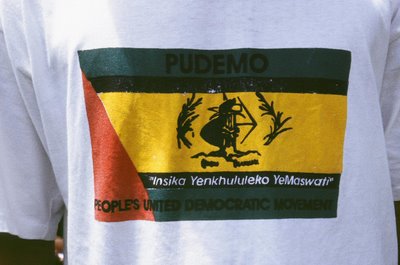
Wednesday, June 28, 2006

Presidential Annual Report 2006

I can hear the roars of thunder in the streets of Swaziland as the masses proclaim…The day of liberation!


PUDEMO President – Cde Mario Masuku

Political Report to the Annual Conference of PUDEMO

28 June – 2nd July, 2006


Table of contents:
  1. Introduction
  2. History is on the side of the poor and oppressed
  3. From spontaneous mass resistance to sustained liberation struggle
  4. The world we live in today and prospects for a democratic victory in Swaziland
  5. Political tasks of the movement
  6. The future belongs to the people


Cde Chairperson of the session,
Members of the National Executive Committee,
International friends and allies,
Representatives of fraternal organizations,
Esteemed delegates


Introduction


In the Political Report we submitted to the Piet Retief Annual Conference of PUDEMO, we said, “In any struggle it is important to recognize the critical moment, the time when decisive action can propel the struggle into a new phase………………..and when the moment of revolution arrives, only a political organization which has been with the people through all their earlier experiences can hope to command their support”.

Indeed, we gather today at this important and Special session in the life of our movement, not out of tradition or being used to it, but fundamentally because we have work to do. We are entrusted by the mass of the poor and oppressed people of Swaziland with the historic duty of destroying the system of tinkhundla royal rule and in its place, creating a new and truly democratic Swaziland.

We are not here to lament about the extent of tinkhundla brutality, neither are we here to make rhetoric about what are the problems we face, but we are here to plot how best to intensify the on-going offensive and accordingly make the necessary changes to our programme regarding the prosecution of our political tasks on the ground.

As we gather today, we wish to pay tribute to all our comrades who happened to pass on during the period between now and the Piet Retief Conference, in particular we pay special tribute to the gallant fighter, revolutionary and firm cadre of our movement; Dumsani Shosholoza Khoza.

We also acknowledge the heroic sacrifices that our member make daily in the trenches of struggle in and outside the country, as they face jail, exile and daily persecution by the forces of tinkhundla royal tyranny. We salute the firmness and boldness that has forced the enemy to accept that change is inevitable in Swaziland.


The Piet Retief Conference of PUDEMO clearly stated what are the concrete tasks of the movement at this phase;
·Building PUDEMO’s political capacity to lead the masses
·Mass mobilisation and deepening a culture of democracy in our society as a whole
·Clear programme for Gender equality and the transformation of land ownership patterns as central elements of social transformation and fundamental change
·Development through the radical growth and redistribution of the economy
·International solidarity for democracy in Swaziland, sovereign development in Africa and justice in global governance.

Therefore, we are here to evaluate how far have we remained true to our own commitments. We must certainly differ from the tinkhundla system not only in terms of our superior political vision, but also our style of operation and honesty to our cause. We make declarations and must live by them, otherwise, this Conference must not even begin, if its one of those usual gatherings and social clubs we can think of.

In seeking to do so, we are inspired and guided by the following key documents of the movement, whose basic outline of our political vision and what should be done to realise it, is correct and clear;
·The People’s manifesto
·PUDEMO Strategy and tactics
·The Sikhawini 5th General Congress Declaration and the subsequent Programme of action
·The Piet Retief Declaration and Resolutions

As well as other such important documents of the movement generally;
·The Ermelo Declaration
·The Mzinti Conference resolutions
·Manzini Conference resolutions
·SWAYOCO and Women’s league documents, resolutions and programmes, particularly the historic 5-year Strategic Plan of SWAYOCO

It is exactly 5 years now since our last Congress at Sikhawini in 2001, and we have a task to clarify whether we have, in concrete terms, made progress since then or not. When we do so, we dare not romanticize issues, but engage them critically so that we can be able to clarify the truth behind the real state of PUDEMO today.


History is on the side of the poor and oppressed


The struggle for social justice, equality and democracy is a struggle for the fundamental change of society, because in the way society is organized today, such noble values cannot be realized.


Therefore, this realization is the very basis of our struggle for a society free from the shackles of royal monopoly and tinkhundla semi-feudal crisis.

The history of every society is but a means to change the ownership of the means of production and the wealth of society in general, it is a struggle rooted in the need to destroy all elements of injustice and structural inequality built and sustained by the system of parasitic rule.

History has proven that every struggle is rooted in the core foundations of class struggle, the real roots of all exploitation and suffering. In this sense, every struggle is a struggle by the poor and oppressed against the oppressive minority of parasites.

In the specific context of Swaziland, the royal minority, who are the puppets of international capital have always used narrow tribal ideology (culture being the manifestation of that) to whip up emotions of reactionary patriotism and breed values of passivity and active compliance with the interests of the ruling royalist minority.

The exploitation of the majority of workers, the rampant abuse of women, the legalized abuse of children and the youth, the brutal exploitation of the rural landless majority and the general subjection of the people to the reign of royal terror is all in the name of Swazi culture.

This is why we must contest and win the battle of ideas in the public space. We must do all and everything in our power to push back the frontiers of tinkhundla backwardness by exposing the political bankruptcy of the system. In this sense, we can boldly claim that history is on the side of the poor, because they are the ultimate victors in the struggle for human dignity, whatever the odds at the moment.

We must never allow a few parasites to opportunistically define what is Swazi culture and what our identity should be as Swazis. We are first and foremost, human beings and aspire to the highest ideals of the human race, the most civilized and progressive traditions that humanity as a whole has so far been able to develop and the most supreme values governing human relations. In this sense, our uniqueness is not about a detour from these basic values, but fundamentally their affirmation in context.


From spontaneous mass resistance to sustained liberation struggle


From humble beginnings in 1983, PUDEMO has risen to be a giant of stature in the political arena of Swaziland. It has become accepted as an important element of any serious and lasting political solution to the problems of our country. In this sense, we can confidently affirm that what we seek to resolve here these few days is of significance far beyond the walls of this building.


It is awaited with keen interest by the whole Swazi society, and of course, the international community.

PUDEMO organized and built a network of underground structures of mass resistance to open space for public debate and struggle. In doing so, the movement sought to deepen a culture of vibrant engagement, but more than that, to deepen a culture of resistance and rebellion against royal exploitation in all its forms. This is why we can boldly and proudly claim that we are now getting into a new era of a sustained liberation movement in Swaziland.

The era we have just emerged from is that of a society in rebellion against oppression, but we must now turn that rebellion into active struggle and a conscious movement for democracy. We must turn the massive anger into political energy through a sustained programme of liberation. This was well articulated by our historic programme of PUDEMO, The last Mile to freedom.

In building a sustained liberation movement of the people we need to learn from the past experiences of the mass resistance movement, which could not turn the massive anger into political energy against the tinkhundla system. Lets turn the struggle against landlessness into political energy, lets turn the massive anger against poor wages and working conditions into political energy, lets turn the massive anger against the abuse of women and children, the HIV/AIDS genocide, the poverty crisis and collapsing state institutions into political energy and deal the tinkhundla regime a serious blow.

We can only announce the political funeral of the tinkhundla system if we are able to develop a comprehensive programme that clarifies our intentions in the short-term, medium term and long term. We must know what we seek to do now, what we seek to do next year and what we seek to do in the next ten years. In this way we can claim with confidence that we are capturing the imaginations of poor, hopeless and desperate masses. They would begin to believe that they are not vesting their energies in the wrong vehicle. PUDEMO must not only prove itself, but demonstrate its determination to be an alternative to the dying and crisis-prone tinkhundla system.

This means we must establish an infrastructure that is equal to the task of making a decisive blow to the forces of tinkhundla tyranny. The Piet Retief Resolutions of the movement are quite explicit about what should be done in this regard, particularly as regards the following core areas of our work;

  • Political work
  • Organisational work
  • Financial work
  • International work


Balance of forces in Swaziland


The state of forces in Swaziland as regards the actual balance of relations between the enemy forces and progressive forces is an important element of our work, hence the need for regular evaluation to assist us position the movement and the forces of revolution in general, in a proper position. In our Political Report to Congress, we shall deal with these at length, but for now, there is a Comrade who shall deal with the actual balance of forces.

In this regard, the following forces are critical;
  • Trade unions
  • Youth and students
  • Women
  • NGOs, professional bodies and Social movements
  • Churches and religious organizations
  • Rural and landless masses


Then on the other hand are the;
  • State
    • Government
    • Judiciary
    • Legislature
  • The institution of the monarchy and the royal family as a whole
  • The state of capital or business in general
  • The security forces; military, police and intelligence forces
  • Ideological apparatus of the regime

It is important that we properly understand these and how they affect or determine the pace of our struggle, as well as what should be done. These must be understood in the context of an on-going class struggle and the forces contesting hegemony in our society.

This also applies to the issue of the constitution which shall be under serious scrutiny in this Conference. But we must clarify one thing about it, our main concern is not whether the constitution is legitimate or not, but it is what is the impact of the recent developments in the country for our struggle. We are fighting a political struggle and not a constitutional struggle, which means we need a political solution, in which case the constitution shall be an element and not the be-it-all of our struggle.

We stand firm in our position in the midst of intimidation and cowardice, we affirm our position and wayfoward that says the constitution should be a product of a democratic process and only then can PUDEMO actively participate in it. We however, remain committed to genuine dialogue and not royal imposition or political circus.

The world we live in today and prospects for a democratic victory in Swaziland

At the beginning of this century and during colonial times, western countries saw their colonies in Africa, Asia and Latin America as sources of raw materials and cheap labour, for industry in the mother country. They used the colonies to generate wealth on terms of trade beneficial to the industrialised countries, which laid the basis for the perpetual unequal relations.

Factors that accounted for the deepening of the unequal relations, inter alia are, particularly the third world debt;
·Crisis in the world economy which could only be bailed out through a transfer of loans to the crumbling poor countries, as well as to bail out the economies of western countries themselves which were undergoing deep-seated structural crisis in their profitability indices. In this sense, loans sought to stimulate the market in the north and set the economic ball rolling;

·OPEC profitability which was invested in western commercial banks that became too loaded with money and decided to plan for a loaning system to developing countries, as a means to service their systems;

·Arms became a key part of the external debt, which was in the interest of western profitability and part of the arms race, so central to the cold war conflict

The crisis and dilemma of Africa’s development prompted the development of the Lagos Plan of action in 1979, which was heavily criticised by the World Bank as not giving enough room for private sector participation, not emphasising enough on the need for reforms in the public sector and being too ambitious in its projections on what Africa could achieve in terms of industrial growth [1].

The world bank therefore went ahead to set up its own assessment of the possibilities to jump start African economies and in accordance with its mandate as the forebearer of capital’s interests throughout the world. It appointed Professor Elliot Berg as the leader of the commission, which came up with a two-pronged solution to the problems;
·Rolling back the state from involvement in the economy through privatisation; and,
·Opening up the economy to more private sector participation and the rule of the market through liberalisation.

In this regard, this is the background to the imposition of Structural adjustments programmes (SAPs) defined as IMF economic policies imposed by western creditors whose ultimate purpose is;
·To generate hard currency to repay debts; and,
·To open up developing country markets to foreign imports.

These cannot be achieved unless a country is so indebted that it can be forced to open up its foreign capital and trade markets. The way to get a country to open up is to offer loans or bail-outs and then apply conditions. Western creditors cannot intervene unless a country becomes indebted. Then the IMF is sent in to put adjustments policies in place.

The conditions tied to SAPs in general impose;
·Higher interest rates
·Cuts in public expenditure, including cuts in health, education and social welfare budgets
·Currency devaluation, making exports cheaper and imports more expensive
·Limiting state interference, which means the removal of state subsidies, such as on basic foodstuffs
·Privatising state industries and agencies, such as transport, agricultural co-operatives, hospitals, schools, etc
·Increasing exports, such as plantation cash crops instead of subsistence food crops.
·Encouraging international investment, such as the establishment of export-processing zones, allowing profit repatriation, limiting the power of unions and other organised mass organs, promoting the unlimited rule of transnational companies, etc.

This is the era we characterize as neo-liberal globalisation. This means all the tragedies of privatization, massive retrenchments, unemployment, cut backs in education and health can only be explained in relation to the dominant system of heightened capital accumulation, particularly driven by and favouring rich elites in the north and their junior counterparts in developing countries.

The Swazi case as an example of Africa’s corrupt elitism

A cousin company to Britain’s defence export services organisation (DESO) is BESO, which is the British Executive Services Overseas, which specializes in cushioning the economic and other interests of the corrupt political elites of certain countries all over the world in line with the fundamental interests of British capitalism, through these puppet elites.

This is the same company that has over the years run the strategic and commercial interests of king Mswati. All the Swazi money he acquires through robbing the Swazi people and invest it in Crown Agents in England, is a classical example of how the systematic looting of Africa’s wealth and its transfer to Europe is being perpetuated.

Certainly the rich and powerful are benefiting from this official looting and historic plunder, hence its interest in maintaining not only undemocratic systems, but also the very corrupt elites, aside their public relations stunts about their much proclaimed commitment to democracy and human rights in Africa, a very convenient political posture indeed.

There is no doubt that a further illustration of this classical example would also indicate that, the primary reason why Swaziland survived for so long as an undemocratic country was due to the fact that the British military intelligence (M16) and its whole security establishment, took full responsibility for protecting the political and economic interests of the Swazi monarchy, since the days of king Sobhuza 11 and worked actively to frustrate all efforts towards a genuine democratic dispensation by the forces of progress in the country.

Maintaining in power the puppet royal regime of Swaziland is in the interests of British imperialism. The role of Tibiyo and Tisuka are to oil the wheels of imperialist accumulation to ensure the effective participation of the royal aristocracy in the process of global capital accumulation and exploitation of the world’s poor majority.

This is what explains the double standards applied by Britain, particularly in dealing with Swaziland as opposed to how they are dealing with Zimbabwe.

Britain has been the most vocal opponent of smart sanctions being applied against Mswati’s regime in the European Union, yet the foremost proponent of the same for Zimbabwe, purportedly for the reason of human rights and democracy, what a shame on a neo-colonial bully!

In the context of all these forces at play and the political architecture globally, we need a proper response and that response must take full advantage of the global balance of forces, whilst exercising extreme caution with regard to the dangers posed by these at all times.

It is in the context of the above that we take this opportunity to salute the work of our international friends and structures, key amongst them are the South African tripartite alliance components, our European counterparts in Denmark and Netherlands in particular, our newly established Canadian structure of the Swaziland Solidarity Network and its main body, the South Africa based Swaziland Solidarity Network (SSN), our international offices in Australia, and South Africa, all of them have done us proud. Without their active and consistent support, we would not be where we are today. We dare not let down their contributions, but demonstrate renewed commitment to the cause.

The recent and highly successful border blockade which was organised jointly with COSATU by the Swaziland Solidarity Network confirmed the practical will by our comrades in South Africa to really make practical the commitment to solidarity with the oppressed people of Swaziland.


Political tasks of the movement –

Towards the renewal of the political giant of the Swazi people to reclaim its rightful place as the leader of their struggle


In 2003, immediately after the Piet Retief Conference, we adopted an Organisational Renewal Strategy called, Imvuselelelo Plan. It was a coherent plan to renew and strengthen PUDEMO through building a very vibrant and dynamic organisation guided by clear and advanced political perspectives.

However, we have not been able, as yet to make the plan work or at least, there has been half-commitment from many of us to this plan, for various reasons and this Conference must affirm the urgency of that plan, otherwise we shall lament forever.

Let us remind each other about what that plan sought to do and what is required of us now. This strategy sought to address the following core issues and tasks of our movement;
·The task of implementing PUDEMO programmes and resolutions on the ground
·The task of linking theory and policies of the organisation with the day-to-day experiences in the concrete realities we face in our daily political practice in our communities and work
·The task of mobilising into active participation, all cadres of PUDEMO to become fully involved in the work of building PUDEMO and advancing the whole struggle on a daily basis
·The task of proper co-ordination, cohesion and organised planning for maximum impact and clear understanding amongst all structures of the movement and all the people of Swaziland.


The tasks ahead – How much work needs to be done on the ground?

The following areas have been identified as critical to our work;
·Recruitment and induction of new cadres
·Political education, leadership development and building mass political consciousness
·Effective information dissemination and popular agitation for mass action
·Active participation in the raging struggles of the masses on the ground, as well as in all social structures; trade unions for worker’s rights, community organisations for basic services, church struggles for moral renewal and social justice, rural masses for land, students for free education, women for human dignity and gender equality, etc.
·Building a strong and visible PUDEMO on the ground, actively leading community struggles and mobilising the people for consistent mass action, which includes building a strong SWAYOCO and Women’s league.

The movement has problems which have gone beyond being internal matters, but they are now public matters. Some of these most pressing problems include;
*Weak or none existent structures and campaigns, particularly in regions and branches as they are there in name or individuals;
*Poor communication within our own structures, first, and with the mass of the people, generally.
*Poor co-ordination and coherence by higher structures, particularly the NEC and regions which are key power centres in the political language of PUDEMO;
*Weak cadreship in terms of; theoretical clarity and understanding of key issues, as well as in terms of frontline militancy and active participation and leadership in the daily struggles of these masses
*Poor profiling of PUDEMO leadership, which makes the masses have less confidence in the movement itself, because people should associate the movement with a particular symbol of resistance and hope.
*Inability of PUDEMO to correctly take up and rally the masses around issues of daily concern to them and their lives, such that we are walking parallel to the struggles of these masses, though we claim to lead them.

Therefore, if we are serious about reclaiming our historical position as the leader of these masses, the above picture must be removed immediately. We must work tirelessly to change the outlook and political posture of the movement to reflect seriousness, urgency and undying commitment, underpinned by unity of purpose and superior methods of organisation in actual struggles.

The idea behind the Plan

Organising PUDEMO into a superior political force guided by advanced political theory and sophisticated methods of organisation on the ground is the real motive behind this plan. It requires the following qualities, in order to succeed;

*Willingness on the part of all members and leaders of PUDEMO to admit that the situation within the movement has reached a serious situation;
*The luxury of casualty is not in the interest of the movement and the suffering masses, hence urgency must be the driving force behind this plan and the whole effort to renew PUDEMO;
*As leaders at all levels, including regions, branches and leagues, we must not be defensive, but upfront about our weaknesses and failures so that we can begin the process of correcting them and improving our work;
*We must allow for honest debates and reflection amongst ourselves, our allies and general structures of our society;
*Frank and vigorous political debates must form the central part of our organisational culture, which requires that we encourage it and not stifle it as has been the culture in some of our structures, particularly in regions where forums for discussions have not been so pronounced;
*Sacrifice is the only guarantee for victory in any revolution, which therefore requires that cadres stop lamenting, but put all their energies at the disposal of the struggle and work for these masses tirelessly. We cannot have both worlds of comfort and normality living side by side with political struggle, because struggle by its very being presupposes sacrifice and abnormality in one’s way of life;
*Finally, We must identify and uproot all elements that hinder progress and frustrate this plan, which is about the future of our movement and the people it represents. We must be upfront about the need for this plan to succeed at all costs.

PUDEMO has two choices; fail in positioning itself properly and regret forever or timeously make a difference and reposition itself properly and remain relevant for years to come.

We all agree that 20 years is a lengthy period for any movement not to have undergone any serious process of renewal, because the conditions change daily and require that we reorganise our machinery on a constant basis to adapt to the ever changing circumstances on the ground as imposed by the scientific reality of the terrain.


What kind of PUDEMO can be considered organised and ready to lead the people of Swaziland into the promised land;

*Fully functional structures; holding regular meetings, reporting constantly to members, carrying out tasks efficiently, uniting the people, etc;
*All cadres fully mobilised and in action. The attitude of people who are militants only in conferences or in social gatherings, without daily active participation in political work is failing the movement and must be defeated;
*All structures carrying out political work amongst the masses and organising popular campaigns around issues affecting the poor in their communities;
*Political education, propaganda work and building strong regions and branches is central to the future of PUDEMO and must be carried out daily by every member of PUDEMO;
*Guaranteeing the full and effective participation of women, disabled people, rural poor, youth, workers and all elements of the marginalised community of our country, in the daily affairs of PUDEMO
*Clear documents, internalised and fully understood by the whole membership, so as to spread PUDEMO hegemony throughout all sectors of our society is a condition for victory;
*Leadership guided by the motto; first in commitment, first in sacrifice and first in discipline at all levels; NEC, RECs and BECs;

NB: Regions shall also be expected to hold their own renewal exercises once this exercise has been completed, to take down the process until it reach the lowest level of PUDEMO organisation, The same shall be expected of the leagues; SWAYOCO & the WL


The future belongs to the people


The future of our struggle, not least of our own glorious movement, PUDEMO, is what we make of it. We are called upon to demonstrate a particular level of determination and seriousness in this effort of seeking to make PUDEMO the real leader of our people in terms of its; superior ideological and theoretical clarity, as well as organisational methods on the ground. The future is in our hands.

Amandla!

[1] Lagos Plan of Action

Thursday, June 22, 2006

PUDEMO goes to annual conference

22nd June 2006

PUDEMO goes to annual conference
28th June to 2nd July to reflect on achievements and repositioning itself as it marches to democracy.


Preamble

PUDEMO, like every organization need to reflect, reorganize and renew itself if it wants to remain relevant in the ever-changing political world of today. This week PUDEMO will be meeting in RSA’s Mpumalanga province it its annual conference to map a way forward.


The question one may ask why in RSA when the country is said to be opening up to democracy with all its freedoms. There is nothing further from the truth. Swaziland has never changed a bit. Swaziland is still a monarchical dictatorship where all power is centred on one man, and that man is the King or Ingwenyama, the mouth that never lies. Preparing for an annual conference is taxing in terms of time and resources. It would have been unwise of PUDEMO to risk all the effort by holding this meeting in Swaziland where the Royal hit squads marauding as police would disrupt the conference.

Another factor is that Swaziland is second only after Zimbabwe to generate exiles. We have quite a sizeable number of our members who fled Swaziland over the years because of political persecution. They are in Australia, UK, RSA and other countries. They need to attend the conference as well so that they can contribute to the liberation plan as it is unfolded.

Invited guests

We have extended our invitation to our external fraternal friends and allies in the ANC, SACP and COSATU. We have also invited various unions, which are affiliated to COSATU and are based in Mpumalanga. These are the people who have been there for the struggling masses of our people over the past 23 years of our struggle.

We have also invited local organizations like the SFTU, SFL, NNLC, SNAT and SNACS. Others included SNA for nurses and STAWU for transport and allied workers unions.


Presentations


We expect the following papers to be presented;

*The state of the nation address by the president
*Building Alliances
*Building a new PUDEMO profile -
*The current constitutional framework
*The balance of forces analysis
*The state of the Swazi economy – we want our members to appreciate the grave economic situation that has been brought about by Royal mismanagement and looting over the past 38 years.

Expected outcome:

*A much stronger PUDEMO capable of making the last push to democracy
*A new way forward document
*A firm position on the new Royal constitution
*A firm position on the motive forces and how we can continue to unite the various sectors of our society against Tinkhundla
*Fresh mandate to our structures and the international offices so that we can continue the campaign to isolate the King of Swaziland and his Tinkhundla system of government.
*There is no time to delay our freedom as the economy of the country is being looted at an alarming rate.

2.0 We call upon the international community to isolate Tinkhundla and the Swazi Royal family

2.1 Swaziland is a time bomb waiting to explode. The people have been suffering for so long and yet there is not much that we hear from the international community. If there is no deafening silence on the repression in Swaziland, there is active support from such organizations as the UNDP and the Commonwealth. Shame on the people who are in the corridors of power who elect to look the other way when our people are suffering from a minority family masquerading as a Royal family. We congratulate the people of Nepal and we wish to take a leaf on how they managed to deal with a similar problem. Whilst PUDEMO has no problem with a constitutional monarchy, it has a lot against an unproductive family that loots the resources of our country at the expense of a poor people. HIV/AIDS is ravaging our people. Some of the cultural practices like forced marriages, reed dance ceremonies where young girls are paraded half naked for the lustful men from the corridors of power both inside and outside Swaziland to satisfy their lust. A lot of these girls are sexually abused in these ceremonies and hence the high prevalence of HIV/AIDS.
2.2 Unemployment is rising to uncontrollable limits, health facilities have nothing more than painkillers and orphaned and vulnerable children are littering the Swazi schools.
2.3 Recently the King took with him lots of people to entertain some of his friends in Taiwan and Indonesia at the expense of the country’s meager resources

The question is for how long will the Swazi suffer before the commonwealth do something.

We thank the ambassadors from USA, Italy, UK and the Netherlands for telling the king that the time for repression is over. We are calling upon all peace loving people of the world to come to the aid of the Swazi people.


PUDEMO welcomes the investigations into the death of freedom fighters in Swaziland

We believe that the process is long overdue. We are happy that a decision has been taken to have the investigations. We are ready to assist with any information that can help get to the bottom of this atrocious act in our country. The people of South Africa and family members of the cadres who were killed in Swaziland must be assured of PUDEMO’s absolute support to the investigations. We are calling our people to come up and make presentations to whatever structure that will be put in place to investigate the killings in Swaziland. But we wish to warn the investigators that they should not hope to get anything from the regime and the Royal family in Swaziland. The reason is simple; it was the same people together with the Royal police who engaged in human trade with the apartheid regime. Some of the police bought farms with the blood money. PUDEMO is ready to assist with the investigations. This is a small contribution we are prepared to help for the families who lost their beloved ones at the hands of a few unscrupulous people.

International solidarity.

Our thoughts are with the people of Darfur and wish that a speedy resolution should be found in order for them to live a normal life.

Our solidarity goes to the people of Iraq and Afghanistan. We are calling upon the world to help resolve the problem in these areas. Too many lives have been lost and any life lost is one too many. We support the creation of two states in the Middle East, the Palestinian and Israeli states living in peace side by side.

We remember the people of East Timor, the Cuban people and all people who are suffering, and we say our solidarity goes to them as we fight our own war of freedom.


IB Dlamini
Secretary General

Sunday, May 21, 2006

PUDEMO replies to Qalakaliboli

21 May 2006


A Right to reply – Qalakaliboli Dlamini’s letter to the editor dated Friday May 19, 2006 entitled “View about the recent blockade at our borders".


I have been a member of PUDEMO since its inception in 1983. I am a proud founding member of this giant political movement. I have served in various structures, from branches to regions and the General council. I will be completing a second term as PUDEMO Secretary General in October this year. All these years I have not found it important to reply to people who write letters to the editor. This is not because there is anything wrong in writing a letter to the editor. My misgivings are that most of these people use pseudonym and they normally hide their true identities. They are cowards. They are jealous of other people’s achievements. How then do you engage a ghost, I ask myself? If someone is man enough to stand up for what he believes in, why hide himself. I have never hidden my identity when it comes to issues I believe in. I have always detested the way we are governed, and since 1983 I have stood out to be seen and heard. The second reason is that you make the “ghost” to feel like he is a living being, he is breathing the same air we breath. I believe you just stoop low to his level and make him feel important. And that is dangerous and unwarranted. We must allow the dead to be amongst the dead.

Qalakaliboli – what is in a name?

This Qalakaliboli, God forgives me, the name speaks for itself. From the name QALAKALIBOLI, you can deduce that he was a mistake from day one. It could be that he is some sort of a case that is still to be concluded. I do not want to speculate what kind of case he is, but may be he was born in a wrong homestead, you know what I mean, may be “tahlangana emahlangeni.” I pray that his or her case be concluded before he or she passes on. Someone is not happy about his being hence liqala solo aliboli.

I have called a lot of the youth league members who were at the university during the time SWAYOCO was founded, and no one seemed to remember this fellow. Until he unmask himself or herself, I may safely say he is not telling the truth when he said he was once a member of this movement.

For the purposes of this writing let me say the author of the letter is a male ghost and hence I will use he when referring to him.

The issues raised


COSATU is not our crony (derogatory term for close friend or companion)

COSATU is, but a true ally in the liberation struggle for a free society. Our relationship with the tripartite alliance goes back to the struggle years. Whilst the Swazi Royal family was playing political prostitute with the Boers, trading on fellow African brothers and sisters (MK cadres) who were fighting for the freedom of the African people in Southern Africa, PUDEMO was either directly fighting on the side of the ANC or aiding it with logistical support. I am proud to state that I was honoured to have worked within the underground structures of the ANC. I put my life and those closer to me at risk for the liberation of South Africa. In short I was a true and full member of the MK.

COSATU is never begged to support the Swazi struggle.

Whenever we meet our true internationalists in South Africa we do not have to remind them to support our struggle. They know of our life long commitment to continue with the struggle until we are all free. I hope this is clear to all and sundry, COSATU will continue to do the noble thing and support the struggling masses of our country. They have been housing PUDEMO in their offices and accommodating our comrades in RSA. It is through their international support that we have managed to isolate the Royal family from the international community.

The blockade and its effect.

The reason that you are moaning about the blockade, it shows that is was very effective. We are encouraged about such feedback and thanks to you Qalakaliboli we will have another one soon. If only we knew you I was going to personally thank you. Every organization needs people like you to tell it how well they have sold their product. This border blockade product was well received by our customers, people like you.

Swazi Business and the struggle.

We must thank those businesspeople that have supported us all these years. They have paid for our offices, and made it a point that we attend conferences and meetings near and far. For that we thank them. To them we say it was unfortunate that the political repression in the country made us take the decision that we took, and in the process their business suffered. It was the case in RSA when there was economic boycott. Innocent businesses became casualties. Unfortunately that is the nature of the struggle anywhere in the world. All that we need to do is for all of us to work together and resolve the issues that affect Swaziland so that these things do not happen. It took brave businessmen in RSA to talk to the ANC in Zambia that a new political dispensation was ushered in. We call for true businesses to actively engage all parties for a genuine political dialogue so that we can all contribute in making Swaziland a country that we can be proud of.

I find it difficult that you Qalakaliboli are a true businessman. May be you are, so many ghost businessmen have mushroomed in recent months. These are the ones that looted E50 million of our taxpayer’s money over eight weeks. The way you talk, I am most inclined to believe that you may be one of them. Remember, most of them were ghost companies like you are. But do not forget that Liqala kaliboli. All the thieves will have to account one day.

A former card carrying member of SWAYOCO


I have adequately covered that in my opening paragraph. If indeed you happened to be a former member, I am sure you are one of those we dismissed because they were working for the state. Like all organizations fighting for freedom, there are those members who find the road to freedom too long, taxing, difficult and very dangerous for them to continue that they decide to turn around and become sellouts. These are always weeded out whenever they are discovered. We still have those at PUDEMO, and we will have them until victory is achieved. To me you fit this description if indeed you were once a member. True members do not leave an organization just because it has taken a few decisions that they are not happy with. The withdrawal of Comrade Mario Masuku from the Royal constitutional Review Commission was a democratic and popular decision. A lot of people, inside and outside the country agree with PUDEMO that that decision was correct. You must remember, all the principled members who were appointed to such shameful commissions resigned. It was not only Comrade Mario alone. Mandla Hlatjwako, Nkozo Hlatjwako, Doctor Jerry Gule, Muhawu Maziya and if I am not mistaken, Zombodze Magagula left these commissions at some point in time.

Why Comrade President Mario Masuku was withdrawn.

The reasons for withdrawing Comrade Mario were put forward. These included the manner in which he was appointed, which was not democratic. He was coming from our movement, and hence we were supposed to be invited to send a representative. And we would have sent a representative. It would have been highly unlikely that we would have sent Comrade Mario as he is our leader, a position we would have fallen back to for a mandate during the deliberation. Secondly, the terms of reference that forbid group submissions were not acceptable to us. We were a group that represented a certain interests, and hence whatever forums we would have participated in our mandate would have to espouse and defend those interests. The third reason why we withdrew comrade Mario was that the political ground was skewed in favour of the Royal family; as the 1973 decree, which you have mentioned, was still in place.

PUDEMO was right; the process of the CRC produced a document that ensures the continued enslaving of many Swazi families by one Dlamini family.

Sometime I am very ashamed to be a Dlamini, a family that has oppressed all the other families; Zwanes, Khumalos, Mambas, Hlatjwakos, Mkhaliphis, Masukus etc for over 254 years. This is the family that does not believe that any Swazi who bears another surname other that Dlamini can be a Prime Minister. In the new constitution the other surnames will now lose their old age rights to bear chiefs. By 2020, more than half of this country will have Dlamini chiefs under the new constitution. This is wrong, and it will take 14 years from now for people to say PUDEMO was right.

So, if Comrade Mario had participated in the CRC, people like Qala kaliboli would have said PUDEMO was part of the process and they contributed to the status quo that currently obtains; that of oppressive rule through an undemocratic constitution. We are proud that we saw that coming and we refused to be party to an unjust process that was meant to give birth to an undemocratic social order.

Failed to participate in an eight days hunger strike.

I am not surprised. You have the tendency to join a group, and when outvoted, turn around and blame the people who were your comrades or friends. Why did you join the hunger strike in the first place since it is clear you were a weakling? You nearly died before “your personal case was settled” Qalakaliboli. You should have told the comrades that you would not be able to engage in a hunger strike, and I do not believe someone would have forced you. Remember PUDEMO has been around for 23 years, and you just could not survive eight days. It is clear you could not have made it in our ranks, the struggle is very hot, and it will be hotter as we reach our destination, which is freedom that you and your children will enjoy.

Comrade Kislon Shongwe, a true compatriot and valiant soldier of our struggle.

If there is one member who has contributed immensely in putting PUDEMO in the forefront of our struggle today, it has to be Comrade Kislon. There is no one who has outdone Comrade Kislon when it came to preaching the gospel of disciplined cadres in PUDEMO. His commitment and loyalty to PUDEMO, to the struggle and Swaziland can never be equaled. You can ask any reporter or self respecting Swazi who has interacted with him, and he will attest to that. Comrade KP has led the movement as President before. However, when he was elected to serve in the position of Deputy Secretary General, his current position. He never ran away. He is my deputy, but he is my leader, and I have learnt a lot from him.

Comrade Mphandla Shongwe uncompromising nature.

A lot of people agree it is not right for one family to use 70% of the country’s resources and force the 98% of the people to share the remaining 30%. However, they are too scared to do anything. When people like comrade Mphandlana stand up and challenge the system, and do that uncompromisingly, they are then labeled names. There is nothing wrong with bringing mayhem and disorder against your enemy. The Royal family is the enemy of the people when it does what it does. If we make it difficult for the family to enjoy our resources, what is wrong with that?

Comrade Mphandlana is not unemployable. He is a qualified teacher, and if he had chose to, he could have emigrated like many intellectuals and skilled people who left the oppressive Swaziland for better opportunities in RSA and elsewhere.

SFTU hijacked PUDEMO


Then there must be something wrong with you Qalakaliboli. How can a labour movement hijack a political party? We helped resuscitate SFTU, and we have many members from the affiliate unions. We have always worked together where our programmes converged, and we will still do that in the future. SFTU needs PUDEMO as much as PUDEMO needs SFTU. If you had qualified your statement, I would have tried to help you understand the relationship we have with SFTU and many civic organizations. It is naïve on your side to say the labour movement used PUDEMO.

Military wing


You had never seen a military wing of PUDEMO. When members of PUDEMO decide to form one you will not be told, but will know a true meaning of a military wing. For now there is no military wing because there is no need for one as yet.

King Sobhuza II and being honoured with the order of comrade Oliver Tambo.

PUDEMO respects the ANC and its decisions. As such we have sent a public statement to that effect. The ANC was not coerced into honouring King Sobhuza II. PUDEMO believes the ANC comrades sat down and took a conscious decision to honour the people it regarded as having played a role in the struggle. The name of King Sobhuza II happened to be amongst those and hence he was honoured. I am sure his children are happy with that. What does this honour mean to PUDEMO? The answer is simple it means nothing.

How do we remember King Sobhuza II


We remember that King Sobhuza II was called Mona. And until 1973 we did not know what that name meant, just like we can guess what Qalakaliboli meant. When he took our freedoms in 1973 by orchestrating the constitutional coup and took control of our lives, we knew what the name Mona meant. When I close my eyes I see a man who took my dignity away and gave my soul to his children. If you ask me whether I would have supported him given the honour, I would tell you that it would have been difficult. However, we must remember that this honour had nothing to do with how well he treated his own people or how well he espoused democracy in Swaziland. The honour was on his contribution to the struggle in RSA at some point in his life.

King Sobhuza II signed the 1982 Pretoria accord.

However, it must be remembered that he signed the Pretoria Accord with the Boers in 1982 before he died. This unholy political matrimony with the apartheid regime, contributed to the killing of MK cadres and Swazi nationals in Swaziland. It took the lives of such fine sons and daughters of the soil like Mildred Msomi, Tutu Nkwanyana, Keith Macfadden, Paul Dikeledi, Zweli Nyanda and many others.

Many despots have made contributions to struggles of other countries. Does that make them good people in the eyes of their people, the answer is no. But can they be honoured for such contributions; the answer is, the decision lies with those who received that donation. So it was within the prerogative of the ANC to honour Sobhuza II, and those South Africans who protested were using their democratic right to do so. Remember South Africa is a democracy, not a banana republic like Swaziland.


PUDEMO and votes


The people of Swaziland will decide who to vote for in a true democratic elections which will come someday soon. For now we cannot speculate. Would we miss your vote, certainly not. My father used to hate it whenever a player who does not train or who was undisciplined scored a goal because he said it was a bad example. It is the same with you; if people would know that you could vote for us they may think we have something that we share. They may think we are cowards like you. There is nothing further from the truths, we are no cowards, and hence we disclose our true identities. Not long ago you wrote in March or there about and gave your address as Mpaka. May be you have changed addresses, may be not.

PUDEMO is the future.

I once told my fellow countrymen in one of the late TV host, Knowledge Makhanya’s programmes that those people who wished PUDEMO and political parties away were just fooling themselves. I told everyone who was listening that PUDEMO would be around when the future of Swaziland is decided. I am happy that PUDEMO is here today and is making an impact such that people like Qalakaliboli are really scared because they are about to lose the selfish monopoly over our resources. I am also happy that a lot of people, even those from the conservative camp have realized that political parties are the way to go in Swaziland. I say bravo to Marwick and his Sibahle Sinje, Mfomfo and Inhlava, Absalom Dlamini and Lutfo and Imbokodvo. Welcome and let the game begin.

Conclusion


PUDEMO have made mistakes in the past. There have been incidents of indiscipline within some section of our movement, and there are things in our history, which we wish could not have happened. This has happened to every organization and groups. But, we are proud about the fact that we have acknowledged these in many forums. It is this admission that has helped us manage to do introspection and take action. We have grown over the years and have moved forward. One thing for sure, no one can take away our contribution in the liberation struggle for a free Swaziland. We have fought for every Swazi. We have fought for true freedom for both the oppressed and the oppressor.

I hope this has shed some light on the issues raised by Qalakaliboli when he was exercising his right to his beliefs, twisted as they are.


Yours in the struggle for a free Swaziland,


Bonginkosi Ignatius Dlamini
Secretary General
P.O.Box 187
Simunye

Sunday, April 16, 2006

Intensify the border blockade against Swaziland

The People's United Democratic Movement of Swaziland PUDEMO International Office
Australia, Asian and the Pacific Region
E-mail: pudemo@yahoo.co.uk
April 16, 2006


Intensify the border blockade against Swaziland

On April 12, 2006 South African workers and supporters of the struggle for democracy in Swaziland staged successful blockades at all of Swaziland’s borders. The protest was in commemoration of the death of democracy on April 12, 1973. On this fateful day, the late King Sobhuza II suspended the Independence Constitution, declared an indefinite state of emergency and imposed a life ban on political parties. In the 2006 blockades, more than twenty people were arrested and some sustained injuries when the South African Police Service (SAPS) used rubber bullets to disperse the peaceful protest. Those arrested include senior members of the South African labour movement.

Condemn police violence
The People’s United Democratic Movement (PUDEMO) is extremely disturbed by the apartheid-style police violence against South African citizens who participated in a peaceful protest to support the struggle for democracy in Swaziland.

The police violence is abhorrent and unwarranted. It invokes painful memories of a pro-apartheid police establishment whose main goal was to sustain an evil system of government. We did not expect this from a post-apartheid police organisation governed by one of the most progressive democratic constitutions in the world. Police brutality against peaceful political protest is symptomatic of intolerant totalitarian regimes such as the absolute monarchy government of Swaziland. In the lead up to the border protest, the regime in Swaziland warned its citizens against participating in the protest and deployed troops and armed police at its border posts.

Through this brutality, the SAPS has disgraced the South African system of democracy, political tolerance and respect for human and political rights. Thus the conduct by the SAPS must be seen by all as a shameful act which warrants the strongest condemnation possible. Democratic forces around the world must register their disgust against this police violence. PUDEMO is pleased to learn that the police have now released all those who were arrested. However, it is not known whether charges have been preferred against the pro-democracy activists.

Border protest: a commitment to free Swaziland
The border protest, which was organised by the Swaziland Solidarity Network (SSN), is part of an ongoing commitment by the South African public to support the democratisation process in Swaziland. For ten years, SSN affiliated organisations such as The South African Congress of Trade Unions (COSATU) and the South African Communist Party (SACP) have relentlessly upheld their commitment to help free Swaziland. In pursuit of this commitment, SSN and its affiliates have, through peaceful public protest actions, demanded significant democratic change in Swaziland which takes cognisance of international requirements such as those established by the International Covenant on Civil and Political Rights. On several occasions, the South African-based solidarity network joined the people of Swaziland in their protests against:

· the ban on political party participation in national politics
· the political discrimination embedded within the Commonwealth-sponsored constitution making process
· torture and violence against the democratic and worker’s movements
· political persecution and imprisonment of political and labour activists
· neglect of public responsibility, e.g., the failure to provide basic public healthcare and,
· misuse of public resources to satisfy obscenely lavish royal lifestyles

PUDEMO highly commends and unreservedly endorses the South African people’s support, including the recent border protest. We regard the action to blockade passage of goods and services to and from Swaziland as a form of legitimate public protest to force the monarchy regime to agree to long-standing demands for significant progress towards democratisation.

In view of the geo-economic position of Swaziland, this support is a valuable political asset to the Swazi struggle for democracy. Geographically, Swaziland is almost surrounded by South Africa with only one border with a second country – Mozambique. South Africa is Swaziland’s largest trading partner and Swaziland has a high degree of reliance on this partnership which accounts for about 60% of total exports and 96% of total imports.

Sustained economic action by the South African public, if combined with government policy to economically isolate the monarchy regime, has great potential to yield substantial political results in Swaziland. It is inconceivable that Swaziland would have the capacity to resist sustained economic pressure brought to bear on the regime by a combination of government and public action in South Africa. Such action has potential to generate space inside Swaziland for a business and public revolt against the monarchy regime.


Economic sanctions as effective political weapon: the anti-apartheid experience
Economic sanctions are a widely used form of peaceful protest against repugnant regimes which oppress and neglect their citizens. They were used successfully against the apartheid system in the 1980s. Increasingly, the effects of international sanctions compelled the business sector to enter public political debate. By mid 1980s, the South African business community and transnational corporations began to turn away from the apartheid government. For these corporations, the apartheid state had become a major liability to business because of its recalcitrant position on democratisation. Prospects for business recovery did not rest with the protection of apartheid but with joining the anti-apartheid movement in creating conditions for a stable democratic state. Thus, the way out of the continued impact of international economic sanctions was to retreat from apartheid.

It was against this backdrop that in 1985 a high profile business delegation began to work with the leading liberation movement, the African National Congress led tripartite alliance. This shift in political alliance was a major setback to the apartheid state as it desperately tried to resist demands for wide-ranging political change.

Although international economic sanctions were used successfully in the South African struggle, they were never perceived as the only panacea. Instead, they were part of multifaceted struggles incorporating various strategies including armed struggle, mass action and clandestine activities. Furthermore, support for economic sanctions was not without its critics. The pro-apartheid media (local and international, including the Swazi media) echoed the apartheid government’s opposition to economic sanctions. Foreign governments with strong economic interests in South Africa such as the United Kingdom and United States of America initially opposed economic sanctions but subsequently endorsed them because of a swell in international support for sanctions. Most importantly, fearful of local political backlash, the Thatcher and Regan administrations preferred to remain in office than continue resisting local and international pressure to isolate the apartheid regime. Opposition to economic sanctions was premised on one dominant discourse - that the sanctions would hurt the Black poor people they purported to help.

The ANC, SACP and COSATU rejected this argument as absurd because Black people had not benefited from the system of apartheid. Under apartheid, the socio-economic wellbeing of Black people was grossly and deliberately neglected. The apartheid state exercised minimal responsibility towards the political, social and economic development of the Black population. Instead, it was mostly preoccupied with the wellbeing of the white minority population. It created an oligarchic society characterised by a highly mobile white community with skills and wealth, on the one hand, and highly immobile Black community which had little apart from its labour which was exchanged for very poor recompense.

Swazi media and government reaction against the border protest
The resemblance between opposition to economic sanctions against apartheid and the reaction of the Swazi media against the recent border protest is striking. There are only two daily newspapers in Swaziland and both have opposed the border protest. One of these papers is the royal family-owned Swazi Observer. Given that this paper usually opposes political actions by unions, it was interesting to see the prominent coverage it gave to the Swaziland Federation of Trade Unions (SFTU)’s decision not to participate in the border protest.

Apparently, Jan Sithole, the SFTU’s Secretary General, issued a national notice against the protest claiming that his union was not involved in the planning process. On the day of the protest, the Swazi Observer (April12, 2006) describes Sithole as having acted “bravely”. King Mswati III praised the trade union leadership and workers for putting the country first by refusing to participate in the border protest. The King told the Weekend Swazi Observer (April 15, 2006) that he was:

…encouraged by reports that some leaders of the unions took a well considered decision not to participate.
This shows a sense of maturity and a consideration for the country and its people. Anything that seeks to undermine peace, the economy and the country’s security must be opposed by all.

Cabinet ministers have also commended the union leadership and have paraded the decision as a trophy. The regime’s comments have thus completely disregarded the SFTU’s explanation for its decision. Before and after the border protest, the SFTU leadership issued public statements that the decision not to participate was taken because of breakdown in communication and that it actually supports the border blockade (see Times of Swaziland, April, 13, 2006).

The Swazi Observer (April12, 2006) editorial comment predicted apocalyptic economic consequences of political actions targeting the economy and warns:

No amount of political demands and pressure should leave us a poorer country because then we would be undermining the interests of the people we purport to fight for.
Any action that frustrates trade and business activity is a one-way ticket to gross suffering and vulnerability and should be discouraged at all costs.

A day after the protest, the Times of Swaziland, a quasi-independent daily newsprint owned by a British conglomerate, echoed the Swazi Observer’s commentary. It described the border protest as unacceptable and calls for “serious action by the local and South African Governments” as well as the Southern African Development Cooperation (SADC). According to the Times of Swaziland, “…unions exceeded their mandate to cause untold harm to an economy that supports the workers in whose sympathy they staged the blockade.” These statements overlook the current political culture in South Africa established by the Constitution of the Republic of South Africa Act 108 of 1996. Under the Constitution, South African citizens have rights and freedoms to protest. Constitutionally, the government cannot, as suggested by the Times of Swaziland commentary, punish its citizens for exercising their constitutional rights and freedoms.

The reaction to the border protest is thus reminiscent of the 1980s alliance between the monarchy regime and the Swazi media against international economic embargo on South Africa. During this period, the Swazi media joined hands with the Liqoqo regime and subsequently with the current government of King Mswati III to denounce economic sanctions against apartheid. The regime went further to collude with the South African “death squad” to hunt down anti-apartheid activists in Swaziland. Several ANC members were murdered and “kidnapped” from Swaziland police stations by apartheid agents. This criminal behaviour of the Government of Swaziland was never investigated and reported in the local media. Whilst other states in Southern Africa supported economic sanctions against the apartheid state and gave protection to anti-apartheid activists, the monarchy regime dined with the devil.

Dining with the devil
From the mid 1980s to the 1990s, Swaziland benefited from its pro-apartheid position by acting as a gateway to international markets for South African companies. Within this period, investment from the South African manufacturing sector boosted the Swazi economy which registered healthy growth at an average rate of 7% per annum (WTO, 1998: IMF, 2002). The monarchy spent lavishly on arms, royal palaces and luxurious automobiles.

However, the economy sharply decelerated after the collapse of the apartheid regime in 1994. During apartheid, South African manufacturers had moved to Swaziland to evade international economic sanctions but after 1994, they largely returned to South Africa. There was thus a massive flight of capital from Swaziland which left the Swazi economy in strife. In the early 1990s, the economy slowed down and growth fell to 2.1% at the beginning of the 21st century. The International Monetary Fund (IMF) Country Report of 2006, estimates real GDP growth in Swaziland to fall to 1.8% for the 2005/2006 financial year. This prediction was correct as the Swaziland Minister of Finance acknowledged in his recent budget speech that the 2005/2006 budget “…has been prepared under very hard economic conditions with barely a 2% GDP growth rate.”

Thus the benefits of the 1980s had created a false economy and the position of support for the apartheid economy was misconceived. The flight of capital has been compounded by other factors such as irresponsible public spending, lack of innovation, reliance on climatic economic activities, mismanagement, corruption and most importantly, the absence of political accountability.

Grim economic outlook and social neglect: indications of a failed state
Like the pro-apartheid media in the 1980s, the Swazi media ignores one important aspect of the debate about economic sanctions – that the majority of Swazis gain very little benefit from the current economic system and have much to gain from significant change in the way in which Swaziland is governed. The current system has driven the majority of Swazis into abject poverty. They have been caught in a treadmill and are hurting now.

Assessments of the level of poverty in Swaziland give a grim reading. Government budget records show that from 2002/3 to 2004/5 financial year, the number of people living below the poverty line (less than US$1 a day) has increased from 65% to 69%. In desperation, Swazis are increasingly resorting to informal loan sharks to survive and are being charged interest of up to 360% per annum. The King’s response has been to tell Swazis to improve their budgeting skills and to save part of their income for emergencies (see the Weekend Swazi Observer, April 15, 2006). He cautioned “his subjects” against “careless borrowing” and advised them to apply a “strict regime of ‘saving for rainy days’” (Ibid). King Mswati III has completely missed the point that Swazis have no money to buy bread today and certainly have no spare cash to save for later. For most Swazis, there are no financially sunny days any more – all are “rainy days”. The country is facing an economic meltdown and the proliferation of loan sharks is merely one of the more obvious signs of a failed state.

The King’s response symbolises the obscene disconnection between the rich and the poor in Swaziland. It is reminiscent of the comment which has come to symbolise the position of the aristocracy in the French Revolution. When told that the poor people had no bread, Marie Antoinette is reported to have said “let them eat cake”.

The King’s response is also profoundly unSwazi and again demonstrates the fraudulent nature of his claims to be the guardian and arbiter of Swazi culture. One of the strongest and deepest values of Swazi culture is Ubuntfu - a communal approach to life and deep sense of responsibility to others. Our tradition is to help people who are poor and struggling in life. Our tradition is not to criticise that person and call them stupid or lazy. Yet this is precisely what King Mswati III has done. He is telling the majority of Swazis who are living below the poverty line that their poverty is the result of their lack of budgeting, not due to his profligacy and contempt for the welfare of Swazi citizens.

Whilst the government spends lavishly on the royal family household and politicians, the majority of Swazis have no jobs, nothing to eat, are sick and dying because of the acute lack of healthcare services. Unemployment is estimated at 30% and much higher among the youth population (IMF, 2006; Government of Swaziland, 2006).

More than 20% of the population of approximately 1.1 million, an equivalent of 220, 000 people, are living with HIV/AIDS. In 2003 alone, 17, 000 adults and children died from HIV/AIDS (WHO, 2004). In Swaziland the death rate amongst adults is exacerbated by the high prevalence of tuberculosis, an infection that can be adequately contained and eradicated through effective health policies. The World Health Organisation (June, 2005) observes that with a ratio of 1:3 adults infected, “…Swaziland faces a generalised HIV/AIDS epidemic”.

However, WHO is incorrect in its assessment of government response to the HIV epidemic. According to WHO, “the Government of Swaziland has demonstrated a high level of political commitment to fight HIV/AIDS since the start of the epidemic” in 1987. Contrary to this observation, the high infection rate is a result of state neglect of its responsibility and duty of care to protect its citizens through effective containment policies. Swaziland authorities were very slow to understand the potential impact of HIV/AIDS and actually discouraged people from using condoms. Current neglect of the healthcare system by the government shows that there is still a serious lack of political commitment in fighting the epidemic.

In 2005, Swaziland’s authorities refused to join the rest of the world to commemorate the annual World Aids Day because it was held during the time of the sacred Incwala ceremony. Incwala is a sacred traditional ritual which represents the spiritual renewal of the nation and affirms our belief that life is sacred. Traditionally, it is a symbol of hope and healing, particularly when the nation is under siege from natural disasters such as drought and disease. The ceremony draws tens of thousands of young and old men, and many Swazis continue to appreciate its significance. HIV/AIDS campaigns share the core values of Incwala – renewal of the nation’s health and the protection of life. The coincidence of Incwala and World Aids Day presented an opportunity to the authorities and the HIV/AIDS campaigners to raise awareness of the epidemic and promote positive health messages. A combination of these ceremonies would have had long-lasting effects, particularly among the older generation and rural population which have strong sense of Swazi traditions. It would also have provided the King with a well-overdue opportunity to make amends for his disastrous initial response to HIV in which he declared the use of condoms to be “unSwazi”. The decision not to commemorate World Aids Day was short-sighted and yet again reveals the truly careless and incompetent response of the regime to the HIV epidemic. The failure to grasp the opportunities offered by the coincidence of Incwala and World Aids Day shows the absence of innovative ideas and leadership among the ruling elite and its determination to ignore the biggest threat ever faced by the Swazi nation.

With 70% of farmers engaged in subsistence food production, the high rate of HIV/AIDS has almost incapacitated the capacity of rural households to produce sufficient food supplies, even in good rainy seasons. Assessments by the Food and Agriculture Organisation (FAO) and World Food Programme (WFP) published in 2006 show that “many households are facing chronic and acute food insecurity, which is not merely caused by poor climatic conditions, but is also compounded by the effects of HIV/AIDS and a general economic decline.”

The healthcare service in Swaziland is a disgrace and the authorities should hang their heads in shame for this acute neglect. Health facilities such as the Mbabane Government Hospital illustrate the government’s complete failure to meet its responsibilities. Reports in the local media have revealed horrific conditions at the Mbabane Government Hospital including assault of patients, rat infestations, sanitation problems and inadequate pharmaceutical, food and water supplies. (see Times of Swaziland, 17/12/05; 28/12/05; 26/02/06). Investigative journalists from The Times of Swaziland (26/02/06) describe the situation at the Mbabane Government Hospital:

Instead of giving hope for life to patients, the place simply sucks life away from them day after day until they die. Once they are admitted there, there is simply no hope that they will come out alive.

The place is dirty and it stinks.

The smell is now permanent and there are allegations that some nurses are shunning this particular ward because of the terrible state it is in. This is where patients are made to drink water that is also used to flush away their waste. The same water is also used to wash the sick patients.

“We have no option but to wash them here because there is no other place where we can wash them,” commented one patient.

Just when he was speaking, a female came with a bucket full of human waste to deposit in the sink where he was washing his dishes.

“This is a norm, we have no other place where we can deposit our waste this is because the toilets do not flush and even if they did, there is no water to run the waste,” commented another patient.

On April 15, 2006, the Swazi News (Saturday Times of Swaziland) reported yet another water crisis at the Mankayane government hospital. The hospital has had no water for a week due to a burst pipe which could have been repaired within a day. However, this was not done and hospital authorities decided to send patients home as the crisis worsened. Meanwhile, the government had the audacity to spend over E200,000 (approx. US$33,000) of public funds on luxurious curtains for the Prime Minister’s residence. The cost of fixing the water crisis at the Mankayane hospital would come nowhere near the money spent on the curtains. Whilst public health facilities have no running water and Swazi citizens are denied the basic right to healthcare, the Prime Minister barricades himself behind luxurious curtains. The sick at Mankayane hospital have gone home to die and the Prime Minister cannot be seen behind his curtains –a symbol of visual separation and indifference to the painful experience of many Swazis.

The economic situation in Swaziland is grim and shows no signs of improving. Swaziland is digging deeper into international reserves to finance the waste of public resources and the lavish lifestyle of those in authority. According to the 2005/6 budget reports, the economy registered a deficit of 4.3% of GDP. Whilst the economic situation continues to decline, corruption, misuse of public resources, political neglect and financial mismanagement are on the increase. Recently, more than E50 million (approx. US$8.2m) has disappeared without trace and no one in government is willing to take responsibility. This money was earmarked for the purchase of a water drilling rig which would have made a difference in supplying water in rural areas where the bulk of the poverty stricken population lives.

In view of the economic trends over the past 10 years, it is inconceivable that a solution to the economic crisis can be found in the existing system of government. The Swaziland business community and foreign investors should realise that the current system of government has become a big liability to economic growth and business prosperity. As the South African business community realised in the 1980s, the solution to this crisis is the creation of a stable democratic state with a new social contract between citizens and structures of governance. It is in the interest of the Swazi business community to come out of their cocoons and help hasten the change to democracy.

Our people are dying, hungry and sick and their situation cannot be resolved through piecemeal political reforms such as the recently adopted national constitution. We all have the responsibility and moral obligation to give Swaziland a chance to rejuvenate.

Appeal to the Government of South Africa and South African citizens
For over twenty years now, PUDEMO has been relentless in its endeavour to fight for political change through peaceful engagement with the monarchy regime. We have appealed to the international community to seriously consider economic sanctions against this repressive regime. The emphasis of our appeal has been on South Africa because of its geo-economic position.

PUDEMO reiterates its appeal to the Government of South Africa to stand up for democracy in Swaziland and impose comprehensive economic sanctions against the monarchy regime. In our view, if comprehensive sanctions are imposed, it will take a relatively short period before the monarchy relents to demands to open up space for significant political change. The recent border blockade has reopened the debate on economic sanctions as a form of struggle with great potential to yield political outcomes. Results from the one-day border action are already evident. Government officials including the head of state, King Mswati III, have been drawn into the public debate about the political crisis in Swaziland. Comments from King Mswati and his ministers reveal their fear of economic sanctions. The hysteria about the border protest shows that economic sanctions have the capacity to bite deep into the regime. South African citizens together with their government can effectively exploit this vulnerability to hasten broader political change and decelerate the slide into socio-economic decay in Swaziland. A slide into further decay in Swaziland threatens peace and security in the region.

The South African public, led by SSN and its affiliates, has taken the initiative to help the people of Swaziland bring the repression and economic decay to an end. PUDEMO supports this and calls for the intensification of the economic blockade against the monarchy regime. We appeal to the South African public to stay the course and not to relent under scare tactics that economic sanctions will hurt the poor. Our people now look up to the Government of South Africa to seriously reconsider this issue and take a leadership role against the recalcitrant regime in Swaziland. For too long now, the world has turned a blind eye on the political crisis in Swaziland. King Mswati III and his ministers have been at leisure in their endeavour to undermine regional and international aspirations of responsible governance and democratic practices. Consequently, Swaziland has, for a considerable period, been a stagnant backwater where nothing happens because international organisations such as the Commonwealth have decreed that nothing must happen.

In reaction to the border protest, King Mswati was quick to refer to the Commonwealth endorsement of the constitution making process which he described as inclusive. He also claimed that there are structures in Swaziland through which citizens can express dissatisfaction with the political condition. The argument is ridiculous, nonsensical and grossly misleading. No one with knowledge of the political situation in Swaziland would believe it. It contradicts the Constitutional Review Commission Terms of Reference which prohibited political and civic organisation from participating in the constitution making process. The product of this process, the Constitution of the Kingdom of Swaziland Act, 2005 upholds the ban on party participating in national politics.

Political intolerance and hostility against critics are core elements of the current system of government founded upon the King’s Proclamation to the Nation on April 12, 1973. It is against this background that the government has refused to open dialogue with the pro-democracy movement in Swaziland and to constructively contribute to international efforts to improve the quality of governance. The prohibition of political party participation in national politics grossly undermines the principles and aspirations of the New Partnership for Africa’s Development (NEPAD). One of these aspirations is to see that “Africa adopts and implements principles of democracy and good political economic and corporate governance, and the protection of human rights becomes further entrenched in every African country” (NEPAD). It is regrettable that the Government of Swaziland has, to this date, not signed up to NEPAD’s Africa Peer Review Mechanism (APRM) designed to monitor and assist progress towards quality governance in Africa. This recalcitrant position is characteristic of a totalitarian and secretive regime determined to stifle regional progress. The absolute monarchy is a political system born of another age. The time to change it is well overdue and South Africa’s contribution to Swaziland’s development is absolutely crucial.

Signed:


Dr Jabulane Matsebula
PUDEMO Representative
Australia, Asia and the Pacific Region

Friday, March 3, 2006

President Mario Masuku's briefing to diplomats

President Mario Masuku's briefing to diplomats
Invitation to all civilised humanity:

Join us in the march towards a new and democratic Swaziland

A turning point in the history of Swaziland

Distinguished guests,
Friends and allies in the struggle for human dignity,

Please receive, on behalf of the National Executive Committee of PUDEMO and all the struggling people of Swaziland in general, warm and fraternal greetings at this historic moment in the political life of our country. We take this opportunity to welcome all of you and appreciate your interest in this subject matter that has escaped international headlines for far too long.


1. Background to the political crisis in Swaziland

The country called Swaziland is in geo-political terms situated between South Africa and Mozambique with a population of about 1.2 million people and occupying a space of about 17 000 square kilometers. This means it is a relatively small country, but well endowed with natural resources and a rich heritage, as well as fairly good climate.

However, this small country is facing big political problems arising out of a crisis of royal hegemony and the failure of imposed authority by a system which vests all powers in the hands of a tiny minority to the total exclusion of the majority of the people.

The system of royal oppression takes the institutional form of a political architecture called “tinkhundla”. If apartheid used race to exclude other people and safeguard the privileges of one group over another, then tinkhundla uses “royal bona-fides” or royal relations to serve the same purpose. Therefore, if in the context of humanity’s resolve to broaden the frontiers of dignity for all apartheid was declared a crime against humanity on the grounds of its brutality against the majority of the
people, then there is no question whatsoever that the tinkhundla system is equally a crime against humanity.

With these few reflections, we do not only seek to raise uncomfortable questions about global standards of acceptable governance, but to further deepen discussion about the challenges facing the international community in resolving global conflicts and building a global society based on the
ideals of democracy, peace and justice.

The people of Swaziland, of necessity, are playing their part in this whole process of seeking to create a new and truly democratic Swaziland. They have defied all odds to mount a mass movement for democracy led by their political voice and proud representative, PUDEMO. Everywhere in Swaziland, the people are on their feet demanding justice; workers at the workplace, students in institutions of learning, the poor and unemployed
in communities, believers in churches, the landless masses in rural areas are all speaking in one voice, demanding an immediate end to the system that has caused untold suffering to our country and its people.

They are demanding a system that seeks to end; poverty, reckless spending, economic plunder, destruction of the environment, women and children abuse, and oppression in all its forms. All this is not possible without fundamental and thoroughgoing changes in the country’s political system. Tinkhundla must be removed and in its place, a truly democratic system must be created. This is the lasting solution to the crisis facing our
country. No amount of desperate quick-fix solution will bring about the desired stability and progress. No amount of military might and proficient strategy will bring about a real political solution, because the problem is political and not military, such that only through genuine political dialogue rooted in popular participation, can a lasting solution be found. Finally, like all other people, Swazis want progress and prosperity.


2. Historical development of the ruling system in Swaziland

Developments in Swaziland are primarily linked to developments in the whole Southern African region, particularly South Africa. This means, the historical development of the Swazi political system remains integrally linked to or can only be understood through tracing the development of the whole region, with more emphasis on South Africa.

There are three distinct periods in the development of the tinkhundla political system;
· Pre-colonial period and the making of a dynasty
· Colonial period and the making of a repressive modern state
· Post-colonial period and the consolidation of royal supremacy through the tinkhundla project

Swaziland was colonized by Britain (though we are told it was a
protectorate, as if it meant some form of benevolence) from 1902 until 1968 when the colonialists handed over power to the royal aristocracy of Swaziland. The British had left in place a constitution which by any standards allowed a fair space for democratic engagement, which was repealed by the monarchy in its desperate thirst for power in 1973 through a royal decree whose provisions entailed, inter alia;
· Banning of political parties
· Banning of the most basic rights and freedoms to associate, organize and speak, as well as all forms of political activity
· Proclamation of a perpetual state of emergency, which is effective to date.

Recently there has been speculation to the effect that the decree has been removed with the coming into force of the new royal constitution. It is important to clarify the confusion surrounding this matter, because what the regime has done is to formalize and institutionalize further the contents and provisions of this decree as a core element of the new
constitution being paraded as the heralding of democracy in our country.

In this sense, it may no longer need a separate document containing these, because the constitution is a revised version, though in advanced form, of the 1973 king’s decree. If this is what some commentators call victory for democracy, then we have a reason to be worried.

The scrapping of the 1968 constitution by the late king Sobhuza 11 and its replacement by the 1973 decree was also informed by the advice of the Afrkaner Broederbond Society through its agent Van Wyk De Vries, a Pretoria advocate. It must be remembered that the threat to the apartheid regime at the time was the liberation movement of South Africa, particularly the ANC-led Alliance, which prompted the apartheid regime to realize that its own survival lies in consolidating closer and stronger
ties with and supporting what it called “like-minded” regimes. Amongst these was Mobutu Seseseko of the then Zaire (now DRC), Hastings Kamuzu Banda of Malawi and the Swazi monarchy, who had come to constitute, together with their apartheid patrons, the axis of resistance to freedom and democracy.

After the banning of the constitution and political parties in particular, the system called tinkhundla came to constitute the political vehicle through which royal hegemony was to be entrenched by the monarchy. It was formally introduced in the political scene of Swazi society in 1978. Its official introduction came with an electoral system based on an electoral
college through which people were to elect at tinkhundla centers
(constituencies), electees who were to constitute the electoral college and not parliament.

Only the electoral college could elect parliamentarians from a list provided by the royal house, who were to then constitute the parliament of the kingdom of Swaziland. In this sense, it was guaranteed that the ultimate product of this process is composed of members of the ruling system or at least those blindly loyal and sympathetic to it. This is on top of a politically sophisticated parliamentary system, in which the
upper house, Senate comprised of the most staunch stalwarts of the system, particularly chiefs and princes, who had veto powers over the house of assembly in the case of “deviations” from the official line (royal interests). This parliamentary form of gate-keeping is still in command in the current system, though in an even more sophisticated and subtle form, as an upgraded model of the same.


3. The Road towards democracy begins:
The Birth of PUDEMO in 1983 as a watershed moment in the history of Swaziland

The consolidation of royal supremacy through the formalisation of tinkhundla as a political system of Swaziland left the people with no alternative or hope for change without waging a mass based struggle for democracy. This led to workers, students, rural and landless masses, women of different religious, racial and social backgrounds coming together on the 6th July, 1983 to form the People’s United Democratic Movement (PUDEMO) as their legitimate representative and co-ordinator of the struggle for democracy in Swaziland.

In its founding provisions, they proclaimed that, “We, the people of Swaziland met on the 6th July, 1983 to form the People’ s United Democratic Movement, to represent fully the interests of the people of Swaziland and to unite them against undemocratic governance, oppression, exploitation, unfair discrimination, corruption, nepotism and favouritism. We declare to the world that Swaziland belongs to all its people regardless of race, colour, sex, religion or social status and that
PUDEMO is our true representative. We dedicate ourselves to struggling together in unity until final victory”.

It must also be remembered that part of the basis for PUDEMO formation related to its internationalist duty to assist the liberation movement of South Africa in the struggle against the brutal clutches of apartheid, particularly after a realization that Swaziland can never be liberated or democratic while South Africa was still under apartheid, because of the well known policy of aggression by the apartheid regime.

The intensified persecution of anti-apartheid activists on Swazi soil by a joint force of the apartheid regime and their tinkhundla counterparts confirmed the need for a political intervention on Swazi soil. This persecution saw the deaths of many ANC cadres, amongst them; Zweli Nyanda, Mildred Msomi, Cassius Make, Paul Dikeledi just to mention a few (for
elaborate details please refer to the South African TRC report on Swaziland). This was not by accident, but a deliberate effort on the part of the Swazi regime and its apartheid ally, because as early as February, 1982 a secret non-aggression pact was signed between the two regimes, which was immediately followed in 1984 by the Extradition treaty, which allowed the apartheid regime to extradite cadres of the anti-apartheid movement from Swaziland to South Africa, most of who later died in the hands of the racist regime.

In this sense, the birth of PUDEMO in 1983 signalled two important and interlinked events:
- The beginning of organized resistance and challenge to the tinkhundla regime and the nearing end of royal oppression in Swaziland, and
- The organized challenge to the open collaboration between the tinkhundla and apartheid regimes, to accelerate the process of moving towards a free and democratic South Africa, ultimately leading to a free and democratic Southern Africa, with Swaziland included.

PUDEMO worked consistently from the underground to build a mass movement for democracy until the regime rounded up the leadership of the movement in the now famous treason trial of 1990. However, the trial did not succeed in dampening the fighting spirit of PUDEMO and the mass of the oppressed people of Swaziland in general, instead it bolstered their
confidence and inspired an unprecedented wave of mass activities for democracy and social justice throughout the whole country, as workers, students, rural masses, churches, women and all organs of social organization began to articulate their demands in an even more clearer way than before, all of which hinged on the need for fundamental change and democracy in the country.

This explains why today the whole Swazi society speak with one voice that, a day more without democracy means more unbearable suffering and terror against the democracy-loving people of our country. The struggle for democracy is at the heart of the solutions we need to build a new and prosperous Swaziland in all facets of our society.


4. The situation in Swaziland today

The tinkhundla regime is on the warpath against the democracy-loving people of Swaziland

The Swazi regime continues to inflict legislative and political terror upon the people as the political atmosphere in the country has become even more grim and threatening reflecting the growing insecurity of the regime, which despite its arrogant posture has never been so isolated not only from the mass of the people of our country, but also from world public opinion. Alarmingly, there are signs that, with the full connivance of the ruling authorities secret squads are beginning to operate in Swaziland.

The several attempts on individual comrades’ lives is one example of the numerous assaults, tortures, arbitrary arrests and all forms of persecution on men and women who refuse to bow to the tyranny of tinkhundla. Families of political activists are daily being terrorized by the regime in its desperate attempt to crush, through force of arms, the democratic movement and instill fear amongst the oppressed and struggling masses.

The tinkhundla ruling system of Swaziland is facing a deep irreversible crisis. Years of royal misrule has plunged our country into a permanent crisis of; economic decline, massive poverty and unemployment, the HIV and AIDS disaster, women and children abuse in the holy name of Swazi culture, as well as the all-round political instability characteristic of our country today.

In the recent past we have seen the following indicators of the worsening crisis;
- The intensified arrests of PUDEMO and SWAYOCO activists for holding peaceful demonstrations and spreading the message of liberation throughout all corners of the country

- The closure of two independent newspapers by the monarchy for reporting uncomfortable truths about Swaziland

- The overruling of judicial rulings by the king and the subsequent resignation of the whole bench of the Court of appeal

- The massive arrests of trade union leaders for demanding the right of workers to organize, as well as improved conditions of work

- The massive evacuation of communities in the eastern part of the country; Kamkhweli and Macetjeni for refusing the recognize an imposed royal puppet as their chief. These people were forced to flee the country for their safety and in the process lost their property and suffered serious disruption in their lives as workers, students and ordinary citizens of the country.

- The extravagant royal spending spree and intensified economic plunder that has caused severe economic bleeding and resulted in a social decay as regards social services for the majority

These are just some of the prime features of Swazi society today and they are explained in no better terms than the way the 2006 Budget presented by the minister of finance and those preceding it, have shown the continued skyrocketing military or security expenditure, presumably to safeguard people who are hungry. This means more and more security for less and less food. The indicators are terrifying to say the least;

· HIV and AIDS stand at around 40%

· Unemployment is around 40%

· Disinvestment and lack of new investment in the country have resulted in deepening socio-economic crisis

· Declining sources of revenue for government, which has resulted in the regime resorting to extreme anti-poor means of raising revenue. The decline and threat of ultimate loss of SACU (Southern African Customs Union) is a glaring example

· The alarming increase in the number of insecure, casual and highly inhumane jobs, which have tremendously lowered the dignity and living standards of our people

· The crisis of landlessness is on the increase and threatens the very future of stability, as the regime has resorted to the strategy of forceful evictions as a means to re-organise the economy or resolve the crisis

· The scourge of corruption has eaten into the core of our society and turned every sphere of Swazi society into an extension of the wholly corrupt system as a whole.

This situation has resulted in a new resolve by the oppressed people of Swaziland and a rejuvenated determination to find a lasting solution to the country, which unfortunately is not possible without the accompanying sacrifices of jail, torture, inhumane treatment and all sorts of suffering to which those who stand for justice must, of necessity go through.

On the other hand, people have resorted to all sorts of methods to secure their freedom, amongst others, an armed response to the perpetual violence of the state, which situation has given a justification to the regime to carry out its long held desire to militarise our country and turn the whole Swaziland into an army barrack.

As PUDEMO, we wish to state clearly and unequivocally that we are still committed to a negotiated settlement to rescue our country from the ills of tinkhundla crisis. We are still committed to methods of struggle that do not seek to divert us from our proven record of peaceful engagement. We however, want to warn seriously that our patience is not limitless. We love our country and our people and for that we are not prepared to bow down on our knees and tolerate suffering forever, we only hope sanity will prevail in the minds of the royal powers that be.

This leads us to the next issue of the massive arrests against PUDEMO and SWAYOCO activists whose only crime is that of their political affiliation and commitment to the cause of democracy, hence they are rotting in tinkhundla jails. Their arrests have nothing to do with what they did, but what they believe in. The ideas they stand for, as espoused by the movement, are so powerful, they threaten the very foundation of royal injustice and corruption.

About 18 activists of PUDEMO and SWAYOCO are facing charges of treason. They were immediately rounded up after the string of bombings that shook the whole Swaziland recently. The regime has failed to bring forward concrete evidence, except to link the political ideas of the comrades and their membership to PUDEMO to acts of treason, such that being a member of the movement is a treasonable offence in Swaziland. Instead, the regime has resorted to acts of terror against other activists outside jail to fabricate evidence and trump up charges, secured through torture to implicate other comrades.

I can testify myself to the unbearable conditions in Swazi jails, certainly because I have been a regular visitor myself. This imposes upon all of us the urgency of doing something practical NOW to secure their release.

But further, we must clarify that their release should not be for the sake of it, but as an integral element of the struggle to secure the release of all the people of Swaziland from the Royal prison called tinkhundla, which has suffocated our people for the past 33 years.

Torture, poor habitation conditions, poor diet and solitary confinement are the daily experiences faced by the comrades in jail. They are the conditions the regime learnt from their apartheid patrons over the years, which calls for immediate international attention and action. Amnesty International released a report on the abominable jail conditions in
Swaziland sometime back, but since then conditions have worsened even more. We have seen numerous deaths in jails relation to torture, amongst the most recent are the wife of one of the arrested comrades, Mduduzi Mamba, Mathousand Ngubeni and Mthokothoko Mamba, to mention a few. Deaths in jail are becoming a daily experience and “normal” feature of Swazi society, if not an integral part of our country’s life.

While the focus is on those who are in jail, we also have those who have been forced out of their own country into exile by the same conditions, with the most recent group having left Swaziland a few days away. On top of that, we have those who are still inside the country but whose lives are nothing less than hell itself. They are daily victims of police raids, instant detention and torture after which they are immediately released,
those who are daily subjected to police surveillance in their private and general lives, etc. All these are pointers of a society that has become militarized to the core. The question is what should be done. I am sure none of us does not know what should be done, because the answer to that is; we should all intensify our efforts to support the movement for democracy in Swaziland, practically. We have neither the luxury of time
nor the leisure of academic debates about it.

As we talk, we have a comrade, Brian Shaw, who was shot by the police for no other reason than their own desperacy and frustration about the case that can't produce tangible evidence, hence putting them in the spotlight about fabricating lies about PUDEMO. He has been refused access to lawyers, his parents denied access to him, comrades could not be allowed to see him, and everybody else could not see him for days. This was part
of the strategy to ensure that by the time everybody else sees him, he should have recovered from the wounds of the bullet, so as to destroy all evidence against the state. Brian was shot by the police who then later tried to criminalise his case and claim he was running away on criminal charges. The list goes on and on about the acts of terror that we are daily subjected to in the country we call home.

Finally, we seek to clarify the situation with regard to the on-going constitutional crisis as an element of the political crisis in general.


The tinkhundla royal constitution has gone through several stages;

· Announcement of several Royal commissions, purportedly to gather the views of the people about the direction the country should take in political terms, which was in response to the pressure PUDEMO and the mass democratic movement as a whole, with the trade union movement as a key player, were putting for change and a new constitutional dispensation for Swaziland

· Consolidation of those views gathered under very politically hostile conditions of intimidation, police terror and state of emergency

· Formal introduction of the finished product to the public and the world

In all these stages, there have been key characteristics, such as attempts to buy time and divert the issues from the core matters facing the country into some artificial and trivial discussions about our country, whipping up values of prejudice against democracy as foreign and unSwazi, as well as intimidating all those whose views differ with the system, including their frequent arrests and victimization from work, as well as in their places of residence.

The regime tried to silence PUDEMO and the trade union movement by co-opting some of us into the process as commissioners, but it could not succeed as the principled character of PUDEMO came to the fore, when the National Congress of the movement resolved that we can only participate in a constitutional process under pinned by the following conditions:

Time-frames and clear processes for a national forum of all stakeholders in Swaziland to discuss the future of the country; political parties, trade unions, women and youth organisations, religious and faith-based organisations, business, professional and academic institutions, etc;

Time-frames for the removal of all laws that militate against democratic change, in particular the most problematic elements of the 1973 king’s decree;

Time-frames for a transitional authority in Swaziland to oversee the smooth process of change;

Immediate guarantee of the most basic rights for all; free expression, free assembly, free organisation, etc;

But on the contrary, the conditions that gave birth to the current constitutional product of the regime have been;

Hostile political environment; arrests, detentions, torture and systematic persecution of innocent people for their belief in democracy

Lack of basic freedoms to expression, assembly, organisation and the general state of fear and reign of terror enforced by the 1973 king’s decree

Systematic and organised offensive against any semblance of judicial independence, media criticism, worker’s organised power and all the institutions that work to protect the interest of the people, in the absence of formal political space in the form of political parties

Continued dominance of the political stage by members of the royal family and their friends, hence the overwhelming dominance of princes, chiefs, princesses and hangers-on of the system in the constitutional team and related commissions.

Systematic propaganda demonising multiparty democratic as evil, foreign and divisive in order to instil a sense of loyalty to the tinkhundla system. This was made possible by the regime’s limitless access to the media which became the key instrument of character assassination against the progressive movement which enjoys no access to the media.

Civic education of a special type, which in actual fact was state propaganda meant to instil tinkhundla values amongst the people.

Political parties and political space in general remain closed, such that free political debate has not been possible to ensure the mass involvement of the majority of the people of Swaziland.

These and many other reasons led to the principled stand and position of the progressive movement in general, PUDEMO in particular, which said that the process cannot deliver the real solution to the serious political and constitutional problems of the country. The overwhelming majority of the people of Swaziland in their organised and unorganised forums expressed
their unequivocal rejection of the process, as a window-dressing mechanism of the system to renew, rather than abolish the system of royal oppression.

On the issue of a constitution, as PUDEMO we have consistently remained primarily committed to genuine dialogue as expressed in our document entitled, “Wayforward towards a Constituent Assembly through a negotiated settlement”, whose provisions states clearly that,

‘In keeping with this noble resolve, we welcome any genuine invitation to all organised formations, registered and unregistered, to a properly constituted and representative constitutional forum that will be mandated to work the wayforward for Swaziland. However, to safeguard against a
repeat of the political blackmail and socio-economic evils of the tinkhundla legacy, there are important pre-conditions that should be satisfied.”

The satisfaction of these pre-conditions is of utmost importance to us, because we have learnt through bitter experiences what kind of a regime is the tinkhundla royal regime.

We cannot take chances about people’s lives and raise their hopes and expectations beyond what is real, to such an extent that the people lose faith in the very cause of democracy and justice.


5. Towards a free and democratic Swaziland through intensified mass action and international solidarity


Our goal is very clear; to destroy the system of tinkhundla royal supremacy and in its stead, establish a truly democratic society.

It was on the 12th April, 1973, when the late king Sobhuza 11 proclaimed to the nation that, `

“Now therefore I, Sobhuza 11, king of Swaziland, hereby declare that, in collaboration with my cabinet ministers and supported by the whole nation, I have assumed supreme power in the kingdom of Swaziland and that all legislative, executive and judicial power is now vested in myself and shall, for the meantime by excercised in collaboration with my cabinet ministers. I further declare that to ensure the continued maintenance of peace, order and good government, my armed forces have been posted to all strategic places and have taken charge of all government places and all public services” (section 3)…………………………………………all political parties and similar bodies that cultivate and bring about disturbances and ill-feelings within the nation are hereby dissolved and prohibited” (section 11, 1973 King’s decree to the nation).

Any struggle cannot progress until the people have the courage to organise and fight and the will to sacrifice and readiness, if needs be, to die! Our will and determination to be free has now gone beyond the point of general remarks into concrete and clear time-frames for democratic change.

The issue today is not whether or not freedom will come. The question is on which side you should be – whether to perish with tinkhundla or to triumph with the forces of democracy and change. Freedom is within sight, the horizons of democracy are ever drawing nearer on a daily basis.

Therefore, anyone seeking refuge in the tinkhundla house shall perish with it. The flames of revolution and justice are unstoppable. This is why anyone talking dialogue with a violent and treacherous system can only succeed in misleading the people and betraying the ideals for which our movement was formed. This is not the time for tea breaks, but the moment we have been waiting for all along, to bury the royal demon once and for
all.

By refusing to be bullied into acceptance of the enemy’s constitutional schemes, we reaffirmed our determination to defend the integrity of the Swazi people in pursuit of a common victory against a common enemy. We are asserting the truth that freedom is indivisible, that democracy for some is democracy for none, and hence, that no section of the people can be free while another is oppressed.

On the shoulders of the tinkhundla regime rest such crimes as the scandalously high infant mortality rate amongst our children, the HIV and AIDS genocide, the unemployment disaster and the general crisis that bring about endless misery for our people in their own country. Swaziland is littered with graves of young men and women, patriots of our nation and future hopefuls of our country who are victims of the viciousness of the system. Therefore, we have no reason to relax, our nation is dying out slowly like a candle in the wind.

Swaziland is in flames and no one can afford to sit by and watch as the royal regime massacre agents of hope and democracy. Who can deny that time is against us in the quest for human dignity. We are individually and collectively responsible for all lives lost to tinkhundla brutality, therefore, we must act NOW to save a whole nation from a looming catastrophe and possibly, a civil war.


6. The future belongs to the people!
The Programme towards a new and democratic Swaziland

The Swazi regime is daily arming itself with the most dangerous weapons of war, which constitutes a threat to world peace. Yet the tinkhundla regime, in its turn is only able to continue its murderous system and piracy because of the support it receives from “like-minded” regimes throughout the world.

This is where the international solidarity initiative comes in, providing the momentum for an intensification of the campaign to cut links with the brutal regime of Swaziland. As the crisis mounts to its peak, let all humanity vow that it will tolerate no further delay in the application of effective pressure against Swaziland in support of the suffering and struggling masses of our country.

The young people of Swaziland, organized workers and freedom fighters in the ranks of the democratic movement, are daily demonstrating their courage and determination, their willingness to sacrifice in the fight for freedom. It is not only in their interests, but in the interests of progress and human security for all of the world’s peoples, that PUDEMO and the mass democratic movement in general are calling for a meaningful
response to the call for anti-tinkhundla solidarity. The agony of tinkhundla must be ended. We urge all democracy-loving people to recognize their responsibility to do something practical NOW to help bring an end to it.


To this end, we have identified pillars of our short-term programme in the current period, which are;
· Rolling mass action to demand the release of all political prisoners through mass rallies and other forms of mass activities

· Creation of mass awareness through exploring alternative media and information avenues to counter the misinformation campaign of the tinkhundla regime

· Deepen our work amongst all organs of social mobilization to build a mass movement against tinkhundla, in the country and internationally

· Build PUDEMO to assume fully its role as the hope of the Swazi people, ready and capable of leading the whole country towards a new and democratic society

These elements of our programme forms the basis of our continued struggle on the ground, but they do not substitute our will to engage in dialogue, whenever reasonable and dignified people.

Finally, we shall be convening an urgent Conference of the movement to clearly outline our medium-to-long term programme, which envisages a real and qualitative advance to people’s power in Swaziland.

We cannot delay any further, we must adopt concrete measures in our search for an alternative system to the crisis of tinkhundla. This programme shall include all elements and stages of a real challenge to the system for a lasting solution in our country. We are sure after that Conference, the history of Swaziland shall be written anew.


We thank you all!