Sunday, August 6, 2006

KING MSWATI’S ROYAL POLICE VIOLENTLY DISPERSE A PEACEFUL 15TH ANNIVERSARY OF THE SWAZILAND YOUTH CONGRESS

PRESS STATEMENT
KING MSWATI’S ROYAL POLICE VIOLENTLY DISPERSE A PEACEFUL 15TH ANNIVERSARY OF THE SWAZILAND YOUTH CONGRESS IN MBABANE SATURDAY 5TH August 2006 AND ARREST MEMBERS.

We salute our gallant young lions for facing up to the Royal hit squads at Msunduza location in the capital town Mbabane Saturday 5th August 2006.

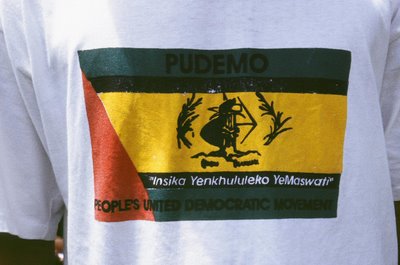
The Peoples United Democratic Movement (PUDEMO) a movement for the majority poor people of our country salutes the young lions who stood up to the armed Royal hit squads called police in its 15th anniversary.

We are saying to the people of our country, no amount of intimidation, violence and force can push back the hand of history. PUDEMO and its youth league have come a long way in the struggle for a free Swaziland. A Swaziland that belongs to all its citizens, a Swaziland that does not discriminate based on family background. PUDEMO and SWAYOCO is proud that it has managed to bring to the attention of the Swazi population and the international community the suffering of our people at the hands of one minority family, the Dlamini family.

We cannot sit back and allow the so-called Royal family to continue to loot the meager resources of our country just because they have a private army and police.

Our people are dying of HIV/AIDS, hunger, poverty, unemployment, lack of clean water and sanitation, curable diseases like TB and cholera just because the resources that should be helping them are misused by one family.

The following figures do not lie and they are disheartening to PUDEMO;

*69% of the population lives below the poverty line of E128 ($20 Canadian) per month.
*48% of the population live under abject poverty
*40% of households have never had enough to eat
*More than 300 000 people depend on food aid to survive
*Unemployment is more than 40%.
*HIV/AIDS prevalence rate is estimated at 42% making our country to be the highest in infection rate in the world.
*56.4% of the wealth is held by the richest 20% whilst the poorest 20% hold only 4.3%
*Total population of disadvantaged people is estimated at 756 000 and is ever escalating. This represents more than 70% of the population.
*The health facilities are worse than in colonial times. You cannot find a simple pain killer in any government hospital today.
*The education system has crumbled under Royal administration. Our children no longer have access to government scholarships when those of the Royal family attend pre-schools in England and America.

Against this background you have one family masquerading as a Royal family living like the sultans of Brunei or the rich Saudi families or the richest mafia families of the world.

Truly a mafia family runs this country. The difference is that the Italian or American mafia wakes up and sells drugs to make money, whilst this Dlamini mafia sleeps and wake up to suck the blood of our people. In short the Swazi mafia is worse of all the mafia families in the world.

The luxuries of the Swazi Royal family at the expense of the suffering masses of our people:

*Majority shareholdings in all major companies in Swaziland including the blood sucking MTN mobile network that enjoys minority status.
*Controls the sugar industry
*Top of the range BMW X% for each of the 12 or 14 wives of the king
*12 palaces for the wives
*Many state houses, both inside and overseas countries like Taiwan, and Indonesia
*The multimillion Maybach luxury car for the King
*The multimillion Pullman luxury car for he King
*The new private airport that cost our tax payers almost E1 Billion
*The Royal family children are educated in overseas schools and are paid hefty maintenance allowances and bought fancy luxury vehicles called toys.
*A well maintained army and police force that is trained to maintain the suffering of our people.

Peaceful political march to celebrate 15 years anniversary of the birth of the Swaziland Youth Congress (SWAYOCO) violently suppressed by the Royal police.

When our people exercise their inalienable right to freedom of association and assembly, the police use live ammunition, teargas and batons to suppress them. Two of our members were seriously hurt after being shot at. One was shot in the leg and the other one shot at the arm. Scores have been arrested and later released after the intervention of our lawyers. The secretary for the gender affairs in the youth league, comrade Dudu Sithole was arrested and tortured in a police cells in Mbabane.

She was arrested with another comrade. Upon release at night she was never assisted with transport and the leadership was never told of her release so that they can arrange for transport or accommodation.

Teargas canisters were randomly fired at children and women. So many of these canisters landed inside houses of the poor location.

And for this we are expected to say all is fine. To the Dlamini family we say this will never happen. This is our country as well. We own each and every inch of Swaziland. We never chose to be born in these lands, but these were given to us as a birthright by God and we shall defend this birthright with our own blood if need be.

Another pro Royal family political party is allowed to hold its 5th convention in a hotel just 10 kilometres away from where our members are brutalized.

It is not surprising that whilst the police was suppressing our youth league’s 15th anniversary, the police were giving support to another political party that is aligned to the Royal family just less than 10 kilometres away. This is the party called Sive Siyincaba Sibahle sinje national movement which was holding its 5th convention it the Royal Swazi sun hotels at the Ezulwini valley. Most members of this party are members of the Royal family and the hangers on. Adefuye and the commonwealth accept these double standards. We are tempted to say to hell with such double standards by these unscrupulous people.

The International community

When all these things happen we are told that we should accept and be tolerant. The people we trusted to be custodian of democracy and good governance are the bearers of this order. These are the powers that be in such bodies like the Commonwealth. The commonwealth sends the so-called Nigerian chief Adefuye to coerce us into accepting Royal oppression because it is an African way of authority. We are saying our people reject the notion that Africans must have different types of democracy and liberties. If the people of Nigeria are no longer ruled by Kings and chiefs like Adefuye why is he expecting us to accept such a political order? This is an insult to our people, and we shall never accept to be treated like aliens in our country of birth.

We wish to appeal to the international community to:

*Support our cause in terms of financial and material and moral support to the peoples’ movement
Isolate the Royal regime in Swaziland by pushing for smart sanctions against the family and its surrogate government leaders
*Send credible monitors to establish the facts for themselves
*Assist our exiled members with schooling, food and shelter.
*Put pressure on the King to accept our gesture for peaceful negotiations.

Our freedom is in our hands.

We have always maintained that freedom is in our hands. We have first hand experience of the Royal repression. We see the king parading his luxury convoy of cars everyday with sirens blazing. We see our people pushed aside from the roads like rabid dogs whenever these convoys pass by.

We watch in dismay the Royal family spend millions of our taxes in birthday celebrations. We witness wastages in ceremonies that never help our people like Umhlanga reed dance, Lusekwane and Incwala. Every now and again we watch the King and his family leave Swaziland to overseas countries to spend our taxes.

Against all these we bury our people on a daily basis. And these are victims of a system that has long past its sell time. These are victims of HIV/AIDS, hunger and of curable diseases like diabetes and diarrhea.

We shall struggle to rid our country of this suffering of our poor people.

The peoples’ Struggle as lead by PUDEMO is about delivering to our people the following;

  • Health facilities that can respond to the needs of our people. PUDEMO shall build hospitals and clinics and provide primary health care to all our people particularly those in the rural areas.
  • Provide ARVs and nutritious food supplement to assist the HIV/AIDS dying population
  • Provide better schools particularly in the rural areas
  • Provide scholarships to the needy. We shall use the money that is provided to send Royal children to crèches and schools overseas. Each Royal family child’s yearly school fees can help educate 10 000 of our poor children
  • We shall turn the many palaces to areas of learning and health facilities
  • We shall appropriate the so-called Royal farms under tibiyo and give them to our landless people and provide farming logistics so that they can produce enough food for themselves and their families.
  • We are fighting for a sound social grant system that shall provide support to our aged and infirm. The current E80-00 per month is an insult to our people as this is too meager to support a family as the old support most families as HIV/AIDS have killed most of the young and productive members of our societies.
  • We are struggling for universal free primary education for our poor people in order to raise the literacy rate. We know from the Royal experience that an uneducated population is doomed
  • We are struggling for the provision of clean water to our people, particularly the rural Lubombo region folk. We shall use the money for palaces and luxury cars to build dams and reservoirs so that our people can produce enough food for their families.
  • We are fighting to restore dignity and freedom to our people.
  • We shall turn the Royal police force and armed forces to people’s forces that shall be re-trained in agricultural skills so that they can work with the people in the quest for rural development

Finally, there is no amount of oppression and violence that will stop us from our march to freedom. We can hear the bells of freedom ringing and PUDEMO shall fulfill its 23 yearlong mandate to help the Swazi people attain their freedom. For our freedom we do not beg the Royal family and their hit squads called the police. We are committed to a free Swazi nation that shall share the resources of this country.

We shall continue the fight until we free ourselves from the shackles of oppression.
Yours in the struggle for freedom and social justice,
Ignatius Bonginkosi Dlamini

P.O. Box 187
Simunye
Swaziland
Southern Africa
Office 301 SNAT Co-op. Building, Manzini
Tel: (09268) 6075479/(09268) 3838718
E-mail: kweleza@yahoo.com

06 August 2006

Thursday, August 3, 2006

The Middle East Crisis is the greatest threat to world peace

The Middle East Crisis is the greatest threat to world peace

PRESS STATEMENT August 3, 2006

The Peoples United Democratic Movement (PUDEMO), a movement that represents the struggling people of Swaziland is concerned about the Middle East crisis. Too many innocent lives have been lost, and it appears the world is content to stand by and watch.
  • The world must condemn the targeting of innocent civilians. There is no justification for killing children, women and the infirm in any war situation. The world seems not to have learnt anything from what happened during the destruction of Hiroshima and Nagasaki, the Yugoslavia ethnic cleansing, the Rwandan genocide and the apartheid era in South Africa. This is a serious indictment to the leaders of the United Nations and the so-called civilized world. To us, a liberation movement that has been peacefully fighting for the restoration of democracy and justice in our country has a cause to be concerned and afraid. We are afraid to see the world being indifferent to such mass slaughter of defenceless women and children. This has a clear message; the definition of life in world politics takes different meaning. To the world there are people whose lives are more precious than others. What does this tell the Royal family in Swaziland? It says you can practice modern day slavery and oppress the people because the world will be quiet and nothing will happen to you. This is totally unacceptable.

PUDEMO’s views;

World must intervene now.

The world, through the United Nations must intervene now and stop the war. In this way lives of citizens of Lebanon, Palestine and Israel will be saved. There must be a cessation of hostilities between the warring factions.

Humanitarian aid must be made available to the affected people in order to avoid a further deterioration of the current catastrophe.

The United Nations must rebuild the damaged infrastructure of the affected areas so that the people can go back and lead normal lives like the rest of the people of the world.

Israel must withdraw from all foreign lands; Palestinian territories and the Golan Heights.

The Israel neighbours must all accept the right of the state of Israel to exist. The Israelis must be assured of peaceful and safe existence with its neighbours.

The last two points are fundamental to lasting peace in the Middle East, and hence any attempts to overlook them will not resolve the situation.

Our thoughts and prayers are with the people of these affected countries and we call upon every peace loving person of the world to make a small contribution towards the end of this senseless war. More that anything else, there must be a lasting solution to these crisis for sustainable peace in the region. War has never been a solution to conflicts.

Iraq and Afghanistan


Our prayers are also with the people of Iraq and Afghanistan, and we say may these people find peace and live normal lives like all the people of the world. Too many innocent lives have been lost in these countries and there is no hope for an end to these killings.

Zimbabwe.

We are calling on our brothers north of Limpompo to also find it within themselves to find lasting peace so that they can collectively rebuild their beautiful country Zimbabwe. They should not do these for themselves, but for the children and the many generations to come. They also owe these to the brave freedom fighters who died for their freedom. They must do it for the Chitepos and all those combatants who died so that the Zimbabweans can have dignity and freedom.

The people of the Daffur Region.

We cannot forget our brothers and sisters who are dying in the Southern Sudan region of Daffur. Again we ask the Khartoum government to ensure that the crisis are resolved soon as Africa cannot develop with so many wars taking place on its lands.


Yours in the struggle for social justice and peace in Swaziland,

Ignatius Bonginkosi Dlamini

Secretary
P.O. Box 187
Simunye,
Swaziland
Southern Africa
Office 301 SNAT Co-op. Building, Manzini
Tel: (09268) 6075479/(09268) 3838718
E-mail: kweleza@yahoo.com

Wednesday, July 12, 2006

Turning a blind eye to history: senior ANC member endorses repression in Swaziland

The People's United Democratic Movement of Swaziland
PUDEMO International Office
Australia, Asian and the Pacific Region
E-mail: pudemo@yahoo.co.uk
July 12, 2006


Turning a blind eye to history: senior ANC member endorses repression in Swaziland

The July 9, 2006 issue of the Sunday Times (Swaziland) published comments by the former Premier of Mpumalanga Province and current member of the ANC Executive Committee condemning COSATU for leading the boarder blockade against Swaziland. According to the Sunday Times, Mathews Phosa described the blockade as “a disturbance to prosperity and peace”, “unnecessary” and “fruitless efforts of destabilising the country”. Worse, Mr Phosa is reported to have condoned the savage and unprovoked police violence against South African workers during the peaceful boarder blockade.

PUDEMO reiterates its appreciation of COSATU and the people of South Africa for their relentless solidarity with our people. Over the years, our relationship has grown from strength to strength and we ask COSATU and the people of South Africa not to succumb to Mr Phosa’s tantrum. Mr Phosa’s attack is unnecessary, misguided and unhelpful. The blockade was peaceful and there was never an intention on the part of the organisers and participants to disturb the peace. On the contrary, it was part of ongoing commitments by COSATU, SACP and the South African-based Swaziland Solidarity Network (SNS) to the struggle for peaceful political change in Swaziland. It was the South African police that attacked unarmed people as they were staging peaceful protests at the South African and Swaziland border posts. Thus, it was the police and not the protesters that disturbed the peace.

By referring to peace in Swaziland, Mr Phosa, like so many other puppets of the Mswati regime, has invoked what PUDEMO has previously exposed as the travel agent’s myth of a peaceful Swaziland. This myth continues to dominate popular discourses of the country and seeks to portray Swazis as docile and accepting of their fate as virtual slaves of the monarchy. In this image, Swazis are presented as submissive, compliant peasants who do not complain despite the oppression they suffer. In short, they are seen as happy with their lot. The travel agent’s myth may help tourists and multinational companies feel less guilt about their role in maintaining the oppression of Swazis but it is of course a false and harmful image. There has been little peace for the oppressed Swazi population over the generations. There is little peace in the homes of many Swazis now as the population is ravaged by oppression, chronic diseases such as HIV/AIDS, hunger, homelessness, unemployment and poverty and burdened by a corrupt and morally bankrupt dictatorship. Anyone familiar with the history of our liberation movement will know that we do not easily submit intimidation. In recent years, the Commonwealth tried unsuccessfully to intimidate us to accept repression in Swaziland.


Through his comments, Mr Phosa has effectively endorsed the repression in Swaziland and the conditions under which the majority of Swazis have been forced to live. The comments reflect a man who has turned a blind eye not only to his own experience but also to the history of the global anti-apartheid movement. It should be remembered that international economic blockade against the apartheid regime was, undoubtedly, one of the ANC’s most effective strategies of struggle. Even recalcitrant leaders and diehard apartheid supporters such as the former British Prime Minister, Margaret Thatcher could not resist the will of the international community as it used its economic power to bring down the apartheid regime.

Like Phosa, Thatcher described economic sanctions as unnecessary and destabilising. King Sobhuza II, an architect of the repressive system in Swaziland, refused to join the international community. Instead, he invited apartheid capital to invest in Swaziland, yet the ANC-led Government has recently honoured him for fighting apartheid. King Sobhuza II’s son and successor, King Mswati III, followed in his father’s footsteps and dined with the devil at the time when the ANC was intensifying its economic blockade campaign.

It is extremely unfortunate that a senior ANC member has chosen to echo ideas of a diehard supporter of apartheid and to provide solace to a repressive regime.

There seems to be a trend for former South African political leaders to assist the repressive regime in Swaziland. A day before the Sunday Times (Swaziland) published Mr Phosa’s comments, the Swazi News (July 8, 2006) reported on the new role of former apartheid President, F.W. de Klerk, as political advisor to King Mswati III. Is this a consolidated resistance against the struggle for democracy in Swaziland by two former foes who have come together to give a helping hand to Africa’s last absolute monarchy? These developments are indeed disturbing to the pro-democracy movement in Swaziland. We ask Mr Phosa and Mr F.W. de Klerk to reconsider their positions and not to put their personal interests before the lives of more than a million people who have already suffered too much under this regime.

Signed:
Dr Matsebula
PUDEMO Representative
Australia, Asia and the Pacific Region


Contact phone in South Africa: 0827923165

Sunday, July 2, 2006

PUDEMO Report: The Internal and External Balance of Forces in SWAZILAND

The Internal and External Balance of

Forces in SWAZILAND


PUDEMO Annual Conference and Strategic Planning
June 28 –July 02, 2006
By Cde B.Vincent Dlamini

Introduction


This paper seeks to help delegates and participants in this Annual Conference and Strategic Session to understand who are the forces for change, forces against change and neutral forces that require reorienting. Another aspect is to give a detailed analysis of these forces and their strength, i.e. soldiers and police numbers and capacity; workers union numbers and the camps they belong to, etc.
An assessment of the balance of forces is part of the process that must inform our discussion on Strategy and Tactics in this Conference. Any balance of forces is dynamic and evolving, influenced by changing objective and subjective factors. This understanding of the balance of forces enables the liberation movement (PUDEMO) to make decisive interventions from time to time to propel the struggle forward.

This discussion paper will first give an overview of the balance of forces from 2003 to the present moment. It will examine major developments that have occurred in recent times (particularly since 2003) and the subjective actions of PUDEMO to shift the balance of forces favourably. Finally, it raises some of the challenges- objective and subjective- in critical areas, which face us as we prepare for our 6th National Congress. At the end we must determine whether or not these shifts and challenges in the balance of forces entail any need for amendments to our Strategy and Tactics.

A proper understanding of the given balance of forces is critical in defining the tactics that PUDEMO should adopt at this stage of our struggle. To ignore this would be to fall victim to actions that have nothing to do with the strategic objectives of our revolution and such actions could lead to the defeat of the revolution itself. Historic moments are few and far between, where revolutionaries are called upon to throw caution to the wind.

On the other hand, a fixation with balance of forces as an unchangeable phenomenon results in dangerous stagnation and can lead to indecision and even reaction. Objective circumstances are not carved in stone. We must not preach caution where bold action is required. Any balance of forces is dynamic, influenced by changing internal and external factors.

Our strategy and tactics must be informed by the obtaining political conditions in our country; the strength of the Tinkhundla system; the economic conditions; the balance of forces between PUDEMO and her allies on the one side, and the Tinkhundla regime and its allies on the other side.


An Overview of the Situation in Swaziland


The 2003 PUDEMO Annual Conference made the following observations on the general assessment of both the Royal Regime’s strategy and existing conditions in Swaziland:

§The Tinkhundla system is facing a deep seated and permanent crisis forcing the royal regime to attempt to overhaul the system.

§The crisis of the system gives rise to on-going struggle.

§The Tinkhundla regime has a well oiled machinery in financial and political terms, owing to their control of the state apparatus, particularly the security forces, civil service, key sectors of the economy and a traditional social base of loyalists.

§The forces of democracy, political and otherwise, are not yet in a position to challenge for and usurp power although large sections of our people clearly see the Tinkhundla regime as having no legitimacy. We are therefore, near and yet so far from our goal of democracy.

§Major forces internationally and regionally are seeking a way with which to effect a compromise between the contending forces, which might not necessarily be favourable to the struggling masses.


Swaziland is amongst the most economically unequal (skewed) and poverty stricken countries of the world as shown by the following indicators:

  • 69% of the population lives below the poverty line of E128 per month. This situation is further worsened by the neo-liberal restructuring of the economy through the government’s Public Sector Management Programme (PSMP), the Economic and Social Reform Agenda (ESRA) and the current SPEED. These policies combine to widen the gap between the rich and the poor, whilst worsening the living conditions for the majority of our people, working and rural masses in particular.
  • 48% of the population lives under extreme poverty; 76% of the poor are found in rural areas and more than 40% of households have never had enough to eat (SHIES 2001).
  • An estimated 300 000 people depend on food aid to survive.
  • 56.4% of the wealth is held by the richest 20% whilst the poorest 20% hold only 4.3% (SHIES 2001).
  • Unemployment is estimated at around 40% (2005 est.) Youth unemployment is around 40% and it is estimated at 70% for women.
  • 54% of the population are children below 19 years of age and 3.1% are adults above 64 years. Women make up 54% of the total population.
  • HIV/ AIDS prevalence rate is estimated at around 42% making Swaziland a country with the highest infection rate in the world. Meanwhile the 2006/2007 budget allocated a paltry E30M to NERCHA for anti-HIV/AIDS programmes and a whopping E200M for Royal expenditure!
  • There is no meaningful social security scheme to provide for the elderly, orphans, the unemployed, children, the disabled, etc., except for the chaotic OVC Fund run by the Ministry of Education and the token E80 per month given some elderly people.
  • About 70% of the population lives in the rural areas and derive their livelihood mainly from subsistence agriculture on Swazi Nation Land (SNL).
  • Population density is approximately 69 persons per square km. Only 11% of the country’s land area of 17,360 square kilometers is arable. 56% of this is SNL, communal land held by the King in trust for the nation and administered by chiefs; 43% is TDL, privately owned by government, companies and individuals (including royalty) and less than 1% is for urban development.
  • Real GDP is estimated at 1.8% per annum (Central Bank Report 31/03/06).
  • Total population of disadvantaged people was estimated at 756,000 in 2001 (SHIES 2001).


The Motive Forces for Change

The motive forces for change in Swaziland comprise the unemployed, workers, women, progressive intellectuals, small business people, the youth, students and the rural and peasant masses. Of course the core of the motive forces for change is the working class and the peasants, who by virtue of their class position and social existence are placed in the leadership of the struggle for freedom. By its heroic activism and strong organization, the working class has won the respect of other motive forces as the leader of the National Democratic Revolution (NDR). Along with the poor rural masses, the working class stands to gain most from the success of the liberation struggle. Because of its organization and role, and objectively because of its numbers and position in the production process, the working class is critical to the process of liberation.

Let us analyze some of these motive forces one by one:

  • Trade Unions and Organized Workers

The trade union movement is the single most organized sector of the working class. This coupled with its strategic placement at the production process, bestows upon it the task of being the most frontline detachment in the struggle for freedom. This is very true for Swaziland where political movements are barred by legislation and hence trade unions remain key in the providing a forum for mass mobilization and organization.

The state of the trade union movement at present is one characterized, at least at leadership level, by serious lack of internal democracy (transparency, accountability and worker control); an unclear ideological orientation; poor service delivery to membership in most unions; corruption; careerism and opportunism, etc. However, there are also efforts initiated by lower structures of national federations and unions to change this situation around and this has been met with resistance resulting in suspensions, marginalization, threats and even blackmail.

The two federations (SFTU and SFL) are characterized by different traditions, approaches, philosophies and general orientations towards issues affecting workers both in the workplace and in their communities. One of them is rooted in the traditions of militant social movement type of activism, while the other one is rooted in traditions of compliance activism or narrow corporate activism. Outside of these two federations, exists an independent and non-affiliated national teachers’ union, SNAT, which is rooted in traditions of craft trade unionism and blends traditions of the two federations, to varying extents.

There are SFTU affiliates that were suspended by the federation, i.e., SNACS, SNA and STAWU which issue still remains unresolved at present. One of them, STAWU, is reported to support for the formation of a third federation to represent workers. SNACS is reported to be studying her options on this matter. Another affiliate of SFTU, the Swaziland Amalgamated Trade Unions (SATU), has accused the federation of dispatching saboteurs to destroy it by recruiting its members wherever they exist. This is another indication of the problems faced by the trade union movement in Swaziland. PUDEMO must provide political leadership and guidance on these and other similar problems existing with the labour movement, SFTU in particular.

PUDEMO noted (2003) that our relationship with the trade union movement is characterized by contradictions, mutual understanding, mistrust and skepticism. There is no space for open and honest debates on the fundamental questions and strategic tasks of our struggle. Debates usually revolve around spontaneous campaigns, without honestly reflecting on the broad thrust and long-term programme of transformation in Swaziland. The behaviour of leadership of SFTU and SNAT around the April 12, 2006 border blockade, which they publicly denounced, is one clear-cut example of how deep the contradictions can run. On the one hand, the same SFTU invited PUDEMO to address the ILO high-level mission to Swaziland on June 22, 2006. It is a fundamental reality that the trade union movement is heavily contested by various forces some of which are hostile to PUDEMO.

Trade Union Membership

Swaziland National Association of Teachers (SNAT)
SNAT membership is estimated at 8,371 out of a total teacher population of 9,291. These figures only reflect the public sector, i.e., teachers employed by the Swaziland Government.

Swaziland National Association of Civil Servants (SNACS)

SNACS membership is estimated at 4,897 out of total employees numbering 19,773.

Swaziland Nurses Association (SNA)

SNA total membership is estimated at 1,552 comprising 720 members in the public sector and 832 members in the private sector.
Swaziland Transport & Allied Workers Union (STAWU)
STAWU membership is estimated at around 1500 members.

Swaziland Amalgamated Trade Unions (SATU)

SATU organizes the construction, engineering, mining & quarrying sectors. Its membership is estimated at around 2000 members.

Swaziland Federation of Labour (SFL)
SFL is composed of 11 affiliates totaling an estimated 10,900 members broken down as follows:

Affilliate

Membership


Swaziland Manufacturing & Allied Workers Union
(SMAWU) 6,500

Swaziland Commercial & Allied Workers Union
(SCAWU) 2,140

Swaziland Union of Financial Institutions &
Allied Workers Union (SUFIAWU) 1,100

Swaziland Pulp & Paper Manufacturing &
Allied Workers Union (SWAPPMAWU) 400

Swaziland National Learning Institutions &
Allied Workers Union (SNALIAWU) 260

Insurance & Allied Undertakings Workers
Union (IAUWU) 150

Swaziland Pre-Schools & Allied Workers
Union (SPRESAWU) 100

Swaziland Beverages Staff Association 85

Swaziland Health Institutions & Allied Workers
Union (SHIAWU) 60

Staff Association of Swazi Spa Holdings
(SASH) 60

Siyanqoba Staff Association (SSA) 45

Total Membership

10,900


Swaziland Federation of Trade Unions (SFTU)

The membership of SFTU is estimated at around 12,000. SFTU affiliates are estimated at around 15 and their individual membership breakdown could not be ascertained.


Swaziland Media, Publishers & Allied Workers Union

Workers Union of Swaziland Town Councils

Swaziland Processing & Refining Allied Workers Union

Swaziland Water Services and Allied Workers Union

Swaziland Security Guards & Allied Workers Union

Swaziland Agriculture & Plantations Workers Union

Union of Swaziland Conservation Workers

Swaziland Electricity Supply, Maintenance & Allied Workers Union

Swaziland Hotel, Catering & Allied Workers Union

Swaziland Posts & Telecommunications Workers Union

Swaziland Union of Non-Academic Staff for Higher Institutions

Commercial & Allied Union of Swaziland

Construction Workers Union of Swaziland

Total Membership 12,000


Swazi Migrant Workers Employed In RSA Mines


Year 1996
Gold 13,340
Coal 295
Other 1,090
Total 14,725

Year 1997
Gold 11,742
Coal 259
Other
Total 12,960


Year 1998
Gold 9.364

Coal 207
Coal 765
Other
Total 10,336


Year 1999
Gold 8,506
Coal 687
Other 417
Total 9,610

Year 2000
Gold
7,527
Coal 166
Other 615
Total 8,308


Year 2001
Gold 6,559
Coal 145
Other 535
Total 7,239


Year 2002
Gold 5,714
Coal 126
Other 466
Total 6,307


Paid Employment by Sector and Industry for 2002


Private Sector


Public Sector


Industry Total


Agriculture &
Forestry

18,072

1,261

19,339


Mining & Quarrying

953

0

953


Manufacturing


19,485

0

19,485


Electricity & Water


0

1,447

1,447


Construction


3,667

689

4,356


Distribution


10,453

0

10,543


Transport & Storage

1,031

1,685

2,716


Finance etc.


6,546

1,097

7,643


Services


5,010

21,258

26,268

Grand Totals

65,217

27,437

92,654


The decline in the numbers of employed people, or rather the increase in job losses, over the years a result of the neo-liberal policies of globalization and privatization, has led to the fragmentation of the working class (particulalry organized workers in gainful employment) into three categories:

1.Unionized workers in formal employment enjoying, in comparison, better jobs and working conditions;

2.Casual and temporary labour, including those involved in survivalist activities and;

3.An army of the unemployed and marginalized dependent on food aid and remittances from extended families in the other two categories.

The challenges faced by the labour movement require that PUDEMO and SWAYOCO cadres, particularly those in trade unions, participate fully in building and strengthening trade unions as part of their commitment towards achieving the goals of our struggle. PUDEMO encourages all workers who members of the movement to participate in various forums, particularly the Workers’ Forum, where they debate and sharpen their skills in trade union organizing and mobilization.


  • Women
“ The emancipation of women is not an act of charity, the result of a humanitarian or compassionate attitude. The liberation of women is a fundamental necessity for the Revolution, the guarantee of its continuity and the pre-condition for its victory….” Samora Machel (04 March 1973)

Women constitute approximately 52% of the Swazi population. PUDEMO must prioritize gender issues in order to effectively challenge gender oppression and advance the cause of women’s emancipation. In 1997, there were approximately 507,202 females in the country compared to 473, 520 males (Swaziland Census Report 1997).

All PUDEMO cadres must fully grasp the reality that women are triple oppressed: first as women in society and in the family/ home situation; secondly they are oppressed as human beings denied their freedom by the Tinkhundla regime and lastly they are exploited by the system of capitalism at the workplace.

It is in this regard that efforts to build a strong and revolutionary national women’s movement under the umbrella of PUDEMO Women’s League should be supported in all respects. We must consciously prioritize issues affecting working class and rural women since they are the motive forces of our revolution. At the same time we should cautiously engage all NGOs that work with women in order to pursue our goals.


  • Rural and Peasant Masses
70% of the Swazi population lives in the rural areas, mainly on Swazi Nation Land (SNL), which constitutes 56% of arable land in the country. This land in administered on behalf of the King by chiefs who forcefully require tribute labour from the peasant masses. The emancipation of the rural and peasant masses heavily relies on the successful resolution of the land question and political power relations in Swaziland. The current constitution entrenches previous land ownership and administration patterns that vested all such powers in the King subjecting the masses to arbitrary removals and evictions like slaves.

The organization of the rural masses requires mastery of their lifestyle and values and the most importantly the use of their language, siSwati, to express our viewpoints. Total literacy rose from 70% in 1986 to 81.3% in 1997. In 1997 rural literacy rate was estimated at 78.3% compared to 90% in urban areas and it was higher amongst men (82.6%) than amongst women (80.2%).

Creative forms of propaganda are required to breakdown the barriers of ignorance, royal values, mystified ideas and backwardness amongst the rural people in Swaziland. We should avoid falling victim to either of two extremes:

  1. Upholding backward cultural values and practices of the past in an attempt to appease the masses and win influence;
  2. Rejecting even the cultural values and practices that do not hinder the progress of our struggle in an effort to demonstrate radicalism.


Another important statistics for mobilizing rural communities are:

  1. In Shiselweni only 3.5% of households travel less than 30 minutes to the nearest health facility and in Lubombo, the figure is 7.6%.
  2. In rural areas 50% of households don’t have access to safe water sources and in dry winter they are forced to share water with animals.
  3. According to the 1997 SPHC, there were 395,385 housing units throughout Swaziland; 317,480 (80%) were in rural areas where most of the poor live. Of these, 163,905 were grass-thatched and 213,314 constructed with mud, poles and grass.
  4. The poverty prevalence in grass-thatched houses was 79% compared to 18% in tiled roofs. It was 73% poverty in mud and poles compared to 44% in brick-walled houses.
  5. Youth and Students
The youth constitute the majority of the Swazi population and about 40% of the unemployed working class. People under the age of 19 account for 54% of the population; those under 15 years account for 44.4% and only 3.1% for those above 64 years. This is SWAYOCO terrain of organizing and mobilizing as it fulfills the mission to “act as a preparatory political school of the movement, building and supplying advanced cadres to the whole movement for democracy in line with PUDEMO’s goals”.

In Swaziland 23% of children never go to school and a further 17% dropout of school before they finish primary school. Those children are deprived of a basic need to read and write and their chances of breaking the poverty cycle are very slim. In 2001 there were 547 primary schools in the country, mainly constructed by communities, with a total enrolment of 230,000 pupils.
Of the total enrolment 82% of the children are in rural areas. In 1999, there were 51 junior secondary schools admitting 4,943 students and 126 senior secondary schools admitting 25,798 students. In the 2003/04 academic year there were approximately 5000 students at UNISWA.

SWAYOCO, SNUS and SAS should combine their political foresightedness and vision, commitment and dedication, as well as focus and disciplined engagement on the ground to mobilize students and the youth on the ground around issues of free education for all.


  • The SDA
This structure is a front as correctly observed by PUDEMO in 2003 due to its loose qualification procedures. It is currently crippled by the fact that the NNLC decided to contest elections in 2003 and their president who happens to be the chairperson of the SDA could not continue with this role for obvious reasons. There is a need for honest debate around the character of this or any similar structure in order to establish the principles of engagement and participation therein.

  • Religious Organizations
“Religion is social phenomenon. As a social reality it is inevitably political. Throughout human history, religion has been used as an ideology by either oppressive powers or by forces of political renewal in their struggles for a more just and humane world.” J.N. Vilakati

According to the CIA World Fact book (2006), religious organization in Swaziland is distributed as follows:

Zionist -- 40% (a blend of Christianity and indigenous ancestral worship);
Roman Catholic -- 20%
Muslim -- 10%
Anglican, Bahai, Methodist, Mormon, Jewish and other -- 20%

The above broadly fall under one of the following organizations:

--- The League of Swaziland Churches
--- The Swaziland Conference of Churches
--- The Council of Swaziland Churches

From the opening quote by Vilakati, it is clear that we need to mobilize the church around practical programmes and win them over to our struggle for a more just and humane world.


  • Business Community
These must be mobilized, particularly small and medium Swazi business people who should be made to understand that freedom and democracy in Swaziland is their long-term strategic interests hence they must play a positive role towards the success of political transformation.

Business people are broadly organized under:

---Federation of Swaziland Employers/ Chamber of Commerce & Industry

--- Federation of the Swazi Business Community

=

=

=

=

=

=

=

=

Forces that Resist Change


  • The Monarchy: King, Queen, Princes and Princesses, SNC, Cabinet, Parliament, Chiefs, Tindvuna at all levels, etc.
  • There are about 340 Chiefdoms in Swaziland under 55 Tinkhundla Centers.

The 2006 Constitution

§It has the potential of dividing the progressive movement in general and Pudemo in particular. In 2003, even some of PUDEMO members contested the elections and lost in areas like Piggs-Peak, Siphofaneni, Zombodze Emuva, and Lavumisa. This was against the movement’s Esikhawini Congress Resolution on this matter.

§The constitution and the euphoria around it may blind us into a political cul-de sac flashing reforms that are far from the objectives of our struggle.


Armed Forces

§Umbutfo Swaziland Defence Force (USDF) consists of an estimated
4300 members. However, it may it is known that some civilians with royal connections are paid under the defence budget as soldiers even if they are not active combatants. This figure should be assumed at not more than 5% of the estimate.

§Royal Swaziland Police Force (RSP) members are estimated around
3211 as at 01/04/06 but will increase to 3384 by 01/04/07

§His Majesty’s Correctional Services members are estimated at
1,222** as at 01/04/06.


The External Balance of Forces


  1. The world is currently under the dominance of the capitalist system, with a growing divide between the rich North and the predominantly poor South, which includes our country Swaziland. Despite this we must continue in our efforts to bring freedom and democracy in our country. Globalisation in its structure and manifestations provide both opportunities and threats to our quest to build a more equitable and just society.
  2. Africa has taken important steps to position herself to achieve her renaissance. The moves towards greater regional integration, the efforts for Africa to resolve her own conflicts, the formation of the African Union and the NEPAD initiative are important steps taken by the continent towards creating a better environment for development. Problems, constraints and challenges still remain around these issues but they should not derail progress.
  3. The anti-globalization movement has played a big role in putting the issues of a more just world order on the front pages and in the headlines of the world media. We note that social movements cannot become substitutes for an ideologically coherent and cohesive political movement, which is an instrument for the advance of the interests of the poor and working people all over the world.
  4. A serious challenge to the international progressive forces has been created in the aftermath of September 11th 2001. The global war against terrorism has created the intensification of war rhetoric and the increase of war budgets and resources. This created space for certain countries to take unilateral decisions of the deepest implication for global peace and security and for the war against poverty and underdevelopment. Rather than intensify the war against terrorism, this ahs created ripe conditions for more violence and strife.
  5. Combined efforts of the international mission of PUDEMO and SSN has created more avenues for the advance of our struggle particularly in Europe and this has come at the most opportune moment.
  6. The royal regime is beginning to feel the “heat” as evidenced by its attempts to launch propaganda mission in Europe led by the PM and the DPM “to try and clarify Swazi democracy.” The open calls for the King to allow multi-party politics made by the British High Commissioner and subsequently the Dutch ambassador earlier this year are commendable indicators that indeed the winds of change are blowing.
  7. Of course, there are still reactionary voices like the Italian ambassador but he also must be engaged because “the great valley of Umzimkulu is in darkness but the light will come there. Ndotsheni is in darkness too but the light will come there also.”

References

ANC Strategy and Tactics: December 1997.

CIA- The World Factbook – Swaziland. http://www.cia.gov/cia/publications/factbook/geos/wz/html (06/15/2006)

Department of Labour “Annual Labour Report: 2005.” Department of Labour, Mbabane.

Establishment Register: Summary of Posts By Department 2006/2007. Swaziland Government

Machel S. “The Emancipation of Women Is Essential for the Revolution.” 1973

Mutangira J.P.B. “Demographic Transformation In Swaziland: The Role Of Educational And Training.” OSSREA Swaziland 2003

Poverty Reduction Task Force. Draft Poverty Reduction Strategy and Action Plan, Volume 1. MioEPD, March 2005

Umrabulo Number 16 .The Balance of Forces, August 2002.

PUDEMO Political Report: Annual Conference 2003. Piet Retief

Swaziland Population and Housing Census 1997. Central Statistical Office, Mbabane.

The Political Balance of Forces: A COSATU Perspective. http://sacp.org.za/SACP/ac/ac162g.html (06/06/2006)

Vilakati J.N. From Cultural Nationalism To Christian Nationalism: Continuity And Innovation Within Ruling Class Ideology In Swaziland. OSSREA Swaziland Chapter 2003.
Saturday, July 1, 2006

Mlumati Declaration July 1, 2006.

PUDEMO’s Mlumati Declaration July 1, 2006.

We, the Peoples’ United Democratic Movement (PUDEMO), a movement of the
struggling masses of the people of Swaziland met in foreign lands, at
Mlumati College in the Republic of South Africa’s Mpumalanga province on
this 28 June to 1 July 2006, to chart a way forward towards our freedom
from the Swazi royal family and its surrogate government called
'tinkhundla'.

We meet in these foreign lands not out of choice, but for the simple
reason that we are denied the right to associate and the right to
conscience in our own country by a family that regards our people as mere
objects of abuse.

We noted that:

History has tasked us with the noble responsibility to free our people
from royal bondage and 'tinkhundla' exploitation.

Our people are poor and have the highest HIV/AIDS infection in the world
primarily because of their poverty.

Our women folk are the most oppressed sector of our people.

The liberation of our people must be an act of the people themselves.

The forces of change are not united around the liberation programme.

The oppressive forces are weak and in disarray.

The royal constitution, as we have always maintained, is a farce intended
to further entrench the current social order, where one family oppresses
our people.

The 'tinkhundla' self-inflicted crisis as well as economic mismanagement,
rampant corruption, and political bankruptcy are a catalyst for its
downfall.

The international community has seen the oppressive nature of the royal
government and the threat it poses to regional, continental and world
peace.

The royal family continues to unleash its police and army on the innocent
people of our country, and in the past year, we have seen many of our
people dying at the hands of the police.

True freedom had never come without sacrifice.

The people of South Africa have continued to give solidarity and support
to our people, and for that, our people are greatly indebted to them. The
same goes to the people of Denmark, and all those who support our struggle
in one form or another.


We resolve that:

PUDEMO shall continue with the historical role bestowed on it of leading
the forces for change in Swaziland.

The central task is to unite the people of Swaziland and work with and
within them for their liberation. In this regard, we resolve to continue
to engage and unite the primary motive forces of our society. These
include the workers, youth, women, business, rural folk, and the church.

There is an urgent need to redirect and invigorate the movement’s external
offices for the main purpose of intensifying the call to the international
community to isolate the king, his family and the 'tinkhundla' system of
government. Urgent tasks here include the continued exposure of the daily
suffering of our people at the hands of the royal family. Further, it is
resolved that the offices must intensify the call for the introduction of
smart sanctions against the royal family and the 'tinkhundla' system of
government. Lastly, the external offices must continue to muster
international support for our movement, as without it the freedom of our
people shall be delayed.

The royal constitution, which was imposed by the King on our people, is
rejected with the contempt it deserves. In this regard, PUDEMO shall not
participate in elections organized under the royal constitution. PUDEMO
shall continue to struggle for a free multiparty democratic Swazi society,
where all people are given equal opportunity.

PUDEMO and the people of Swaziland reserve the right to defend themselves
against the royal police brutality.

Solidarity is our key weapon that has paralyzed the royal oppressive
institutions, and shall continue to take us forward as we march to victory.

Our 6th general congress which is due in the next few months has been
tasked to present a concrete programme of action for our liberation.


We declare that:

PUDEMO shall continue to strive for a peaceful resolution to the Swazi
political crisis. We love our motherland Swaziland, and the people who
live in her and for that we shall continue to struggle for its liberation
from the clutches of 'tinkhundla' royal oppression.

The freedom of our people cannot be delayed further and the time for us to
join the free nations of the world is now. We call upon SADCC, the African
Union, the Commonwealth and the United Nations to intervene in Swaziland
before the country degenerates to civil war as in other countries of our
continent.


On the international front we declare:

Our solidarity with the struggling peoples of the world: the people of
the Darfur, of Cuba and Palestine. We support the creation of an
independent Palestinian state with the unconditional return of all lands
under Israeli occupation.

We also support the right to the Israeli state and its people to exist and
live side by side in peace with the Palestinian people.

We support a peaceful resolution to the crisis in Zimbabwe, Iraq, and
Afghanistan. We believe too many lives have been lost in the latter two
countries and any more person killed is one too many.

We congratulate the people of Nepal for freeing themselves from royal
oppression. They are a source of inspiration to our people.

Finally, we declare to the world our undying commitment to the peaceful
struggle for a free Swaziland, and we believe our time for freedom has
come.

Yours in the struggle for a free Swaziland,

Ignatius Bonginkosi Dlamini
Secretary General

Friday, June 30, 2006

CRITICALLY ENGAGING THE CONTENT OF THE NEW SWAZI CONSTITUTION

CRITICALLY ENGAGING THE CONTENT OF THE NEW SWAZI CONSTITUTION
Prepared by :
Muzi Masuku
Swaziland Programme Manager OSISA

The fact that Swaziland has already reached her milestone in terms formulating a constitution that will meet the demands of a democratic order is a highly contested issue. However, merely having a constitution does not mean that a country is automatically committed to constitutionalism. If the touchstone of constitutionalism is the limitation of unfettered government power and respect for the rule of law not every country that has a constitution meets the standards of constitutionalism. It is in this respect that a distinction is made between a normative and nominal constitution. In a recently held Open Society Initiative for Southern Africa (OSISA) funded regional conference on constitutionalism, held in Swaziland participants agreed that the appropriate normative standards for any content of a constitution worth its salt would be the following: a multi-party system of governance, separation of powers, systems of government, independent judiciary, a Bill of Rights, accountability and transparency, regular free and fair elections, institutions protecting constitutional democracy and procedure for amendment. The following discussion however attempts to look at the specific position of the Swaziland Constitution Act of 2005 in so far as it purports to set up a democratic order in Swaziland thereby replacing the hugely unpopular Kings Proclamation of 1973 anchored constitutional order.

Separation of Powers:

Being one of the cardinal tenets of a democracy, the area of separation of powers was going to be one of the areas likely to draw the most attention in so far as the new national constitution in Swaziland is concerned. A distinct and widely held understanding has been created that the notion of separation of powers is closely linked to checks and balances. It is a given that there should be three arms of government which are vested with co-equal powers, which enjoy relative autonomy with one arm complementing the other while concurrently holding each other in check. The ultimate test for our current constitution was always going to be how much of a departure does it make with the past position which has been authored by the King’s Proclamation to the Nation of 1973 in terms of which all the original powers of the three arms had been concentrated in the office of the King who then delegated some of his powers to what passed for an executive, judiciary and a legislature. It would therefore be critically important to closely follow the pervasive influence of the King’s powers as they are set out in the Constitution Act to help us discern whether indeed there is any semblance of separation that has been achieved or not and how much of the notion of separation would be compromised by the powers that are enjoyed by the King. My contention though is that our Swazi constitution places the King above the constitution and protects his powers over that of the legislature, executive and judiciary. There is no check in the authority of the monarchy. Such a position is therefore likely to result in a situation where the current system of patronage and lack of accountability is perpetuated. It would have been very important for the drafters to ensure that separation of powers provides for a system of checks and balances that ensures and protects good governance and democratic processes. I find Tawanda Mutasah‘s article on Volume 1, issue 2 of OSISA’s Open Space instructive on the concept of good governance where he lists the following:
· The rule of law, by which is meant not only a general atmosphere of legality, but also the existence of good laws that are generally respected by the executive organs of government;
· Accountability of government for its decisions, traditionally relating to the executive but increasingly also to the judiciary and parliament, as well as para-government bodies such as parastatals, government appointed commissions, etc;
· Predictability of government decisions, essentially meaning government is better if it governs rationally, in a way that enables citizens to anticipate public processes and their impact on private citizens lives;
· Checks and balances in the traditional Montesquean sense of separation of powers and functions and the development of appropriate accountabilities between the three branches of government, the Executive, the Legislature and the Judiciary;
· Transparency, including access to information held by government and /or government agencies which are in public interest;
· Anti corruption and a general commitment to ensure integrity in the management of public affairs;
· Auditing of governmental transactions by oversight bodies;
· Decentralisation whereby the state genuinely devolves authority for local level decision making to democratically elected local entities. This is to be distinguished from local client patron relationships and from decongestion of central functions to local authorities without resource and policy back up.

Judiciary:
Chapter 2 of the Constitution avails immunities to the dual office of the King and Ingwenyama, the Indlovukazi and the authorized person. This immunity is availed against legal suits and legal process in any cause in respect of things done or omitted to be done by these offices. The Immunity if also availed for these parties against being summonsed to appear as a witness in any civil or legal proceedings. This is a position that is not new in Swaziland’s political landscape as even the Independence Constitution of 1968 articulated the same position although in not so much detail as in the current constitution. The major implication of this is that when the King’s name or any of the other parties as enjoying those immunities, is cited in any legal proceedings, whoever is seeking legal redress, will not be able to obtain that redress since the citation of the King’s name will be seen as embarrassing His good office and a personal affront on his name and character. In explaining the rationale for this position, the former Attorney General Phesheya Dlamini indicated that it would be wrong to suggest that these immunities catapulted the King to be above the law noting that this was merely an affirmation and recognition that a person holding that esteemed position will not stoop so low so as to commit crime and therefore be a subject of court proceedings. Swaziland has in the recent past and even to date been seized with issues surrounding the rule of law or the lack of it. The matters that related to the transgressions on the rule of law have unfortunately impinged on the immunities availed to the King which then puts to test the position as stated by the former Attorney General. Moreover when availing these immunities, the constitution has failed to anticipate a situation wherein other people who perceive themselves as appendages to these offices might also seek to benefit from the immunities availed. The bottom line is that it has become difficult to tell who else can benefit from the immunities availed to the King. Surprisingly though even before the constitution is put to a rigorous test in this respect, the Attorney General, Mr Majahenkhaba Dlamini, instead of preparing to defend government as per his office’s mandate, is already throwing his hands in the air as a form of submission in terms of the interpretation of this clause in the case of the Inkhosikati who is suing the police for defamation. His contention is that defending the suit will be tantamount to fighting the King yet Emakhisikati are not availed immunities in terms of the constitution.

The most severe assault, in so far as I am concerned on the judiciary occurred when the King submitted his proposals to parliament through the special message which unfortunately found its way in its entirety to the text of the constitution. The King proposed the inclusion of subsection 8 of section 151 in terms of which the High Court was being stripped of its original and appellate jurisdiction over matters that relate to the office of Ingwenyama, Indlovukazi, the authorized person, the appointment, revocation and suspension of chiefs, the constitution of the regimental (libutfo) system, the constitution of the Swaziland National Council. The courts have since the founding of modern day Swaziland had unlimited original jurisdiction over any matter. This position was also captured in the Independence Constitution of 1968. However, the institution cited above were listed in Schedule 3 of the Independence Constitution as being outside the purview of parliament which meant that parliament could not legislate on these matters. To that end the listed matters were identified as the sole preserve of Swazi law and custom in so far as legislating on them was concerned. This position was not changed by the Proclamation to the Nation of 1973. However in his “wisdom”, the King found it proper to list these matters as being outside the competence of the courts and for them to be the sole preserve of Swazi law and custom. Ironically the ultimate authority of Swazi law and custom is the Ingwenyama which literally means that the King with the assistance of our parliament has found it prudent to appropriate these matters to his traditional office. It should be noted that Swazi law and custom is a very nebulous institution subject to manipulation and different interpretation depending on who you are talking to at a given time save for the fact that in terms of Swazi law and Custom what the Ingwenyama ultimately says, cannot be contested by any other office since it is taken to be the Nicodemus truth” the mouth that never lies” (umlomo longacali manga).

The Judicial Service Commission is in terms of this constitution slated as the structure that will advise the King in the appointment of judges and other members of the judicature. It is generally held that if a structure advises, there will be a recording of minutes capturing whatever advice that may be given. However the position that has been alluded to above has to be looked at in light of the rather disturbing position articulated in section 65(3) and (4) which indicates that when the King is called upon in terms of this constitution to exercise any function after consultation with any person or authority, he may or he may not act on the basis of that advise given. The literal interpretation of that position is that the King is not necessarily enjoined or compelled to act on the basis of any advice even by the Judicial Service Commission. This concern is raised in light of the many positions that are suggested to be filled by the King after he has sought advice from one structure or another.

Section 78 of the constitution provides for the setting up of a prerogative of mercy committee which is a structure that I perceive not to be seriously intended. The reason that this is seen as not being seriously intended is because this section suggests that the fact that a non member can sit with and influence proceedings of this committee will not serve to nullify proceedings. Similarly, the fact that the prerogative of mercy committee sat without forming a quorum will not serve to nullify proceedings. The effect of the position that is stated in section 78 is that court judgements could be undermined by a structure that is not seriously intended thereby militating against the rule of law.

Executive:

Section 64 (3) of the constitution states that the King can exercise executive authority directly or through cabinet or a Minister. While it is generally accepted that the repository of executive authority in any jurisdiction is the head of state, it becomes untenable in a Kingdom for the King to then exercise executive authority directly when there is a cabinet that is supposed to be doing the day to day business even going to the extent of advising that head of state on the government of the country. Maybe this situation mirrors the executive nature of our monarch and is suitable for political dispensations that do not have political parties. The question however is how tenable is this position in advancing the notion of the separation of powers? In other monarchs such as Lesotho for instance, while the King is the repository of executive authority, that executive authority is exercised by the Prime minister and his cabinet ministers.

In terms of the Constitution Act of Swaziland, the Ingwenyama shall appoint a King’s Advisory Council which is identified as a structure tasked with advising the King on matters of Swazi law and custom. Their mandate however is extended by the fact that it is said that they will also advise the King on any matter that the King may refer to them. This position has to be juxtaposed with the traditional role of cabinet which is that of advising the King on matters of governance. Ironically the Prime Minister is in terms of this constitution a product of advice by the King’s Advisory Council whereas Ministers are appointed by the King on the advice of the Prime Minister. Problems of superiority and or seniority of the structures which are all anticipated to advise the King are likely to arise as they have in the past. The problem with this duality of structures which are known to be in competition could serve to compromise the ability of the executive to take decisions that further their objectives and or policies.

There are a plethora of positions that are proposed by this constitution which it is stated will be appointed by the King on the basis of advice from one structure or another. However this position has to be looked at against the position that is stated in section 65(3) and (4) which does not compel the King to act in compliance with any advise literally giving the King latitude to totally ignore advice and act on his own.

Legislature:

Section 108 of this constitution empowers the King to withhold his assent to Bills thereby giving him veto power. This position comes about because of the silence of the constitution in stating what should happen if the number of days that is given to the King to indicate his displeasure about a Bill lapses. This position also affects Bills that seek to amend the constitution

Section 134 empowers the King to disband parliament before their tenure of office expires without giving any reasons for that. This is a dangerous position for a country like Swaziland where parliament remains our only bastion of hope in ensuring accountability and curbing excesses by the executive. The fear that abounds is that if parliament in exercising their oversight role takes decisions which may not find favour with the authorities they could be disbanded prematurely without any reasons being advanced for their premature disbanding.

Bills that impinge on Swazi law and custom have been removed from the competence of the popularly elected House of Assembly and they can only be tabled before Senate and the Council of Chiefs. It is a well know fact that Senate is not populated by people that are elected by the electorate. Twenty (20) of the senators are appointed by the King and the other ten (10) are elected by the House of Assembly once it is fully constituted. Further more the Council of Chiefs comprises of people that are wholly appointed by the King. It is worth recalling though that parliament has during the debate of the constitution tried to get a certain quota of the Council of Chiefs to be elected to serve in this structure. That position was however altered after the introduction of the special message from His Majesty which indicated that the King wished to appoint all the members of the Council of Chiefs. The fact of the matter is that the structures that will be determining the position of our law in so far as it relates to Swazi law and custom is not answerable to the general electorate no matter how unpopular and repressive the law they will enact will be. The introduction of the concept of Council of Chiefs puts to question the claims by our constitution of the bicameral nature of our parliament if another structure besides the House of Assembly and Senate can legitimately engage in the process of making law.


Amendments:
A lot of hullabaloo has been made about how the national constitution should be given a chance as it represents work in progress and can be amended as and when the need arises. This position has to be understood in light of the provisions articulated in section 108(3)(a) which only indicates the number of days within which the King should have indicated whether he assents or withholds assent to a Bill. It does not go on to state for instance what will happen when the stated number of days lapses without the King having assented to a Bill or what should happen if he indicates that he is withholding his assent to a particular Bill. It does not even enumerate or state instances when the King cold be enjoined not to withhold his assent anymore. Effectively this section makes us alive to the hardcore fact that any amendments can occur at the benevolence of the King or at worst the King can veto a Bill that seeks to amend the constitution. A reading of section 246 along with section 108 would indicate that the constitution leaves very little room if any for amendments of specially entrenched clauses if those amendments are not in the King’s interest. This argument is being advanced in light of the fact that this constitution demands a three quarters majority of a fully constituted bicameral sitting. The three quarters majority that the constitution requires of the full 104 members bicameral sitting would be 78. It should be recalled that the King has a quota of 30 appointees to parliament. This means that the King’s quota of appointees can frustrate the attainment of that three quarters majority. Even if by some stroke of luck the King’s appointees were to vote in favour of any proposed amendment, at no stage does the constitution indicate that the attainment of a majority vote will compel the King to subsequently assent. Even though this section alludes to the conduct of a referendum, nowhere in the constitution is it suggested that a majority vote by the electorate in favour of amendments can then compel the King to assent. Moreover, the list of matters listed as being specially entrenched in section 246 is unnecessarily long. This will mean that proposed amendments will now be expensive given the number of times that a referendum will need to be sought to effectively comply with the legal requirements for effecting amendments.


Bill of Rights:
The Bill of Rights has severe derogations and claw-backs which at the end of the day render the Bill of Rights to be useless. Some of the derogations are couched in generalized and spurious terms such as national security, public interest, public morality et al which ultimately avail a lot of room for denial of rights to the citizenry. It would therefore have been appropriate to just list the rights and treasured freedoms that are intended for the Swazi citizens without making any derogations or limitations and then formulating a generalized derogation formulated as follows:

“The rights in the Bill of rights may be limited only in terms of law of general application to the extent that the limitation is reasonable and justifiable in an open and democratic society based on human dignity equality and freedom taking into account all relevant factors including;
1. The nature of the right
2. The importance of the purpose of limitation
3. The relation between the limitation and its purpose
4. Less restrictive means to achieve the purpose”

A lot of discussions have been had on whether section 25, which affirms freedom of assembly and association, now creates an environment where political parties can now exist legally thereby changing the position that was introduced by the King’s Proclamation to the nation of 1973. Section 25 has to be understood in light of the provisions of section 79 which clearly states that one’s assumption of political office will be premised on individual merit. We also have to understand that political parties exist primarily so that they can contest for political office and avail the electorate an alternative to whatever government is holding fort at any given time and are not merely entities that exist to hold “Sunday picnics”. The closure of space within which they can contest for political office could serve as a denial of their existence in the first place. It should be noted that constitutions that do not contain a clause committing the country to multi-partyism cannot be considered as having a culture of constitutionalism. To further indicate the authorities’ paranoia for any form of political grouping, the words political and civic under section 58 of the Bill were ordered to be removed in terms of the special message communicated to parliament by the King. In their analysis of the draft constitution, the International Bar Association Expert Panel stated that the right to form and join political parties should be expressed and clearly guaranteed. This observation is pertinent and necessary for a country that has a history of a one party or no party rule.


Some major contradictions obtain in this constitution. An example would be the right to life which is given and subsequently derogated upon in section 15 while section 38 on the other hand identifies the right to life as one of those rights that cannot be derogated upon. We can only wait and see what happens in this arena when the courts continue handing down capital punishment on offenders as per the dictates of section 15 and those offenders invoke section 38 of the same constitution which cited the right to life as inviolable.

A whole set of rights which are part of the four United Nations Conventions that Swaziland ratified in 2004 which encompass social, economic and political rights have been removed from the Bill of Rights and are located under the directive principles of state policy in Chapter 5 and are made non enforceable. Directive principles of state policy generally refers to aims and objectives of the state and do not place an onus on government to provide for services such as health, education, housing, shelter and adequate nutrition. This means that we have now missed a chance as a country to domesticate some very critical instruments to which we had entered no exception or reservations. The obvious counter argument to this critique could be that some developing countries in the region and some of the celebrated democracies in the world such as India have a similar formulation as Swaziland in so far as socio and economic rights are concerned. It is often said that the rationale for this is that these countries do not want to be burdened with providing for these rights as they lack the financial means to meet such entitlements. In fact in some of these celebrated democracies, their courts, have in interpreting the directive principles of state policy in so far as they contain the rights enumerated above, actually affirmed these rights even though they had been clearly cited as being non justiciable. Whereas judicial activism abounds in most jurisdictions, one tends to doubt that that could be the case in Swaziland especially if we look at the fact that almost the entire bench is working on an acting capacity thereby not enjoying security of tenure. It is human nature that where there is no security of tenure, you do not find instances where people will act in a manner or take decisions that will offend the master lest they put their chance of further employment in jeopardy. Moreover, the democratic culture does not exist in Swaziland which could help in nurturing that environment where judges will act in a way that they will know that their decisions will not be visited with severe repercussions on their careers. It would therefore be important that the rights located under the directive principles of state policy are located in the Bill of Rights proper and as already suggested, rather than specifying in each right the circumstances where a limitation of such right is reasonable or justifiable or is impracticable to implement, a universal limitation clause should be included which will indicate the general requirements for limiting rights and providing for limitations of limitations such as the principles of proportionality or necessity in a democratic society and the prohibition of interference with the essential content of specific rights and liberties. Again the location of political rights under directive principles of state policies is indicative of government’s attitude to plurality.

The constitution sets up a Human Rights Commission. However section 165(3) (c ) of the constitution states that the Commission shall not investigate a matter relating to the exercise of any royal prerogative by the Crown. Effectively this means that the King and his functionaries, cannot be reported or investigated by the commission if the King’s name is cited as a result of the transgression on one’s rights.

By its very nature a Bill of Rights avails to the citizenry a shield with which they protect themselves against any transgressions on their rights from primarily their state and other citizens, institutions and organisations. This stems from the understanding that government and especially the executive arm of government is vested with too much power which it could use to run roughshod over rights of the citizenry hence the vertical and horizontal operation of rights. However section 169 of the constitution bars the commission from investigating any matter leading to, resulting from or connected with the decision of a minister, inquire into or question the policy of government in accordance with which the decision was made. This position is totally unacceptable as it permits the adoption of policies that will be in variance with the spirit of the constitution in so far as it espouses people’s rights. All rights must be enforceable and have practical application. The constitution must provide that when people allege that their rights have been violated, they have access to a court and if the alleged violation has occurred, an adequate remedy is applied for the violation. Without such a provision, a Bill of Rights has as much worth as the paper it is written on. A Bill of Rights that is implementable and enforceable is one of the most powerful protections that citizens acquire against tyranny, oppression and abuse.

The absence of the right to information is quite glaring for a country like Swaziland where certain national budgetary lines do not fall for debate such as the Swaziland National Treasury and the army budget. Infact accountability and transparency are two terms that are frequently used as indicators to assess a country’s democratic processes. A generalized assumption is that if a constitution provides for an open and democratic society, based on public accountability, transparency, freedom and equality that country is committed to democratic governance. This may not always be the case as the manner in which systems seek to provide transparency and accountability may pose problems. Moreover the amount of corruption that this country has reached suggests that the right to information is needed yesterday as the perpetrators are almost all in high echelons of power.

The enumeration of variables against which discrimination can obtain falls short of the appropriate standard as segregation on the basis of sex, marital status, language, conscience, social origin, and culture have not been listed. This could create room for discrimination to lawfully obtain if it is premised on these variables.

In relation to women’s rights, section 28 of the Bill of Rights contains the rights to equality with subsection 3 stating that a woman shall not be compelled to undergo a practice to which she in conscience opposed. The major problem with this formulation is that it places the onus on the woman to identify the practice that she does not want to undergo instead of simply making unlawful or unconstitutional any custom that offends against women. Women will find themselves fighting lone battles against their families, communities, churches and other groupings with which they interact if those structures will hold a contrary view to that which the woman will have on that given custom.

Moreover parliamentarians had sought to amend the section 28 to enumerate culture as an additional basis upon which women should be equal. This again was a timely intervention as most of the inequality is premised on custom. That was changed in compliance with the message from the throne. One is yet to understand the rationale that informed the rejection of parliament’s suggestion on this section.

Whereas section 211 purports to give land to all citizens across gender lines, the problem comes about in the formulation of the section wherein it anticipates and accommodates “exigencies of a particular situation”. This statement can provide an overarching basis for denial of access to land since those exigencies are not enumerated. Further section 211 cites the usage of the land as being limited to only domestic purposes thereby limiting the ability of ordinary Swazi farmers residing on Swazi Nation Land to farm commercially.

Citizenship can still not be passed on by Swazi women to their children or their spouses yet we have a clause purporting to introduce equality.

In conclusion, the million dollar question is “Is this the kind of constitution that we want for ourselves and our children? It is worth recalling that Swazis have been largely classified as a passive society that does not read which places them in a position wherein they cannot critically engage documents and structures that map out their identity and subsequently their destiny. A lot of instruments have been signed and or ratified by our government which spell out a general direction that countries the world over want to use as bench marks for determining the relevance of their structure to a democratic polity. Our constitution offends most of these standards that the rest of the world has set in order to create open societies. It remains critically important that the citizens wakeup from their deep slumber and become part of the critical mass that will challenge our government not to take its citizenry for granted. This piece therefore challenges every Swazi to acquaint themselves with their constitution and constructively seeks means and ways of engaging our government to create a proper democratic order if our country is to embrace a proper democratic order.

Thursday, June 29, 2006

Mlumati Resolution

THE PEOPLES UNITED DEMOCRATIC MOVEMENT
MPUMALANGA CONFERENCE AND STRATEGIC WORKSHOP
June 28 - July 1, 2006

RESOLUTIONS:

We, the sons and daughters of the majority of the poor and marginalized Swazi citizens, the true patriots of our beloved country Swaziland, have met here in the Republic of South Africa's Mpumalanga province's Mlumati Technical College to reflect on our historical struggle for a democratic and free Swaziland. For a period spanning three decades (1973 to 2006), our people have been yearning for freedom from the Royal oppressors and this basic right has been continually denied to them. We meet in foreign lands for the same reason of oppression in our own country where a simple political meeting is enough to be charged for high treason. We meet in these foreign lands not out of choice, but because a minority regime have been denying us this right for the past 33 years.

We are aware of the noble role that history has bestowed on us, and that is to continue to lead our people in their struggle for freedom from the yoke of Royal oppression. We know we shall overcome because history is on our side. There is no regime that will survive forever if its very existence is derived
from sucking the blood of the people it purports to govern. Ours is just to guide the people's energy and collective effort and channel such towards a struggle that the Royal family will find it difficult to repel.

Our time is now, and the bells of freedom are ringing. We believe we shall overcome someday soon.

As we meet in these three days, we have resolved that we should put in motion the following programme as per the resolutions taken by a body of true soldiers
of democracy and liberty.

POLITICAL WORK - MASS MOBILISATION
NOTING THAT:

Whilst PUDEMO has been accepted by our people as the sole organization that has demonstrated its selfless sacrifices over 33 years for the liberation of the majority marginalized people of Swaziland, it still has the challenge to:

- Provide leadership and confidence on the people in order for them to stand up and be part of the liberation agenda.
- Reach out to the rural areas of the country where the majority of our marginalized and oppressed people live and bring awareness of the daily problems they face as a result of the repressive Royal family and its Tinkhundla system of government.
- Unite the fragmented progressive motive forces so to build a strong and united front that will be able to bring about democracy and social liberties in our country.

BELIEVING THAT:

- It is through our Movement's collective political objectives that our society can be transformed to a democratic one.
- Our cadres must be visible in the length and breadth of our country with a clear mandate to organize and give direction to all members of our communities.
- Through our movement's efforts, the people will be empowered to rise against the Royal regime and be their own liberators.
THEREFORE RESOLVED THAT THE PEOPLES' MOVEMENT MUST:

1. Create and define an aggressive political programme for mass insurrection.
2. Set a programme with clear demands based on objectives and / or goals: flood the country with activism
3. Identify and define clearly who the enemy is
4. Campaign and advocate for a democratically established constitutional forum.
5. Form and forge alliances with civic organization
6. Work towards an enabling environment for workers to participate meaningfully in politics.
7. Root PUDEMO ideals within the communities and integrate the movement's programmes in community-based struggles.
8. Empower and train all marshals on minimum defense skills.


ORGANISATIONAL WORK
NOTING THAT:

- The movement is weak in terms of structures on the ground as most regional structures are yet to be built. Out of the 14 regions that form the structure of the movement, only 4 are active and functional.
- The movement requires resources in order to develop cadres.
- There is a need to implement the programme of action which is a vehicle for liberation, and hence there is a need to mobilize the society around these programmes.


BELIEVING THAT:

- Only a strong PUDEMO can bring down the Royal family and replace it with a democratic political system
- PUDEMO has not developed and engaged the Royal family at its full potential because of its own weakness as a movement
- The Royal family is not in power because it is strong, but because the movement has not done enough to galvanise the people around a liberation programme that could create an irresistible wave that will ensure liberation sooner.


THEREFORE RESOLVED THAT THE PEOPLES' MOVEMENT MUST;


1. Establish units and enhance their operations and visibility.
2. Instill and ensure proper and feasible coordinating process.
3. Ensure effective communication within and among all structures of the movement.
4. Put in place a clear and workable program of action, articulating time frames for all programmes and a practical reporting mechanism.
5. Create the organs of people's power within all communities.
6. Engage in perpetual and constant empowerment of Movement's personnel to sustain cadre ship and Movements' programmes.
7. Establish and empower the Movement's international offices and representation to profile the Movement and solicit funds.
8. Put in place a Working Committee to facilitate and monitor all programmes of the movement.
9. Establish a high-powered Directorate of Policies to ensure the Movement haspolicy documents that are written in both SiSwati and English and are distributed to as wide a population as possible. This will bring to the fore that the movement is ready to govern.


BALANCE OF FORCES
NOTING THAT:

- Currently the balance of forces favour the regime as it has a police force of 3211, an army of 4300 soldiers, and correctional services members of 1222.
- The King has increased salaries and bettered living conditions for these forces to ensure continued support.
- More resources are spent on initiatives like the Tinkhundla soccer tournements which are made to buy some lost favours from the population.
- The progressive forces is weak and divided as can be seen by the dysfunctional of the Swaziland Democratic Alliance.
- The fragmentation of the labour force particularly developments within SFTUare not helping the cause for pro democracy forces.
- The continued retrenching of workers has both negative and positive effects. Retrenchments bring about diminishing worker complement and weak trade union
movement as a force for change. On the other hand, retrenchments bring about high unemployment, which in turn bring about civil strife that can bring about the fall of the Royal regime.
- There is increased pressure on the monarchy to embrace democracy from the international community.
- The economy is doing badly partly because of the Royal extravagant spending and mismanagement of resources


BELIEVING THAT:

- There is an urgent need to tilt the balance of forces in the favour of the Movement as a vanguard for the liberation of the Swazi people.
- Unity within the progressive forces is of paramount importance
- Strengthening the trade union movement is key in ensuring the balance of forces become favourable to the liberation programme.
- Political education on the motive forces is key to ensuring all the motive forces know and understand the role they have to play in their liberation.
- Taking charge of all spheres of our society by the movement is critical in order to ensure political hegemony in the Swazi struggle.

THEREFORE RESOLVED THAT THE PEOPLES' MOVEMENT MUST:

1. Revive and develop a competent deploying committee to strategize and ensure all those deployed remain accountable to the movement regardless of positions they hold in whatever sector of society they might be deployed to.
2. Build units within sectors of interest to the Movement's revolution and capacitate them to ensure a sustained PUDEMO conscious society.
3. Harmonise the multi-class character of the movement with the ultimate goal of liberation and democracy.
4. Develop a clear PUDEMO programme on the motive forces.
5. Establish a fully operational intelligence and underground operations.
6. Ensure there is a relationship and interface of the four pillars of the struggle in the Movement's Strategies and Tactics.
7. Establish a Communication and Propaganda Desk.


CONSTITUTION
NOTING THAT:

- History has it that it was the people through PUDEMO who demanded a democratic constitution for the country.
- The Royal family had consistently rejected the need for a constitution, let alone a democratic constitution for Swaziland. The Royal family always maintained that there was no need for a constitution, as everyone knew his or her position in the semi-feudal Swazi society; a society it acknowledged to be based on master and servant or King and commoner relationship.
- The Royal family yielded under PUDEMO orchestrated pressure; internal and external, and decided to hijack the constitutional making process. A result of
this process is a constitution that is fraudulent and is only aimed at reinforcing the unlimited and abusive powers of the king and his stranglehold on our people
- As expected, the majority of the freedom loving people of our country and the world rejects the Royal constitution.

BELIEVING THAT:
- It is the people who can force for an all inclusive and democratic constitutional making process through their concerted efforts.
- The Royal family will always resist any effort that will give birth to a society that accepts all its people as equal, and hence we must brace ourselves for a stiff and brutal resistance to such noble endeavours
- We shall have a democratic constitution after we have managed to win a lot of battles on the ground. What we could not win on the battlefront, we shall
not win on the constitutional making table.
- PUDEMO is right in calling for a democratic constitution and rejecting a constitution that serves the minority Royal family

THEREFORE RESOLVED THAT THE PEOPLES' MOVEMENT MUST:

1. Establish a competent Constitutional Task team.
2. Advocate for establishment of a Constituent Assembly to realize civic education, interim government and subsequently democratic elections.
3. Publicize PUDEMO Way Forward outlining and highlighting the masses demands and subsequently a People's Charter.
4. Continue to use PUDEMO way forward, subject to review by Congress.
5. Tirelessly work with all stakeholders for a democratic constitution that is written by a free Swazi nation for themselves, their children and the many generations to come. The prerequisite shall be the unconditional return of all political exiles, unbanning of political parties and removal of all impediments
like the monopoly of the media, the allowing of free access to the people and the removal of political threats on all those who have differing views.

President
Secretary General
People's United Democratic Movement