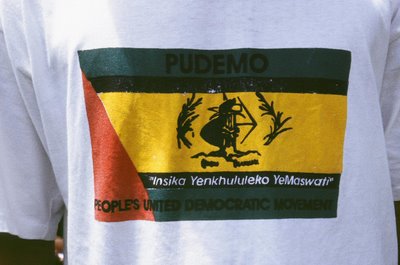

The African Human Rights Commission
The Director
Mbabane
Dear Madam
PUDEMO is pleased for being afforded the opportunity by the commission to brief it about its position regarding the adoption and coming into force and effect of the Swaziland Constitutional Act 001/2006.
BRIEF BACKGROUND
The purported ‘acceptance’ of the Constitution by His Majesty the King and a small section of the Swazi nation it to be lamented as it will be recalled that such“acceptance” was done amidst objection by organised civil society, basically for the reason among many that the process was exclusionary, in that it prevented and prohibited a large section of the people of Swaziland from participating and making submissions to both Constitution Review Commission and the Constitution Drafting Commission. While the said reception of the Constitution by His Majesty the King andsome members of the Swazi nation cannot be said to have been acceptance by all the people of Swaziland, the enactment thereof by Parliament was also flawed inthat Parliament was not authorised and mandated to do so, particularly giventhat it is not itself a product of a democratic process representing thegeneral consensus of the people of Swaziland.
In this regard, it should be noted that in as much as the Tinkhundla system of Government was imposed upon the Nation by King Sobhuza II, it does not represent the exercise of sovereignty by the people. This is the main faction of the Tinkhundla system of government which criminalises and bans political parties. The electoral process under this system, is an important element of deception as evidenced by the fact that both the candidates and the voters donot decide anything fundamental and basic, but are used to rigidly set the term and parameters on acceptable position of major political question. The report of the Commonwealth Expect Teamof October 2003, it stresses this point by saying “We do not consider the creditability of the national elections as an issue; no elections can be credible when they are for parliament which has no power and when political parties are banned’.
It must not be left out of account that this electoral system and the regime governing its operation which this constitution purports to enshrine in section 79 thereof does not come any closer to the electoral bench mark envisaged by the Electoral Institute of Southern Africa.
Note further that the African Commission, after due consideration and determination of the Swaziland Lawyers for Human Rights petition found that the Swaziland Constitution making process was exclusionary and in the result undemocratic and contravening some international conventions which Swaziland was signatory to. This constitution is a recipe for national strife, whose consequences are too ghastly to contemplate.
CONSTITUTIONAL CHALLENGE
After ong preparatory discussions and consultations with various stakeholders and legal experts, PUDEMO and other organised civil society groupings have ultimately resolved to institute legal proceedings to challenge the validly ofthe 2005 Swaziland Constitution on the following grounds.
a) That the process did not comply with spirit, object and purport of the provisions of the King’s Proclamation to the Nation of 1973, particularly paragraph 2(e)thereof which reads thus:-
That I and all my people heartily desire at long last after a long constitutional struggle, to achieve full freedom and independence under a constitution created by ourselves for ourselves in complete liberty and without outside pressures; as a Nation we desire to march forward progressively under our own constitution guaranteeing peace, order and good government and the happiness of all our people.
The fact that the said Proclamation was a legal nullity from its inception is no longer an issue served to show the propensity on the part of the powers that be, even in future to act unconstitutionally and unlawfully and to the further detriment of real and genuine national interests. It should be noted that interms of the constitution at issue, His Majesty the King can even unilaterally and/or on the advice of the prime minister, who is appointed by him, repeal this constitution.
b) The2005 Swaziland Constitution was not accepted by the King and the whole Swazi nation as envisaged by Section 80 (2) of the 1978 King’s Order Council,pursuant to the spirit of the 1973 Proclamation. PUDEMO holds the view that a process of returning the country to a constitutional multiparty parliamentary democracy has to be initiated and implemented by a body that has been created through universally recognised democratic principles. Anybody else, inclusive of the said Constitutional ReviewCommission (CRC) and the Constitutional Drafting Commission (CDC), created outside this minimum standard invariably lacks the mandate and is unable to command national respect and support and as such it cannot create the necessary foundation for peace and good government. Note further that the commissioners for both the said CRC and the CDC were hand-picked and appointed by an individual [the king] who further imposed on them the terms of reference. If this, on the part of our absolute monarchy does not amount to absolute dictatorship, the latter needs to be redefined.
c) TheCRC and the CDC were wrong in giving a narrow meaning to Decree No.2 of 1996 and in the result, prohibiting, preventing and refusing all organised groups,particularly the applicants, from participating and to receive submissions from them.
d) In any case, the constitution making process was instituted by Decrees, yet His Majesty the King did not have power to legislate by decree; see Ray Gwebu vs. The King. Given that even the repeal of the Swaziland Independence Constitution was done unconstitutionally and unlawfully, the said propensity poses a real and immediate threat to the peace, prosperity and stability of the nation as pointed out in paragraph [a] herein supra.
e) In interpreting the provisions of the 1973 King’s Proclamation to the nation as read with the 1978 Establishment of Parliament Order, the 1996 Decree No.1 of 2002,the CRC and the CDC were obliged to take into account the provisions of international human rights instruments and international law, in order to giveeffect to the rights of each and every citizen of Swaziland, whether individually or as organisations especially in the context of constitution making. For these reasons, PUDEMO andthe other applicants request that the Court declares the 2005 Swaziland Constitution null and void, and of no force or effect.
In the alternative, it will be requested that the provision of the Bill of Rights,particularly Section 25 thereof must be interpreted to mean that the people of Swaziland have the right, not just to form associations such as churches,farmers association, community development schemes and others, but fundamentally that they have a right to form, join and belong to political parties and organisations on their own free will and of their voluntary choice for purposes of forming a Government. This is so particularly given that eight times the constitution pays respect to democratic principles, values and standards. In this respect Section 79 which purports to prevent and prohibit multi-party parliamentary national elections must be set aside as being null and void from the inception.
It is the view of PUDEMO, the other applicants and all right thinking and reasonable men and women of the Swaziland that democracy and good governance have been adequatelyand correctly defined and articulated and in the light hereof, Swaziland cannot re-invent the wheel. The basic tenants and attributes of democracy and governance are no longer in dispute even behind the façade of the so called unique Swazi culture and custom, which in order to survive the assault of time, should adapt to socio-economic and political transformation. It is accordingly unreasonable and as such, unacceptable the Swazi authorities in their Constitution Review Report undertake to domesticate the various international conventions, which the country has ratified only if they are not inconsistent with the not yet codified Swazi law and custom.
PLEA
PUDEMO wishes to plea with the people of the country, just as African leaders did under NEPAD agreement. Good governance,human rights and constitutionalism have been long denied in Swaziland. This so-called new constitution is not worthy the paper it is written on. It entrenches a system of government which,we as a people, have not agreed upon. That system is a discriminatory system and not giving value to the dignity (buntfu) of all Swazis. We have not only a moral obligation, but a duty to strive for a constitution that will ensure equitable sharing of resources, equal treatment of all people before the law,as well as the creation of independent structures that will guarantee the growth and development of constitutionalism.
It is not only for the reason of being excluded in the process that PUDEMO and other applicants denounce and reject this cattle byre Constitution, it is also because of the unacceptable contents thereof. We call upon the Swazi people to galvanise themselves so that, at the end of the day, they can all enjoy a better life under a government truly created by themselves, for themselves and accountable to them for all intents and purposes. We want a constitution that will create a conducive environment for peace and prosperity. A constitution that will, within the framework of civilised and acceptable constitutional law, provide an enabling environment wherein the people of this country can severally and/or jointly pursue, to the fullest, their separate and/or combined interests in social,economic, political and other fields of public life.
It is not only in the interest of the Swaziland, but the whole SADC region and Africa at large that Swaziland should be assisted to amicably resolve her constitutional and political problems. In this connection, pre-emptive action by the said region cannot be overstated.
The struggle continues.
Yours in the struggle
KISLONP. SHONGWE
DEPUTY SECRETARYGENERAL – PUDEMO
cc: Electoral Institute of Southern Africa –Victor Shale
Southern African Litigation Centre – NicoleFritz
Wednesday, August 30, 2006

Monday, August 14, 2006
State violence against SWAYOCO: a reflection on Commonwealth and Sibahle Sinje complacence about political repression in Swaziland.
The People's United Democratic Movement of Swaziland
Australia, Asian and the Pacific Region
E-mail: pudemo@yahoo.co.uk
August 14, 2006
State violence against SWAYOCO: a reflection on Commonwealth and Sibahle Sinje complacence about political repression in Swaziland.
For ten years the Commonwealth Secretariat has been misleading the international community by promising that a new constitution would bring about political change in Swaziland. It refused to listen to public concerns about the arbitrary and discriminatory approach to the constitution making process. The process excluded political party participation and was purely driven by the royal family and the Commonwealth Secretariat. Consequently, the new constitution is a product of a negotiated deal between the royal family and the Commonwealth. Many Swazis have come out to disown it.
PUDEMO and its youth wing, SWAYOCO, reaffirm the people’s commitment to continue the struggle for a system of governance that reflects the public’s aspiration for a new culture of responsible governance and respect for human rights. The recent peaceful protest led by SWAYOCO on August 5, 2005 is a reflection of this commitment. Since the adoption of the new constitution, PUDEMO and SWAYOCO have organised numerous peaceful protests which were all violently suppressed by the police. Surprisingly, no public statement was ever issued by the Commonwealth calling upon the government to stop this brutality. However, the Commonwealth Secretary-General, Don McKinnon was quick to condemn the so-called bombings in Swaziland. The government and the local media accused and persecuted our members of “bombing” state infrastructure between 2005 and 2006. A total of sixteen PUDEMO and SWAYOCO members were charged with High Treason and are now on bail awaiting trial under the new constitution supported by the Commonwealth. Under this Constitution, a conviction of High Treason can result in the death penalty.
When King Mswati III signed the controversial constitution in February 2006, the Commonwealth Secretariat renewed its commitment to support the dictatorship. On behalf of the Commonwealth, Don McKinnon, pledged further support to assist the Government of Swaziland to implement the constitution despite widespread public rejection of this law. Ultimately, this means that the Commonwealth is fully behind the application of the death penalty and would support the execution of our members if convicted on these trumped up charges.
In many of its deceitful statements, the Commonwealth Secretariat hid behind inclusion of the Bill of Rights in the constitution. The assumption is that the Bill of Rights guarantees and protects basic freedoms such as freedom of expression, association and assembly. We argued that the Bill of Rights will have no meaning and effect under the current political order. The royal family made it clear throughout the constitution making process that it is opposed to a Bill of Rights. It was only adopted as a deal between the Commonwealth and the royal family to give a semblance of respectability to the constitution. In this regard, the Commonwealth acted as a political spin-doctor for the regime and never, at any stage, showed any deep concern about the protection of basic rights and freedoms in Swaziland. Hence, to the general population these freedoms and rights remain an illusion. The judiciary is helpless because it has limited powers to enforce the Bill of Rights. Past experiences show that when the judiciary takes decisions to protect citizens against abuse of power by the state, the royal family moves swiftly and aggressively against such decisions and attacks the judiciary itself.
In 2002, the royal family government responded ruthlessly to the High Court’s decision to hear a case against the abduction of a school girl. It was alleged that she was abducted in order to forcefully marry her to King Mswati III. The government ordered the High Court to abandon the abduction case.
In the same year, the royal family responded ruthlessly to the Court of Appeal’s ruling to protect 200 families from Macetjeni and KaMkhweli who were cruelly evicted from their homes. In this case, the government ordered the police to disobey the Court of Appeal’s ruling. This threw the rule of law into crisis at the time when public dissent against the constitution making process was particularly intense.
As Swaziland teetered on the brink of becoming a failed state, its parliament failed the country completely. Not a single member of parliament questioned the eviction and the vicious attack on the administration of justice because it was sanctioned by the royal family. Under the new constitution, King Mswati and his family continue to enjoy total immunity from legal prosecution and political scrutiny. The courts will not prosecute him if complaints are levelled against him in his capacity as a head of state and overseer of government business. Parliament is under his iron grip and will not, under any circumstances, challenge or investigate his decisions.
The manner in which the Commonwealth dealt with the judicial issue in Swaziland was appalling. Its primary concern was to avoid a complete collapse of its constitution making project. In order to appease the royal family, it took up the role of travel agent to rebuild the damaged image of the royal family government in the international arena. Commonwealth officials told the international community that the government was doing its best to resolve the crisis. In September 2004, the government and the Commonwealth announced that the crisis was now resolved yet this was far from truth. The abduction case was never reopened and the evicted residents of Macetjeni and KaMkhweli were not allowed to return under the conditions set by the Court of Appeal. Ultimately, they returned to their homes under the conditions outlined by the royal family. Two senior police officers, including the Commissioner of Police, were found guilty of contempt of court because of their actions in blocking the execution of the Court of Appeal’s order. However, they have never been arrested and there has never been any attempt to bring the executive to account for its actions in denying the authority of the judiciary and bringing the rule of law to the point of collapse. When The Director of Public Prosecution, Lincoln Ng’arua, brought charges against the Attorney-General for his role in this matter, he was summarily dismissed from his job.
In its approach to the judicial crisis, the Commonwealth showed no concern about the gross violation of basic human rights and naked abuse of state power in Swaziland. The organisation did not concern itself with the evicted families and it offered no humanitarian assistance. We are yet to find public records of any Commonwealth expression of serious concern about the culture of bad governance in Swaziland and the poor human rights reputation of this regime. There is no substantial evidence to suggest that the existence of the Commonwealth-sponsored constitution has had positive impact with regard to the way in which Swaziland is governed. Violation of human rights, bad governance and political repression continue unabated.
As long as there is no political will and no commitment within the royal family to genuine political change in Swaziland, the Bill of Rights will remain meaningless. As has been shown by the recent police violence and determination to suppress demands for multi-party democracy, the state will continue to undermine the Bill of Rights with impunity. This clearly demonstrates the political bankruptcy of this regime. A regime that violates its own laws is morally and politically bankrupt. This is the prominent feature of the royal family government and the Commonwealth.
As we have stated on numerous occasions, the Commonwealth’s support and approval of a repressive political system in Swaziland is in stark contrast with its principles outlined in the Harare Declaration of 1991. It calls into serious question the ethics of the Commonwealth, particularly the Secretary-General who described the constitution “as a brilliant piece of work” (Swazi Observer, March 17, 2006). McKinnon honoured “…His Majesty King Mswati, who deserves our admiration for his own vision and statesmanship in having made it possible for this Nation to embrace constitutional rule” (Swazi Observer, February 19, 2006).
McKinnon must come to terms with the political reality in Swaziland. There is no constitutional rule in Swaziland. The government is cherry-picking in applying the provisions of the constitution, particularly when this concerns freedoms and rights. Why would police violently suppress peaceful protests with impunity if there is constitutional rule in Swaziland? What is the Commonwealth doing about this?
There is, therefore, demonstrated evidence that the Commonwealth and the royal family were not sincere when they included the Bill of Rights in the constitution. The primary object, it seems, is to trap and appease critics into believing that something good had at least come out of a bad process. This was the Commonwealth Secretariat trump card which it used successfully to mislead the international community. The Commonwealth continues to peddle this lie about the Bill of Rights. It recently told a Canadian Member of the Legislative Assembly of New Brunswick that the constitution is working well and political parties are now allowed in Swaziland. This statement is misleading at best and deceitful at worst. There is no mention of political parties in the constitution and there is no provision for parties to contest elections with the aim of winning over government. There is no single political party that has been legally registered in Swaziland. The government rejected an application for registration by the Ngwane National Liberation Congress (NNLC) - one of the pro-democracy movements.
It is irresponsible on the part of the Commonwealth not to inform the Canadian Member of the Legislative Assembly that the constitution making process does not enjoy the blessing of the majority of Swazis. Consequently, its legitimacy is highly questionable. A significant section of the population, including all pro-democracy groups, the labour movement and the church, has disowned the constitution. Even the chiefs, the most trusted ally of royal family, have now come out to disowned the constitution.
When the Commonwealth, through its representative Chief Adefuye, tried to bully us into accepting the constitution, we refused to participate in our own oppression. We reminded the Commonwealth of its obligation to the Harare Declaration of 1991 and that we will hold the organisation responsible for the continued repression and total neglect of the wellbeing of our people. By participating and continuing to support a constitution which gives false hope, the Commonwealth has turned against our people. This is a dereliction of political responsibility and duty of care to our people as citizens of the Commonwealth. It is a rude departure from the core principles of the organisation. We regard this position as a commitment to assist repression in Swaziland. It is a reflection of a determined world body to stand by the dictatorial regime as it bullies our people and suppresses political dissent.
Since the signing of the constitution into law, business has gone on as usual. PUDEMO and its youth wing, SWAYOCO, have been ruthlessly suppressed through false accusations and naked displays of violence. Recently, SWAYOCO peaceful protests in different parts of the country were violently crushed by trigger-happy police. Two of the peaceful protesters sustained serious gun shots and scores more were injured. Attempts to get medical treatment were not successful because the hospitals in Swaziland have been run down because of government neglect. As usual, the recent police violence escalated to indiscriminate attacks against members of the public who had not even participated in the protest, including children. We hold the Commonwealth responsible for this violence against our people.
Whilst the police were breaking up the SWAYOCO protest, the royal family’s surrogate political organisation, Sibahle Sinje, enjoyed all the luxuries associated with Swazi royalty during its 10th anniversary. Commonly referred to as a cultural organisation, Sibahle Sinje has declared itself a political movement. Its primary intention is to further entrench the absolute powers of the royal family in Swaziland politics. It was not surprising that the government spokesperson, Percy Simelane, immediately invited Sibahle Sinje to register with the government as a political party. This is bizarre given that the same government rejected NNLC’s application. Most importantly, there is no provision in the constitution for the registration of political parties.
Like the Commonwealth Secretariat, Sibahle Sinje pursues a double agenda. On one hand, it claims to advocate democratic change and on the other hand it is committed to the protection of the very system that resists calls for democracy. Similarly, the Commonwealth Secretariat prides itself as an organisation founded on strong democratic and human rights principles yet it actively encourages and assists human rights violations in Swaziland.
In its involvement in Swaziland, the Commonwealth Secretariat has aggressively pursued the idea of changing the system from within. It has bullied political organisations opposed to this approach and awarded those which share its ideas. The tactics used by Sibahle Sinje to recruit from the ranks of the ruling royal elite and to participate actively in formal politics, are consistent with the Commonwealth’s agenda. Ironically, Sibahle Sinje was established in 1996 when the Commonwealth actively entered Swaziland politics to rescue the royal family from a major crisis of political legitimacy. At the time, the regime was crumbling under sustained mass uprisings led by the labour and pro-democracy movements. Sibahle Sinje saw this as a threat to the monarchy and launched an aggressive fear campaign arguing that the movement for democracy would erode the nation’s cultural identity.
The use of culture as an ideology of fear and source of political power in Swaziland has a long history. It was used in the pre-independence campaign to delegitimise pro-multi party democracy movements such as the NNLC. In his infamous Proclamation to the Nation of 1973, Sobhuza II, father of the current king, used culture to justify his ruthless attack on basic political and human rights. Sobhuza II argued that multi-party parliamentary democracy and individual freedoms are unSwazi and would generate cultural disharmony. As evidenced by the recent police violence against SWAYOCO and the prohibition of political party participation in governance under the new constitution, this Proclamation remains effective. Culture remains a powerful ideology of fear and oppression, particularly in rural areas where 75% of the population lives under the watchful eyes of traditional chiefs.
By proclaiming itself to be the guardian of Swazi culture, Sibahle Sinje seeks to reproduce the repressive powers of this ideology. There is great desire within this organisation to monopolise the interpretation of our culture and hold the Swazi nation hostage of cultural practices that promote violations of basic rights and freedoms. By so doing, the organisation is actively participating in closing space for cultural growth. It is holding back the cultural intellectual development of the Swazi nation which is so vital in nation building and prosperity. When Sibahle Sinje was established, it echoed King Sobhuza’s views by publicly declaring that multi-party parliamentary democracy was culturally unacceptable. It denounced the growing number of Swazis calling for this system of governance as ‘not true Swazis’.
The Commonwealth also holds onto this notion of cultural incongruence to advance its double agenda. We have been consistently told by Commonwealth officials that multi-party democracy is not suitable to Swaziland because it is incongruent with the Swazi culture. This rigid view of culture and of democracy has been the cornerstone of the royal family political power. When the Commonwealth and Sibahle Sinje talk about Swazi culture, they speak not of the Swazi nation’s view of what this constitutes but of the royal family’s view of culture. Thus discourses of culture in Swaziland coalesce around the activities of the royal family and its surrogate bodies. The power to speak of Swazi culture authoritatively, what it is and what it is not, is regarded the preserve of the royal family. Organisations such as Sibahle Sinje and the Commonwealth have been steadfast in their commitment to preserve, if not to increase this power. In this context, the views and voices of the general population which offer alternative views are discarded as radical and delegitimised as‘unSwazi’.
Whether or not the similarity of the positions taken by the Commonwealth and Sibahle Sinje is coincidental, these developments run parallel to pre-independence politics. During the colonial era, the British administration ruled together with King Sobhuza II to suppress mass anti-colonial dissent. Referred to under the colonial administration as Paramount Chief, Sobhuza II was instrumental in ensuring corporation with the colonial administration because of his cultural influence among the population. The British government rewarded him by offering full support to his pre-independence campaign for office. Colonial representatives advised and assisted Sobhuza II to form a royal family political party – the Imbokodvo National Movement (INM).
IMN came into existence at the time when pro-independence protests, led by the labour movement and pro-multi party democracy organisations such as NNLC, was gaining influence. As can be deduced from the name Imbokodvo or grinding stone, the idea behind the formation of INM was the suppression and subsequent destruction of the pro-democracy movement. This movement was regarded within the royal family on the one hand, as advancing ideas that were alien to Swazi culture and on the other hand, by the colonial administration as communism. Culture as a political ideology was, therefore, central in INM campaigns and was effectively used to generate mass moral panic which delivered massive electoral victories for King Sobhuza II. In 1973, INM achieved its desire to destroy alternative political voices when King Sobhuza II unconstitutionally repealed the constitution and outlawed political parties and criticism against the state.
Sibahle Sinje, is a reincarnation of INM and thrives on fear of cultural annihilation. Through the politics of fear, today the organisation boasts of significant “electoral” victories. We detest the abuse of our culture for political gain, especially when it is used as a form of ideological terrorism to generate mass psychological terror among the population. In order to advance its cause, the organisation draws its membership from senior government ranks, the royal family and self-made moral entrepreneurs such as the royal palace governor, Jim Gama. Like INM, Sibahle Sinje hopes that it would, with the assistance of the Commonwealth, a British neo-colonial body, repeat history by crushing the nation’s aspiration for multi-party democracy.
If Sibahle Sinje is committed to genuine democratic change, it needs to make this position crystal clear and condemn state brutality against our people. It must rally behind the public’s demand for a fresh constitution making process with popular mandate. The Commonwealth has made its position clear that it does not support democracy in Swaziland. There is no need to involve it in a fresh constitutional dispensation. However, we are committed to persuade all Swazis, including members of Sibahle Sinje, to join hands and drive the new process.
PUDEMO will work with Sibahle Sinje if it is honest with the people of Swaziland by confronting the monarchy as a source of political repression. It has been shown from time to time that the political problems in Swaziland will not be resolved through piecemeal deals and half-baked strategies. Only honesty, boldness, innovation, relentlessness and commitment to the cause will propel us forward. PUDEMO and SWAYOCO have been bold and honest about their political convictions and objectives – the overthrow of the absolute monarchy system of governance and its replacement with multi-party parliamentary democracy. We stared the bull in the eye, frightened the weak and earned the respect of the fearless. Sibahle Sinje and the Commonwealth want us to go back and embrace the monarchy that is responsible for the current social, economic and political misery of our people. We say, NO! We shall not betray our people and principles. Our commitment is solid – improving the general wellbeing of the people of Swaziland by emancipating them from all forms of oppression.
Signed:
Dr Jabulane Matsebula
PUDEMO Representative
Australia, Asia and the Pacific Region
PUDEMO
International OfficeAustralia, Asian and the Pacific Region
E-mail: pudemo@yahoo.co.uk
August 14, 2006
State violence against SWAYOCO: a reflection on Commonwealth and Sibahle Sinje complacence about political repression in Swaziland.
For ten years the Commonwealth Secretariat has been misleading the international community by promising that a new constitution would bring about political change in Swaziland. It refused to listen to public concerns about the arbitrary and discriminatory approach to the constitution making process. The process excluded political party participation and was purely driven by the royal family and the Commonwealth Secretariat. Consequently, the new constitution is a product of a negotiated deal between the royal family and the Commonwealth. Many Swazis have come out to disown it.
PUDEMO and its youth wing, SWAYOCO, reaffirm the people’s commitment to continue the struggle for a system of governance that reflects the public’s aspiration for a new culture of responsible governance and respect for human rights. The recent peaceful protest led by SWAYOCO on August 5, 2005 is a reflection of this commitment. Since the adoption of the new constitution, PUDEMO and SWAYOCO have organised numerous peaceful protests which were all violently suppressed by the police. Surprisingly, no public statement was ever issued by the Commonwealth calling upon the government to stop this brutality. However, the Commonwealth Secretary-General, Don McKinnon was quick to condemn the so-called bombings in Swaziland. The government and the local media accused and persecuted our members of “bombing” state infrastructure between 2005 and 2006. A total of sixteen PUDEMO and SWAYOCO members were charged with High Treason and are now on bail awaiting trial under the new constitution supported by the Commonwealth. Under this Constitution, a conviction of High Treason can result in the death penalty.
When King Mswati III signed the controversial constitution in February 2006, the Commonwealth Secretariat renewed its commitment to support the dictatorship. On behalf of the Commonwealth, Don McKinnon, pledged further support to assist the Government of Swaziland to implement the constitution despite widespread public rejection of this law. Ultimately, this means that the Commonwealth is fully behind the application of the death penalty and would support the execution of our members if convicted on these trumped up charges.
In many of its deceitful statements, the Commonwealth Secretariat hid behind inclusion of the Bill of Rights in the constitution. The assumption is that the Bill of Rights guarantees and protects basic freedoms such as freedom of expression, association and assembly. We argued that the Bill of Rights will have no meaning and effect under the current political order. The royal family made it clear throughout the constitution making process that it is opposed to a Bill of Rights. It was only adopted as a deal between the Commonwealth and the royal family to give a semblance of respectability to the constitution. In this regard, the Commonwealth acted as a political spin-doctor for the regime and never, at any stage, showed any deep concern about the protection of basic rights and freedoms in Swaziland. Hence, to the general population these freedoms and rights remain an illusion. The judiciary is helpless because it has limited powers to enforce the Bill of Rights. Past experiences show that when the judiciary takes decisions to protect citizens against abuse of power by the state, the royal family moves swiftly and aggressively against such decisions and attacks the judiciary itself.
In 2002, the royal family government responded ruthlessly to the High Court’s decision to hear a case against the abduction of a school girl. It was alleged that she was abducted in order to forcefully marry her to King Mswati III. The government ordered the High Court to abandon the abduction case.
In the same year, the royal family responded ruthlessly to the Court of Appeal’s ruling to protect 200 families from Macetjeni and KaMkhweli who were cruelly evicted from their homes. In this case, the government ordered the police to disobey the Court of Appeal’s ruling. This threw the rule of law into crisis at the time when public dissent against the constitution making process was particularly intense.
As Swaziland teetered on the brink of becoming a failed state, its parliament failed the country completely. Not a single member of parliament questioned the eviction and the vicious attack on the administration of justice because it was sanctioned by the royal family. Under the new constitution, King Mswati and his family continue to enjoy total immunity from legal prosecution and political scrutiny. The courts will not prosecute him if complaints are levelled against him in his capacity as a head of state and overseer of government business. Parliament is under his iron grip and will not, under any circumstances, challenge or investigate his decisions.
The manner in which the Commonwealth dealt with the judicial issue in Swaziland was appalling. Its primary concern was to avoid a complete collapse of its constitution making project. In order to appease the royal family, it took up the role of travel agent to rebuild the damaged image of the royal family government in the international arena. Commonwealth officials told the international community that the government was doing its best to resolve the crisis. In September 2004, the government and the Commonwealth announced that the crisis was now resolved yet this was far from truth. The abduction case was never reopened and the evicted residents of Macetjeni and KaMkhweli were not allowed to return under the conditions set by the Court of Appeal. Ultimately, they returned to their homes under the conditions outlined by the royal family. Two senior police officers, including the Commissioner of Police, were found guilty of contempt of court because of their actions in blocking the execution of the Court of Appeal’s order. However, they have never been arrested and there has never been any attempt to bring the executive to account for its actions in denying the authority of the judiciary and bringing the rule of law to the point of collapse. When The Director of Public Prosecution, Lincoln Ng’arua, brought charges against the Attorney-General for his role in this matter, he was summarily dismissed from his job.
In its approach to the judicial crisis, the Commonwealth showed no concern about the gross violation of basic human rights and naked abuse of state power in Swaziland. The organisation did not concern itself with the evicted families and it offered no humanitarian assistance. We are yet to find public records of any Commonwealth expression of serious concern about the culture of bad governance in Swaziland and the poor human rights reputation of this regime. There is no substantial evidence to suggest that the existence of the Commonwealth-sponsored constitution has had positive impact with regard to the way in which Swaziland is governed. Violation of human rights, bad governance and political repression continue unabated.
As long as there is no political will and no commitment within the royal family to genuine political change in Swaziland, the Bill of Rights will remain meaningless. As has been shown by the recent police violence and determination to suppress demands for multi-party democracy, the state will continue to undermine the Bill of Rights with impunity. This clearly demonstrates the political bankruptcy of this regime. A regime that violates its own laws is morally and politically bankrupt. This is the prominent feature of the royal family government and the Commonwealth.
As we have stated on numerous occasions, the Commonwealth’s support and approval of a repressive political system in Swaziland is in stark contrast with its principles outlined in the Harare Declaration of 1991. It calls into serious question the ethics of the Commonwealth, particularly the Secretary-General who described the constitution “as a brilliant piece of work” (Swazi Observer, March 17, 2006). McKinnon honoured “…His Majesty King Mswati, who deserves our admiration for his own vision and statesmanship in having made it possible for this Nation to embrace constitutional rule” (Swazi Observer, February 19, 2006).
McKinnon must come to terms with the political reality in Swaziland. There is no constitutional rule in Swaziland. The government is cherry-picking in applying the provisions of the constitution, particularly when this concerns freedoms and rights. Why would police violently suppress peaceful protests with impunity if there is constitutional rule in Swaziland? What is the Commonwealth doing about this?
There is, therefore, demonstrated evidence that the Commonwealth and the royal family were not sincere when they included the Bill of Rights in the constitution. The primary object, it seems, is to trap and appease critics into believing that something good had at least come out of a bad process. This was the Commonwealth Secretariat trump card which it used successfully to mislead the international community. The Commonwealth continues to peddle this lie about the Bill of Rights. It recently told a Canadian Member of the Legislative Assembly of New Brunswick that the constitution is working well and political parties are now allowed in Swaziland. This statement is misleading at best and deceitful at worst. There is no mention of political parties in the constitution and there is no provision for parties to contest elections with the aim of winning over government. There is no single political party that has been legally registered in Swaziland. The government rejected an application for registration by the Ngwane National Liberation Congress (NNLC) - one of the pro-democracy movements.
It is irresponsible on the part of the Commonwealth not to inform the Canadian Member of the Legislative Assembly that the constitution making process does not enjoy the blessing of the majority of Swazis. Consequently, its legitimacy is highly questionable. A significant section of the population, including all pro-democracy groups, the labour movement and the church, has disowned the constitution. Even the chiefs, the most trusted ally of royal family, have now come out to disowned the constitution.
When the Commonwealth, through its representative Chief Adefuye, tried to bully us into accepting the constitution, we refused to participate in our own oppression. We reminded the Commonwealth of its obligation to the Harare Declaration of 1991 and that we will hold the organisation responsible for the continued repression and total neglect of the wellbeing of our people. By participating and continuing to support a constitution which gives false hope, the Commonwealth has turned against our people. This is a dereliction of political responsibility and duty of care to our people as citizens of the Commonwealth. It is a rude departure from the core principles of the organisation. We regard this position as a commitment to assist repression in Swaziland. It is a reflection of a determined world body to stand by the dictatorial regime as it bullies our people and suppresses political dissent.
Since the signing of the constitution into law, business has gone on as usual. PUDEMO and its youth wing, SWAYOCO, have been ruthlessly suppressed through false accusations and naked displays of violence. Recently, SWAYOCO peaceful protests in different parts of the country were violently crushed by trigger-happy police. Two of the peaceful protesters sustained serious gun shots and scores more were injured. Attempts to get medical treatment were not successful because the hospitals in Swaziland have been run down because of government neglect. As usual, the recent police violence escalated to indiscriminate attacks against members of the public who had not even participated in the protest, including children. We hold the Commonwealth responsible for this violence against our people.
Whilst the police were breaking up the SWAYOCO protest, the royal family’s surrogate political organisation, Sibahle Sinje, enjoyed all the luxuries associated with Swazi royalty during its 10th anniversary. Commonly referred to as a cultural organisation, Sibahle Sinje has declared itself a political movement. Its primary intention is to further entrench the absolute powers of the royal family in Swaziland politics. It was not surprising that the government spokesperson, Percy Simelane, immediately invited Sibahle Sinje to register with the government as a political party. This is bizarre given that the same government rejected NNLC’s application. Most importantly, there is no provision in the constitution for the registration of political parties.
Like the Commonwealth Secretariat, Sibahle Sinje pursues a double agenda. On one hand, it claims to advocate democratic change and on the other hand it is committed to the protection of the very system that resists calls for democracy. Similarly, the Commonwealth Secretariat prides itself as an organisation founded on strong democratic and human rights principles yet it actively encourages and assists human rights violations in Swaziland.
In its involvement in Swaziland, the Commonwealth Secretariat has aggressively pursued the idea of changing the system from within. It has bullied political organisations opposed to this approach and awarded those which share its ideas. The tactics used by Sibahle Sinje to recruit from the ranks of the ruling royal elite and to participate actively in formal politics, are consistent with the Commonwealth’s agenda. Ironically, Sibahle Sinje was established in 1996 when the Commonwealth actively entered Swaziland politics to rescue the royal family from a major crisis of political legitimacy. At the time, the regime was crumbling under sustained mass uprisings led by the labour and pro-democracy movements. Sibahle Sinje saw this as a threat to the monarchy and launched an aggressive fear campaign arguing that the movement for democracy would erode the nation’s cultural identity.
The use of culture as an ideology of fear and source of political power in Swaziland has a long history. It was used in the pre-independence campaign to delegitimise pro-multi party democracy movements such as the NNLC. In his infamous Proclamation to the Nation of 1973, Sobhuza II, father of the current king, used culture to justify his ruthless attack on basic political and human rights. Sobhuza II argued that multi-party parliamentary democracy and individual freedoms are unSwazi and would generate cultural disharmony. As evidenced by the recent police violence against SWAYOCO and the prohibition of political party participation in governance under the new constitution, this Proclamation remains effective. Culture remains a powerful ideology of fear and oppression, particularly in rural areas where 75% of the population lives under the watchful eyes of traditional chiefs.
By proclaiming itself to be the guardian of Swazi culture, Sibahle Sinje seeks to reproduce the repressive powers of this ideology. There is great desire within this organisation to monopolise the interpretation of our culture and hold the Swazi nation hostage of cultural practices that promote violations of basic rights and freedoms. By so doing, the organisation is actively participating in closing space for cultural growth. It is holding back the cultural intellectual development of the Swazi nation which is so vital in nation building and prosperity. When Sibahle Sinje was established, it echoed King Sobhuza’s views by publicly declaring that multi-party parliamentary democracy was culturally unacceptable. It denounced the growing number of Swazis calling for this system of governance as ‘not true Swazis’.
The Commonwealth also holds onto this notion of cultural incongruence to advance its double agenda. We have been consistently told by Commonwealth officials that multi-party democracy is not suitable to Swaziland because it is incongruent with the Swazi culture. This rigid view of culture and of democracy has been the cornerstone of the royal family political power. When the Commonwealth and Sibahle Sinje talk about Swazi culture, they speak not of the Swazi nation’s view of what this constitutes but of the royal family’s view of culture. Thus discourses of culture in Swaziland coalesce around the activities of the royal family and its surrogate bodies. The power to speak of Swazi culture authoritatively, what it is and what it is not, is regarded the preserve of the royal family. Organisations such as Sibahle Sinje and the Commonwealth have been steadfast in their commitment to preserve, if not to increase this power. In this context, the views and voices of the general population which offer alternative views are discarded as radical and delegitimised as‘unSwazi’.
Whether or not the similarity of the positions taken by the Commonwealth and Sibahle Sinje is coincidental, these developments run parallel to pre-independence politics. During the colonial era, the British administration ruled together with King Sobhuza II to suppress mass anti-colonial dissent. Referred to under the colonial administration as Paramount Chief, Sobhuza II was instrumental in ensuring corporation with the colonial administration because of his cultural influence among the population. The British government rewarded him by offering full support to his pre-independence campaign for office. Colonial representatives advised and assisted Sobhuza II to form a royal family political party – the Imbokodvo National Movement (INM).
IMN came into existence at the time when pro-independence protests, led by the labour movement and pro-multi party democracy organisations such as NNLC, was gaining influence. As can be deduced from the name Imbokodvo or grinding stone, the idea behind the formation of INM was the suppression and subsequent destruction of the pro-democracy movement. This movement was regarded within the royal family on the one hand, as advancing ideas that were alien to Swazi culture and on the other hand, by the colonial administration as communism. Culture as a political ideology was, therefore, central in INM campaigns and was effectively used to generate mass moral panic which delivered massive electoral victories for King Sobhuza II. In 1973, INM achieved its desire to destroy alternative political voices when King Sobhuza II unconstitutionally repealed the constitution and outlawed political parties and criticism against the state.
Sibahle Sinje, is a reincarnation of INM and thrives on fear of cultural annihilation. Through the politics of fear, today the organisation boasts of significant “electoral” victories. We detest the abuse of our culture for political gain, especially when it is used as a form of ideological terrorism to generate mass psychological terror among the population. In order to advance its cause, the organisation draws its membership from senior government ranks, the royal family and self-made moral entrepreneurs such as the royal palace governor, Jim Gama. Like INM, Sibahle Sinje hopes that it would, with the assistance of the Commonwealth, a British neo-colonial body, repeat history by crushing the nation’s aspiration for multi-party democracy.
If Sibahle Sinje is committed to genuine democratic change, it needs to make this position crystal clear and condemn state brutality against our people. It must rally behind the public’s demand for a fresh constitution making process with popular mandate. The Commonwealth has made its position clear that it does not support democracy in Swaziland. There is no need to involve it in a fresh constitutional dispensation. However, we are committed to persuade all Swazis, including members of Sibahle Sinje, to join hands and drive the new process.
PUDEMO will work with Sibahle Sinje if it is honest with the people of Swaziland by confronting the monarchy as a source of political repression. It has been shown from time to time that the political problems in Swaziland will not be resolved through piecemeal deals and half-baked strategies. Only honesty, boldness, innovation, relentlessness and commitment to the cause will propel us forward. PUDEMO and SWAYOCO have been bold and honest about their political convictions and objectives – the overthrow of the absolute monarchy system of governance and its replacement with multi-party parliamentary democracy. We stared the bull in the eye, frightened the weak and earned the respect of the fearless. Sibahle Sinje and the Commonwealth want us to go back and embrace the monarchy that is responsible for the current social, economic and political misery of our people. We say, NO! We shall not betray our people and principles. Our commitment is solid – improving the general wellbeing of the people of Swaziland by emancipating them from all forms of oppression.
Signed:
Dr Jabulane Matsebula
PUDEMO Representative
Australia, Asia and the Pacific Region
Sunday, August 6, 2006
KING MSWATI’S ROYAL POLICE VIOLENTLY DISPERSE A PEACEFUL 15TH ANNIVERSARY OF THE SWAZILAND YOUTH CONGRESS
PRESS STATEMENT
KING MSWATI’S ROYAL POLICE VIOLENTLY DISPERSE A PEACEFUL 15TH ANNIVERSARY OF THE SWAZILAND YOUTH CONGRESS IN MBABANE SATURDAY 5TH August 2006 AND ARREST MEMBERS.
We salute our gallant young lions for facing up to the Royal hit squads at Msunduza location in the capital town Mbabane Saturday 5th August 2006.
The Peoples United Democratic Movement (PUDEMO) a movement for the majority poor people of our country salutes the young lions who stood up to the armed Royal hit squads called police in its 15th anniversary.
We are saying to the people of our country, no amount of intimidation, violence and force can push back the hand of history. PUDEMO and its youth league have come a long way in the struggle for a free Swaziland. A Swaziland that belongs to all its citizens, a Swaziland that does not discriminate based on family background. PUDEMO and SWAYOCO is proud that it has managed to bring to the attention of the Swazi population and the international community the suffering of our people at the hands of one minority family, the Dlamini family.
We cannot sit back and allow the so-called Royal family to continue to loot the meager resources of our country just because they have a private army and police.
Our people are dying of HIV/AIDS, hunger, poverty, unemployment, lack of clean water and sanitation, curable diseases like TB and cholera just because the resources that should be helping them are misused by one family.
The following figures do not lie and they are disheartening to PUDEMO;
*69% of the population lives below the poverty line of E128 ($20 Canadian) per month.
*48% of the population live under abject poverty
*40% of households have never had enough to eat
*More than 300 000 people depend on food aid to survive
*Unemployment is more than 40%.
*HIV/AIDS prevalence rate is estimated at 42% making our country to be the highest in infection rate in the world.
*56.4% of the wealth is held by the richest 20% whilst the poorest 20% hold only 4.3%
*Total population of disadvantaged people is estimated at 756 000 and is ever escalating. This represents more than 70% of the population.
*The health facilities are worse than in colonial times. You cannot find a simple pain killer in any government hospital today.
*The education system has crumbled under Royal administration. Our children no longer have access to government scholarships when those of the Royal family attend pre-schools in England and America.
Against this background you have one family masquerading as a Royal family living like the sultans of Brunei or the rich Saudi families or the richest mafia families of the world.
Truly a mafia family runs this country. The difference is that the Italian or American mafia wakes up and sells drugs to make money, whilst this Dlamini mafia sleeps and wake up to suck the blood of our people. In short the Swazi mafia is worse of all the mafia families in the world.
The luxuries of the Swazi Royal family at the expense of the suffering masses of our people:
*Majority shareholdings in all major companies in Swaziland including the blood sucking MTN mobile network that enjoys minority status.
*Controls the sugar industry
*Top of the range BMW X% for each of the 12 or 14 wives of the king
*12 palaces for the wives
*Many state houses, both inside and overseas countries like Taiwan, and Indonesia
*The multimillion Maybach luxury car for the King
*The multimillion Pullman luxury car for he King
*The new private airport that cost our tax payers almost E1 Billion
*The Royal family children are educated in overseas schools and are paid hefty maintenance allowances and bought fancy luxury vehicles called toys.
*A well maintained army and police force that is trained to maintain the suffering of our people.
Peaceful political march to celebrate 15 years anniversary of the birth of the Swaziland Youth Congress (SWAYOCO) violently suppressed by the Royal police.
When our people exercise their inalienable right to freedom of association and assembly, the police use live ammunition, teargas and batons to suppress them. Two of our members were seriously hurt after being shot at. One was shot in the leg and the other one shot at the arm. Scores have been arrested and later released after the intervention of our lawyers. The secretary for the gender affairs in the youth league, comrade Dudu Sithole was arrested and tortured in a police cells in Mbabane.
She was arrested with another comrade. Upon release at night she was never assisted with transport and the leadership was never told of her release so that they can arrange for transport or accommodation.
Teargas canisters were randomly fired at children and women. So many of these canisters landed inside houses of the poor location.
And for this we are expected to say all is fine. To the Dlamini family we say this will never happen. This is our country as well. We own each and every inch of Swaziland. We never chose to be born in these lands, but these were given to us as a birthright by God and we shall defend this birthright with our own blood if need be.
Another pro Royal family political party is allowed to hold its 5th convention in a hotel just 10 kilometres away from where our members are brutalized.
It is not surprising that whilst the police was suppressing our youth league’s 15th anniversary, the police were giving support to another political party that is aligned to the Royal family just less than 10 kilometres away. This is the party called Sive Siyincaba Sibahle sinje national movement which was holding its 5th convention it the Royal Swazi sun hotels at the Ezulwini valley. Most members of this party are members of the Royal family and the hangers on. Adefuye and the commonwealth accept these double standards. We are tempted to say to hell with such double standards by these unscrupulous people.
The International community
When all these things happen we are told that we should accept and be tolerant. The people we trusted to be custodian of democracy and good governance are the bearers of this order. These are the powers that be in such bodies like the Commonwealth. The commonwealth sends the so-called Nigerian chief Adefuye to coerce us into accepting Royal oppression because it is an African way of authority. We are saying our people reject the notion that Africans must have different types of democracy and liberties. If the people of Nigeria are no longer ruled by Kings and chiefs like Adefuye why is he expecting us to accept such a political order? This is an insult to our people, and we shall never accept to be treated like aliens in our country of birth.
We wish to appeal to the international community to:
*Support our cause in terms of financial and material and moral support to the peoples’ movement
Isolate the Royal regime in Swaziland by pushing for smart sanctions against the family and its surrogate government leaders
*Send credible monitors to establish the facts for themselves
*Assist our exiled members with schooling, food and shelter.
*Put pressure on the King to accept our gesture for peaceful negotiations.
Our freedom is in our hands.
We have always maintained that freedom is in our hands. We have first hand experience of the Royal repression. We see the king parading his luxury convoy of cars everyday with sirens blazing. We see our people pushed aside from the roads like rabid dogs whenever these convoys pass by.
We watch in dismay the Royal family spend millions of our taxes in birthday celebrations. We witness wastages in ceremonies that never help our people like Umhlanga reed dance, Lusekwane and Incwala. Every now and again we watch the King and his family leave Swaziland to overseas countries to spend our taxes.
Against all these we bury our people on a daily basis. And these are victims of a system that has long past its sell time. These are victims of HIV/AIDS, hunger and of curable diseases like diabetes and diarrhea.
We shall struggle to rid our country of this suffering of our poor people.
The peoples’ Struggle as lead by PUDEMO is about delivering to our people the following;
Finally, there is no amount of oppression and violence that will stop us from our march to freedom. We can hear the bells of freedom ringing and PUDEMO shall fulfill its 23 yearlong mandate to help the Swazi people attain their freedom. For our freedom we do not beg the Royal family and their hit squads called the police. We are committed to a free Swazi nation that shall share the resources of this country.
We shall continue the fight until we free ourselves from the shackles of oppression.
Yours in the struggle for freedom and social justice,
Ignatius Bonginkosi Dlamini
P.O. Box 187
Simunye
Swaziland
Southern Africa
Office 301 SNAT Co-op. Building, Manzini
Tel: (09268) 6075479/(09268) 3838718
E-mail: kweleza@yahoo.com
06 August 2006
KING MSWATI’S ROYAL POLICE VIOLENTLY DISPERSE A PEACEFUL 15TH ANNIVERSARY OF THE SWAZILAND YOUTH CONGRESS IN MBABANE SATURDAY 5TH August 2006 AND ARREST MEMBERS.
We salute our gallant young lions for facing up to the Royal hit squads at Msunduza location in the capital town Mbabane Saturday 5th August 2006.
The Peoples United Democratic Movement (PUDEMO) a movement for the majority poor people of our country salutes the young lions who stood up to the armed Royal hit squads called police in its 15th anniversary.
We are saying to the people of our country, no amount of intimidation, violence and force can push back the hand of history. PUDEMO and its youth league have come a long way in the struggle for a free Swaziland. A Swaziland that belongs to all its citizens, a Swaziland that does not discriminate based on family background. PUDEMO and SWAYOCO is proud that it has managed to bring to the attention of the Swazi population and the international community the suffering of our people at the hands of one minority family, the Dlamini family.
We cannot sit back and allow the so-called Royal family to continue to loot the meager resources of our country just because they have a private army and police.
Our people are dying of HIV/AIDS, hunger, poverty, unemployment, lack of clean water and sanitation, curable diseases like TB and cholera just because the resources that should be helping them are misused by one family.
The following figures do not lie and they are disheartening to PUDEMO;
*69% of the population lives below the poverty line of E128 ($20 Canadian) per month.
*48% of the population live under abject poverty
*40% of households have never had enough to eat
*More than 300 000 people depend on food aid to survive
*Unemployment is more than 40%.
*HIV/AIDS prevalence rate is estimated at 42% making our country to be the highest in infection rate in the world.
*56.4% of the wealth is held by the richest 20% whilst the poorest 20% hold only 4.3%
*Total population of disadvantaged people is estimated at 756 000 and is ever escalating. This represents more than 70% of the population.
*The health facilities are worse than in colonial times. You cannot find a simple pain killer in any government hospital today.
*The education system has crumbled under Royal administration. Our children no longer have access to government scholarships when those of the Royal family attend pre-schools in England and America.
Against this background you have one family masquerading as a Royal family living like the sultans of Brunei or the rich Saudi families or the richest mafia families of the world.
Truly a mafia family runs this country. The difference is that the Italian or American mafia wakes up and sells drugs to make money, whilst this Dlamini mafia sleeps and wake up to suck the blood of our people. In short the Swazi mafia is worse of all the mafia families in the world.
The luxuries of the Swazi Royal family at the expense of the suffering masses of our people:
*Majority shareholdings in all major companies in Swaziland including the blood sucking MTN mobile network that enjoys minority status.
*Controls the sugar industry
*Top of the range BMW X% for each of the 12 or 14 wives of the king
*12 palaces for the wives
*Many state houses, both inside and overseas countries like Taiwan, and Indonesia
*The multimillion Maybach luxury car for the King
*The multimillion Pullman luxury car for he King
*The new private airport that cost our tax payers almost E1 Billion
*The Royal family children are educated in overseas schools and are paid hefty maintenance allowances and bought fancy luxury vehicles called toys.
*A well maintained army and police force that is trained to maintain the suffering of our people.
Peaceful political march to celebrate 15 years anniversary of the birth of the Swaziland Youth Congress (SWAYOCO) violently suppressed by the Royal police.
When our people exercise their inalienable right to freedom of association and assembly, the police use live ammunition, teargas and batons to suppress them. Two of our members were seriously hurt after being shot at. One was shot in the leg and the other one shot at the arm. Scores have been arrested and later released after the intervention of our lawyers. The secretary for the gender affairs in the youth league, comrade Dudu Sithole was arrested and tortured in a police cells in Mbabane.
She was arrested with another comrade. Upon release at night she was never assisted with transport and the leadership was never told of her release so that they can arrange for transport or accommodation.
Teargas canisters were randomly fired at children and women. So many of these canisters landed inside houses of the poor location.
And for this we are expected to say all is fine. To the Dlamini family we say this will never happen. This is our country as well. We own each and every inch of Swaziland. We never chose to be born in these lands, but these were given to us as a birthright by God and we shall defend this birthright with our own blood if need be.
Another pro Royal family political party is allowed to hold its 5th convention in a hotel just 10 kilometres away from where our members are brutalized.
It is not surprising that whilst the police was suppressing our youth league’s 15th anniversary, the police were giving support to another political party that is aligned to the Royal family just less than 10 kilometres away. This is the party called Sive Siyincaba Sibahle sinje national movement which was holding its 5th convention it the Royal Swazi sun hotels at the Ezulwini valley. Most members of this party are members of the Royal family and the hangers on. Adefuye and the commonwealth accept these double standards. We are tempted to say to hell with such double standards by these unscrupulous people.
The International community
When all these things happen we are told that we should accept and be tolerant. The people we trusted to be custodian of democracy and good governance are the bearers of this order. These are the powers that be in such bodies like the Commonwealth. The commonwealth sends the so-called Nigerian chief Adefuye to coerce us into accepting Royal oppression because it is an African way of authority. We are saying our people reject the notion that Africans must have different types of democracy and liberties. If the people of Nigeria are no longer ruled by Kings and chiefs like Adefuye why is he expecting us to accept such a political order? This is an insult to our people, and we shall never accept to be treated like aliens in our country of birth.
We wish to appeal to the international community to:
*Support our cause in terms of financial and material and moral support to the peoples’ movement
Isolate the Royal regime in Swaziland by pushing for smart sanctions against the family and its surrogate government leaders
*Send credible monitors to establish the facts for themselves
*Assist our exiled members with schooling, food and shelter.
*Put pressure on the King to accept our gesture for peaceful negotiations.
Our freedom is in our hands.
We have always maintained that freedom is in our hands. We have first hand experience of the Royal repression. We see the king parading his luxury convoy of cars everyday with sirens blazing. We see our people pushed aside from the roads like rabid dogs whenever these convoys pass by.
We watch in dismay the Royal family spend millions of our taxes in birthday celebrations. We witness wastages in ceremonies that never help our people like Umhlanga reed dance, Lusekwane and Incwala. Every now and again we watch the King and his family leave Swaziland to overseas countries to spend our taxes.
Against all these we bury our people on a daily basis. And these are victims of a system that has long past its sell time. These are victims of HIV/AIDS, hunger and of curable diseases like diabetes and diarrhea.
We shall struggle to rid our country of this suffering of our poor people.
The peoples’ Struggle as lead by PUDEMO is about delivering to our people the following;
- Health facilities that can respond to the needs of our people. PUDEMO shall build hospitals and clinics and provide primary health care to all our people particularly those in the rural areas.
- Provide ARVs and nutritious food supplement to assist the HIV/AIDS dying population
- Provide better schools particularly in the rural areas
- Provide scholarships to the needy. We shall use the money that is provided to send Royal children to crèches and schools overseas. Each Royal family child’s yearly school fees can help educate 10 000 of our poor children
- We shall turn the many palaces to areas of learning and health facilities
- We shall appropriate the so-called Royal farms under tibiyo and give them to our landless people and provide farming logistics so that they can produce enough food for themselves and their families.
- We are fighting for a sound social grant system that shall provide support to our aged and infirm. The current E80-00 per month is an insult to our people as this is too meager to support a family as the old support most families as HIV/AIDS have killed most of the young and productive members of our societies.
- We are struggling for universal free primary education for our poor people in order to raise the literacy rate. We know from the Royal experience that an uneducated population is doomed
- We are struggling for the provision of clean water to our people, particularly the rural Lubombo region folk. We shall use the money for palaces and luxury cars to build dams and reservoirs so that our people can produce enough food for their families.
- We are fighting to restore dignity and freedom to our people.
- We shall turn the Royal police force and armed forces to people’s forces that shall be re-trained in agricultural skills so that they can work with the people in the quest for rural development
Finally, there is no amount of oppression and violence that will stop us from our march to freedom. We can hear the bells of freedom ringing and PUDEMO shall fulfill its 23 yearlong mandate to help the Swazi people attain their freedom. For our freedom we do not beg the Royal family and their hit squads called the police. We are committed to a free Swazi nation that shall share the resources of this country.
We shall continue the fight until we free ourselves from the shackles of oppression.
Yours in the struggle for freedom and social justice,
Ignatius Bonginkosi Dlamini
P.O. Box 187
Simunye
Swaziland
Southern Africa
Office 301 SNAT Co-op. Building, Manzini
Tel: (09268) 6075479/(09268) 3838718
E-mail: kweleza@yahoo.com
06 August 2006
Thursday, August 3, 2006
The Middle East Crisis is the greatest threat to world peace
The Middle East Crisis is the greatest threat to world peace
PRESS STATEMENT August 3, 2006
The Peoples United Democratic Movement (PUDEMO), a movement that represents the struggling people of Swaziland is concerned about the Middle East crisis. Too many innocent lives have been lost, and it appears the world is content to stand by and watch.
PUDEMO’s views;
World must intervene now.
The world, through the United Nations must intervene now and stop the war. In this way lives of citizens of Lebanon, Palestine and Israel will be saved. There must be a cessation of hostilities between the warring factions.
Humanitarian aid must be made available to the affected people in order to avoid a further deterioration of the current catastrophe.
The United Nations must rebuild the damaged infrastructure of the affected areas so that the people can go back and lead normal lives like the rest of the people of the world.
Israel must withdraw from all foreign lands; Palestinian territories and the Golan Heights.
The Israel neighbours must all accept the right of the state of Israel to exist. The Israelis must be assured of peaceful and safe existence with its neighbours.
The last two points are fundamental to lasting peace in the Middle East, and hence any attempts to overlook them will not resolve the situation.
Our thoughts and prayers are with the people of these affected countries and we call upon every peace loving person of the world to make a small contribution towards the end of this senseless war. More that anything else, there must be a lasting solution to these crisis for sustainable peace in the region. War has never been a solution to conflicts.
Our prayers are also with the people of Iraq and Afghanistan, and we say may these people find peace and live normal lives like all the people of the world. Too many innocent lives have been lost in these countries and there is no hope for an end to these killings.
Zimbabwe.
We are calling on our brothers north of Limpompo to also find it within themselves to find lasting peace so that they can collectively rebuild their beautiful country Zimbabwe. They should not do these for themselves, but for the children and the many generations to come. They also owe these to the brave freedom fighters who died for their freedom. They must do it for the Chitepos and all those combatants who died so that the Zimbabweans can have dignity and freedom.
The people of the Daffur Region.
We cannot forget our brothers and sisters who are dying in the Southern Sudan region of Daffur. Again we ask the Khartoum government to ensure that the crisis are resolved soon as Africa cannot develop with so many wars taking place on its lands.
Yours in the struggle for social justice and peace in Swaziland,
Ignatius Bonginkosi Dlamini
Secretary
P.O. Box 187
Simunye,
Swaziland
Southern Africa
Office 301 SNAT Co-op. Building, Manzini
Tel: (09268) 6075479/(09268) 3838718
E-mail: kweleza@yahoo.com
PRESS STATEMENT August 3, 2006
The Peoples United Democratic Movement (PUDEMO), a movement that represents the struggling people of Swaziland is concerned about the Middle East crisis. Too many innocent lives have been lost, and it appears the world is content to stand by and watch.
- The world must condemn the targeting of innocent civilians. There is no justification for killing children, women and the infirm in any war situation. The world seems not to have learnt anything from what happened during the destruction of Hiroshima and Nagasaki, the Yugoslavia ethnic cleansing, the Rwandan genocide and the apartheid era in South Africa. This is a serious indictment to the leaders of the United Nations and the so-called civilized world. To us, a liberation movement that has been peacefully fighting for the restoration of democracy and justice in our country has a cause to be concerned and afraid. We are afraid to see the world being indifferent to such mass slaughter of defenceless women and children. This has a clear message; the definition of life in world politics takes different meaning. To the world there are people whose lives are more precious than others. What does this tell the Royal family in Swaziland? It says you can practice modern day slavery and oppress the people because the world will be quiet and nothing will happen to you. This is totally unacceptable.
PUDEMO’s views;
World must intervene now.
The world, through the United Nations must intervene now and stop the war. In this way lives of citizens of Lebanon, Palestine and Israel will be saved. There must be a cessation of hostilities between the warring factions.
Humanitarian aid must be made available to the affected people in order to avoid a further deterioration of the current catastrophe.
The United Nations must rebuild the damaged infrastructure of the affected areas so that the people can go back and lead normal lives like the rest of the people of the world.
Israel must withdraw from all foreign lands; Palestinian territories and the Golan Heights.
The Israel neighbours must all accept the right of the state of Israel to exist. The Israelis must be assured of peaceful and safe existence with its neighbours.
The last two points are fundamental to lasting peace in the Middle East, and hence any attempts to overlook them will not resolve the situation.
Our thoughts and prayers are with the people of these affected countries and we call upon every peace loving person of the world to make a small contribution towards the end of this senseless war. More that anything else, there must be a lasting solution to these crisis for sustainable peace in the region. War has never been a solution to conflicts.
Iraq and Afghanistan
Our prayers are also with the people of Iraq and Afghanistan, and we say may these people find peace and live normal lives like all the people of the world. Too many innocent lives have been lost in these countries and there is no hope for an end to these killings.
Zimbabwe.
We are calling on our brothers north of Limpompo to also find it within themselves to find lasting peace so that they can collectively rebuild their beautiful country Zimbabwe. They should not do these for themselves, but for the children and the many generations to come. They also owe these to the brave freedom fighters who died for their freedom. They must do it for the Chitepos and all those combatants who died so that the Zimbabweans can have dignity and freedom.
The people of the Daffur Region.
We cannot forget our brothers and sisters who are dying in the Southern Sudan region of Daffur. Again we ask the Khartoum government to ensure that the crisis are resolved soon as Africa cannot develop with so many wars taking place on its lands.
Yours in the struggle for social justice and peace in Swaziland,
Ignatius Bonginkosi Dlamini
Secretary
P.O. Box 187
Simunye,
Swaziland
Southern Africa
Office 301 SNAT Co-op. Building, Manzini
Tel: (09268) 6075479/(09268) 3838718
E-mail: kweleza@yahoo.com
Wednesday, July 12, 2006
Turning a blind eye to history: senior ANC member endorses repression in Swaziland
The People's United Democratic Movement of Swaziland
PUDEMO International Office
Australia, Asian and the Pacific Region
E-mail: pudemo@yahoo.co.uk
July 12, 2006
Turning a blind eye to history: senior ANC member endorses repression in Swaziland
The July 9, 2006 issue of the Sunday Times (Swaziland) published comments by the former Premier of Mpumalanga Province and current member of the ANC Executive Committee condemning COSATU for leading the boarder blockade against Swaziland. According to the Sunday Times, Mathews Phosa described the blockade as “a disturbance to prosperity and peace”, “unnecessary” and “fruitless efforts of destabilising the country”. Worse, Mr Phosa is reported to have condoned the savage and unprovoked police violence against South African workers during the peaceful boarder blockade.
PUDEMO reiterates its appreciation of COSATU and the people of South Africa for their relentless solidarity with our people. Over the years, our relationship has grown from strength to strength and we ask COSATU and the people of South Africa not to succumb to Mr Phosa’s tantrum. Mr Phosa’s attack is unnecessary, misguided and unhelpful. The blockade was peaceful and there was never an intention on the part of the organisers and participants to disturb the peace. On the contrary, it was part of ongoing commitments by COSATU, SACP and the South African-based Swaziland Solidarity Network (SNS) to the struggle for peaceful political change in Swaziland. It was the South African police that attacked unarmed people as they were staging peaceful protests at the South African and Swaziland border posts. Thus, it was the police and not the protesters that disturbed the peace.
By referring to peace in Swaziland, Mr Phosa, like so many other puppets of the Mswati regime, has invoked what PUDEMO has previously exposed as the travel agent’s myth of a peaceful Swaziland. This myth continues to dominate popular discourses of the country and seeks to portray Swazis as docile and accepting of their fate as virtual slaves of the monarchy. In this image, Swazis are presented as submissive, compliant peasants who do not complain despite the oppression they suffer. In short, they are seen as happy with their lot. The travel agent’s myth may help tourists and multinational companies feel less guilt about their role in maintaining the oppression of Swazis but it is of course a false and harmful image. There has been little peace for the oppressed Swazi population over the generations. There is little peace in the homes of many Swazis now as the population is ravaged by oppression, chronic diseases such as HIV/AIDS, hunger, homelessness, unemployment and poverty and burdened by a corrupt and morally bankrupt dictatorship. Anyone familiar with the history of our liberation movement will know that we do not easily submit intimidation. In recent years, the Commonwealth tried unsuccessfully to intimidate us to accept repression in Swaziland.
Through his comments, Mr Phosa has effectively endorsed the repression in Swaziland and the conditions under which the majority of Swazis have been forced to live. The comments reflect a man who has turned a blind eye not only to his own experience but also to the history of the global anti-apartheid movement. It should be remembered that international economic blockade against the apartheid regime was, undoubtedly, one of the ANC’s most effective strategies of struggle. Even recalcitrant leaders and diehard apartheid supporters such as the former British Prime Minister, Margaret Thatcher could not resist the will of the international community as it used its economic power to bring down the apartheid regime.
Like Phosa, Thatcher described economic sanctions as unnecessary and destabilising. King Sobhuza II, an architect of the repressive system in Swaziland, refused to join the international community. Instead, he invited apartheid capital to invest in Swaziland, yet the ANC-led Government has recently honoured him for fighting apartheid. King Sobhuza II’s son and successor, King Mswati III, followed in his father’s footsteps and dined with the devil at the time when the ANC was intensifying its economic blockade campaign.
It is extremely unfortunate that a senior ANC member has chosen to echo ideas of a diehard supporter of apartheid and to provide solace to a repressive regime.
There seems to be a trend for former South African political leaders to assist the repressive regime in Swaziland. A day before the Sunday Times (Swaziland) published Mr Phosa’s comments, the Swazi News (July 8, 2006) reported on the new role of former apartheid President, F.W. de Klerk, as political advisor to King Mswati III. Is this a consolidated resistance against the struggle for democracy in Swaziland by two former foes who have come together to give a helping hand to Africa’s last absolute monarchy? These developments are indeed disturbing to the pro-democracy movement in Swaziland. We ask Mr Phosa and Mr F.W. de Klerk to reconsider their positions and not to put their personal interests before the lives of more than a million people who have already suffered too much under this regime.
Signed:
Dr Matsebula
PUDEMO Representative
Australia, Asia and the Pacific Region
PUDEMO International Office
Australia, Asian and the Pacific Region
E-mail: pudemo@yahoo.co.uk
July 12, 2006
Turning a blind eye to history: senior ANC member endorses repression in Swaziland
The July 9, 2006 issue of the Sunday Times (Swaziland) published comments by the former Premier of Mpumalanga Province and current member of the ANC Executive Committee condemning COSATU for leading the boarder blockade against Swaziland. According to the Sunday Times, Mathews Phosa described the blockade as “a disturbance to prosperity and peace”, “unnecessary” and “fruitless efforts of destabilising the country”. Worse, Mr Phosa is reported to have condoned the savage and unprovoked police violence against South African workers during the peaceful boarder blockade.
PUDEMO reiterates its appreciation of COSATU and the people of South Africa for their relentless solidarity with our people. Over the years, our relationship has grown from strength to strength and we ask COSATU and the people of South Africa not to succumb to Mr Phosa’s tantrum. Mr Phosa’s attack is unnecessary, misguided and unhelpful. The blockade was peaceful and there was never an intention on the part of the organisers and participants to disturb the peace. On the contrary, it was part of ongoing commitments by COSATU, SACP and the South African-based Swaziland Solidarity Network (SNS) to the struggle for peaceful political change in Swaziland. It was the South African police that attacked unarmed people as they were staging peaceful protests at the South African and Swaziland border posts. Thus, it was the police and not the protesters that disturbed the peace.
By referring to peace in Swaziland, Mr Phosa, like so many other puppets of the Mswati regime, has invoked what PUDEMO has previously exposed as the travel agent’s myth of a peaceful Swaziland. This myth continues to dominate popular discourses of the country and seeks to portray Swazis as docile and accepting of their fate as virtual slaves of the monarchy. In this image, Swazis are presented as submissive, compliant peasants who do not complain despite the oppression they suffer. In short, they are seen as happy with their lot. The travel agent’s myth may help tourists and multinational companies feel less guilt about their role in maintaining the oppression of Swazis but it is of course a false and harmful image. There has been little peace for the oppressed Swazi population over the generations. There is little peace in the homes of many Swazis now as the population is ravaged by oppression, chronic diseases such as HIV/AIDS, hunger, homelessness, unemployment and poverty and burdened by a corrupt and morally bankrupt dictatorship. Anyone familiar with the history of our liberation movement will know that we do not easily submit intimidation. In recent years, the Commonwealth tried unsuccessfully to intimidate us to accept repression in Swaziland.
Through his comments, Mr Phosa has effectively endorsed the repression in Swaziland and the conditions under which the majority of Swazis have been forced to live. The comments reflect a man who has turned a blind eye not only to his own experience but also to the history of the global anti-apartheid movement. It should be remembered that international economic blockade against the apartheid regime was, undoubtedly, one of the ANC’s most effective strategies of struggle. Even recalcitrant leaders and diehard apartheid supporters such as the former British Prime Minister, Margaret Thatcher could not resist the will of the international community as it used its economic power to bring down the apartheid regime.
Like Phosa, Thatcher described economic sanctions as unnecessary and destabilising. King Sobhuza II, an architect of the repressive system in Swaziland, refused to join the international community. Instead, he invited apartheid capital to invest in Swaziland, yet the ANC-led Government has recently honoured him for fighting apartheid. King Sobhuza II’s son and successor, King Mswati III, followed in his father’s footsteps and dined with the devil at the time when the ANC was intensifying its economic blockade campaign.
It is extremely unfortunate that a senior ANC member has chosen to echo ideas of a diehard supporter of apartheid and to provide solace to a repressive regime.
There seems to be a trend for former South African political leaders to assist the repressive regime in Swaziland. A day before the Sunday Times (Swaziland) published Mr Phosa’s comments, the Swazi News (July 8, 2006) reported on the new role of former apartheid President, F.W. de Klerk, as political advisor to King Mswati III. Is this a consolidated resistance against the struggle for democracy in Swaziland by two former foes who have come together to give a helping hand to Africa’s last absolute monarchy? These developments are indeed disturbing to the pro-democracy movement in Swaziland. We ask Mr Phosa and Mr F.W. de Klerk to reconsider their positions and not to put their personal interests before the lives of more than a million people who have already suffered too much under this regime.
Signed:
Dr Matsebula
PUDEMO Representative
Australia, Asia and the Pacific Region
Contact phone in South Africa: 0827923165
Sunday, July 2, 2006
PUDEMO Report: The Internal and External Balance of Forces in SWAZILAND
The Internal and External Balance of
Forces in SWAZILAND
PUDEMO Annual Conference and Strategic Planning
June 28 –July 02, 2006
By Cde B.Vincent Dlamini
Introduction
This paper seeks to help delegates and participants in this Annual Conference and Strategic Session to understand who are the forces for change, forces against change and neutral forces that require reorienting. Another aspect is to give a detailed analysis of these forces and their strength, i.e. soldiers and police numbers and capacity; workers union numbers and the camps they belong to, etc.
An assessment of the balance of forces is part of the process that must inform our discussion on Strategy and Tactics in this Conference. Any balance of forces is dynamic and evolving, influenced by changing objective and subjective factors. This understanding of the balance of forces enables the liberation movement (PUDEMO) to make decisive interventions from time to time to propel the struggle forward.
This discussion paper will first give an overview of the balance of forces from 2003 to the present moment. It will examine major developments that have occurred in recent times (particularly since 2003) and the subjective actions of PUDEMO to shift the balance of forces favourably. Finally, it raises some of the challenges- objective and subjective- in critical areas, which face us as we prepare for our 6th National Congress. At the end we must determine whether or not these shifts and challenges in the balance of forces entail any need for amendments to our Strategy and Tactics.
A proper understanding of the given balance of forces is critical in defining the tactics that PUDEMO should adopt at this stage of our struggle. To ignore this would be to fall victim to actions that have nothing to do with the strategic objectives of our revolution and such actions could lead to the defeat of the revolution itself. Historic moments are few and far between, where revolutionaries are called upon to throw caution to the wind.
On the other hand, a fixation with balance of forces as an unchangeable phenomenon results in dangerous stagnation and can lead to indecision and even reaction. Objective circumstances are not carved in stone. We must not preach caution where bold action is required. Any balance of forces is dynamic, influenced by changing internal and external factors.
Our strategy and tactics must be informed by the obtaining political conditions in our country; the strength of the Tinkhundla system; the economic conditions; the balance of forces between PUDEMO and her allies on the one side, and the Tinkhundla regime and its allies on the other side.
An Overview of the Situation in Swaziland
The 2003 PUDEMO Annual Conference made the following observations on the general assessment of both the Royal Regime’s strategy and existing conditions in Swaziland:
§The Tinkhundla system is facing a deep seated and permanent crisis forcing the royal regime to attempt to overhaul the system.
§The crisis of the system gives rise to on-going struggle.
§The Tinkhundla regime has a well oiled machinery in financial and political terms, owing to their control of the state apparatus, particularly the security forces, civil service, key sectors of the economy and a traditional social base of loyalists.
§The forces of democracy, political and otherwise, are not yet in a position to challenge for and usurp power although large sections of our people clearly see the Tinkhundla regime as having no legitimacy. We are therefore, near and yet so far from our goal of democracy.
§Major forces internationally and regionally are seeking a way with which to effect a compromise between the contending forces, which might not necessarily be favourable to the struggling masses.
Swaziland is amongst the most economically unequal (skewed) and poverty stricken countries of the world as shown by the following indicators:
- 69% of the population lives below the poverty line of E128 per month. This situation is further worsened by the neo-liberal restructuring of the economy through the government’s Public Sector Management Programme (PSMP), the Economic and Social Reform Agenda (ESRA) and the current SPEED. These policies combine to widen the gap between the rich and the poor, whilst worsening the living conditions for the majority of our people, working and rural masses in particular.
- 48% of the population lives under extreme poverty; 76% of the poor are found in rural areas and more than 40% of households have never had enough to eat (SHIES 2001).
- An estimated 300 000 people depend on food aid to survive.
- 56.4% of the wealth is held by the richest 20% whilst the poorest 20% hold only 4.3% (SHIES 2001).
- Unemployment is estimated at around 40% (2005 est.) Youth unemployment is around 40% and it is estimated at 70% for women.
- 54% of the population are children below 19 years of age and 3.1% are adults above 64 years. Women make up 54% of the total population.
- HIV/ AIDS prevalence rate is estimated at around 42% making Swaziland a country with the highest infection rate in the world. Meanwhile the 2006/2007 budget allocated a paltry E30M to NERCHA for anti-HIV/AIDS programmes and a whopping E200M for Royal expenditure!
- There is no meaningful social security scheme to provide for the elderly, orphans, the unemployed, children, the disabled, etc., except for the chaotic OVC Fund run by the Ministry of Education and the token E80 per month given some elderly people.
- About 70% of the population lives in the rural areas and derive their livelihood mainly from subsistence agriculture on Swazi Nation Land (SNL).
- Population density is approximately 69 persons per square km. Only 11% of the country’s land area of 17,360 square kilometers is arable. 56% of this is SNL, communal land held by the King in trust for the nation and administered by chiefs; 43% is TDL, privately owned by government, companies and individuals (including royalty) and less than 1% is for urban development.
- Real GDP is estimated at 1.8% per annum (Central Bank Report 31/03/06).
- Total population of disadvantaged people was estimated at 756,000 in 2001 (SHIES 2001).
The Motive Forces for Change
The motive forces for change in Swaziland comprise the unemployed, workers, women, progressive intellectuals, small business people, the youth, students and the rural and peasant masses. Of course the core of the motive forces for change is the working class and the peasants, who by virtue of their class position and social existence are placed in the leadership of the struggle for freedom. By its heroic activism and strong organization, the working class has won the respect of other motive forces as the leader of the National Democratic Revolution (NDR). Along with the poor rural masses, the working class stands to gain most from the success of the liberation struggle. Because of its organization and role, and objectively because of its numbers and position in the production process, the working class is critical to the process of liberation.Let us analyze some of these motive forces one by one:
- Trade Unions and Organized Workers
The trade union movement is the single most organized sector of the working class. This coupled with its strategic placement at the production process, bestows upon it the task of being the most frontline detachment in the struggle for freedom. This is very true for Swaziland where political movements are barred by legislation and hence trade unions remain key in the providing a forum for mass mobilization and organization.
The state of the trade union movement at present is one characterized, at least at leadership level, by serious lack of internal democracy (transparency, accountability and worker control); an unclear ideological orientation; poor service delivery to membership in most unions; corruption; careerism and opportunism, etc. However, there are also efforts initiated by lower structures of national federations and unions to change this situation around and this has been met with resistance resulting in suspensions, marginalization, threats and even blackmail.
The two federations (SFTU and SFL) are characterized by different traditions, approaches, philosophies and general orientations towards issues affecting workers both in the workplace and in their communities. One of them is rooted in the traditions of militant social movement type of activism, while the other one is rooted in traditions of compliance activism or narrow corporate activism. Outside of these two federations, exists an independent and non-affiliated national teachers’ union, SNAT, which is rooted in traditions of craft trade unionism and blends traditions of the two federations, to varying extents.
There are SFTU affiliates that were suspended by the federation, i.e., SNACS, SNA and STAWU which issue still remains unresolved at present. One of them, STAWU, is reported to support for the formation of a third federation to represent workers. SNACS is reported to be studying her options on this matter. Another affiliate of SFTU, the Swaziland Amalgamated Trade Unions (SATU), has accused the federation of dispatching saboteurs to destroy it by recruiting its members wherever they exist. This is another indication of the problems faced by the trade union movement in Swaziland. PUDEMO must provide political leadership and guidance on these and other similar problems existing with the labour movement, SFTU in particular.
PUDEMO noted (2003) that our relationship with the trade union movement is characterized by contradictions, mutual understanding, mistrust and skepticism. There is no space for open and honest debates on the fundamental questions and strategic tasks of our struggle. Debates usually revolve around spontaneous campaigns, without honestly reflecting on the broad thrust and long-term programme of transformation in Swaziland. The behaviour of leadership of SFTU and SNAT around the April 12, 2006 border blockade, which they publicly denounced, is one clear-cut example of how deep the contradictions can run. On the one hand, the same SFTU invited PUDEMO to address the ILO high-level mission to Swaziland on June 22, 2006. It is a fundamental reality that the trade union movement is heavily contested by various forces some of which are hostile to PUDEMO.
Trade Union Membership
Swaziland National Association of Teachers (SNAT)SNAT membership is estimated at 8,371 out of a total teacher population of 9,291. These figures only reflect the public sector, i.e., teachers employed by the Swaziland Government.
Swaziland National Association of Civil Servants (SNACS)
SNACS membership is estimated at 4,897 out of total employees numbering 19,773.Swaziland Nurses Association (SNA)
SNA total membership is estimated at 1,552 comprising 720 members in the public sector and 832 members in the private sector.
Swaziland Transport & Allied Workers Union (STAWU)
STAWU membership is estimated at around 1500 members.
Swaziland Amalgamated Trade Unions (SATU)
SATU organizes the construction, engineering, mining & quarrying sectors. Its membership is estimated at around 2000 members.
Swaziland Federation of Labour (SFL)
SFL is composed of 11 affiliates totaling an estimated 10,900 members broken down as follows:
Affilliate | Membership |
(SMAWU) 6,500
(SCAWU) 2,140
Allied Workers Union (SUFIAWU) 1,100
Allied Workers Union (SWAPPMAWU) 400
Allied Workers Union (SNALIAWU) 260
Union (IAUWU) 150
Union (SPRESAWU) 100
Union (SHIAWU) 60
(SASH) 60
Total Membership |
Swaziland Federation of Trade Unions (SFTU)
The membership of SFTU is estimated at around 12,000. SFTU affiliates are estimated at around 15 and their individual membership breakdown could not be ascertained.
Total Membership 12,000 |
Swazi Migrant Workers Employed In RSA Mines
Gold 13,340
Coal 295
Other 1,090
Total 14,725
Year 1997
Gold 11,742
Coal 259
Other
Total 12,960
Gold 9.364
Coal 765
Other
Total 10,336
Gold 8,506
Coal 687
Other 417
Total 9,610
Gold 7,527
Coal 166
Other 615
Total 8,308
Gold 6,559
Coal 145
Other 535
Total 7,239
Gold 5,714
Coal 126
Other 466
Total 6,307
Paid Employment by Sector and Industry for 2002
Private Sector
Public Sector
Industry Total
Forestry
Grand Totals |
The decline in the numbers of employed people, or rather the increase in job losses, over the years a result of the neo-liberal policies of globalization and privatization, has led to the fragmentation of the working class (particulalry organized workers in gainful employment) into three categories:
1.Unionized workers in formal employment enjoying, in comparison, better jobs and working conditions;
2.Casual and temporary labour, including those involved in survivalist activities and;
3.An army of the unemployed and marginalized dependent on food aid and remittances from extended families in the other two categories.
The challenges faced by the labour movement require that PUDEMO and SWAYOCO cadres, particularly those in trade unions, participate fully in building and strengthening trade unions as part of their commitment towards achieving the goals of our struggle. PUDEMO encourages all workers who members of the movement to participate in various forums, particularly the Workers’ Forum, where they debate and sharpen their skills in trade union organizing and mobilization.
- Women
Women constitute approximately 52% of the Swazi population. PUDEMO must prioritize gender issues in order to effectively challenge gender oppression and advance the cause of women’s emancipation. In 1997, there were approximately 507,202 females in the country compared to 473, 520 males (Swaziland Census Report 1997).
It is in this regard that efforts to build a strong and revolutionary national women’s movement under the umbrella of PUDEMO Women’s League should be supported in all respects. We must consciously prioritize issues affecting working class and rural women since they are the motive forces of our revolution. At the same time we should cautiously engage all NGOs that work with women in order to pursue our goals.
- Rural and Peasant Masses
The organization of the rural masses requires mastery of their lifestyle and values and the most importantly the use of their language, siSwati, to express our viewpoints. Total literacy rose from 70% in 1986 to 81.3% in 1997. In 1997 rural literacy rate was estimated at 78.3% compared to 90% in urban areas and it was higher amongst men (82.6%) than amongst women (80.2%).
Creative forms of propaganda are required to breakdown the barriers of ignorance, royal values, mystified ideas and backwardness amongst the rural people in Swaziland. We should avoid falling victim to either of two extremes:
- Upholding backward cultural values and practices of the past in an attempt to appease the masses and win influence;
- Rejecting even the cultural values and practices that do not hinder the progress of our struggle in an effort to demonstrate radicalism.
Another important statistics for mobilizing rural communities are:
- In Shiselweni only 3.5% of households travel less than 30 minutes to the nearest health facility and in Lubombo, the figure is 7.6%.
- In rural areas 50% of households don’t have access to safe water sources and in dry winter they are forced to share water with animals.
- According to the 1997 SPHC, there were 395,385 housing units throughout Swaziland; 317,480 (80%) were in rural areas where most of the poor live. Of these, 163,905 were grass-thatched and 213,314 constructed with mud, poles and grass.
- The poverty prevalence in grass-thatched houses was 79% compared to 18% in tiled roofs. It was 73% poverty in mud and poles compared to 44% in brick-walled houses.
- Youth and Students
In Swaziland 23% of children never go to school and a further 17% dropout of school before they finish primary school. Those children are deprived of a basic need to read and write and their chances of breaking the poverty cycle are very slim. In 2001 there were 547 primary schools in the country, mainly constructed by communities, with a total enrolment of 230,000 pupils.
Of the total enrolment 82% of the children are in rural areas. In 1999, there were 51 junior secondary schools admitting 4,943 students and 126 senior secondary schools admitting 25,798 students. In the 2003/04 academic year there were approximately 5000 students at UNISWA.
SWAYOCO, SNUS and SAS should combine their political foresightedness and vision, commitment and dedication, as well as focus and disciplined engagement on the ground to mobilize students and the youth on the ground around issues of free education for all.
- The SDA
- Religious Organizations
According to the CIA World Fact book (2006), religious organization in Swaziland is distributed as follows:
Zionist -- 40% (a blend of Christianity and indigenous ancestral worship);
Roman Catholic -- 20%
Muslim -- 10%
Anglican, Bahai, Methodist, Mormon, Jewish and other -- 20%
The above broadly fall under one of the following organizations:
--- The League of Swaziland Churches
--- The Swaziland Conference of Churches
--- The Council of Swaziland Churches
From the opening quote by Vilakati, it is clear that we need to mobilize the church around practical programmes and win them over to our struggle for a more just and humane world.
- Business Community
Business people are broadly organized under:
---Federation of Swaziland Employers/ Chamber of Commerce & Industry
--- Federation of the Swazi Business Community
=
==
==
==
=Forces that Resist Change
- The Monarchy: King, Queen, Princes and Princesses, SNC, Cabinet, Parliament, Chiefs, Tindvuna at all levels, etc.
- There are about 340 Chiefdoms in Swaziland under 55 Tinkhundla Centers.
The 2006 Constitution
§It has the potential of dividing the progressive movement in general and Pudemo in particular. In 2003, even some of PUDEMO members contested the elections and lost in areas like Piggs-Peak, Siphofaneni, Zombodze Emuva, and Lavumisa. This was against the movement’s Esikhawini Congress Resolution on this matter.
§The constitution and the euphoria around it may blind us into a political cul-de sac flashing reforms that are far from the objectives of our struggle.
Armed Forces
§Umbutfo Swaziland Defence Force (USDF) consists of an estimated 4300 members. However, it may it is known that some civilians with royal connections are paid under the defence budget as soldiers even if they are not active combatants. This figure should be assumed at not more than 5% of the estimate.
§Royal Swaziland Police Force (RSP) members are estimated around 3211 as at 01/04/06 but will increase to 3384 by 01/04/07
§His Majesty’s Correctional Services members are estimated at 1,222** as at 01/04/06.
The External Balance of Forces
- The world is currently under the dominance of the capitalist system, with a growing divide between the rich North and the predominantly poor South, which includes our country Swaziland. Despite this we must continue in our efforts to bring freedom and democracy in our country. Globalisation in its structure and manifestations provide both opportunities and threats to our quest to build a more equitable and just society.
- Africa has taken important steps to position herself to achieve her renaissance. The moves towards greater regional integration, the efforts for Africa to resolve her own conflicts, the formation of the African Union and the NEPAD initiative are important steps taken by the continent towards creating a better environment for development. Problems, constraints and challenges still remain around these issues but they should not derail progress.
- The anti-globalization movement has played a big role in putting the issues of a more just world order on the front pages and in the headlines of the world media. We note that social movements cannot become substitutes for an ideologically coherent and cohesive political movement, which is an instrument for the advance of the interests of the poor and working people all over the world.
- A serious challenge to the international progressive forces has been created in the aftermath of September 11th 2001. The global war against terrorism has created the intensification of war rhetoric and the increase of war budgets and resources. This created space for certain countries to take unilateral decisions of the deepest implication for global peace and security and for the war against poverty and underdevelopment. Rather than intensify the war against terrorism, this ahs created ripe conditions for more violence and strife.
- Combined efforts of the international mission of PUDEMO and SSN has created more avenues for the advance of our struggle particularly in Europe and this has come at the most opportune moment.
- The royal regime is beginning to feel the “heat” as evidenced by its attempts to launch propaganda mission in Europe led by the PM and the DPM “to try and clarify Swazi democracy.” The open calls for the King to allow multi-party politics made by the British High Commissioner and subsequently the Dutch ambassador earlier this year are commendable indicators that indeed the winds of change are blowing.
- Of course, there are still reactionary voices like the Italian ambassador but he also must be engaged because “the great valley of Umzimkulu is in darkness but the light will come there. Ndotsheni is in darkness too but the light will come there also.”
References
ANC Strategy and Tactics: December 1997.
CIA- The World Factbook – Swaziland. http://www.cia.gov/cia/publications/factbook/geos/wz/html (06/15/2006)
Department of Labour “Annual Labour Report: 2005.” Department of Labour, Mbabane.
Establishment Register: Summary of Posts By Department 2006/2007. Swaziland Government
Machel S. “The Emancipation of Women Is Essential for the Revolution.” 1973
Mutangira J.P.B. “Demographic Transformation In Swaziland: The Role Of Educational And Training.” OSSREA Swaziland 2003
Poverty Reduction Task Force. Draft Poverty Reduction Strategy and Action Plan, Volume 1. MioEPD, March 2005
Umrabulo Number 16 .The Balance of Forces, August 2002.
PUDEMO Political Report: Annual Conference 2003. Piet Retief
Swaziland Population and Housing Census 1997. Central Statistical Office, Mbabane.
The Political Balance of Forces: A COSATU Perspective. http://sacp.org.za/SACP/ac/ac162g.html (06/06/2006)
Vilakati J.N. From Cultural Nationalism To Christian Nationalism: Continuity And Innovation Within Ruling Class Ideology In Swaziland. OSSREA Swaziland Chapter 2003.
Saturday, July 1, 2006
Mlumati Declaration July 1, 2006.
PUDEMO’s Mlumati Declaration July 1, 2006.
We, the Peoples’ United Democratic Movement (PUDEMO), a movement of the
struggling masses of the people of Swaziland met in foreign lands, at
Mlumati College in the Republic of South Africa’s Mpumalanga province on
this 28 June to 1 July 2006, to chart a way forward towards our freedom
from the Swazi royal family and its surrogate government called
'tinkhundla'.
We meet in these foreign lands not out of choice, but for the simple
reason that we are denied the right to associate and the right to
conscience in our own country by a family that regards our people as mere
objects of abuse.
We noted that:
History has tasked us with the noble responsibility to free our people
from royal bondage and 'tinkhundla' exploitation.
Our people are poor and have the highest HIV/AIDS infection in the world
primarily because of their poverty.
Our women folk are the most oppressed sector of our people.
The liberation of our people must be an act of the people themselves.
The forces of change are not united around the liberation programme.
The oppressive forces are weak and in disarray.
The royal constitution, as we have always maintained, is a farce intended
to further entrench the current social order, where one family oppresses
our people.
The 'tinkhundla' self-inflicted crisis as well as economic mismanagement,
rampant corruption, and political bankruptcy are a catalyst for its
downfall.
The international community has seen the oppressive nature of the royal
government and the threat it poses to regional, continental and world
peace.
The royal family continues to unleash its police and army on the innocent
people of our country, and in the past year, we have seen many of our
people dying at the hands of the police.
True freedom had never come without sacrifice.
The people of South Africa have continued to give solidarity and support
to our people, and for that, our people are greatly indebted to them. The
same goes to the people of Denmark, and all those who support our struggle
in one form or another.
We resolve that:
PUDEMO shall continue with the historical role bestowed on it of leading
the forces for change in Swaziland.
The central task is to unite the people of Swaziland and work with and
within them for their liberation. In this regard, we resolve to continue
to engage and unite the primary motive forces of our society. These
include the workers, youth, women, business, rural folk, and the church.
There is an urgent need to redirect and invigorate the movement’s external
offices for the main purpose of intensifying the call to the international
community to isolate the king, his family and the 'tinkhundla' system of
government. Urgent tasks here include the continued exposure of the daily
suffering of our people at the hands of the royal family. Further, it is
resolved that the offices must intensify the call for the introduction of
smart sanctions against the royal family and the 'tinkhundla' system of
government. Lastly, the external offices must continue to muster
international support for our movement, as without it the freedom of our
people shall be delayed.
The royal constitution, which was imposed by the King on our people, is
rejected with the contempt it deserves. In this regard, PUDEMO shall not
participate in elections organized under the royal constitution. PUDEMO
shall continue to struggle for a free multiparty democratic Swazi society,
where all people are given equal opportunity.
PUDEMO and the people of Swaziland reserve the right to defend themselves
against the royal police brutality.
Solidarity is our key weapon that has paralyzed the royal oppressive
institutions, and shall continue to take us forward as we march to victory.
Our 6th general congress which is due in the next few months has been
tasked to present a concrete programme of action for our liberation.
We declare that:
PUDEMO shall continue to strive for a peaceful resolution to the Swazi
political crisis. We love our motherland Swaziland, and the people who
live in her and for that we shall continue to struggle for its liberation
from the clutches of 'tinkhundla' royal oppression.
The freedom of our people cannot be delayed further and the time for us to
join the free nations of the world is now. We call upon SADCC, the African
Union, the Commonwealth and the United Nations to intervene in Swaziland
before the country degenerates to civil war as in other countries of our
continent.
On the international front we declare:
Our solidarity with the struggling peoples of the world: the people of
the Darfur, of Cuba and Palestine. We support the creation of an
independent Palestinian state with the unconditional return of all lands
under Israeli occupation.
We also support the right to the Israeli state and its people to exist and
live side by side in peace with the Palestinian people.
We support a peaceful resolution to the crisis in Zimbabwe, Iraq, and
Afghanistan. We believe too many lives have been lost in the latter two
countries and any more person killed is one too many.
We congratulate the people of Nepal for freeing themselves from royal
oppression. They are a source of inspiration to our people.
Finally, we declare to the world our undying commitment to the peaceful
struggle for a free Swaziland, and we believe our time for freedom has
come.
Yours in the struggle for a free Swaziland,
Ignatius Bonginkosi Dlamini
Secretary General
We, the Peoples’ United Democratic Movement (PUDEMO), a movement of the
struggling masses of the people of Swaziland met in foreign lands, at
Mlumati College in the Republic of South Africa’s Mpumalanga province on
this 28 June to 1 July 2006, to chart a way forward towards our freedom
from the Swazi royal family and its surrogate government called
'tinkhundla'.
We meet in these foreign lands not out of choice, but for the simple
reason that we are denied the right to associate and the right to
conscience in our own country by a family that regards our people as mere
objects of abuse.
We noted that:
History has tasked us with the noble responsibility to free our people
from royal bondage and 'tinkhundla' exploitation.
Our people are poor and have the highest HIV/AIDS infection in the world
primarily because of their poverty.
Our women folk are the most oppressed sector of our people.
The liberation of our people must be an act of the people themselves.
The forces of change are not united around the liberation programme.
The oppressive forces are weak and in disarray.
The royal constitution, as we have always maintained, is a farce intended
to further entrench the current social order, where one family oppresses
our people.
The 'tinkhundla' self-inflicted crisis as well as economic mismanagement,
rampant corruption, and political bankruptcy are a catalyst for its
downfall.
The international community has seen the oppressive nature of the royal
government and the threat it poses to regional, continental and world
peace.
The royal family continues to unleash its police and army on the innocent
people of our country, and in the past year, we have seen many of our
people dying at the hands of the police.
True freedom had never come without sacrifice.
The people of South Africa have continued to give solidarity and support
to our people, and for that, our people are greatly indebted to them. The
same goes to the people of Denmark, and all those who support our struggle
in one form or another.
We resolve that:
PUDEMO shall continue with the historical role bestowed on it of leading
the forces for change in Swaziland.
The central task is to unite the people of Swaziland and work with and
within them for their liberation. In this regard, we resolve to continue
to engage and unite the primary motive forces of our society. These
include the workers, youth, women, business, rural folk, and the church.
There is an urgent need to redirect and invigorate the movement’s external
offices for the main purpose of intensifying the call to the international
community to isolate the king, his family and the 'tinkhundla' system of
government. Urgent tasks here include the continued exposure of the daily
suffering of our people at the hands of the royal family. Further, it is
resolved that the offices must intensify the call for the introduction of
smart sanctions against the royal family and the 'tinkhundla' system of
government. Lastly, the external offices must continue to muster
international support for our movement, as without it the freedom of our
people shall be delayed.
The royal constitution, which was imposed by the King on our people, is
rejected with the contempt it deserves. In this regard, PUDEMO shall not
participate in elections organized under the royal constitution. PUDEMO
shall continue to struggle for a free multiparty democratic Swazi society,
where all people are given equal opportunity.
PUDEMO and the people of Swaziland reserve the right to defend themselves
against the royal police brutality.
Solidarity is our key weapon that has paralyzed the royal oppressive
institutions, and shall continue to take us forward as we march to victory.
Our 6th general congress which is due in the next few months has been
tasked to present a concrete programme of action for our liberation.
We declare that:
PUDEMO shall continue to strive for a peaceful resolution to the Swazi
political crisis. We love our motherland Swaziland, and the people who
live in her and for that we shall continue to struggle for its liberation
from the clutches of 'tinkhundla' royal oppression.
The freedom of our people cannot be delayed further and the time for us to
join the free nations of the world is now. We call upon SADCC, the African
Union, the Commonwealth and the United Nations to intervene in Swaziland
before the country degenerates to civil war as in other countries of our
continent.
On the international front we declare:
Our solidarity with the struggling peoples of the world: the people of
the Darfur, of Cuba and Palestine. We support the creation of an
independent Palestinian state with the unconditional return of all lands
under Israeli occupation.
We also support the right to the Israeli state and its people to exist and
live side by side in peace with the Palestinian people.
We support a peaceful resolution to the crisis in Zimbabwe, Iraq, and
Afghanistan. We believe too many lives have been lost in the latter two
countries and any more person killed is one too many.
We congratulate the people of Nepal for freeing themselves from royal
oppression. They are a source of inspiration to our people.
Finally, we declare to the world our undying commitment to the peaceful
struggle for a free Swaziland, and we believe our time for freedom has
come.
Yours in the struggle for a free Swaziland,
Ignatius Bonginkosi Dlamini
Secretary General
Subscribe to:
Comments (Atom)