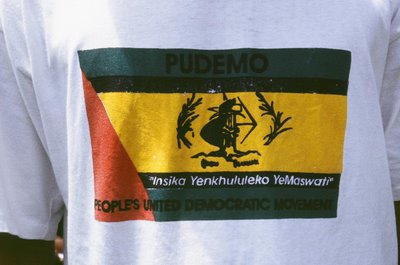

PUDEMO Press Statement on-A Secret Army or a Fairy Tale Story?
Date: November 28, 2006
The South African-based daily newspaper, The Star (25/11/06), reported to have uncovered a PUDEMO/SWAYOCO secret guerrilla training 'camp' and plans to violently overthrow the Swazi regime. According to the report, the camp is run by the Young Communist League. This story must go down in history as one of the greatest fairy tale stories that have been told about the Swaziland liberation movement. The Swazi Observer (27/11/06), a royal family-owned daily newspaper, was the first to reproduce The Star's report in Swaziland with a high degree of sensationalism. Although The Star does not mention the military capacity of this 'guerrilla unit', The Swazi Observer calls it "the deadly unit" (Ibid).
Readers should not be surprised by this report because in the past, there have been numerous fabricated stories of armed insurrection plans linked to PUDEMO and its youth wing, the Swaziland Youth Congress (SWAYOCO). Each time, we remind our people, the international community and the media of our policy. We again take this opportunity to reiterate that our policy is to peacefully bring about political change in Swaziland. In his response to the report, the PUDEMO President, Cde Mario Masuku, unambiguously affirmed the organisation's commitment to this policy. Recently, Masuku told the Chris Hani Institute that PUDEMO believes that there is still hope for a peaceful dialogue with the regime.
Although the government has never responded to numerous calls from our organisation for a negotiated solution to the political crisis, we have not yet abandoned our policy. Unfortunately, the government has abused our commitment to peace by waging a violent witch-hunt against our membership. It has misinterpreted our non-violent resistance as an invitation for the state to use violence against us.
For more than twenty years, the regime has worked tirelessly to draw our organisation into a violent confrontation but we have maintained that we will not be drawn into such confrontation on the government's terms. Our policy priority is peace and restoration of political, social and economic harmony among our people. We are more interested in making life better for all Swazis than destroying it as this government has done for many years. This is what the regime fears – our capacity to make a difference and give Swazis a fresh start in life. The regime cannot engage with PUDEMO because it does not have the political competence to remain viable in an open democratic environment.
It is telling that the only time the government talks about PUDEMO is in relation to fairy tale stories. This time, the story is about an armed insurrection. In late 2005 and early 2006, the government peddled allegations of a PUDEMO/SWAYOCO petrol bombing campaign. The local media, particularly The Swazi Observer is guilty of giving unprecedented coverage of these slurs against our organisation. Both the government and The Swazi Observer have refused to engage with the substantive issues we continually raise about the future of this country and its people. Instead, they are concerned about protecting the political and economic privilege of the ruling royal family. The so-called training guerrilla camp is a rehashed old strategy to divert public attention away from the current corruption scandal involving senior government officials.
The timing of the report is interesting. It could herald the beginning of the treason trial against our members accused of the so-called petrol bombing campaign in December 2005. Several PUDEMO and SWAYOCO members were rounded up and accused of fire bombing government infrastructure. One of the accused was tortured to make false confession and subsequently turned into a state witness. However, he later withdrew his statement claiming that it was made under duress. This put the prosecution case at risk. The Directorate of Public Prosecution applied for an indefinite suspension of the trial whilst it searched for a new state witness and 'fresh evidence'. A year after the first arrests, our members are still awaiting trial. Could the report published in The Star be the 'smoking gun' the government is hoping to produce as evidence against our members?
Alternatively, the enthusiasm with which government officials have received The Star's story could be the beginning of another violent Christmas witch hunt against our membership. Renown for his hatred of the pro-democracy movement, the government spokesperson, Percy Simelane, warned of a massive crackdown ( The Swazi Observer, 27/11/06). In 2005, police tortured an innocent woman to death in their fanatic attempts to prove the existence of mythical PUDEMO 'petrol bombers'. As was the case in 2005, the government will use the training camp story to create unnecessary public panic and present itself as the guardian of peace in the hope that this will yield political benefits.
We have been waiting for some time for the regime to try to cash in on international fears of terrorism by trying to implicate PUDEMO in terrorist activities. Unfortunately, their attempts to do so have been characteristically incompetent. As we have mentioned, the attempt to construct a PUDEMO-led bombing campaign has been a spectacular failure. This latest attempt is also inept and should embarrass any self-respecting dictator.
Michael Schmidt, the author of The Star article, must hang his head in shame for allowing himself to be used by this evil regime. None of the people he contacted other than his so-called informant, confirmed the existence of a secret PUDEMO/SWAYOCO guerrilla army. Even the siSwati name of the 'guerrilla army' (uKukhulwa eMaswati) does not make sense – but then perhaps it is unfair of us to expect a non-Swazi to be competent in Siswati when he is writing fairy-tales. Schmidt writes that this "is an official yet underground armed wing of Pudemo…" but fails to support this with concrete evidence. Thus, the story lacks even the tiniest fragment of credibility. Michael Schmidt was a white apartheid supporter and a Communist hater fearful of the 'red plot' in the 1980s. He now hopes to use our liberation movement to mobilise the royal family in Swaziland to hunt the 'reds' under the beds. Anyone who believes in this story believes in Alice in Wonderland.
Signed
Dr. Jabulane Matsebula
PUDEMO Representative Australia, Asia and the South Pacific Region
Tuesday, November 28, 2006

Monday, October 30, 2006
Swaziland rewards corruption and political incompetence
PUDEMO International Office
E-mail: pudemo@yahoo.co.uk
Date: October 30, 2006
Swaziland rewards corruption and political incompetence
In a space of one week, the Swaziland government offered handsome rewards to bad practices of governance. On October 19, 2006, parliament appointed Thandi Nxumalo, an allegedly corrupt businesswoman, to the Senate. According to the Times of Swaziland – Sunday (October 22, 2006) report, the new Senator admitted swindling money from the Women United business enterprise. The story appeared again in the October 29 edition of the Times of Swaziland – Sunday with information that a formal charge has been laid against the new Senator. According to the report, Senator Nxumalo has been charged for defrauding Women United a sum of E530 974.58 (approx. US$76,000).
A week after the “election” of Nxumalo, King Mswati III promoted Constance Simelane, to the position of Deputy Prime Minister. Constance Simelane is a minister with an irrefutable record of incompetence and was moved from the Ministry of Education after widespread criticisms about the failure of leadership within the ministry. Many commentators, including the Swaziland National Association of Teachers (SNAT), have described the education system as being in crisis and in desperate need of fresh and innovative leadership. Recently, students from the University of Swaziland, William Pitcher Teacher’s College and Swaziland College of Technology abandoned classes to protest against the mismanagement of scholarship. In response to the crisis in education, particularly the mismanagement of the OVC (Orphaned and Vulnerable Children) funding scheme, SNAT called for the removal of the minister. Instead, she was promoted to the Deputy Prime Minster’s position.
It is disgraceful that King Mswati III and his Prime Minister chose to ignore public opinion. The royal family government is so drunk with power that it can’t even hear the increasingly loud voices of concerned citizens. It can’t see if it is going sideways, backwards or forwards. When the Australian Channel Nine Sixty Minutes TV crew asked King Mswati III if “the king gets too much criticism in Swaziland”, he said he didn’t know. Western audiences thought that he was avoiding the question but it is quite conceivable that he doesn’t know how much he is being criticised. Disturbingly, the King is completely insulated from criticism by the local media which refuses to publish criticisms against the monarch. In any case, he is drunk with power and has no interest in listening to the public. His absolute rule is now firmly protected by the Commonwealth-sponsored Constitution Act of 2005.
Media complacence, bias and self-censorship
Within the local media, it is established practice to apportion blame for bad governance to the cabinet in order to absolve the King from responsibility. The recent appointment of Constance Simelane has been viewed in the local media as a bad choice by the Prime Minister. Whilst it is public knowledge that the Prime Minister makes recommendations to the King about ministerial appointments, he does not have the authority to appoint or dismiss ministers. This authority rests with the King alone. The view that cabinet ministers are appointed and dismissed by the Prime Minister is misguided. It ignores the King’s absolute authority on such matters and the powerful influence of the royal inner circle which advises the King. In most cases, this advisory body is responsible for nominating and recommending individuals for cabinet positions. Simelane may have been nominated by the Prime Minister but this would have had no effect if the nomination was not blessed by the King and his advisory body. If Constance Simelane is a bad choice, she is King Mswati III’s bad choice.
It is time for the local media to be more honest and less biased in its coverage of matters relating to the governance of this country. Whilst it is understood that local journalists operate under extreme conditions of censorship, they contribute to this situation through self-censorship and political bias. There is a well-established policy in the local media to favour coverage of political views that absolve King Mswati III of responsibility for current problems. Consequently, journalists prefer to work with political organisations that have relationships with the royal family and those that pursue a reformist agenda. Voices which locate the current political malaise within the absolute monarchy system of government are denied access to the media. PUDEMO is one political organisation that calls for a broader political approach to the problems we face in this country. Like many of our public statements, it is highly likely that none of the local media will have the courage to publish this article because of its critical stance against the absolute monarchy.
As a result, Swaziland has been unable to publicly debate the extent to which the monarchy contributes to Swaziland’s problems. The monarchy is not only immune from adverse media coverage but also from public parliamentary discussion and government statements. On several occasions, the Speaker of Parliament, Charles S’gayoyo Magongo, reminded MPs not to mention the name of the King in parliamentary debates. It is not surprising that Magongo has been elevated to a cabinet post as a reward for loyalty. Where there is a God-like institution, democracy dies and blind loyalty to the ruling elite becomes an important means of political advancement. This has been the case in Swaziland since the King’s Proclamation in 1973 when the late King Sobhuza II declared himself an absolute monarch.
PUDEMO calls upon the media to engage in comprehensive debate about the political, social and economic crisis we face in this country. The freedom of the press enjoyed in other countries will not come easily without a bitter struggle and sacrifices. One of the main indicators of a free nation is the quality of media reporting including deeper analysis of social problems. As we have said in the past, any attempts to find long-term solutions to the myriad social, economic and political problems will prove inadequate unless these problems are understood in relationship to the current political system. PUDEMO regards the Absolute monarchy and its Tinkhundla system of government as a major problem. For the entire post-colonial period, the royal family has dominated the political decision-making process and is accountable to no one but itself. It is time for the local media to take this issue to the public arena. Instead of asking the Prime Minster why a minister known to be incompetent was promoted to a senior position, the media must direct this question to the appointing authority and head of state – King Mswati III.
Tinkhundla electoral system delivers corrupt senator
When the late Deputy Prime Minister, Albert Shabangu died, he left his seat in parliament and his cabinet position vacant. Under normal democratic procedures guided by the doctrine of representative parliamentary democracy, a by-election should have been held to fill the parliament seat left by the late Deputy Prime Minister. However, the electoral system in Swaziland has a conveyor belt which determines who goes into parliament and cabinet. Shabangu was also a product of this bizarre electoral system in which people are appointed rather than elected to parliament. For more than twenty years, Shabangu served as a cabinet minister but has never contested any elections. His political career depended entirely on royal appointment and favour, not the people’s vote.
One of the flaws of the current political order which PUDEMO seeks to change is the electoral system which has delivered an apparently corrupt businesswoman to parliament. The system is characterised by practices antagonistic to democratic principles. Prominent among these practices is the King’s right to appoint a certain quota of members of parliament. Similarly, the electoral system gives parliament the right to “elect” another quota from the general population. This so-called election occurs behind closed doors under strict conditions of secrecy. The social status and conservative political views of previous and serving MPs “elected” by parliament indicate heavy royal influence. The rest of the parliamentary seats are elected by popular vote on a non-party basis. Again, royal influence is actively visible here through the nomination process in which candidates are graced by chiefs who are traditional representatives of royal authority. In Swaziland, a candidate deemed a preferred choice of labadzala or royalty, has unmatched advantage to succeed in elections.
Under the current electoral system, there is no inbuilt framework of checks and balances to allow adequate investigation into the character, ability and suitability of people nominated for public office. Political campaigns, an important measure of political leadership potential, have a very limited role in Swaziland elections. Thus under the current electoral system, where only independent individuals can contest parliamentary seats, elections are policy-free zones. The system is antithetical to principles of political transparency, accountability and responsible governance and is constructed as to prevent the development of representative parliamentary democracy. As illustrated by the “election” of Thandi Nxumalo, people unfit to be law-makers and political administrators can easily pass through the enormous holes in Swaziland’s electoral system. It is no wonder that the government and the law-making body in Swaziland provide a good home for corrupt and incompetent politicians.
Entrenched culture of bad governance and deceit
These recent developments may have shocked some political observers but to the majority of Swazis they represent a familiar and deeply entrenched culture of rewarding bad behaviour. Recently, the Minister of Public Service and Information, Themba Msibi, interfered in the administration of the state television station by overturning a decision to dismiss an employee, Qhawe Mamba. Qhawe, a close friend of King Mswati III, was dismissed after allegations of theft of equipment, failure to execute his duties with diligence and insubordination. The Minister’s reason for overturning the decision was that Mamba is employed by labadzala or the royalty. This is normally an industrial issue but in Swaziland it seems that a minister can do anything as long as it is in the interests of the ruling family. The employee in question also owns a public-funded television station which is solely responsible for documenting royal events. The service provided by Mamba’s station is one of the biggest publicly-funded propaganda projects and is designed to salvage the discredited image of the monarch government.
Prime Minister, Themba Dlamini seems determined to expand the propaganda project. Recently, he announced a plan to recruit former heads of states to act as travelling agents for Swaziland (see The Swazi Observer, October 27, 2006). This plan was revealed at the same press conference in which the promotion of Constance Simelane was announced. These two announcements represent a double jeopardy scenario for the people of Swaziland. The promotion of an incompetent minister to a senior cabinet position is a severe blow to effective governance. Having been dealt a severe blow, the tax payer will now have to pay the expense of employing international spin doctors. The project is misconceived and morally repugnant. It will dig deeper into the public purse and exacerbate the country’s financial difficulties.
This money could be better spent on urgent needs such as health instead of flying out and paying exorbitant living expenses for former heads of states to spread false propaganda. It is almost certain that the recruitment will target former heads of state with outstanding records of bad governance in their own countries. Themba Dlamini wants his travelling agents to rebuild the image of the country by refuting what he calls “…negative and misleading information that is constantly being published about the kingdom” (The Swazi Observer 27, 2006). However, the Prime Minister was unable to say what information he deems misleading and negative. Is exposing social injustice and bad practices such as corruption, irresponsible spending and absence of democratic forms of governance misleading?
The government has been in bad shape for a long time now and Swaziland is a failing state. Some of the main indicators of a failing state are high levels of corruption and poverty, economic decline and financial bankruptcy, incompetent political leadership and collapsed essential services such as health. These indicators are very prominent in Swaziland with about two-thirds of the population of 1.2 million living in abject poverty whilst the royal family and a few politicians immerse themselves in wealth. There is growing consensus among political observers in Swaziland that the government is now bankrupt and is unable to fund basic public services. Public hospitals are overcrowded and have run out of basic medical supplies such as pain relief drugs and oxygen. HIV infection continues to devastate the impoverished population and there is no reprieve in sight from AIDS-related illness and death.
In his first attempt to respond to growing concerns about Swaziland’s slide into the failed state category, the Prime Minister, Themba Dlamini, “…said it was astonishing to note allegations relating to the HIV and AIDS pandemic in Swaziland. He said Swaziland had been ranked as one of the best models in the fight against HIV/AIDS” by international organisations such as UNAIDS (Swazi Times, October 24, 2006). It is important that the Prime Minister wakes up to the reality about HIV infection in Swaziland. The high rate of infection is not an allegation but has been derived from research data. According to the report published by National Emergency Response Council on HIV/AIDS (NERCHA – Swaziland) in 2006, “…the HIV problem in Swaziland is spreading at an alarming rate. In the last 12 years the HIV prevalence increased from 3.9% in 1992 to 42.6% in 2004” (p.4).
Whilst the Prime Minister was happy to announce that UNAIDS has highly ranked HIV/AIDS programs in Swaziland, he seems to be dismissing UNAIDS statistics on HIV/AIDS prevalence as allegations. There is a general agreement among international bodies working in this area that Swaziland has the highest HIV/AIDS prevalence rate in the world. As shown in the UNAIDS graph below, in the Sub-Saharan African region, Swaziland has surpassed Botswana which, in previous years, has had the highest infection rate.

Source: UNAIDS, 2004 Report
Like his Prime Minister, King Mswati has also misled people about the effectiveness of the umcwasho (chastity) strategy in preventing the spread of HIV infection. Umcwasho is an old-age traditional practice to delay sexual activity among teenage girls. In 2001, King Mswati reintroduced umcwasho under a new ‘chastity law’ which prohibited young women under the age of 18 years from having sex for five years. Failure to conform to the ban on sex attracted heavy sanctions. Families of the offending parties, woman and men, were required to pay a cow each - a highly priced treasure in Swaziland. However, by the time the chastity period ended in 2005 the ban was largely ignored and the enthusiasm by royal authorities to impose sanctions had died away. A survey by NERCHA (2006, p.23) shows that “the proportion of young people reporting to have started engaging in sexual practice below the age of 15 was about 10%.” This figure is alarming and is perhaps much higher if the 15-18 age group is taken into consideration.
There is strongly divided opinion between HIV/AIDS activists and traditionalists whether or not the ‘chastity law’ has helped in the fight against the epidemic. When the Australian Sixty Minutes television journalist asked King Mswati III about the effectiveness of the ‘chastity law’ in fighting HIV/AIDS, he replied: “I was so happy to see that the figures of the HIV rate from their age group it decreased a lot, it helped the country very much.” The King did not back up his statement by saying which figures he was referring to, but we assume that these figures should be in the public domain somewhere. After considerable research, we were able to locate only one set of figures in the public domain which show any decline in HIV rates for that cohort and assume that these figure are the ones to which he referred.
The figures were reported in the Ministry of Health and Social Welfare HIV Ninth Sentinel Serosurveillance Report of 2004. The report shows a slight decline in HIV infection among pregnant teenagers in the 15-19 years age range from 33.5% in 2002 to 29.3% in 2004. There are no statistical analyses of the data recorded so we do not know if the change is in fact statistically significant or if it represents a chance fluctuation. These figures are not representative of the entire population of teenage girls within this age group because they represent a population of pregnant teenagers who attended Ante-Natal Clinics (ANC) and were tested for HIV infection (see Figure 1).

In response to the report, the Prime Minister and the Minister of Health and Social Welfare misled the public by claiming that these data show that “ Swaziland had turned the corner in its battle with AIDS” (IRINnews.org, August 23, 2005). Contrary to the claim by King Mswati III, these data have nothing to do with umcwasho as they are taken from pregnant teenagers who attended Ante-Natal Clinics. The fact that they were pregnant shows that they had broken the ban on sex. If the slight decrease in HIV infection rate is real and not a chance fluctuation, it might reflect changes in risk behaviours of the form promoted by other anti-HIV campaigns, such as increased monogamy. Thus, these data cannot be honestly interpreted as showing that umcwasho was successful in arresting HIV infection rates. Since its introduction in 2001, its main goal was abstinence and not changes in behaviour. Thus, these data are irrelevant to umcwasho, as they relate only to people who, by definition of their pregnancy status, have not followed umcwasho.
A systematic study of the relationship between the ‘chastity law’ and HIV prevalence is yet to be conducted. The pregnancy rate among this age cohort within the period of the sex ban would be more relevant to considering the effectiveness of umcwasho . A significant decline in pregnancy rates might indicate increased abstinence amongst this cohort of women, although it could of course indicate the increased prevalence of other forms of safer sexual practice such as condom usage. During the period of umcwasho, there were a range of other interventions such as anti-HIV/AIDS programmes organised by non-government organisations. Most of these programmes have serious reservations about the contribution of the ‘chastity law’ to the anti-HIV/AIDS campaign. Consequently, umcwasho does not feature in local and international periodic progress reports. Even NERCHA, a statutory body, does not mention umcwasho in its 2006 report. One would assume that if the chastity strategy was effective, it would have featured significantly in the NERCHA report. Instead NERCHA developed its own program (Likusasa Ngelami or The Future is Mine) to encourage young people to consider the health benefits of abstaining from sex.
Royal claims that umcwasho has been an effective intervention in the HIV epidemic just serve to illustrate the regime’s failure yet again to operate in the real world. Their response to the HIV epidemic has been grossly inadequate and now they are citing completely irrelevant data in attempts to show that their intervention was useful. Do they really believe that telling a small section of the female population to abstain from sex would have any impact on the HIV rate? This is ridiculous and in fact there are many ways in which umcwasho could have made the situation worse.
For example, umcwasho may have increased the likelihood that young males in the cohort would have become sexually active with female populations likely to be experiencing higher levels of infection, such as older women and sex workers. The graphical data in Figure 1 show that women in the older cohorts have higher infection rates and that these seem to have increased from 2002-2004, especially in the 25-29 year old and 30+ year old cohorts. Thus, even if young females obeyed umcwasho and delayed becoming sexually active, they may well have found that their male age-peers were more likely to be infected than would have been the case without umcwasho. Their risk of infection once they finished umcwasho and became sexually active with age-peer males may have thus increased. Thus, even if umcwasho managed to delay onset of sexual activity and HIV infection in that female cohort, the longer term outcome could well be higher rates of infection. Ultimately, the King might gain some benefit from having a pool of young virgins from which he chooses a new wife each year at the next reed dance ceremony, but it seems unlikely that umcwasho would help reduce Swaziland’s HIV rate.
The King’s response to the HIV epidemic is reminiscent of the story about Emperor Nero sitting in his palace playing his fiddle while Rome burnt to the ground and his people died. In Swaziland, we have an absolute monarch who sits in his palaces and plays games while people die. Then he takes credit for any positive changes in the HIV rate and completely disregards all the work done by non-government organisations who have struggled to conduct sensible HIV prevention programmes. This is rather like Nero claiming that his fiddling put the fire out and fed the people while failing to mention the emergency services.
Our people are hungry and dying whilst the royal family and politicians are dreaming of the past, stealing from the poor and spending lavishly. The Australian Sixty Minutes television documentary describes the hospital situation as “awful” and gives glimpses of royal luxury, hospital overcrowding, poverty and death. According to the World Health Organisation (WHO, 2006), the life expectancy for men and women in Swaziland is 36 and 39 years respectively.
The Sixty Minutes crew put it to King Mswati that one of the concerns in Swaziland is that he is a big spender and is running the country aground. The King denied this whilst sitting on a golden chair during the interview. He argued that his critics “…don’t know what they are talking about. They haven’t got that information…”. King Mswati is correct because the details of his family spending are a closely guarded secret. However, the lavish lifestyle displayed by the royal family is there for all to see including a fleet of ultra expensive automobiles such as a Maybach 62 and an S-Class Mercedes Pullman. When King Mswati III paid a staggering US$500,000 for the Maybach 62, he became only the third person in Africa to own this car. Royal family children go to prestigious educational institutions in the UK and USA whilst the government is unable to honour its pledge to pay fees for disadvantaged children orphaned by the high AIDS death rate.
Swazis and the international community would remember very well the US$45 million private jet scandal in 2002 when the government and Tibiyo Taka Ngwane secretly planned to steal public funds and buy King Mswati an18-seater Global Express jet. At the time, the cost of the plane was more than twice the health budget. When the information was leaked to the press, no one was willing to own up to this secret plan. However, as outrage about the purchase mounted, it transpired that a deposit of about US$4 million had already been paid. This money has never been recovered. The current Prime Minister, Themba Dlamini was the Director of Tibiyo Taka Ngwane, when the plan was hatched. Tibiyo Taka Ngwane is a multi-million corporate body held in trust for the Swazi nation by the royal family. One of its responsibilities is managing royalties paid to the country by various companies doing business in Swaziland. However, since its formation in 1968, Tibiyo Taka Ngwane has operated as a private royal family business but politicians continue to mislead the nation that this corporate body belongs to the Swazi nation.
The betrayals in Swaziland go on and on. There can now be no doubt about the corruption in this government or the extent of its contempt for its people. While international donors do their best to support ordinary Swazi citizens, the prospects of real change are slim as long as there is no adequate infrastructure to deliver services and aid with integrity. Please support the struggle for democracy in Swaziland and help put a stop to this human suffering.
Signed:
Dr. Jabulane Matsebula
PUDEMO Representative
Australia, Asia and the South Pacific Region
Wednesday, September 13, 2006
The University of Swaziland threatened with closure
The University of Swaziland threatened with closure
The People's United Democratic Movement of Swaziland
(PUDEMO) International Office
(Australia, Asian and the South Pacific Region)
E-mail: pudemo@yahoo.co.uk
September 13, 2006.
The People's United Democratic Movement deplores the threat to shut down the University of Swaziland if students do not return to class. This bullying approach to genuine student concerns has been the culture of this institution since the Liqoqo regime in the early 1980s. Successive leaders at the university have been socialised into this defective leadership culture in which threats and aggression rather than reason is a preferred model of administration.Consequently, the university has become a microcosm of the broader political system that is characterised by extreme levels of intolerance,incompetence and absence of public accountability.
One of the students' grievances is the late payment of scholarship allowances, which means that they are unable to purchase basic necessities such as food and stationery.This is a recurring issue that has a long history. University and government officials have shown no capacity and will to adequately address concerns by generations of university students about this matter. Instead, they resort to aggression and ridicule. On numerous occasions, the university administration has shut down the institution in an attempt to mute students' concerns. Armed police are regularly used to violently suppress students' peaceful protest.
When university students marched to the Ministry of Education and the Prime Minister's office on September 7 to deliver a petition, they were confronted by armed police. A violent skirmish ensued, leaving scores of injured students. Even the Police Commissioner, Edgar Hillary who is renowned for his violent aggression, commented that the police violence was uncalled for. Hillary must do more than this by instituting strict disciplinary actions against the senior officers who ordered the attack. It would be generally expected under a responsible system of government that an independent investigation into the violence would be conducted. However, Swaziland is a failing state with no political will and limited administrative competence to exercise the responsibilities of a responsible government.
In a functioning state with proper financial systems, it really is not difficult to ensure that students or any other group of citizens receive the payments to which they are entitled. After the state has allocated budget to tertiary scholarship, the funds must be quarantined and not used for any other purpose.This guarantees the orderly payment of tuition fees and student allowances. If errors are made in a functioning state, it is no big matter to apologise and fix the problem. Consider the situation in Swaziland, where the government is repeatedly unable to pay the allowances in a reasonably orderly fashion, presumably because it has squandered the money on new luxury cars for the king's wives. Then, when the students request that the problem be fixed, they are demonised and physically injured by the police, whose role is supposed to be to protect the public! It is like a man who drinks all the money for his family then beats up his wife and children when they ask him for food.
The Swazi government is stumbling from crisis to crisis and each time its corruption and incompetence is on display for all to see. This kind of governance is a problem for those people immediately affected by the crisis (in this case the students) but it is also a problem for all Swazis and its effects last for a long time after the crisis has been resolved. For example,this kind of incompetence has significant implications for how Swaziland is regarded by business and other countries. If we repeatedly present ourselves as a country that cannot manage basic financial transactions or peacefully resolve what is a very simple conflict, then we are continuing to build an image of Swaziland as a poor candidate for investment and economic growth. The collapse of the rule of law in 2002 was profoundly embarrassing and the many subsequent crises of poor governance can only further damage our image. If Swaziland continues to present itself as a national joke, we will find it difficult to attract quality economic growth. If we are seen as incompetent, investors will stay away. If we are perceived as oppressive as well as incompetent, we may find that some investors come to Swaziland but that we have attracted those who see the combination of incompetence and oppression as an opportunity to exploit the government and our people.
The Minister of Education's response to the scholarship matter has been pathetic. Her initial reaction was to rebuke and demonise the students as a "crowd" and "mob". This is a typical example of an incompetent politician who resorts to degradation rituals to cover up her incompetence. According to the Swazi News (09/09/06) report, the minister told the university Student Representative Council that "...as a ministry we are not here for playing...", but this is what exactly the ministry is doing - playing with the future of our education system. Constance Simelane is a national disgrace and has done so much damage to our education system.
In a functioning state, the issue of scholarship and particularly the payment of student allowances would not have come this far. However, in a failing state such as Swaziland where corruption and incompetence are the only visible features of governance, nothing gets fixed. Whilst the Minister has finally assured students that their allowances have been deposited into the bank, she does not have a long-term strategy to deal with this recurring problem.Instead, she will sit on her hands and wait for another class boycott and more injured Swazis before she again reacts to this long-standing concern with another short-term fix. This week students at the Swaziland College of Technology (SCOT) are also boycotting classes because of this problem.
Education is one of the most important sectors for national growth. It is irresponsible for any government to entrust responsibility of this sector to an incompetent minister. PUDEMO has earmarked education, health and the economy as our policy priorities. We strongly believe that a government that does not regard these sectors as priorities for public investment is a failed government. When we take over government, we will revolutionise these sectors by building efficient systems of service delivery and management. Our immediate goal in government is to put a stop to corrupt practices and lavish spending for the royal family. We believe that corruption and royal spending consume a significant percentage of national revenue. Putting a stop to this rot and recovering this revenue is the task to which we have committed ourselves in government.
The university class boycott must be understood within the broader political context which promotes a culture of incompetence and irresponsibility. It is a result of decades of leadership failure at state and institutional levels. Both the government and the university administration must take full responsibility for the recurring problem that led to the class boycott. It is time for the university leadership to make a significant culture shift by adopting new ways of dealing with student grievances. As it has been demonstrated from time to time, bullying tactics have not resolved the problem.The university desperately needs a new generation of leadership with fresh insights into tertiary administration. We deplore the continued dominance of the university administration by a tired old guard which has become a total liability to the future of this institution.
Signed:
Dr.Jabulane Matsebula
PUDEMO Representative
Australia, Asia and theSouth Pacific Region
Wednesday, August 30, 2006
PUDEMO Letter to The African Human Rights Commission
The African Human Rights Commission
The Director
Mbabane
Dear Madam
PUDEMO is pleased for being afforded the opportunity by the commission to brief it about its position regarding the adoption and coming into force and effect of the Swaziland Constitutional Act 001/2006.
BRIEF BACKGROUND
The purported ‘acceptance’ of the Constitution by His Majesty the King and a small section of the Swazi nation it to be lamented as it will be recalled that such“acceptance” was done amidst objection by organised civil society, basically for the reason among many that the process was exclusionary, in that it prevented and prohibited a large section of the people of Swaziland from participating and making submissions to both Constitution Review Commission and the Constitution Drafting Commission. While the said reception of the Constitution by His Majesty the King andsome members of the Swazi nation cannot be said to have been acceptance by all the people of Swaziland, the enactment thereof by Parliament was also flawed inthat Parliament was not authorised and mandated to do so, particularly giventhat it is not itself a product of a democratic process representing thegeneral consensus of the people of Swaziland.
In this regard, it should be noted that in as much as the Tinkhundla system of Government was imposed upon the Nation by King Sobhuza II, it does not represent the exercise of sovereignty by the people. This is the main faction of the Tinkhundla system of government which criminalises and bans political parties. The electoral process under this system, is an important element of deception as evidenced by the fact that both the candidates and the voters donot decide anything fundamental and basic, but are used to rigidly set the term and parameters on acceptable position of major political question. The report of the Commonwealth Expect Teamof October 2003, it stresses this point by saying “We do not consider the creditability of the national elections as an issue; no elections can be credible when they are for parliament which has no power and when political parties are banned’.
It must not be left out of account that this electoral system and the regime governing its operation which this constitution purports to enshrine in section 79 thereof does not come any closer to the electoral bench mark envisaged by the Electoral Institute of Southern Africa.
Note further that the African Commission, after due consideration and determination of the Swaziland Lawyers for Human Rights petition found that the Swaziland Constitution making process was exclusionary and in the result undemocratic and contravening some international conventions which Swaziland was signatory to. This constitution is a recipe for national strife, whose consequences are too ghastly to contemplate.
CONSTITUTIONAL CHALLENGE
After ong preparatory discussions and consultations with various stakeholders and legal experts, PUDEMO and other organised civil society groupings have ultimately resolved to institute legal proceedings to challenge the validly ofthe 2005 Swaziland Constitution on the following grounds.
a) That the process did not comply with spirit, object and purport of the provisions of the King’s Proclamation to the Nation of 1973, particularly paragraph 2(e)thereof which reads thus:-
That I and all my people heartily desire at long last after a long constitutional struggle, to achieve full freedom and independence under a constitution created by ourselves for ourselves in complete liberty and without outside pressures; as a Nation we desire to march forward progressively under our own constitution guaranteeing peace, order and good government and the happiness of all our people.
The fact that the said Proclamation was a legal nullity from its inception is no longer an issue served to show the propensity on the part of the powers that be, even in future to act unconstitutionally and unlawfully and to the further detriment of real and genuine national interests. It should be noted that interms of the constitution at issue, His Majesty the King can even unilaterally and/or on the advice of the prime minister, who is appointed by him, repeal this constitution.
b) The2005 Swaziland Constitution was not accepted by the King and the whole Swazi nation as envisaged by Section 80 (2) of the 1978 King’s Order Council,pursuant to the spirit of the 1973 Proclamation. PUDEMO holds the view that a process of returning the country to a constitutional multiparty parliamentary democracy has to be initiated and implemented by a body that has been created through universally recognised democratic principles. Anybody else, inclusive of the said Constitutional ReviewCommission (CRC) and the Constitutional Drafting Commission (CDC), created outside this minimum standard invariably lacks the mandate and is unable to command national respect and support and as such it cannot create the necessary foundation for peace and good government. Note further that the commissioners for both the said CRC and the CDC were hand-picked and appointed by an individual [the king] who further imposed on them the terms of reference. If this, on the part of our absolute monarchy does not amount to absolute dictatorship, the latter needs to be redefined.
c) TheCRC and the CDC were wrong in giving a narrow meaning to Decree No.2 of 1996 and in the result, prohibiting, preventing and refusing all organised groups,particularly the applicants, from participating and to receive submissions from them.
d) In any case, the constitution making process was instituted by Decrees, yet His Majesty the King did not have power to legislate by decree; see Ray Gwebu vs. The King. Given that even the repeal of the Swaziland Independence Constitution was done unconstitutionally and unlawfully, the said propensity poses a real and immediate threat to the peace, prosperity and stability of the nation as pointed out in paragraph [a] herein supra.
e) In interpreting the provisions of the 1973 King’s Proclamation to the nation as read with the 1978 Establishment of Parliament Order, the 1996 Decree No.1 of 2002,the CRC and the CDC were obliged to take into account the provisions of international human rights instruments and international law, in order to giveeffect to the rights of each and every citizen of Swaziland, whether individually or as organisations especially in the context of constitution making. For these reasons, PUDEMO andthe other applicants request that the Court declares the 2005 Swaziland Constitution null and void, and of no force or effect.
In the alternative, it will be requested that the provision of the Bill of Rights,particularly Section 25 thereof must be interpreted to mean that the people of Swaziland have the right, not just to form associations such as churches,farmers association, community development schemes and others, but fundamentally that they have a right to form, join and belong to political parties and organisations on their own free will and of their voluntary choice for purposes of forming a Government. This is so particularly given that eight times the constitution pays respect to democratic principles, values and standards. In this respect Section 79 which purports to prevent and prohibit multi-party parliamentary national elections must be set aside as being null and void from the inception.
It is the view of PUDEMO, the other applicants and all right thinking and reasonable men and women of the Swaziland that democracy and good governance have been adequatelyand correctly defined and articulated and in the light hereof, Swaziland cannot re-invent the wheel. The basic tenants and attributes of democracy and governance are no longer in dispute even behind the façade of the so called unique Swazi culture and custom, which in order to survive the assault of time, should adapt to socio-economic and political transformation. It is accordingly unreasonable and as such, unacceptable the Swazi authorities in their Constitution Review Report undertake to domesticate the various international conventions, which the country has ratified only if they are not inconsistent with the not yet codified Swazi law and custom.
PLEA
PUDEMO wishes to plea with the people of the country, just as African leaders did under NEPAD agreement. Good governance,human rights and constitutionalism have been long denied in Swaziland. This so-called new constitution is not worthy the paper it is written on. It entrenches a system of government which,we as a people, have not agreed upon. That system is a discriminatory system and not giving value to the dignity (buntfu) of all Swazis. We have not only a moral obligation, but a duty to strive for a constitution that will ensure equitable sharing of resources, equal treatment of all people before the law,as well as the creation of independent structures that will guarantee the growth and development of constitutionalism.
It is not only for the reason of being excluded in the process that PUDEMO and other applicants denounce and reject this cattle byre Constitution, it is also because of the unacceptable contents thereof. We call upon the Swazi people to galvanise themselves so that, at the end of the day, they can all enjoy a better life under a government truly created by themselves, for themselves and accountable to them for all intents and purposes. We want a constitution that will create a conducive environment for peace and prosperity. A constitution that will, within the framework of civilised and acceptable constitutional law, provide an enabling environment wherein the people of this country can severally and/or jointly pursue, to the fullest, their separate and/or combined interests in social,economic, political and other fields of public life.
It is not only in the interest of the Swaziland, but the whole SADC region and Africa at large that Swaziland should be assisted to amicably resolve her constitutional and political problems. In this connection, pre-emptive action by the said region cannot be overstated.
The struggle continues.
Yours in the struggle
KISLONP. SHONGWE
DEPUTY SECRETARYGENERAL – PUDEMO
cc: Electoral Institute of Southern Africa –Victor Shale
Southern African Litigation Centre – NicoleFritz
Monday, August 14, 2006
State violence against SWAYOCO: a reflection on Commonwealth and Sibahle Sinje complacence about political repression in Swaziland.
The People's United Democratic Movement of Swaziland
Australia, Asian and the Pacific Region
E-mail: pudemo@yahoo.co.uk
August 14, 2006
State violence against SWAYOCO: a reflection on Commonwealth and Sibahle Sinje complacence about political repression in Swaziland.
For ten years the Commonwealth Secretariat has been misleading the international community by promising that a new constitution would bring about political change in Swaziland. It refused to listen to public concerns about the arbitrary and discriminatory approach to the constitution making process. The process excluded political party participation and was purely driven by the royal family and the Commonwealth Secretariat. Consequently, the new constitution is a product of a negotiated deal between the royal family and the Commonwealth. Many Swazis have come out to disown it.
PUDEMO and its youth wing, SWAYOCO, reaffirm the people’s commitment to continue the struggle for a system of governance that reflects the public’s aspiration for a new culture of responsible governance and respect for human rights. The recent peaceful protest led by SWAYOCO on August 5, 2005 is a reflection of this commitment. Since the adoption of the new constitution, PUDEMO and SWAYOCO have organised numerous peaceful protests which were all violently suppressed by the police. Surprisingly, no public statement was ever issued by the Commonwealth calling upon the government to stop this brutality. However, the Commonwealth Secretary-General, Don McKinnon was quick to condemn the so-called bombings in Swaziland. The government and the local media accused and persecuted our members of “bombing” state infrastructure between 2005 and 2006. A total of sixteen PUDEMO and SWAYOCO members were charged with High Treason and are now on bail awaiting trial under the new constitution supported by the Commonwealth. Under this Constitution, a conviction of High Treason can result in the death penalty.
When King Mswati III signed the controversial constitution in February 2006, the Commonwealth Secretariat renewed its commitment to support the dictatorship. On behalf of the Commonwealth, Don McKinnon, pledged further support to assist the Government of Swaziland to implement the constitution despite widespread public rejection of this law. Ultimately, this means that the Commonwealth is fully behind the application of the death penalty and would support the execution of our members if convicted on these trumped up charges.
In many of its deceitful statements, the Commonwealth Secretariat hid behind inclusion of the Bill of Rights in the constitution. The assumption is that the Bill of Rights guarantees and protects basic freedoms such as freedom of expression, association and assembly. We argued that the Bill of Rights will have no meaning and effect under the current political order. The royal family made it clear throughout the constitution making process that it is opposed to a Bill of Rights. It was only adopted as a deal between the Commonwealth and the royal family to give a semblance of respectability to the constitution. In this regard, the Commonwealth acted as a political spin-doctor for the regime and never, at any stage, showed any deep concern about the protection of basic rights and freedoms in Swaziland. Hence, to the general population these freedoms and rights remain an illusion. The judiciary is helpless because it has limited powers to enforce the Bill of Rights. Past experiences show that when the judiciary takes decisions to protect citizens against abuse of power by the state, the royal family moves swiftly and aggressively against such decisions and attacks the judiciary itself.
In 2002, the royal family government responded ruthlessly to the High Court’s decision to hear a case against the abduction of a school girl. It was alleged that she was abducted in order to forcefully marry her to King Mswati III. The government ordered the High Court to abandon the abduction case.
In the same year, the royal family responded ruthlessly to the Court of Appeal’s ruling to protect 200 families from Macetjeni and KaMkhweli who were cruelly evicted from their homes. In this case, the government ordered the police to disobey the Court of Appeal’s ruling. This threw the rule of law into crisis at the time when public dissent against the constitution making process was particularly intense.
As Swaziland teetered on the brink of becoming a failed state, its parliament failed the country completely. Not a single member of parliament questioned the eviction and the vicious attack on the administration of justice because it was sanctioned by the royal family. Under the new constitution, King Mswati and his family continue to enjoy total immunity from legal prosecution and political scrutiny. The courts will not prosecute him if complaints are levelled against him in his capacity as a head of state and overseer of government business. Parliament is under his iron grip and will not, under any circumstances, challenge or investigate his decisions.
The manner in which the Commonwealth dealt with the judicial issue in Swaziland was appalling. Its primary concern was to avoid a complete collapse of its constitution making project. In order to appease the royal family, it took up the role of travel agent to rebuild the damaged image of the royal family government in the international arena. Commonwealth officials told the international community that the government was doing its best to resolve the crisis. In September 2004, the government and the Commonwealth announced that the crisis was now resolved yet this was far from truth. The abduction case was never reopened and the evicted residents of Macetjeni and KaMkhweli were not allowed to return under the conditions set by the Court of Appeal. Ultimately, they returned to their homes under the conditions outlined by the royal family. Two senior police officers, including the Commissioner of Police, were found guilty of contempt of court because of their actions in blocking the execution of the Court of Appeal’s order. However, they have never been arrested and there has never been any attempt to bring the executive to account for its actions in denying the authority of the judiciary and bringing the rule of law to the point of collapse. When The Director of Public Prosecution, Lincoln Ng’arua, brought charges against the Attorney-General for his role in this matter, he was summarily dismissed from his job.
In its approach to the judicial crisis, the Commonwealth showed no concern about the gross violation of basic human rights and naked abuse of state power in Swaziland. The organisation did not concern itself with the evicted families and it offered no humanitarian assistance. We are yet to find public records of any Commonwealth expression of serious concern about the culture of bad governance in Swaziland and the poor human rights reputation of this regime. There is no substantial evidence to suggest that the existence of the Commonwealth-sponsored constitution has had positive impact with regard to the way in which Swaziland is governed. Violation of human rights, bad governance and political repression continue unabated.
As long as there is no political will and no commitment within the royal family to genuine political change in Swaziland, the Bill of Rights will remain meaningless. As has been shown by the recent police violence and determination to suppress demands for multi-party democracy, the state will continue to undermine the Bill of Rights with impunity. This clearly demonstrates the political bankruptcy of this regime. A regime that violates its own laws is morally and politically bankrupt. This is the prominent feature of the royal family government and the Commonwealth.
As we have stated on numerous occasions, the Commonwealth’s support and approval of a repressive political system in Swaziland is in stark contrast with its principles outlined in the Harare Declaration of 1991. It calls into serious question the ethics of the Commonwealth, particularly the Secretary-General who described the constitution “as a brilliant piece of work” (Swazi Observer, March 17, 2006). McKinnon honoured “…His Majesty King Mswati, who deserves our admiration for his own vision and statesmanship in having made it possible for this Nation to embrace constitutional rule” (Swazi Observer, February 19, 2006).
McKinnon must come to terms with the political reality in Swaziland. There is no constitutional rule in Swaziland. The government is cherry-picking in applying the provisions of the constitution, particularly when this concerns freedoms and rights. Why would police violently suppress peaceful protests with impunity if there is constitutional rule in Swaziland? What is the Commonwealth doing about this?
There is, therefore, demonstrated evidence that the Commonwealth and the royal family were not sincere when they included the Bill of Rights in the constitution. The primary object, it seems, is to trap and appease critics into believing that something good had at least come out of a bad process. This was the Commonwealth Secretariat trump card which it used successfully to mislead the international community. The Commonwealth continues to peddle this lie about the Bill of Rights. It recently told a Canadian Member of the Legislative Assembly of New Brunswick that the constitution is working well and political parties are now allowed in Swaziland. This statement is misleading at best and deceitful at worst. There is no mention of political parties in the constitution and there is no provision for parties to contest elections with the aim of winning over government. There is no single political party that has been legally registered in Swaziland. The government rejected an application for registration by the Ngwane National Liberation Congress (NNLC) - one of the pro-democracy movements.
It is irresponsible on the part of the Commonwealth not to inform the Canadian Member of the Legislative Assembly that the constitution making process does not enjoy the blessing of the majority of Swazis. Consequently, its legitimacy is highly questionable. A significant section of the population, including all pro-democracy groups, the labour movement and the church, has disowned the constitution. Even the chiefs, the most trusted ally of royal family, have now come out to disowned the constitution.
When the Commonwealth, through its representative Chief Adefuye, tried to bully us into accepting the constitution, we refused to participate in our own oppression. We reminded the Commonwealth of its obligation to the Harare Declaration of 1991 and that we will hold the organisation responsible for the continued repression and total neglect of the wellbeing of our people. By participating and continuing to support a constitution which gives false hope, the Commonwealth has turned against our people. This is a dereliction of political responsibility and duty of care to our people as citizens of the Commonwealth. It is a rude departure from the core principles of the organisation. We regard this position as a commitment to assist repression in Swaziland. It is a reflection of a determined world body to stand by the dictatorial regime as it bullies our people and suppresses political dissent.
Since the signing of the constitution into law, business has gone on as usual. PUDEMO and its youth wing, SWAYOCO, have been ruthlessly suppressed through false accusations and naked displays of violence. Recently, SWAYOCO peaceful protests in different parts of the country were violently crushed by trigger-happy police. Two of the peaceful protesters sustained serious gun shots and scores more were injured. Attempts to get medical treatment were not successful because the hospitals in Swaziland have been run down because of government neglect. As usual, the recent police violence escalated to indiscriminate attacks against members of the public who had not even participated in the protest, including children. We hold the Commonwealth responsible for this violence against our people.
Whilst the police were breaking up the SWAYOCO protest, the royal family’s surrogate political organisation, Sibahle Sinje, enjoyed all the luxuries associated with Swazi royalty during its 10th anniversary. Commonly referred to as a cultural organisation, Sibahle Sinje has declared itself a political movement. Its primary intention is to further entrench the absolute powers of the royal family in Swaziland politics. It was not surprising that the government spokesperson, Percy Simelane, immediately invited Sibahle Sinje to register with the government as a political party. This is bizarre given that the same government rejected NNLC’s application. Most importantly, there is no provision in the constitution for the registration of political parties.
Like the Commonwealth Secretariat, Sibahle Sinje pursues a double agenda. On one hand, it claims to advocate democratic change and on the other hand it is committed to the protection of the very system that resists calls for democracy. Similarly, the Commonwealth Secretariat prides itself as an organisation founded on strong democratic and human rights principles yet it actively encourages and assists human rights violations in Swaziland.
In its involvement in Swaziland, the Commonwealth Secretariat has aggressively pursued the idea of changing the system from within. It has bullied political organisations opposed to this approach and awarded those which share its ideas. The tactics used by Sibahle Sinje to recruit from the ranks of the ruling royal elite and to participate actively in formal politics, are consistent with the Commonwealth’s agenda. Ironically, Sibahle Sinje was established in 1996 when the Commonwealth actively entered Swaziland politics to rescue the royal family from a major crisis of political legitimacy. At the time, the regime was crumbling under sustained mass uprisings led by the labour and pro-democracy movements. Sibahle Sinje saw this as a threat to the monarchy and launched an aggressive fear campaign arguing that the movement for democracy would erode the nation’s cultural identity.
The use of culture as an ideology of fear and source of political power in Swaziland has a long history. It was used in the pre-independence campaign to delegitimise pro-multi party democracy movements such as the NNLC. In his infamous Proclamation to the Nation of 1973, Sobhuza II, father of the current king, used culture to justify his ruthless attack on basic political and human rights. Sobhuza II argued that multi-party parliamentary democracy and individual freedoms are unSwazi and would generate cultural disharmony. As evidenced by the recent police violence against SWAYOCO and the prohibition of political party participation in governance under the new constitution, this Proclamation remains effective. Culture remains a powerful ideology of fear and oppression, particularly in rural areas where 75% of the population lives under the watchful eyes of traditional chiefs.
By proclaiming itself to be the guardian of Swazi culture, Sibahle Sinje seeks to reproduce the repressive powers of this ideology. There is great desire within this organisation to monopolise the interpretation of our culture and hold the Swazi nation hostage of cultural practices that promote violations of basic rights and freedoms. By so doing, the organisation is actively participating in closing space for cultural growth. It is holding back the cultural intellectual development of the Swazi nation which is so vital in nation building and prosperity. When Sibahle Sinje was established, it echoed King Sobhuza’s views by publicly declaring that multi-party parliamentary democracy was culturally unacceptable. It denounced the growing number of Swazis calling for this system of governance as ‘not true Swazis’.
The Commonwealth also holds onto this notion of cultural incongruence to advance its double agenda. We have been consistently told by Commonwealth officials that multi-party democracy is not suitable to Swaziland because it is incongruent with the Swazi culture. This rigid view of culture and of democracy has been the cornerstone of the royal family political power. When the Commonwealth and Sibahle Sinje talk about Swazi culture, they speak not of the Swazi nation’s view of what this constitutes but of the royal family’s view of culture. Thus discourses of culture in Swaziland coalesce around the activities of the royal family and its surrogate bodies. The power to speak of Swazi culture authoritatively, what it is and what it is not, is regarded the preserve of the royal family. Organisations such as Sibahle Sinje and the Commonwealth have been steadfast in their commitment to preserve, if not to increase this power. In this context, the views and voices of the general population which offer alternative views are discarded as radical and delegitimised as‘unSwazi’.
Whether or not the similarity of the positions taken by the Commonwealth and Sibahle Sinje is coincidental, these developments run parallel to pre-independence politics. During the colonial era, the British administration ruled together with King Sobhuza II to suppress mass anti-colonial dissent. Referred to under the colonial administration as Paramount Chief, Sobhuza II was instrumental in ensuring corporation with the colonial administration because of his cultural influence among the population. The British government rewarded him by offering full support to his pre-independence campaign for office. Colonial representatives advised and assisted Sobhuza II to form a royal family political party – the Imbokodvo National Movement (INM).
IMN came into existence at the time when pro-independence protests, led by the labour movement and pro-multi party democracy organisations such as NNLC, was gaining influence. As can be deduced from the name Imbokodvo or grinding stone, the idea behind the formation of INM was the suppression and subsequent destruction of the pro-democracy movement. This movement was regarded within the royal family on the one hand, as advancing ideas that were alien to Swazi culture and on the other hand, by the colonial administration as communism. Culture as a political ideology was, therefore, central in INM campaigns and was effectively used to generate mass moral panic which delivered massive electoral victories for King Sobhuza II. In 1973, INM achieved its desire to destroy alternative political voices when King Sobhuza II unconstitutionally repealed the constitution and outlawed political parties and criticism against the state.
Sibahle Sinje, is a reincarnation of INM and thrives on fear of cultural annihilation. Through the politics of fear, today the organisation boasts of significant “electoral” victories. We detest the abuse of our culture for political gain, especially when it is used as a form of ideological terrorism to generate mass psychological terror among the population. In order to advance its cause, the organisation draws its membership from senior government ranks, the royal family and self-made moral entrepreneurs such as the royal palace governor, Jim Gama. Like INM, Sibahle Sinje hopes that it would, with the assistance of the Commonwealth, a British neo-colonial body, repeat history by crushing the nation’s aspiration for multi-party democracy.
If Sibahle Sinje is committed to genuine democratic change, it needs to make this position crystal clear and condemn state brutality against our people. It must rally behind the public’s demand for a fresh constitution making process with popular mandate. The Commonwealth has made its position clear that it does not support democracy in Swaziland. There is no need to involve it in a fresh constitutional dispensation. However, we are committed to persuade all Swazis, including members of Sibahle Sinje, to join hands and drive the new process.
PUDEMO will work with Sibahle Sinje if it is honest with the people of Swaziland by confronting the monarchy as a source of political repression. It has been shown from time to time that the political problems in Swaziland will not be resolved through piecemeal deals and half-baked strategies. Only honesty, boldness, innovation, relentlessness and commitment to the cause will propel us forward. PUDEMO and SWAYOCO have been bold and honest about their political convictions and objectives – the overthrow of the absolute monarchy system of governance and its replacement with multi-party parliamentary democracy. We stared the bull in the eye, frightened the weak and earned the respect of the fearless. Sibahle Sinje and the Commonwealth want us to go back and embrace the monarchy that is responsible for the current social, economic and political misery of our people. We say, NO! We shall not betray our people and principles. Our commitment is solid – improving the general wellbeing of the people of Swaziland by emancipating them from all forms of oppression.
Signed:
Dr Jabulane Matsebula
PUDEMO Representative
Australia, Asia and the Pacific Region
PUDEMO
International OfficeAustralia, Asian and the Pacific Region
E-mail: pudemo@yahoo.co.uk
August 14, 2006
State violence against SWAYOCO: a reflection on Commonwealth and Sibahle Sinje complacence about political repression in Swaziland.
For ten years the Commonwealth Secretariat has been misleading the international community by promising that a new constitution would bring about political change in Swaziland. It refused to listen to public concerns about the arbitrary and discriminatory approach to the constitution making process. The process excluded political party participation and was purely driven by the royal family and the Commonwealth Secretariat. Consequently, the new constitution is a product of a negotiated deal between the royal family and the Commonwealth. Many Swazis have come out to disown it.
PUDEMO and its youth wing, SWAYOCO, reaffirm the people’s commitment to continue the struggle for a system of governance that reflects the public’s aspiration for a new culture of responsible governance and respect for human rights. The recent peaceful protest led by SWAYOCO on August 5, 2005 is a reflection of this commitment. Since the adoption of the new constitution, PUDEMO and SWAYOCO have organised numerous peaceful protests which were all violently suppressed by the police. Surprisingly, no public statement was ever issued by the Commonwealth calling upon the government to stop this brutality. However, the Commonwealth Secretary-General, Don McKinnon was quick to condemn the so-called bombings in Swaziland. The government and the local media accused and persecuted our members of “bombing” state infrastructure between 2005 and 2006. A total of sixteen PUDEMO and SWAYOCO members were charged with High Treason and are now on bail awaiting trial under the new constitution supported by the Commonwealth. Under this Constitution, a conviction of High Treason can result in the death penalty.
When King Mswati III signed the controversial constitution in February 2006, the Commonwealth Secretariat renewed its commitment to support the dictatorship. On behalf of the Commonwealth, Don McKinnon, pledged further support to assist the Government of Swaziland to implement the constitution despite widespread public rejection of this law. Ultimately, this means that the Commonwealth is fully behind the application of the death penalty and would support the execution of our members if convicted on these trumped up charges.
In many of its deceitful statements, the Commonwealth Secretariat hid behind inclusion of the Bill of Rights in the constitution. The assumption is that the Bill of Rights guarantees and protects basic freedoms such as freedom of expression, association and assembly. We argued that the Bill of Rights will have no meaning and effect under the current political order. The royal family made it clear throughout the constitution making process that it is opposed to a Bill of Rights. It was only adopted as a deal between the Commonwealth and the royal family to give a semblance of respectability to the constitution. In this regard, the Commonwealth acted as a political spin-doctor for the regime and never, at any stage, showed any deep concern about the protection of basic rights and freedoms in Swaziland. Hence, to the general population these freedoms and rights remain an illusion. The judiciary is helpless because it has limited powers to enforce the Bill of Rights. Past experiences show that when the judiciary takes decisions to protect citizens against abuse of power by the state, the royal family moves swiftly and aggressively against such decisions and attacks the judiciary itself.
In 2002, the royal family government responded ruthlessly to the High Court’s decision to hear a case against the abduction of a school girl. It was alleged that she was abducted in order to forcefully marry her to King Mswati III. The government ordered the High Court to abandon the abduction case.
In the same year, the royal family responded ruthlessly to the Court of Appeal’s ruling to protect 200 families from Macetjeni and KaMkhweli who were cruelly evicted from their homes. In this case, the government ordered the police to disobey the Court of Appeal’s ruling. This threw the rule of law into crisis at the time when public dissent against the constitution making process was particularly intense.
As Swaziland teetered on the brink of becoming a failed state, its parliament failed the country completely. Not a single member of parliament questioned the eviction and the vicious attack on the administration of justice because it was sanctioned by the royal family. Under the new constitution, King Mswati and his family continue to enjoy total immunity from legal prosecution and political scrutiny. The courts will not prosecute him if complaints are levelled against him in his capacity as a head of state and overseer of government business. Parliament is under his iron grip and will not, under any circumstances, challenge or investigate his decisions.
The manner in which the Commonwealth dealt with the judicial issue in Swaziland was appalling. Its primary concern was to avoid a complete collapse of its constitution making project. In order to appease the royal family, it took up the role of travel agent to rebuild the damaged image of the royal family government in the international arena. Commonwealth officials told the international community that the government was doing its best to resolve the crisis. In September 2004, the government and the Commonwealth announced that the crisis was now resolved yet this was far from truth. The abduction case was never reopened and the evicted residents of Macetjeni and KaMkhweli were not allowed to return under the conditions set by the Court of Appeal. Ultimately, they returned to their homes under the conditions outlined by the royal family. Two senior police officers, including the Commissioner of Police, were found guilty of contempt of court because of their actions in blocking the execution of the Court of Appeal’s order. However, they have never been arrested and there has never been any attempt to bring the executive to account for its actions in denying the authority of the judiciary and bringing the rule of law to the point of collapse. When The Director of Public Prosecution, Lincoln Ng’arua, brought charges against the Attorney-General for his role in this matter, he was summarily dismissed from his job.
In its approach to the judicial crisis, the Commonwealth showed no concern about the gross violation of basic human rights and naked abuse of state power in Swaziland. The organisation did not concern itself with the evicted families and it offered no humanitarian assistance. We are yet to find public records of any Commonwealth expression of serious concern about the culture of bad governance in Swaziland and the poor human rights reputation of this regime. There is no substantial evidence to suggest that the existence of the Commonwealth-sponsored constitution has had positive impact with regard to the way in which Swaziland is governed. Violation of human rights, bad governance and political repression continue unabated.
As long as there is no political will and no commitment within the royal family to genuine political change in Swaziland, the Bill of Rights will remain meaningless. As has been shown by the recent police violence and determination to suppress demands for multi-party democracy, the state will continue to undermine the Bill of Rights with impunity. This clearly demonstrates the political bankruptcy of this regime. A regime that violates its own laws is morally and politically bankrupt. This is the prominent feature of the royal family government and the Commonwealth.
As we have stated on numerous occasions, the Commonwealth’s support and approval of a repressive political system in Swaziland is in stark contrast with its principles outlined in the Harare Declaration of 1991. It calls into serious question the ethics of the Commonwealth, particularly the Secretary-General who described the constitution “as a brilliant piece of work” (Swazi Observer, March 17, 2006). McKinnon honoured “…His Majesty King Mswati, who deserves our admiration for his own vision and statesmanship in having made it possible for this Nation to embrace constitutional rule” (Swazi Observer, February 19, 2006).
McKinnon must come to terms with the political reality in Swaziland. There is no constitutional rule in Swaziland. The government is cherry-picking in applying the provisions of the constitution, particularly when this concerns freedoms and rights. Why would police violently suppress peaceful protests with impunity if there is constitutional rule in Swaziland? What is the Commonwealth doing about this?
There is, therefore, demonstrated evidence that the Commonwealth and the royal family were not sincere when they included the Bill of Rights in the constitution. The primary object, it seems, is to trap and appease critics into believing that something good had at least come out of a bad process. This was the Commonwealth Secretariat trump card which it used successfully to mislead the international community. The Commonwealth continues to peddle this lie about the Bill of Rights. It recently told a Canadian Member of the Legislative Assembly of New Brunswick that the constitution is working well and political parties are now allowed in Swaziland. This statement is misleading at best and deceitful at worst. There is no mention of political parties in the constitution and there is no provision for parties to contest elections with the aim of winning over government. There is no single political party that has been legally registered in Swaziland. The government rejected an application for registration by the Ngwane National Liberation Congress (NNLC) - one of the pro-democracy movements.
It is irresponsible on the part of the Commonwealth not to inform the Canadian Member of the Legislative Assembly that the constitution making process does not enjoy the blessing of the majority of Swazis. Consequently, its legitimacy is highly questionable. A significant section of the population, including all pro-democracy groups, the labour movement and the church, has disowned the constitution. Even the chiefs, the most trusted ally of royal family, have now come out to disowned the constitution.
When the Commonwealth, through its representative Chief Adefuye, tried to bully us into accepting the constitution, we refused to participate in our own oppression. We reminded the Commonwealth of its obligation to the Harare Declaration of 1991 and that we will hold the organisation responsible for the continued repression and total neglect of the wellbeing of our people. By participating and continuing to support a constitution which gives false hope, the Commonwealth has turned against our people. This is a dereliction of political responsibility and duty of care to our people as citizens of the Commonwealth. It is a rude departure from the core principles of the organisation. We regard this position as a commitment to assist repression in Swaziland. It is a reflection of a determined world body to stand by the dictatorial regime as it bullies our people and suppresses political dissent.
Since the signing of the constitution into law, business has gone on as usual. PUDEMO and its youth wing, SWAYOCO, have been ruthlessly suppressed through false accusations and naked displays of violence. Recently, SWAYOCO peaceful protests in different parts of the country were violently crushed by trigger-happy police. Two of the peaceful protesters sustained serious gun shots and scores more were injured. Attempts to get medical treatment were not successful because the hospitals in Swaziland have been run down because of government neglect. As usual, the recent police violence escalated to indiscriminate attacks against members of the public who had not even participated in the protest, including children. We hold the Commonwealth responsible for this violence against our people.
Whilst the police were breaking up the SWAYOCO protest, the royal family’s surrogate political organisation, Sibahle Sinje, enjoyed all the luxuries associated with Swazi royalty during its 10th anniversary. Commonly referred to as a cultural organisation, Sibahle Sinje has declared itself a political movement. Its primary intention is to further entrench the absolute powers of the royal family in Swaziland politics. It was not surprising that the government spokesperson, Percy Simelane, immediately invited Sibahle Sinje to register with the government as a political party. This is bizarre given that the same government rejected NNLC’s application. Most importantly, there is no provision in the constitution for the registration of political parties.
Like the Commonwealth Secretariat, Sibahle Sinje pursues a double agenda. On one hand, it claims to advocate democratic change and on the other hand it is committed to the protection of the very system that resists calls for democracy. Similarly, the Commonwealth Secretariat prides itself as an organisation founded on strong democratic and human rights principles yet it actively encourages and assists human rights violations in Swaziland.
In its involvement in Swaziland, the Commonwealth Secretariat has aggressively pursued the idea of changing the system from within. It has bullied political organisations opposed to this approach and awarded those which share its ideas. The tactics used by Sibahle Sinje to recruit from the ranks of the ruling royal elite and to participate actively in formal politics, are consistent with the Commonwealth’s agenda. Ironically, Sibahle Sinje was established in 1996 when the Commonwealth actively entered Swaziland politics to rescue the royal family from a major crisis of political legitimacy. At the time, the regime was crumbling under sustained mass uprisings led by the labour and pro-democracy movements. Sibahle Sinje saw this as a threat to the monarchy and launched an aggressive fear campaign arguing that the movement for democracy would erode the nation’s cultural identity.
The use of culture as an ideology of fear and source of political power in Swaziland has a long history. It was used in the pre-independence campaign to delegitimise pro-multi party democracy movements such as the NNLC. In his infamous Proclamation to the Nation of 1973, Sobhuza II, father of the current king, used culture to justify his ruthless attack on basic political and human rights. Sobhuza II argued that multi-party parliamentary democracy and individual freedoms are unSwazi and would generate cultural disharmony. As evidenced by the recent police violence against SWAYOCO and the prohibition of political party participation in governance under the new constitution, this Proclamation remains effective. Culture remains a powerful ideology of fear and oppression, particularly in rural areas where 75% of the population lives under the watchful eyes of traditional chiefs.
By proclaiming itself to be the guardian of Swazi culture, Sibahle Sinje seeks to reproduce the repressive powers of this ideology. There is great desire within this organisation to monopolise the interpretation of our culture and hold the Swazi nation hostage of cultural practices that promote violations of basic rights and freedoms. By so doing, the organisation is actively participating in closing space for cultural growth. It is holding back the cultural intellectual development of the Swazi nation which is so vital in nation building and prosperity. When Sibahle Sinje was established, it echoed King Sobhuza’s views by publicly declaring that multi-party parliamentary democracy was culturally unacceptable. It denounced the growing number of Swazis calling for this system of governance as ‘not true Swazis’.
The Commonwealth also holds onto this notion of cultural incongruence to advance its double agenda. We have been consistently told by Commonwealth officials that multi-party democracy is not suitable to Swaziland because it is incongruent with the Swazi culture. This rigid view of culture and of democracy has been the cornerstone of the royal family political power. When the Commonwealth and Sibahle Sinje talk about Swazi culture, they speak not of the Swazi nation’s view of what this constitutes but of the royal family’s view of culture. Thus discourses of culture in Swaziland coalesce around the activities of the royal family and its surrogate bodies. The power to speak of Swazi culture authoritatively, what it is and what it is not, is regarded the preserve of the royal family. Organisations such as Sibahle Sinje and the Commonwealth have been steadfast in their commitment to preserve, if not to increase this power. In this context, the views and voices of the general population which offer alternative views are discarded as radical and delegitimised as‘unSwazi’.
Whether or not the similarity of the positions taken by the Commonwealth and Sibahle Sinje is coincidental, these developments run parallel to pre-independence politics. During the colonial era, the British administration ruled together with King Sobhuza II to suppress mass anti-colonial dissent. Referred to under the colonial administration as Paramount Chief, Sobhuza II was instrumental in ensuring corporation with the colonial administration because of his cultural influence among the population. The British government rewarded him by offering full support to his pre-independence campaign for office. Colonial representatives advised and assisted Sobhuza II to form a royal family political party – the Imbokodvo National Movement (INM).
IMN came into existence at the time when pro-independence protests, led by the labour movement and pro-multi party democracy organisations such as NNLC, was gaining influence. As can be deduced from the name Imbokodvo or grinding stone, the idea behind the formation of INM was the suppression and subsequent destruction of the pro-democracy movement. This movement was regarded within the royal family on the one hand, as advancing ideas that were alien to Swazi culture and on the other hand, by the colonial administration as communism. Culture as a political ideology was, therefore, central in INM campaigns and was effectively used to generate mass moral panic which delivered massive electoral victories for King Sobhuza II. In 1973, INM achieved its desire to destroy alternative political voices when King Sobhuza II unconstitutionally repealed the constitution and outlawed political parties and criticism against the state.
Sibahle Sinje, is a reincarnation of INM and thrives on fear of cultural annihilation. Through the politics of fear, today the organisation boasts of significant “electoral” victories. We detest the abuse of our culture for political gain, especially when it is used as a form of ideological terrorism to generate mass psychological terror among the population. In order to advance its cause, the organisation draws its membership from senior government ranks, the royal family and self-made moral entrepreneurs such as the royal palace governor, Jim Gama. Like INM, Sibahle Sinje hopes that it would, with the assistance of the Commonwealth, a British neo-colonial body, repeat history by crushing the nation’s aspiration for multi-party democracy.
If Sibahle Sinje is committed to genuine democratic change, it needs to make this position crystal clear and condemn state brutality against our people. It must rally behind the public’s demand for a fresh constitution making process with popular mandate. The Commonwealth has made its position clear that it does not support democracy in Swaziland. There is no need to involve it in a fresh constitutional dispensation. However, we are committed to persuade all Swazis, including members of Sibahle Sinje, to join hands and drive the new process.
PUDEMO will work with Sibahle Sinje if it is honest with the people of Swaziland by confronting the monarchy as a source of political repression. It has been shown from time to time that the political problems in Swaziland will not be resolved through piecemeal deals and half-baked strategies. Only honesty, boldness, innovation, relentlessness and commitment to the cause will propel us forward. PUDEMO and SWAYOCO have been bold and honest about their political convictions and objectives – the overthrow of the absolute monarchy system of governance and its replacement with multi-party parliamentary democracy. We stared the bull in the eye, frightened the weak and earned the respect of the fearless. Sibahle Sinje and the Commonwealth want us to go back and embrace the monarchy that is responsible for the current social, economic and political misery of our people. We say, NO! We shall not betray our people and principles. Our commitment is solid – improving the general wellbeing of the people of Swaziland by emancipating them from all forms of oppression.
Signed:
Dr Jabulane Matsebula
PUDEMO Representative
Australia, Asia and the Pacific Region
Sunday, August 6, 2006
KING MSWATI’S ROYAL POLICE VIOLENTLY DISPERSE A PEACEFUL 15TH ANNIVERSARY OF THE SWAZILAND YOUTH CONGRESS
PRESS STATEMENT
KING MSWATI’S ROYAL POLICE VIOLENTLY DISPERSE A PEACEFUL 15TH ANNIVERSARY OF THE SWAZILAND YOUTH CONGRESS IN MBABANE SATURDAY 5TH August 2006 AND ARREST MEMBERS.
We salute our gallant young lions for facing up to the Royal hit squads at Msunduza location in the capital town Mbabane Saturday 5th August 2006.
The Peoples United Democratic Movement (PUDEMO) a movement for the majority poor people of our country salutes the young lions who stood up to the armed Royal hit squads called police in its 15th anniversary.
We are saying to the people of our country, no amount of intimidation, violence and force can push back the hand of history. PUDEMO and its youth league have come a long way in the struggle for a free Swaziland. A Swaziland that belongs to all its citizens, a Swaziland that does not discriminate based on family background. PUDEMO and SWAYOCO is proud that it has managed to bring to the attention of the Swazi population and the international community the suffering of our people at the hands of one minority family, the Dlamini family.
We cannot sit back and allow the so-called Royal family to continue to loot the meager resources of our country just because they have a private army and police.
Our people are dying of HIV/AIDS, hunger, poverty, unemployment, lack of clean water and sanitation, curable diseases like TB and cholera just because the resources that should be helping them are misused by one family.
The following figures do not lie and they are disheartening to PUDEMO;
*69% of the population lives below the poverty line of E128 ($20 Canadian) per month.
*48% of the population live under abject poverty
*40% of households have never had enough to eat
*More than 300 000 people depend on food aid to survive
*Unemployment is more than 40%.
*HIV/AIDS prevalence rate is estimated at 42% making our country to be the highest in infection rate in the world.
*56.4% of the wealth is held by the richest 20% whilst the poorest 20% hold only 4.3%
*Total population of disadvantaged people is estimated at 756 000 and is ever escalating. This represents more than 70% of the population.
*The health facilities are worse than in colonial times. You cannot find a simple pain killer in any government hospital today.
*The education system has crumbled under Royal administration. Our children no longer have access to government scholarships when those of the Royal family attend pre-schools in England and America.
Against this background you have one family masquerading as a Royal family living like the sultans of Brunei or the rich Saudi families or the richest mafia families of the world.
Truly a mafia family runs this country. The difference is that the Italian or American mafia wakes up and sells drugs to make money, whilst this Dlamini mafia sleeps and wake up to suck the blood of our people. In short the Swazi mafia is worse of all the mafia families in the world.
The luxuries of the Swazi Royal family at the expense of the suffering masses of our people:
*Majority shareholdings in all major companies in Swaziland including the blood sucking MTN mobile network that enjoys minority status.
*Controls the sugar industry
*Top of the range BMW X% for each of the 12 or 14 wives of the king
*12 palaces for the wives
*Many state houses, both inside and overseas countries like Taiwan, and Indonesia
*The multimillion Maybach luxury car for the King
*The multimillion Pullman luxury car for he King
*The new private airport that cost our tax payers almost E1 Billion
*The Royal family children are educated in overseas schools and are paid hefty maintenance allowances and bought fancy luxury vehicles called toys.
*A well maintained army and police force that is trained to maintain the suffering of our people.
Peaceful political march to celebrate 15 years anniversary of the birth of the Swaziland Youth Congress (SWAYOCO) violently suppressed by the Royal police.
When our people exercise their inalienable right to freedom of association and assembly, the police use live ammunition, teargas and batons to suppress them. Two of our members were seriously hurt after being shot at. One was shot in the leg and the other one shot at the arm. Scores have been arrested and later released after the intervention of our lawyers. The secretary for the gender affairs in the youth league, comrade Dudu Sithole was arrested and tortured in a police cells in Mbabane.
She was arrested with another comrade. Upon release at night she was never assisted with transport and the leadership was never told of her release so that they can arrange for transport or accommodation.
Teargas canisters were randomly fired at children and women. So many of these canisters landed inside houses of the poor location.
And for this we are expected to say all is fine. To the Dlamini family we say this will never happen. This is our country as well. We own each and every inch of Swaziland. We never chose to be born in these lands, but these were given to us as a birthright by God and we shall defend this birthright with our own blood if need be.
Another pro Royal family political party is allowed to hold its 5th convention in a hotel just 10 kilometres away from where our members are brutalized.
It is not surprising that whilst the police was suppressing our youth league’s 15th anniversary, the police were giving support to another political party that is aligned to the Royal family just less than 10 kilometres away. This is the party called Sive Siyincaba Sibahle sinje national movement which was holding its 5th convention it the Royal Swazi sun hotels at the Ezulwini valley. Most members of this party are members of the Royal family and the hangers on. Adefuye and the commonwealth accept these double standards. We are tempted to say to hell with such double standards by these unscrupulous people.
The International community
When all these things happen we are told that we should accept and be tolerant. The people we trusted to be custodian of democracy and good governance are the bearers of this order. These are the powers that be in such bodies like the Commonwealth. The commonwealth sends the so-called Nigerian chief Adefuye to coerce us into accepting Royal oppression because it is an African way of authority. We are saying our people reject the notion that Africans must have different types of democracy and liberties. If the people of Nigeria are no longer ruled by Kings and chiefs like Adefuye why is he expecting us to accept such a political order? This is an insult to our people, and we shall never accept to be treated like aliens in our country of birth.
We wish to appeal to the international community to:
*Support our cause in terms of financial and material and moral support to the peoples’ movement
Isolate the Royal regime in Swaziland by pushing for smart sanctions against the family and its surrogate government leaders
*Send credible monitors to establish the facts for themselves
*Assist our exiled members with schooling, food and shelter.
*Put pressure on the King to accept our gesture for peaceful negotiations.
Our freedom is in our hands.
We have always maintained that freedom is in our hands. We have first hand experience of the Royal repression. We see the king parading his luxury convoy of cars everyday with sirens blazing. We see our people pushed aside from the roads like rabid dogs whenever these convoys pass by.
We watch in dismay the Royal family spend millions of our taxes in birthday celebrations. We witness wastages in ceremonies that never help our people like Umhlanga reed dance, Lusekwane and Incwala. Every now and again we watch the King and his family leave Swaziland to overseas countries to spend our taxes.
Against all these we bury our people on a daily basis. And these are victims of a system that has long past its sell time. These are victims of HIV/AIDS, hunger and of curable diseases like diabetes and diarrhea.
We shall struggle to rid our country of this suffering of our poor people.
The peoples’ Struggle as lead by PUDEMO is about delivering to our people the following;
Finally, there is no amount of oppression and violence that will stop us from our march to freedom. We can hear the bells of freedom ringing and PUDEMO shall fulfill its 23 yearlong mandate to help the Swazi people attain their freedom. For our freedom we do not beg the Royal family and their hit squads called the police. We are committed to a free Swazi nation that shall share the resources of this country.
We shall continue the fight until we free ourselves from the shackles of oppression.
Yours in the struggle for freedom and social justice,
Ignatius Bonginkosi Dlamini
P.O. Box 187
Simunye
Swaziland
Southern Africa
Office 301 SNAT Co-op. Building, Manzini
Tel: (09268) 6075479/(09268) 3838718
E-mail: kweleza@yahoo.com
06 August 2006
KING MSWATI’S ROYAL POLICE VIOLENTLY DISPERSE A PEACEFUL 15TH ANNIVERSARY OF THE SWAZILAND YOUTH CONGRESS IN MBABANE SATURDAY 5TH August 2006 AND ARREST MEMBERS.
We salute our gallant young lions for facing up to the Royal hit squads at Msunduza location in the capital town Mbabane Saturday 5th August 2006.
The Peoples United Democratic Movement (PUDEMO) a movement for the majority poor people of our country salutes the young lions who stood up to the armed Royal hit squads called police in its 15th anniversary.
We are saying to the people of our country, no amount of intimidation, violence and force can push back the hand of history. PUDEMO and its youth league have come a long way in the struggle for a free Swaziland. A Swaziland that belongs to all its citizens, a Swaziland that does not discriminate based on family background. PUDEMO and SWAYOCO is proud that it has managed to bring to the attention of the Swazi population and the international community the suffering of our people at the hands of one minority family, the Dlamini family.
We cannot sit back and allow the so-called Royal family to continue to loot the meager resources of our country just because they have a private army and police.
Our people are dying of HIV/AIDS, hunger, poverty, unemployment, lack of clean water and sanitation, curable diseases like TB and cholera just because the resources that should be helping them are misused by one family.
The following figures do not lie and they are disheartening to PUDEMO;
*69% of the population lives below the poverty line of E128 ($20 Canadian) per month.
*48% of the population live under abject poverty
*40% of households have never had enough to eat
*More than 300 000 people depend on food aid to survive
*Unemployment is more than 40%.
*HIV/AIDS prevalence rate is estimated at 42% making our country to be the highest in infection rate in the world.
*56.4% of the wealth is held by the richest 20% whilst the poorest 20% hold only 4.3%
*Total population of disadvantaged people is estimated at 756 000 and is ever escalating. This represents more than 70% of the population.
*The health facilities are worse than in colonial times. You cannot find a simple pain killer in any government hospital today.
*The education system has crumbled under Royal administration. Our children no longer have access to government scholarships when those of the Royal family attend pre-schools in England and America.
Against this background you have one family masquerading as a Royal family living like the sultans of Brunei or the rich Saudi families or the richest mafia families of the world.
Truly a mafia family runs this country. The difference is that the Italian or American mafia wakes up and sells drugs to make money, whilst this Dlamini mafia sleeps and wake up to suck the blood of our people. In short the Swazi mafia is worse of all the mafia families in the world.
The luxuries of the Swazi Royal family at the expense of the suffering masses of our people:
*Majority shareholdings in all major companies in Swaziland including the blood sucking MTN mobile network that enjoys minority status.
*Controls the sugar industry
*Top of the range BMW X% for each of the 12 or 14 wives of the king
*12 palaces for the wives
*Many state houses, both inside and overseas countries like Taiwan, and Indonesia
*The multimillion Maybach luxury car for the King
*The multimillion Pullman luxury car for he King
*The new private airport that cost our tax payers almost E1 Billion
*The Royal family children are educated in overseas schools and are paid hefty maintenance allowances and bought fancy luxury vehicles called toys.
*A well maintained army and police force that is trained to maintain the suffering of our people.
Peaceful political march to celebrate 15 years anniversary of the birth of the Swaziland Youth Congress (SWAYOCO) violently suppressed by the Royal police.
When our people exercise their inalienable right to freedom of association and assembly, the police use live ammunition, teargas and batons to suppress them. Two of our members were seriously hurt after being shot at. One was shot in the leg and the other one shot at the arm. Scores have been arrested and later released after the intervention of our lawyers. The secretary for the gender affairs in the youth league, comrade Dudu Sithole was arrested and tortured in a police cells in Mbabane.
She was arrested with another comrade. Upon release at night she was never assisted with transport and the leadership was never told of her release so that they can arrange for transport or accommodation.
Teargas canisters were randomly fired at children and women. So many of these canisters landed inside houses of the poor location.
And for this we are expected to say all is fine. To the Dlamini family we say this will never happen. This is our country as well. We own each and every inch of Swaziland. We never chose to be born in these lands, but these were given to us as a birthright by God and we shall defend this birthright with our own blood if need be.
Another pro Royal family political party is allowed to hold its 5th convention in a hotel just 10 kilometres away from where our members are brutalized.
It is not surprising that whilst the police was suppressing our youth league’s 15th anniversary, the police were giving support to another political party that is aligned to the Royal family just less than 10 kilometres away. This is the party called Sive Siyincaba Sibahle sinje national movement which was holding its 5th convention it the Royal Swazi sun hotels at the Ezulwini valley. Most members of this party are members of the Royal family and the hangers on. Adefuye and the commonwealth accept these double standards. We are tempted to say to hell with such double standards by these unscrupulous people.
The International community
When all these things happen we are told that we should accept and be tolerant. The people we trusted to be custodian of democracy and good governance are the bearers of this order. These are the powers that be in such bodies like the Commonwealth. The commonwealth sends the so-called Nigerian chief Adefuye to coerce us into accepting Royal oppression because it is an African way of authority. We are saying our people reject the notion that Africans must have different types of democracy and liberties. If the people of Nigeria are no longer ruled by Kings and chiefs like Adefuye why is he expecting us to accept such a political order? This is an insult to our people, and we shall never accept to be treated like aliens in our country of birth.
We wish to appeal to the international community to:
*Support our cause in terms of financial and material and moral support to the peoples’ movement
Isolate the Royal regime in Swaziland by pushing for smart sanctions against the family and its surrogate government leaders
*Send credible monitors to establish the facts for themselves
*Assist our exiled members with schooling, food and shelter.
*Put pressure on the King to accept our gesture for peaceful negotiations.
Our freedom is in our hands.
We have always maintained that freedom is in our hands. We have first hand experience of the Royal repression. We see the king parading his luxury convoy of cars everyday with sirens blazing. We see our people pushed aside from the roads like rabid dogs whenever these convoys pass by.
We watch in dismay the Royal family spend millions of our taxes in birthday celebrations. We witness wastages in ceremonies that never help our people like Umhlanga reed dance, Lusekwane and Incwala. Every now and again we watch the King and his family leave Swaziland to overseas countries to spend our taxes.
Against all these we bury our people on a daily basis. And these are victims of a system that has long past its sell time. These are victims of HIV/AIDS, hunger and of curable diseases like diabetes and diarrhea.
We shall struggle to rid our country of this suffering of our poor people.
The peoples’ Struggle as lead by PUDEMO is about delivering to our people the following;
- Health facilities that can respond to the needs of our people. PUDEMO shall build hospitals and clinics and provide primary health care to all our people particularly those in the rural areas.
- Provide ARVs and nutritious food supplement to assist the HIV/AIDS dying population
- Provide better schools particularly in the rural areas
- Provide scholarships to the needy. We shall use the money that is provided to send Royal children to crèches and schools overseas. Each Royal family child’s yearly school fees can help educate 10 000 of our poor children
- We shall turn the many palaces to areas of learning and health facilities
- We shall appropriate the so-called Royal farms under tibiyo and give them to our landless people and provide farming logistics so that they can produce enough food for themselves and their families.
- We are fighting for a sound social grant system that shall provide support to our aged and infirm. The current E80-00 per month is an insult to our people as this is too meager to support a family as the old support most families as HIV/AIDS have killed most of the young and productive members of our societies.
- We are struggling for universal free primary education for our poor people in order to raise the literacy rate. We know from the Royal experience that an uneducated population is doomed
- We are struggling for the provision of clean water to our people, particularly the rural Lubombo region folk. We shall use the money for palaces and luxury cars to build dams and reservoirs so that our people can produce enough food for their families.
- We are fighting to restore dignity and freedom to our people.
- We shall turn the Royal police force and armed forces to people’s forces that shall be re-trained in agricultural skills so that they can work with the people in the quest for rural development
Finally, there is no amount of oppression and violence that will stop us from our march to freedom. We can hear the bells of freedom ringing and PUDEMO shall fulfill its 23 yearlong mandate to help the Swazi people attain their freedom. For our freedom we do not beg the Royal family and their hit squads called the police. We are committed to a free Swazi nation that shall share the resources of this country.
We shall continue the fight until we free ourselves from the shackles of oppression.
Yours in the struggle for freedom and social justice,
Ignatius Bonginkosi Dlamini
P.O. Box 187
Simunye
Swaziland
Southern Africa
Office 301 SNAT Co-op. Building, Manzini
Tel: (09268) 6075479/(09268) 3838718
E-mail: kweleza@yahoo.com
06 August 2006
Thursday, August 3, 2006
The Middle East Crisis is the greatest threat to world peace
The Middle East Crisis is the greatest threat to world peace
PRESS STATEMENT August 3, 2006
The Peoples United Democratic Movement (PUDEMO), a movement that represents the struggling people of Swaziland is concerned about the Middle East crisis. Too many innocent lives have been lost, and it appears the world is content to stand by and watch.
PUDEMO’s views;
World must intervene now.
The world, through the United Nations must intervene now and stop the war. In this way lives of citizens of Lebanon, Palestine and Israel will be saved. There must be a cessation of hostilities between the warring factions.
Humanitarian aid must be made available to the affected people in order to avoid a further deterioration of the current catastrophe.
The United Nations must rebuild the damaged infrastructure of the affected areas so that the people can go back and lead normal lives like the rest of the people of the world.
Israel must withdraw from all foreign lands; Palestinian territories and the Golan Heights.
The Israel neighbours must all accept the right of the state of Israel to exist. The Israelis must be assured of peaceful and safe existence with its neighbours.
The last two points are fundamental to lasting peace in the Middle East, and hence any attempts to overlook them will not resolve the situation.
Our thoughts and prayers are with the people of these affected countries and we call upon every peace loving person of the world to make a small contribution towards the end of this senseless war. More that anything else, there must be a lasting solution to these crisis for sustainable peace in the region. War has never been a solution to conflicts.
Our prayers are also with the people of Iraq and Afghanistan, and we say may these people find peace and live normal lives like all the people of the world. Too many innocent lives have been lost in these countries and there is no hope for an end to these killings.
Zimbabwe.
We are calling on our brothers north of Limpompo to also find it within themselves to find lasting peace so that they can collectively rebuild their beautiful country Zimbabwe. They should not do these for themselves, but for the children and the many generations to come. They also owe these to the brave freedom fighters who died for their freedom. They must do it for the Chitepos and all those combatants who died so that the Zimbabweans can have dignity and freedom.
The people of the Daffur Region.
We cannot forget our brothers and sisters who are dying in the Southern Sudan region of Daffur. Again we ask the Khartoum government to ensure that the crisis are resolved soon as Africa cannot develop with so many wars taking place on its lands.
Yours in the struggle for social justice and peace in Swaziland,
Ignatius Bonginkosi Dlamini
Secretary
P.O. Box 187
Simunye,
Swaziland
Southern Africa
Office 301 SNAT Co-op. Building, Manzini
Tel: (09268) 6075479/(09268) 3838718
E-mail: kweleza@yahoo.com
PRESS STATEMENT August 3, 2006
The Peoples United Democratic Movement (PUDEMO), a movement that represents the struggling people of Swaziland is concerned about the Middle East crisis. Too many innocent lives have been lost, and it appears the world is content to stand by and watch.
- The world must condemn the targeting of innocent civilians. There is no justification for killing children, women and the infirm in any war situation. The world seems not to have learnt anything from what happened during the destruction of Hiroshima and Nagasaki, the Yugoslavia ethnic cleansing, the Rwandan genocide and the apartheid era in South Africa. This is a serious indictment to the leaders of the United Nations and the so-called civilized world. To us, a liberation movement that has been peacefully fighting for the restoration of democracy and justice in our country has a cause to be concerned and afraid. We are afraid to see the world being indifferent to such mass slaughter of defenceless women and children. This has a clear message; the definition of life in world politics takes different meaning. To the world there are people whose lives are more precious than others. What does this tell the Royal family in Swaziland? It says you can practice modern day slavery and oppress the people because the world will be quiet and nothing will happen to you. This is totally unacceptable.
PUDEMO’s views;
World must intervene now.
The world, through the United Nations must intervene now and stop the war. In this way lives of citizens of Lebanon, Palestine and Israel will be saved. There must be a cessation of hostilities between the warring factions.
Humanitarian aid must be made available to the affected people in order to avoid a further deterioration of the current catastrophe.
The United Nations must rebuild the damaged infrastructure of the affected areas so that the people can go back and lead normal lives like the rest of the people of the world.
Israel must withdraw from all foreign lands; Palestinian territories and the Golan Heights.
The Israel neighbours must all accept the right of the state of Israel to exist. The Israelis must be assured of peaceful and safe existence with its neighbours.
The last two points are fundamental to lasting peace in the Middle East, and hence any attempts to overlook them will not resolve the situation.
Our thoughts and prayers are with the people of these affected countries and we call upon every peace loving person of the world to make a small contribution towards the end of this senseless war. More that anything else, there must be a lasting solution to these crisis for sustainable peace in the region. War has never been a solution to conflicts.
Iraq and Afghanistan
Our prayers are also with the people of Iraq and Afghanistan, and we say may these people find peace and live normal lives like all the people of the world. Too many innocent lives have been lost in these countries and there is no hope for an end to these killings.
Zimbabwe.
We are calling on our brothers north of Limpompo to also find it within themselves to find lasting peace so that they can collectively rebuild their beautiful country Zimbabwe. They should not do these for themselves, but for the children and the many generations to come. They also owe these to the brave freedom fighters who died for their freedom. They must do it for the Chitepos and all those combatants who died so that the Zimbabweans can have dignity and freedom.
The people of the Daffur Region.
We cannot forget our brothers and sisters who are dying in the Southern Sudan region of Daffur. Again we ask the Khartoum government to ensure that the crisis are resolved soon as Africa cannot develop with so many wars taking place on its lands.
Yours in the struggle for social justice and peace in Swaziland,
Ignatius Bonginkosi Dlamini
Secretary
P.O. Box 187
Simunye,
Swaziland
Southern Africa
Office 301 SNAT Co-op. Building, Manzini
Tel: (09268) 6075479/(09268) 3838718
E-mail: kweleza@yahoo.com
Subscribe to:
Posts (Atom)