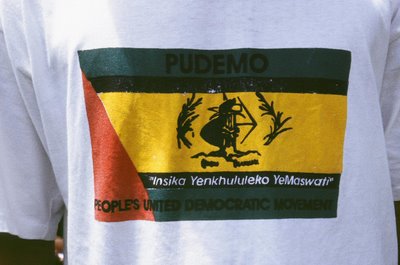

PUDEMO President - Mario Masuku
“There is no night so long that it does not end with dawn”
(Ngugi Wa Thiongo)
Political Report presented on behalf of the National Executive Committee at the 6th National Congress of PUDEMO held on the 21-24th December, 2006
Contents
· Introduction
· After this landmark Congress, the history of Swaziland shall be written anew
· History will never forgive us for delaying the elimination of the tinkhundla crime against the Swazi people
· A brief diary of the watershed moments in the life of the Swazi people’s struggle for democracy
· After this Congress the history of Swaziland shall be written anew - How far are we to the promised land?
· We dare not lose our political bearings as we proceed on the road to a new and democratic Swaziland
· Organisational renewal and the introduction of a new culture of hard work, efficiency and selflessness are fundamental conditions for victory
· All cadres to the battlefront for a new and democratic Swaziland NOW!
Table of contents
1. Introduction
2. What is the meaning and essence of liberation in Swaziland – “The patriots who survived the bullets” and the bitterness of betrayal!
3. History will never forgive us for delaying the elimination of the tinkhundla crime against the Swazi people
4. A brief diary of the watershed moments in the life of the Swazi people’s struggle for democracy
5. After this historic Congress, the history of Swaziland shall be written anew – On the horizons of the promised land!
6. We dare not lose our political bearings as we proceed on the road to a new and democratic Swaziland
7. International solidarity is key – the essence of solidarity is in the practice
8. The ideological offensive against PUDEMO by the state and its media apparatus
9. Organisational renewal and the introduction of a new culture of hard work, efficiency, selflessness and advanced political clarity are fundamental conditions for victory
· What kind of PUDEMO can be considered organised and ready to lead the people of Swaziland into the promised land;
10. All cadres to the battlefront for a new and democratic Swaziland NOW!
- There is work to be done!
11. Priority tasks of PUDEMO at this stage
Members of the National Executive Committee of PUDEMO
The leadership of SWAYOCO and the Women’s league
Esteemed guests
Fraternal organizations and allies
Delegates and cadres of the fighting people’s movement,
Please receive on behalf of the oppressed and poor masses of our country in rural communities, urban slums and ghettoes, workplaces, schools and institutions of learning, sporting and professional organizations, traditional centres, churches and wherever they happen to be, as victims of a savage system imposed upon them by the royal family for years, revolutionary greetings and salutations to this esteemed gathering of freedom fighters on a mission to abolish a system rooted in naked greed, exploitation and oppression supervised by a tiny royal minority upon the mass of our people.
1. Introduction
In one of its major Congresses, FRELIMO adopted a Programme which said, “…………….we express our desire for a true and profound social transformation, based on a scientific analysis of reality, on defining the social base of the revolution and on the need to guarantee that the interests of the broad masses of the people prevail”.
Extract from a Programme adopted by the 5th FRELIMO Congress which ended on the 30th July, 1989 in Mozambique.
Interestingly for PUDEMO the key lessons derived from this historic Congress of the fighting Mozambican people’s movement was not just in the revolutionary content of the programme and declaration, but fundamentally in the extent of mass participation and thoroughness of the preparations towards that Congress. It indeed confirmed FRELIMO as the genuine representative of the oppressed and working people of that country in the way they themselves participated in determining the fate of Mozambique, their revolution and its people.
Pre-Congress discussions took place at grassroots level throughout the country. Party members, as well as the general population, participated in the discussion of the seven draft theses which formed the basis from which elected Congress delegates were to adopt guidelines for the country’s political, economic and social development for the coming five years.
This and other international experiences, including the process leading towards the Freedom Charter of the ANC-led liberation alliance in South Africa, are the kind of examples that are worth emulation in engaging not only PUDEMO members, but the mass of our people and allies in the attempt to development national consensus about the direction that the Swazi struggle must take, as well as the pace at which it must move.
This proud tradition has found full expression in the participatory mode that has characterized the development of the Road map to a new and democratic Swaziland, which has been placed before this Congress by the structures of the movement at all levels and has also embraced the enriching inputs of our allies and people beyond the immediate family of PUDEMO associates. This document is built upon the historic programmes of the movement, amongst them; the Last mile to freedom (Ulibambe Lingashoni), Hlominsika, Umkhombandlela (the Strategic Route), Building a people’s movement rooted in the concrete conditions of Swazi society and our broad guide, the Strategy and tactics. It is a consolidated expression of these profound documents in the way it outlines the tasks of the revolution in the current phase, whilst at the same time, it is a systematic projection into the phase of struggle beyond tinkhundla, where the challenges of development and confronting poverty shall be more naked than ever before in our schedule of tasks.
Therefore, the delegates gathered in this house have a clear and definite task before them. That task is about engaging, intensively and with the deepest passion and absolute clarity, the proposals before us, in order to answer the question, what should be done to advance speedily towards a new and democratic Swaziland. With the successful and proper completion of that task, we can proudly proclaim that this Congress would have done justice to the huge expectations and aspirations of the oppressed people of Swaziland and our dearest friends all over the world, who look to us with hope and a sense of confidence in our ability to integrate Swaziland into the world community of democracy-loving people, as soon as possible.
You will all agree with me comrades that such a task is never an easy one, with all the eyes of the world upon us. But we dare not let down our people. By joining PUDEMO, we have taken an oath to do all within our power to liquidate the monster of royal savagery called tinkhundla, and it is during such times that we are called upon to revisit the essence of that oath and our sense of urgency in executing the tasks of the revolution and in proving our unwavering dedication to the people.
2. What is the meaning and essence of liberation in Swaziland –
“The patriots who survived the bullets” and the bitterness of betrayal!
I have chosen the following illustration from the writings of Ngugi Wa Thiongo to clarify a point about the possibility of the sweet fruits of liberation turning sour, unless the masses are organized to exercise all-round vigilance against the dangers of thieves, who do not work for political change and victory, but always steal the victories of others (the poor and oppressed in this case), who had to suffer and sweat for this victory. This will assist us clarify what our expectations and challenges are in the course of advancing our struggle.
Ngugi Wa Thiongo in his wonderful work of magnificent artistry, rooted in the oral traditions of Africa, Matigari, displays in the most succinct terms what is the definite challenge faced by liberation movements, PUDEMO in particular.
Matigari ma Njiruungi (the patriots who survived the bullets) returns from the liberation struggle after finally destroying his enemies, the white settler Williams and his puppet and collaborator, John Boy, to claim his rights in his independent country. He buries his arms and goes back home to enjoy peace and fulfillment at last. To his astonishment he finds that, in spite of certain superficial changes (black faces where previously there would have been only white, for example) the world is still upside down and justice still elusive as ever. As before;
“the builder sleeps in the open
The worker is left empty-handed
The tailor goes naked
The tiller goes to sleep on an empty stomach
Wealth and power still reside in the hands of a few who abuse it to terrorise and dispossess the people. Matigari, who built the settler’s house, now claims it as his own. But far from being welcomed as a triumphant hero, he is insulted and beaten, arrested and labeled “thief”.
The children of the very men Matigari has spent his life fighting have inherited their places in the power structure. The son of Matigari’s old enemy, settler Williams, now represents the interests of various international financial and commercial organizations whose names as acronyms spell out in the Gikuyu language “the real thieves”.
The son of John Boy, educated at the expense of the whole community who had sent him abroad “singing with pride: he shall come back and clean up our cities, our country and deliver us from slavery”, has indeed returned – as a corrupt and cynical comprador tycoon. The finishing touches to his education have been obtained at Fort hare in South Africa and at the London School of Economics. He has learnt to scorn the values expressed in Matigari’s song of the liberation struggle;
“Great love I saw there
Among the women and children
We shared even
The single bean
That fell upon the ground”
and has substituted his own individualistic philosophy”
“Go your way and let me go mine
For none of us is carrying the other”
We are constantly reminded of the direct relevance of the neo-colonial experience depicted symbolically through the characters in the book by direct pointers like the question unfortunately so apt in many post-colonial countries: “Who in this country does not know John Boy?”, as well as by the introduction which tells us, “Reader/listener: may the story take place in the country of your choice!”
In the true spirit of the challenge posed upon the reader or us, to be more precise, we have chosen Swaziland to depict the story with due consideration of the specific and unique realities on the ground.
The Road map has posed an interesting analysis in response to the question posed by Ngugi, “Who in this country does not know John Boy?”, the collaborator and puppet of the white settler master. It could not be anyone than the monarchy, that proclaims itself the custodian of all that is Swazi and the very essence of our being and identity, yet it works tirelessly to sustain and perpetuate the conditions of neo-colonialism through savage exploitation f the poor in the holy name of Swazi culture. In doing so, it is intertwined in the accumulation scheme that is spearheaded by what Ngugi calls the “corrupt and cynical comprador tycoon”.
This is very important to understand and engage these issues free from narrow face-value viewpoints and generalisations, but from a profound revolutionary standpoint of seeking to explain the position and role of the Swazi monarchy in the broad accumulation process and power structure (political architecture) in the country.
Therefore, the Road map makes an important and fundamental point when it says, “that is why the national democratic transformation struggle can only be meaningful if it is a revolutionary struggle. This means, it must be a profound process of change in which power relations are radically transformed”. In this sense, there should be a remarkable difference between revolutionary sounding slogans and phrases and actual revolutionary content, in theory and practice.
3. History will never forgive us for delaying the elimination of the tinkhundla crime against the Swazi people
For sometime now, PUDEMO has pointed to the burgeoning crisis within the tinkhundla system. The chain of events which have begun to unfold provokes questions as to whether we have fully grasped the depth of that crisis and the extent to which it has traumatized and made useless those who occupy the commanding heights in the system we seek to destroy.
Such crisis do not originate in the personality traits of individual political leaders, although they also form a key part of this.
We learn nothing about the real nature of the crisis currently afflicting tinkhundla by noting ONLY that Mswati as a person plunders Swazi wealth and invests it overseas, abuse women and treats us all as slaves, therefore if he were to stop it the system would be fine or if he were to be removed, the crisis would end. The crisis are systemic and deeply rooted in the rotten foundations of tinkhundla semi-feudalism and neo-colonialism, in which he is, of course, a part.
Personalities, no doubt represent the public face of the crisis and the corrupt system, but they come and go, but the crisis remain, ever deepening. So, what is the solution, what is the place of monarchy in the whole system and what is the place of the individual occupying the position of the monarchy in that regard, and finally, how do they, together, relate to the system in general and what is the system, anyway?
This therefore, brings us to the second and related question, what is tinkhundla and how do we hope to eliminate the system of tinkhundla. Understanding a system is important, because it regulates and determines the behaviour of all who are part of it and unless it is arrogantly changed, it forever structures social relations and patterns of life in society. It determines who gets what power and how can he/she use it.
A system decides the limits within which every act can be carried out, it sets the parameters of what must and must not be done. Therefore, it prescribes what the monarchy should do and should not do, without saying the monarchy is a pitiful object of a system imposed from above, he is very much a part of it and benefits from it, which explains why it is in his best interest for the system to survive. But what must be noted even more deeper, is the fact that the monarchy acts as part of a group of classes and forces collectively advancing their material interests as regard the structure of wealth accumulation and control.
Before us is the task of determining what should be done to speed up the process of eliminating tinkhundla savagery. There are two key contradictions in Swaziland that reinforce each other; class and gender inequalities. They also interface with a whole lot of related contradictions, such as race, which though subordinate, but are critical in the definition of power relations in the country.
The elimination of a system of oppression is determined not only by will, but primarily by the capacity of the forces advancing the revolution to act decisively, taking advantage of the mood of the masses and the momentum or political tempo generated by the work done amongst the masses, to drive a serious political blow against the structures of the system.
We are certain tinkhundla is crumbling, but what we still need to be more certain about is the actual date of its demise.
We offer no apology that our being here today is to plan how best and immediate can we bury this royal demon, once and for all. Our people are impatient and they are justified in being so. They are fed up with sloganeering, bankrupt political posturing and weak action that does not bring about change.
We must therefore, assist clarify how best can we deal with all these problems in order to advance as soon as possible to a new and democratic Swaziland. People will not join or support PUDEMO merely because it has nice colours and revolutionary sounding slogans, neither will they join it because they hate tinkhundla, but fundamentally, they will join PUDEMO because indeed it is a viable alternative, ready and capable of taking forward their ideals and aspirations.
It is imperative that we work as revolutionary plotters, daily engaged in a bitter struggle to bring down the system. In doing so, we must resist the temptation to oversimplify the problem or undermine the strength of the tinkhundla system.
4. A brief diary of the watershed moments in the life of the Swazi people’s struggle for democracy
The Swazi people’s struggle for democracy and profound social transformation has undergone several stages and has passed through several difficult moments that have been critical to its development and strategic orientation.
However, notably, the following have been the most defining watershed moments in the life of our struggle;
- The peasants resistance to the invasion of colonialists and struggle against land dispossession by a combination of the royalists and their colonial patrons
- The workers and people’s resistance to British colonialism and its ultimate betrayal by the monarchy and its comprador allies, that led to the proclamation of the 1973 king’s decree which bans political parties and denied the people all their rights, thus entrenching the supremacy of the royal family and their allies
- The emergence of a new era of sustained political resistance with the birth of PUDEMO in 1983 which inspired a wave of mass and popular forces throughout the country and forced to the regime to introduce some reforms, such as the royal constitution and the series of vuselas.
The common thread that runs through all these periods is that the people are central to every struggle and only them can defend their interests fully, because the reality is that without the constant vigilance of the people, their interests are bound to be subdued by the greed of one elite or the other.
There is real danger that if the people remain spectators in the course of the on-going struggle, a new elite will step forward and claim the victories of the masses and turn it into a new offensive against the people; demobilizing popular forces, deploying reactionary ideas against revolutionary activities, perpetuating elitist accumulation processes and even collaborating with the forces of semi-feudal and neo-colonial reaction against the oppressed, to sustain their newly acquired privileges.
We always refer to these different periods and stages in the course of the development of the Swazi struggle in order to draw useful lessons for the on-going struggle. Each period offers rich lessons for us, as long as we are willing to learn and also reflect on these. But even more fundamental is the task of relating these to the concrete experiences and conditions of Swazi society today. In doing so, we shall be correctly affirming the Sikhawini call to build a movement rooted in the concrete conditions of Swazi society.
5. After this historic Congress, the history of Swaziland shall be written anew – On the horizons of the promised land!
In 2004 we set ourselves the task of ensuring that the next elections in 2008 shall be held in a democratic Swaziland, which means we declared that never again shall national elections be held under tinkhundla. This means, we must work hard to ensure that this is realized in practice.
However, 2008 is not the year we should focus our energies on, but we must go beyond that to develop a vision or plan that goes far beyond that to act as our prime guide towards the fundamental resolution of the problems we face in our society today. These days, only those who plan properly and plan ahead are able to storm the dangerous weathers of political leadership over social change. We need to clarify the issue of time-frames as called upon by the Road Map, because only then can we monitor progress in our work.
We must begin to grapple in more real terms with the reality that our people want more than the promise of a democratic society in general, but fundamentally, they want to know what is entailed by that promise, what does it mean for the landless rural masses, what does it mean for the exploited workers, what does it mean for the women suffering from daily abuse and inequalities, what does it mean for the unemployed and starving and what does it mean for those who cannot access education and health.
This is what we must begin to engage it in more real terms, without the dangerous over-generalizations of the moment. People are asking concrete questions and we are expected to give concrete answers or else we shall face the wrath of a people fed up with words, but wanting concrete issues about their lives.
This 6th General Congress, therefore, is that forum. It is an assembly of the most determined and resolute amongst our people, seeking to give concrete answers to concrete questions. We are not here to be general, but we are here to call things by their names. We are here to clarify what we refer to when we talk about freedom, we are here to clarify what we mean by freedom poverty, we are here to explain more clearly what we mean by the idea of, “the emancipation of the people is an act of the people themselves”.
By the end of this Congress, we should have answered the many questions our people ask us on a daily basis. We know these questions better, because we live in communities and relate to the people on a regular basis. Central to our task is the issue of clear mechanisms for the implementation of our programmes, an area we have had a serious deficiency in during the past few days. It must be clear what should be done, by who and when, as well as how will we assess and monitor progress at regular intervals.
6. We dare not lose our political bearings as we proceed on the road to a new and democratic Swaziland
Being an activist does not necessarily make you progressive, though it’s the fundamental condition for liberation. This means, at all times, we must assess the extent to which we are still on course as regards the direction towards a progressive destination, even in our daily activism, which should be progressive.
On many occasions we have faced the challenge of being actively involved in struggle, without losing our firm principles as revolutionaries. This means we seek to remain consistent in our revolutionary principles as cadres of the movement, whatever the temptations to drift away from our key political bearings, owing to the pressure of the forces at play and power of reactionary forces.
Central to our being on firm on sticking to our political bearings is the question of ideology. This is where we need more than just clarity, but absolute clarity on what we want, whose interests do we represent, what relations exist between those we represent and everyone else, and finally, how do we stick to the interests of those we represent even under conditions of extreme pressure from forces hostile to our agenda and vested powerful interests.
The acid test for any movement’s honesty and absolute dedication to the poor or its prime constituency is its ability to stick religiously to their interests and not betray them even when powerful interests threaten to disrupt the thorough-going process of fundamental change.
There is no revolutionary action without revolutionary ideas, in the words of one advanced thinker of revolutionary theory. No cadre can claim to be advancing revolution when he is not guided by revolutionary ideas and that is what must be said openly and without fear by all of us. This means, the task of deepening revolutionary consciousness is central and pivotal to PUDEMO’s future outlook and direction, as to determine its political orientation in general. No cadre must be allowed to be a member of the movement without having undergone the process of thorough ideological transformation in order to be equipped to meet the challenges of the new society we are striving to build.
According to the renewal plan of PUDEMO, we must ensure that all cadres of PUDEMO have received induction and are regularly exposed to deep ideological and political education to transform their consciousness and upgrade their level of understanding and interpretation of complex matters, in the simplest way possible to ordinary people.
There is a dangerous tendency to assume that ideology means indoctrination. Ideology means a systematic guide that underpins your approach to issues. It assists you explain things in a particular way and is a base of reference for difficult and confusing questions.
At times personal interests begin to define our approach to various issues, which is a real danger and must be fought against at all times, so that the movement has its own distinct identity ideologically and otherwise and must not be clouded with individual opinions and interests. It must at all times, maintain a particular political profile of its own. This is the only way we can ensure uniformity in the views and policies of our movement, particularly as regards how they are projected in public.
However, this must not be interpreted to mean the elimination of diversity in our ranks, but it should mean the intensification of pluralistic ideas, which should be free to express themselves, but also be cohesive enough to harmonise all these into a movement view that unites and around which everyone can feel comfortable, without sacrificing principles on the alter of diversity.
We must not encourage the simplicity with which comrades do things currently, where some members of the movement can choose to associate with problematic elements in our society, out of populism, at the expense of our fundamental principles. This is a recipe for social disaster and political opportunism.
7. International solidarity is key – the essence of solidarity is in the practice
By international solidarity we mean the deliberate and conscious effort to raise the capacity of the forces fighting for social justice and human dignity, to the level required to defeat decisively the forces of reaction, underdevelopment and oppression wherever they are to be found.
In this sense, effective solidarity means more than just the moral obligation to “feel pity or sympathise with the oppressed”, but it is a deliberate act of involvement in the most noble struggle to broaden the frontiers of human progress everywhere. This can only be possible through the liquidation of the forces of counter-revolution, which are as stubborn as are the determined forces of progress to crush them. This creates a particular scenario in the balance of power globally and requires decisiveness to change them towards the struggling and oppressed people of the world. In one word, it requires maximum unity and determination by the people of the world.
The advantage of revolutionary forces in this regard, is that they are rooted in and guided by scientific tools of analysis as imposed by our understanding of the obtaining conditions. This provides us with the following facts;
· It is scientifically determined that society is objectively moving forward, not in a straight line though, as set-backs abound
· That the struggle for freedom and dignity is, for humanity, a struggle to survive and therefore, a basic condition of the very existence of the species itself
With this basis truth on our side, we are assured of victory, but this does not mean complacence or pre-determined victories, but even more determination to struggle and act together to make this happen. We can never take for granted the neck-breaking resistance by the forces of counter-revolution.
Solidarity is not narrowly about, “giving Swazis to fight their own struggle”, same to the Saharawis, Palestinians, Cubans, Burmese, etc to fight their own struggle, but fundamentally it becomes part of our own struggle and its continuation as South Africans, as Namibians, as Europeans, as Canadians, as Soviets, etc. It becomes a central part of what “we”, as South Africans (in the case of South Africa), have always been and continue to fight for, human dignity and freedom for all. It completes the mission of seeking to abolish all conditions that give birth to injustice anywhere and in the process, widens the frontiers favourable to the intensified prosecution of the revolution for its logical conclusion.
This however, should not be simplistically taken to mean that, we say South Africans should fight on behalf of Swazis, Palestinians, etc, but it means in supporting the struggles of the Swazi people, they regard it as their own and are prepared to all and everything to ensure victory, because their own future is tied to the victory of the Swazi people.
It is in this context that we seek to once again, not as a matter of formality, to extend our sincerest appreciation to our allies and compatriots who have refused to be intimidated by the tinkhundla regime and its international friends into dissociating themselves from our cause. They have stubbornly intensified their active participation in the cause of the Swazi people as if it was theirs.
In this instance, we are mindful of the glorious work done by our comrades in Denmark of the Southern Africa Contact, a former anti-apartheid movement under the leadership of Patrick, McManus, Morten Nielsen and Lilian Andressen, the former anti-apartheid movement of Netherlands under the leadership of Fons Geerlings, as well as NIZA and XminusY, the Canada-based Swaziland Solidarity Network under the leadership of Teresa Debly, the British-based ACTSA and all our friends all over the world, including ENIASA, which is a Europe wide former anti-apartheid network. We salute these friends of our people and commit ourselves to ensuring that their good intentions in supporting our case are not let down.
We pay special tribute to our comrades and compatriots in South Africa, who have afforded us all they can to see the cause of peace and democracy triumph in Swaziland for the benefit of the rest of the continent’s people. They support unconditionally the conviction of the African people that the time for despots in Africa is over, the time for man-made hunger and starvation is over, the time for the rampant abuse of women in the holy name of African culture is over and the time for the limitless plunder of Africa’s resources for the benefit of greedy elites is over.
In this regard, we once again, expressed our profound appreciations to the ruling alliance of South Africa, comprised of the ANC, SACP and COSATU and their leagues, as well as the whole MDM formation. We appreciate the outstanding work of these comrades in support of our efforts for democracy in Swaziland. The recent and highly successful border blockade organized by the Swaziland Solidarity Network under the leadership of Solly Mapaila together with COSATU and supported by the SACP, YCL, ANCYL and other components of the MDM send a strong message to the Swazi regime and shook the foundations of royal tyranny. This led to intensified attacks particularly against COSATU by the Swazi regime and some opportunists within the ranks of the trade union movement of Swaziland, seeking to please the monarchy and win recognition at the table of royal privilege.
However, the mass of the working people of Swaziland supported this blockade unconditionally, because liberation for them is not some academic and political posture for narrow opportunistic ends, but a reality of life that their suffering is unbearable and day more is unacceptable, worst still an academic debate about the life and death action against tyranny.
We salute COSATU for standing firm to that end and exposing the dangers we face of sheer opportunism in our ranks sometimes, which must be confronted directly. However, we are seeking to do more to unite the poor and struggling masses, because only the royal fascists benefit from divisions and that is why our Road map programme points to the urgency of a national democratic front.
We must initiate an open and honest debate with all our comrades in the ranks of the democratic forces here in Swaziland about what we see as the most appropriate approach that the democratic struggle must take to avoid the confusion as perpetuated by the enemy.
8. The ideological offensive against PUDEMO by the state and its media apparatus
We continue to note that the state has intensified its strategy of seeking to criminalise PUDEMO and demonise its legitimate and noble activities as acts of banditry. In the true spirit of STRATCOM in apartheid South Africa, the Swazi media has taken upon itself to be the frontrunner in this campaign, acting on behalf of its master and sending shockwaves and fear throughout Swazi society of an impending PUDEMO savagery against the people.
The strategy of the regime is very clear, to create fertile conditions for the intensification of brutality against PUDEMO on a mass scale, as we have seen recently. This means, we need to exercise all-round vigilance against the plan of the regime and its friends in the hostile underworld of mercenaries. We continue to warn that the regime is amassing weapons on a scale never heard off before, creating a huge network of secret squads, some disguised as traditional regiments, yet are auxiliaries of the state.
In this war, the regime has, to its aid some journalists from the old thinking in South Africa, whose attitude to our struggle is informed by their allegiance to apartheid gutter journalism, who, in the name of journalism are acting as political agents of certain agendas and creating fictitious stories to suit their narrow pre-conceived agendas. They are fed by the system from its network of misinformation and disinformation, systematically targeted at PUDEMO and SWAYOCO.
The recent false creation of an underground army, which has been exposed as a disgraced and failed plot of the system working with is friends in and outside the country, to create a state of siege for the masses, is an example of how desperate the enemy is and how dangerous it has become. We must be on the alert as more and more of such false creations are in the pipeline, judging by the look of things now.
We must be ready to engage the enemy in his territory, where he enjoys absolute monopoly over powerful institutions that shape public opinion and close every little space for reactionary ideas, and in the process, we shall be widening the frontiers of progressive ideas in our society.
Every member of PUDEMO must be ready for an all-out ideological offensive in defence of revolutionary ideas, in churches, schools, workplaces, communities, social centers and everywhere, we must be firm in fighting against the ideas of the ruling class and exposing opportunism. PUDEMO’s ideas of hope and change must be the dominant currency in our society, all people must be afforded the opportunity to share and benefit from these good news. The news of liberation must reach out to every corner of Swazi society and leave no stone unturned, even in the most conservative parts of our society, the goods news must filter through. We must intensify our ideological offensive to liberate the minds of the people and inspire confidence in their ability to fight for their liberation and dignity.
We must also be on the alert about the dangerous opportunism of Sibahle Sinje, a state creation to confuse the people. These agents of conservatism and tinkhundla poisonous ideas, have all of a sudden become the self-appointed champions of democracy, yet we know their real colours. Not long ago, they mobilized traditional regiments against the democratic movements, in the most violent fashion, though they did not succeed, but their intentions were very dangerous and they sowed seeds of hatred for democracy and change in the minds of traditionalists, yet today, they have not gone back to those people they misled to apologise for their self-serving narrow agenda against the country’s future and people.
9. Organisational renewal - A new culture of hard work, efficiency, selflessness and advanced political clarity are fundamental conditions for victory
The basic question that every Swazi is asking is, after tinkhundla is gone what is next? Who is the viable alternative, so that we can all rally around as the reliable custodian of our aspirations and hopes as a nation? Since its birth 20 years ago, PUDEMO has always given one answer to this question, and that answer is; “we are the alternative and we are ready to deliver on your hopes and aspirations”.
The Piet Retief decision about an Organisational Renewal Plan (Imvuselelo Plan) of PUDEMO which was adopted in 2003 is long overdue. We need to ask ourselves how far have we gone in its implementation.
PUDEMO has consistently worked to convince the ordinary Swazi that his/her political insurance is nowhere else other than in the movement that braved the situation when no one else could dare rear his head.
Indeed, the people of Swaziland raised their heads to see if what is portrayed is really true, guess what! Confusing signals were sent. At times a glimmer of hope would really send the people on the streets rallying around their historical leader, PUDEMO, whilst at times, their leader either retreated, backtracked, disappeared or went back and forth, without a sense of clear political purpose. This is the message that the ordinary Swazi has of PUDEMO. Luckily for PUDEMO, the mass of the people have not totally forsaken their movement, they still hope it will emerge as the leader that it should be, even at this late hour when the crisis of the regime have deepened to levels where the ordinary people can no longer afford to wait for the sleeping giant to awaken, they still are waiting.
Therefore, the time is now and no words can clearly express this than the Ermelo Declaration of PUDEMO, which said, “30 years of royal slavery is enough, the time for decisive action is NOW”. This sense of urgency and seriousness must be instilled into the hearts and minds of PUDEMO cadres as they go about their daily tasks. Casual political work and part-time political schedules have failed to live up to the expectations of these masses.
We must not take for granted the patience and confidence of these masses in PUDEMO and think it is given, that the masses will forever wait for PUDEMO to move at its snail pace or enjoy its political holiday while basking in the glory of being the “political pioneer of the Swazi struggle”, with unequalled political experience.
The movement has problems which have gone beyond being internal matters, but they are now public matters. Some of these most pressing problems include;
- Weak or none existent structures and campaigns, particularly in regions and branches as they are there in name or individuals;
- Poor communication within our own structures, first, and with the mass of the people, generally.
- Poor co-ordination and coherence by higher structures, particularly the NEC and regions which are key power centres in the political language of PUDEMO;
- Weak cadreship in terms of; theoretical clarity and understanding of key issues, as well as in terms of frontline militancy and active participation and leadership in the daily struggles of these masses
- Poor profiling of PUDEMO leadership, which makes the masses have less confidence in the movement itself, because people should associate the movement with a particular symbol of resistance and hope.
- Inability of PUDEMO to correctly take up and rally the masses around issues of daily concern to them and their lives, such that we are walking parallel to the struggles of these masses, though we claim to lead them.
Therefore, if we are serious about reclaiming our historical position as the leader of these masses, the above picture must be removed immediately. We must work tirelessly to change the outlook and political posture of the movement to reflect seriousness, urgency and undying commitment, underpinned by unity of purpose and superior methods of organisation in actual struggles.
Organising PUDEMO into a superior political force guided by advanced political theory and sophisticated methods of organisation on the ground is the real motive behind this plan. It requires the following qualities, in order to succeed;
- Willingness on the part of all members and leaders of PUDEMO to admit that the situation within the movement has reached a crisis point;
- The luxury of casualty is not in the interest of the movement and the suffering masses, hence urgency must be the driving force behind this plan and the whole effort to renew PUDEMO;
- As leaders at all levels, including regions, branches and leagues, we must not be defensive, but upfront about our weaknesses and failures so that we can begin the process of correcting them and improving our work;
- We must allow for honest debates and reflection amongst ourselves, our allies and general structures of our society;
- Frank and vigorous political debates must form the central part of our organisational culture, which requires that we encourage it and not stifle it as has been the culture in some of our structures, particularly in regions where forums for discussions have not been so pronounced;
- Sacrifice is the only guarantee for victory in any revolution, which therefore requires that cadres stop lamenting, but put all their energies at the disposal of the struggle and work for these masses tirelessly. We cannot have both worlds of comfort and normality living side by side with political struggle, because struggle by its very being presupposes sacrifice and abnormality in one’s way of life;
- Finally, We must identify and uproot all elements that hinder progress and frustrate this plan, which is about the future of our movement and the people it represents. We must be upfront about the need for this plan to succeed at all costs.
PUDEMO has two choices; fail in positioning itself properly and regret forever or timeously make a difference and reposition itself properly and remain relevant for years to come.
What kind of PUDEMO can be considered organised and ready to lead the people of Swaziland into the promised land;
- Fully functional structures; holding regular meetings, reporting constantly to members, carrying out tasks efficiently, uniting the people, etc;
- All cadres fully mobilised and in action. The attitude of people who are militants only in conferences or in social gatherings, without daily active participation in political work is failing the movement and must be defeated;
- All structures carrying out political work amongst the masses and organising popular campaigns around issues affecting the poor in their communities;
- Political education, propaganda work and building strong regions and branches is central to the future of PUDEMO and must be carried out daily by every member of PUDEMO;
- Guaranteeing the full and effective participation of women, disabled people, rural poor, youth, workers and all elements of the marginalised community of our country, in the daily affairs of PUDEMO
- Clear documents, internalised and fully understood by the whole membership, so as to spread PUDEMO hegemony throughout all sectors of our society is a condition for victory;
Leadership guided by the motto; first in commitment, first in sacrifice and first in discipline at all levels; NEC, RECs and BECs;
10. All cadres to the battlefront for a new and democratic Swaziland NOW! – There is work to be done!
The development of revolutionary class consciousness among the broad masses is possible only if they accumulate experiences of struggles that are not only limited to the winning of partial demands within the framework of tinkhundla aristocracy. The gradual injection of these demands into mass struggles can come about only through the efforts of a broad layer of advanced workers who are closely linked to the masses and who distribute and popularise these demands.
Our understanding of the concept of organisation explains the relationship between the masses, the organized sections of society and the whole movement led by PUDEMO. It clarifies the process by which revolutionary consciousness is developed, ultimately explaining the role of SWAYOCO in that process. Because we are waging a struggle under conditions which are not of our own choosing, we are very much conscious of the fact that the ruling ideas in society are the ideas of the tinkhundla regime. This requires intensified and all -round propaganda offensive.
The more the stability of the existing society is brought into question, and the more the class struggle intensifies, and the more the class rule of the exploiters itself begins to waver in practice, the more will at least sections of the oppressed class begin to free themselves from the control of the ideas of the ruling system.
Alongside the struggle for social change, a struggle goes on between the ideology of the oppressors and the new ideas of the revolutionary class. But it is only in the cause of concrete struggles that the majority of the oppressed can liberate themselves from the ideology of oppression. For this control is exerted not only, nor even primarily, through purely ideological manipulation and the mass assimilation of the ruling class ideological production, but the above all through the actual day-to-day workings of the existing economy and society and their effect on the consciousness of the oppressed.
What distinguishes the revolutionary vanguard from this mass is the fact that even during a lull in the struggle it does not abandon the front lines of the class struggle, but continues the war. It thus helps give form to a factor of continuity, as opposed to the necessarily discontinuous action of the mass, and to a factor of consciousness, as opposed to the spontaneity of the mass movement, in and of itself. However, advanced workers are driven to continuous organisation and growing class consciousness less by theory, science, or an intellectual grasp of the social whole than by the practical knowledge acquired in struggle.
We must recognize that most of the mass is active only during the struggle, after the struggle it will sooner or later retreat into private life, i.e. into the struggle for existence.
The possibility of a successful take over of power arises when a merging of actions by the vanguard and the masses with the consciousness of the vanguard and revolutionary layers has been accomplished. For the broad masses, the elementary class struggle arising from the contradictions of the capitalist system is always kindled only by matters of immediate concern. PUDEMO must make all progressive demands and movements of all oppressed social layers and classes its own.
Experience in struggle is by no means sufficient for clarity on the tasks of a broad revolutionary, mass struggle to be attained. Not only, of course are these tasks connected to the immediate motives that set part of the struggle, but they can be grasped only by means of a clear understanding of the overall social development. Without protracted and consistent preparation, without the education of many advanced cadres in the spirit of a revolutionary programme, and without the practical experience accumulated over the years by these advanced cadres through attempting to bring this programme to the broad masses, it would be absolutely illusory to assume that suddenly, with the mere aid of mass actions, a consciousness equal to the demands of the historical situation could be created among these broad masses.
Without the experience of revolutionary struggle by the broad masses, there can be no revolutionary consciousness among these masses.
There could be no better way to clarify and illustrate the tasks of PUDEMO and all its cadres than the way the Road Map document has captured them. Essentially, this means that we have a task ahead and that task is primarily about implementing the resolutions of this Congress and whatever programme we come out with from this historic gathering.
I do not wish to repeat what it has guided us towards, but wants to capture the heart of what is says as regards the direction and pace of the Swazi struggle and what PUDEMO is required to do in that pursuit. It outlines a number of critical tasks, whose implementation shall constitute a decisive advance for the Swazi people’s struggle.
Most importantly, there are three critical areas of primary engagement that the movement’s capacity must clearly be sharpened even more for the battles ahead;
- Capacity for political struggle – The battle to take over state power and use it to transform society in the interests of a better organized Swaziland that guarantees long-term stability and development for all
- Capacity for ideological struggle – fight and win the battle of ideas, convince the people about the need for change and build popular consciousness at all levels of our society
- Capacity for economic struggle – challenge economic injustices to organize the people around their most basic needs in order to build working class power against royal exploitation and despotism
The core functions of every structure of the PUDEMO, wherever it is to be found are the three inter-related tasks, which constitute the daily bread for any cadre of the movement;
- Political education to develop quality cadres and leaders of the movement and the struggle as a whole
- Propaganda and agitation to build revolutionary consciousness and critical thinking for radical action
- Organising the people into structures of mass resistance (building strong organization) for sustained mass struggle
Priority tasks of PUDEMO at this stage:
Convening an urgent Road Map Implementation Indaba to develop an Operational Plan to take forward the programme, particularly to deal in detail with the following tasks;
- Creation of structures to facilitate and sustain implementation of the programme
- Mechanism to popularize the Programme to all sectors of Swazi society and internationally
- Deployment of cadres to various sites of struggle and develop accountability mechanisms to that effect
- Identifying all possible sources of financial, human and material support and setting clear targets
- Set targets for identified tasks; Recruitment, organizational renewal & development of a pool of cadres
- Convene a National Political School of PUDEMO to bring together all cadres of the movement deployed in various sites of struggle to engage and clarify fundamental political issues relating to the direction, content and character of the Swazi revolution, so as to deepen our key strategic priority focus, which will enhance a deeper understanding of this plan and how best it can be implemented on the ground, towards a common objective and in unison.
- Creating the necessary political infrastructure for sustained political education, propaganda and campaigns work, as well as to build a national democratic front of all progressive forces around the minimum programme for a new and democratic constitution for Swaziland, leading to democratic elections for the country
- Establish a Commission on International Affairs to develop a framework for international solidarity mobilisation and a foreign policy document of PUDEMO
A Special Commission on Democratic Governance and Social Transformation shall be established during the Road Map Implementation Indaba to ensure that a clear programme and specific policies on the various spheres of governance are developed. In September, 2007, the NEC should then convene a Special Conference on democratic governance and social transformation in Swaziland to present the final product, which shall constitute a PUDEMO framework for governance.
Conclusion
What distinguishes the revolutionary vanguard from this mass is the fact that even during a lull in the struggle it does not abandon the front lines of the class struggle, but continues the struggle. It thus helps give form to a factor of continuity, as opposed to the necessarily discontinuous action of the mass, and to a factor of consciousness, as opposed to the spontaneity of the mass movement, in and of itself. However, advanced workers are driven to continuous organisation and growing class consciousness less by theory, science, or an intellectual grasp of the social whole than by the practical knowledge acquired in struggle.
This is why we say, we are now in the era of sustained liberation struggle rather than spontaneous occurrences of instant anger without clear political motive. We do whatever we do out of a conscious plan and not as an accident of history.
Amandla!!


