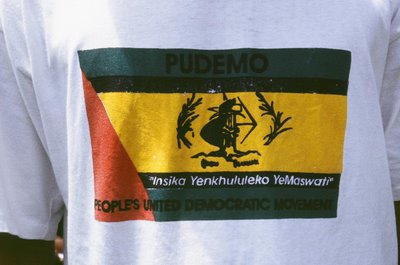

Road map to a new and democratic Swaziland
Political Programme
(Incorporating a Strategic Liberation Plan & a Democratic Governance and Social transformation Plan)
As adopted at the 6th General Congress of PUDEMO held at Matsulu Conference Centre in Mpumalanga, RSA on the 20-24th December, 2006.
………………………………………………………………………………….………………………………
Table of Contents
Page- Introduction ………………………………………………………………………………………………………………………………………….4
- Let all who love our country join the march to a new and democratic Swaziland! – PUDEMO NEC statement ………….……………..5
- The strategic role and position of PUDEMO as the leading political force for change in Swaziland ………………………………………7
- Brief overview of political developments in Swaziland…………………………………………………………………………………………..8
- We have come a long way in our struggle for democracy – Time to consolidate and advance……………………………………………10
- What are the historic tasks of PUDEMO………………………………………………………………………………………………………….12
The two sections of the document:
Section one: Strategic Liberation Plan…………………………………………………………………………………………………………………13
- Characterising the Swazi struggle – Understanding what our struggle is about…………………………………………………..13
- Understanding the concrete features and precise character of Swazi society…………………………………………………….16
- Which are the forces that must be organized to advance the struggle – motive forces of the revolution………………………18
- Towards a national democratic front – unity of all progressive forces is a condition for victory…………………………………20
- Methods of struggle suited to the conditions of Swaziland……………………………………………………………....................22
- What is required of PUDEMO in this immediate period………………………………………………………………………...……23
- Section two: Democratic Governance and Social transformation Plan………………………………………………………………….28
- Basic objectives of PUDEMO policy…………………………………………………………………………………………………….28
- The crisis facing Swaziland today……………………………………………………………………………………………………….29
- Characterising the transition and the imperative of entrenching progressive institutions…………………………………………31
- The negotiations process………………………………………………………………………………………………………..31
- Towards a democratic and progressive constitution for Swaziland…………………………………………………………32
- Transforming the state and its institutions……………………………………………………………………………………..33
- PUDEMO Policy guidelines………………………………………………………………………………………………………………35
- The economy
- Background……………………………………………………………………………………………………………….35
- The structure of the Swazi economy ………………………………………………………………………………….36
- Overview of the economy’s basic performance indicators…………………………………………………………..38
- Towards the fundamental transformation of the economy…………………………………………………………..39
- Objectives of PUDEMO economic policy……………………………………………………………………………...41
- Broad and comprehensive Policy framework for all sectors of our society…………………………………………………42
- Lessons from the experiences of other countries for Swaziland………………………………………………………………………………43
- Capacity necessary for the implementation of this programme…………………………………………………………………..…………..44
- Every PUDEMO member a cadre in the active service of the people………………………………………………………...……..44
- Principal elements and conditions of a sustainable political programme……….……………………………………………………45
- Key performance indicators to measure progress in implementation………………………………………………………………..47
- Priority tasks of PUDEMO in taking forward the programme………………………………………………………………………….48
- Conclusion…………………………………………………………………………………………………………………………………………..49
Introduction
This document is meant to generate deep thinking about the urgency of an alternative solution to the crisis of tinkhundla in Swaziland. It is meant to inspire confidence in the minds and hearts of our people, at the same time affirm PUDEMO’s proven commitment to take the struggle to new heights by moving from general slogans to concrete alternatives and practical solutions to the problems faced by our people. It is a means to re-ignite a sense of hope about the future and the need to build the foundations of that future now. This programme is a result of the consolidation of all our programmes into a coherent plan of action.
Our struggle is not a spontaneous occurrence of unexpected incidents, but a conscious process towards the building of a society based on respect for human dignity. This means the creation of a united, non-sexist and democratic society that affirms equality as a way of life. This requires high levels of social consciousness, for the fullest participation of all our people, not as passive objects, but as active determinants of their own future.
This is happening against the context defined by the following conditions;
- Deep and permanent crisis, which makes the system attempt to overhaul itself
- The crisis of the system are creating fertile conditions for more struggle by the poor masses
- The tinkhundla regime still retains a strong social base amongst traditionalists complemented by its control of the state apparatus; i.e. security forces, civil service, judiciary and local traditional authorities, etc
- The organizations of the poor and exploited, political and otherwise, are not in a position to challenge for state power as yet, though large sections of our people clearly see the present regime as having no legitimacy.
- Major forces internationally and regionally are seeking a way in which to effect a compromise between the contending forces, which might not necessarily be a favourable one to the interests of the struggling masses or to the objective of real democracy and fundamental social transformation in Swaziland, commonwealth hypocrisy being a case in point.
It is within this context that we must seriously consider the following issues; building alliances, response to intensified state violence, conditions for negotiations, character of the constitutional process, the question of tinkhundla isolation and the transitional process in general
Let all who love our country join the march to a new and democratic Swaziland!
All life has no meaning outside the life-affirming struggle for human dignity
NEC Statement by PUDEMO President – Mario Masuku
Dear Compatriots,
If yesterday belonged to tinkhundla oppression, then surely, tomorrow belongs to the people. This means, today……….we must begin our journey on the road map to a tomorrow, a new and democratic Swaziland based on the aspirations of the people.
We have been busy these past few days with the task of clarifying what do we seek to do, when and how. We have gone past lamenting about tinkhundla brutality to the high road of defining what kind of society are we envisaging for our people and country, as well as how we hope to get there. Let us all walk the last mile and endure the difficulties and pains together.
This is what we call the Road map to a new and democratic Swaziland. The compass that shall be the shining star and guiding light of the oppressed and struggling people of Swaziland for a few years to come. It is a programme born of the people, by the people and for the people. It is the organic expression of the irrepressible desire of the people to be free.
The Swazi struggle has come of age and the world can’t anymore ignore the reality and feelings of the people to join the world community of democracy-loving and civilized people. The people have taken upon themselves the task of defining and building their future themselves and no more shall they be objects of pity and royal savage. No more shall they be ignored voices in a hypocritic world that pretends not to see or, at worst, to force down the voices of the people in tragic collaboration with a ruthlessly0 inhumane system.
We hold dear the firm belief that all life is about struggle; the struggle to satisfy all our needs, the struggle to manage our natural resources and the environment efficiently, the struggle to respect and care for each other, the struggle against the control of the economy and all power by a few, the struggle against the evils of ignorance, underdevelopment, exploitation and poverty and, the struggle for true equality, but the essence of all struggle is anchored in the desire to affirm the primacy and sanctity of life.
In this sense, every struggle has a duty to direct all its energies towards breaking the backbone of any system responsible for the dehumanization and suffering of people and not just concern itself with its manifestations. We are faced with the supreme task of liberating a whole nation from the clutches of royal oppression, backwardness and poverty, but central to this task is the core responsibility of ideological development to deepen strategic thinking about what this task actually entails in practical terms.
The processes we have been intensively involved in these few days in the build up to this historic congress, are not just about PUDEMO and its allies, but fundamentally about the future of our country and people. No doubt, a task of such magnitude requires not half-heartedness, but unequivocal commitment and tireless sacrifices from all cadres of this giant movement. All of us are called upon to realise the challenges we face and the seriousness required to address them.
In view of all that, we cannot delay the freedom of our people a day more. We are accountable for any life lost to tinkhundla-caused hunger, disease, landlessness and joblessness.
This programme is about where we are going, its about the tomorrow of our country, and finally, its about the soul of our very being and our quest for freedom. Freedom for us means a Swaziland free from tinkhundla crisis, but littered with hope and prosperity. This freedom cannot be but complete, it cannot be freedom so long as many remain hopeless slaves of hunger and desperation. It will never be until we have successfully removed every remain of the cancerous and corrupting moral bankruptcy of tinkhundla, which corrodes every little element of ubuntu in our society.
We firmly assert the truth that freedom is indivisible, that democracy for some is democracy for none, that no section of the people can be free while another is oppressed. This commits us to fighting together in unity until final victory.
Therefore, the NEC of PUDEMO is pleased to present before the Swazi nation and the world, this humble contribution towards a lasting solution for our beloved country, which has for far too long been an oasis of shame and royal plunder.
This marks the beginning of the protracted effort towards a real solution to the problems we face. Many have complained about the crisis Swaziland is facing, but PUDEMO has taken the bold step to providing concrete and practically workable alternatives to take the debate to new heights.
1. The strategic role and position of PUDEMO as the leading political force for change in Swaziland
PUDEMO was formed on the 6th July, 1983 to unite and mobilize the people of our country against tinkhundla royal oppression and exploitation.
It is a movement of the people committed to the creation of a free and democratic society in this, our beloved country, Swaziland. Our democratic commitment is centred on the firm belief that the pride of our sovereignty, freedom and unity should be the guarantee and respect of the will of the people.
Through the People’s manifesto, PUDEMO is fully committed to the restoration of a culture of respect for human dignity and the creation of a caring and prosperous society in order to rid society of; poverty, crime, exploitation, violence and all other such evils for the establishment of respect for and acceptance of the legitimacy of all state institutions and structures, through the attainment and sustenance of an improving quality of life for the people.
On the basis of this background, PUDEMO was formed as a political representative of all the oppressed and struggling masses of our country. It has consistently led and spearheaded the cause for political democracy, economic freedom and social progress through uniting and co-ordinating the determined struggles our people into a common and conscious purpose for national liberation and democratic change in the interest of the oppressed and struggling masses of our country, who happened to be the working and rural majority, primarily.
In summary, PUDEMO is an active political force in the daily lives of the people, as it seeks to be a movement of mass participation and a force for unity at the centre of a broad range of allied organizations, mass democratic and community based structures. In this regard, the motive forces of our national democratic revolution are workers, youth, women and the rural poor whose mobilization and organization is of priority to the character and purpose of struggle.
The ideals and set of goals outlined in the People’s manifesto shall always guide PUDEMO in its historic mission of destroying the foundations of tinkhundla oppression and underdevelopment, as it undertakes to build a new and democratic society in this country.
2. Brief overview of political developments in Swaziland
The Swazi people’s struggle for democracy and human dignity stands at the momentous threshold. On the one hand, the tinkhundla regime has failed to defeat the democratic movement, on the other hand, the democratic movement is not yet strong enough to defeat the tinkhundla regime. It is therefore, at such crucial moments that we are called upon to pause and re-examine our positions, with the aim of changing the balance of power in our favour.
The situation in Swaziland is changing so rapidly that events that would have seemed unimaginable are now history. The nationwide revolt by the masses has created an immediate crisis. Mass struggle has made it clear that the people’s organizations cannot be ignored forever. However, the tinkhundla regime is not prepared to surrender power. Nor has it been pushed to do so. Nonetheless, the 1973 king’s decree has failed to achieve its objective of eliminating the political organizations and unity of the people. But the regime will not be ready for serious change unless the balance of forces have been shifted through struggle.
In the recent period we have confronted the evil system of tinkhundla on a scale unheard of before. In resolute action we have made the tinkhundla system unworkable and smashed its oppressive institutions in the schools, townships, churches, cultural and sports institutions, workplaces, university and other institutions of learning, as well as in rural areas where our people have evolved elementary organs of people’s power. We continue to engage in mass struggles around issues affecting the people despite intensified tinkhundla brutality.
For our advances, we also acknowledge the tremendous contribution of our international compatriots to the renewed momentum and heightened political tempo in the country for their support and inspiration. This imposes upon us the obligation to clarify things more and continue to convince the world community of freedom-loving peoples that the tinkhundla regime’s “reforms” are an intensification of tinkhundla misrule, meant to buy time and in the process, give the system a new lease of life.
The enemy has resorted to armed force, while the people rely on their mass power and unity in action. The enemy uses force to supervise and enforce the exploitation and oppression over the people, at the same time tightening its firm ideological control over the people by feeding the whole nation with its poisonous ideas of royal supremacy that impose royal interests in the name of Swazi culture and as if they are in the best interests of the people.
This is why the centrality and importance of fighting and winning the battle of ideas in the public sphere is beyond question for any movement serious about changing Swaziland and inspiring the oppressed into action. We must fight and win the battle of ideas in order to convince the majority of the people about the inevitability and necessity of fundamental change if the living conditions of the poor are to improve and the permanent crisis of the system ended.
We have and will continue building organs of people’s power and fighting units to organize and defend ourselves and our people by confronting the royal army, police, secret squads, royal agents and stooges in our midst. By so doing, we shall be intensifying the obvious confusion and crisis of the regime as a critical step towards its actual political demise. Our goal is very clear; we seek the transfer of power to the people and the democratization of all institutions in the country.
The issue today is not whether or not freedom will come. The question is on which side you should be – whether to perish with tinkhundla or to triumph with the forces of democracy and change. Freedom is within sight, the horizons of democracy are ever drawing nearer on a daily basis. Therefore, anyone seeking refuge in the tinkhundla house shall perish with it. The flames of revolution and justice are unstoppable.
By refusing to be bullied into acceptance of the enemy’s fraudulent constitutional schemes, we reaffirmed our determination to defend the integrity of the Swazi people in pursuit of a common victory against a common enemy. We are re-asserting, as we have done on several occasions, the truth that freedom is indivisible, that democracy for some is democracy for none, and hence, that no section of the people can be free while another is oppressed. In this sense, the royal family and their friends cannot continue to enjoy a life of extreme luxury and limitless possibilities while the majority of us face dehumanising conditions of poverty, social destitution and political brutality as our daily experience and common occurrence.
Conditions in the country have matured to a point where a co-optive form of power-sharing is on the tinkhundla regime’s agenda as a result of the pressure exerted by mass struggle. The traditional aristocracy is seeking to hammer out some absolute monarchical constitutional framework based on the so-called “tinkhundla democracy” or “unique and home-brewed democracy”, which conflict with the universal principles of democracy. Through this framework, the regime hopes to engage us on its own terms by setting the parameters of participation and pre-determining the ultimate outcome of that engagement. In this sense, the final product shall be the royal version of democracy, one which guarantees that the basis of tinkhundla privilege remains intact.
3. We have come a long way in our struggle for democracy – Time to consolidate and advance
It was almost 23 years ago, on the rocks and banks of the Mbuluzi river nearly 10 kilometres north of Mbabane, when the finest sons and daughters of the Swazi people gathered to form this glorious people’s movement. They declared for all the people of the world to know that;
“We, the people of Swaziland met on the 6th July, 1983 to form the People’ s United Democratic Movement, to represent fully the interests of the people of Swaziland and to unite them against undemocratic governance, oppression, exploitation, unfair discrimination, corruption, nepotism and favouritism. We declare to the world that Swaziland belongs to all its people regardless of race, colour, sex, religion or social status and that PUDEMO is our true representative. We dedicate ourselves to struggling together in unity until final victory”.
From humble beginnings in 1983, PUDEMO has risen to become a giant of stature in the political arena of Swaziland. It has become accepted as an important element of any serious and lasting political solution to the problems facing our country.
PUDEMO organised and built a network of underground structures of mass resistance to open space for public debate and mass struggle. In doing so, it deepened a culture of vibrant engagement, popular resistance and rebellion against royal exploitation and oppression. However, the primary task facing the movement now is to ensure a co-ordinated response of all the spontaneous struggles into a sustained movement for liberation.
We must turn the spontaneous rebellion into active struggle and a conscious movement for democracy and social justice. We seek to turn instant anger into political energy as clearly articulated by our last mile to freedom programme. We must turn the anger against landlessness into political energy, the anger against poor wages and working conditions into massive political energy, the anger against women and children abuse into political energy, the anger against exploitative traditional leaders into political energy and, finally the anger of all our people against royal suffering into active political energy for fundamental social change.
When the leadership of the movement was detained in the now famous TREASON TRIAL of 1991, the state had hoped to bury PUDEMO once and for all, but the opposite was to happen. PUDEMO became more popular and recognised as the public face for a new and democratic Swaziland. It inspired widespread resistance throughout the country that was to shake the foundations of tinkhundla to the level where it had to make some concessions and reforms. The Vuselas and all the constitutional schemes of the system are a result of the pressure put by this political giant of the people. The several political trials, detentions, arbitrary arrests and extreme brutalities, as well as personal victimisation against PUDEMO and SWAYOCO cadres, a fact that can be better confirmed by the files and records of the Swazi police and army, still could not dampen the fighting spirit of PUDEMO as well as the morale and hope of the oppressed masses in a democratic future for Swaziland.
However, basking in the glory of a past or well decorated history does not make one a revolutionary, but reflecting on these important historical facts and achievements is very important for the purpose of learning from them and improving on our performance as we confront new challenges, is the secret of success.
There is no doubt PUDEMO continue to inspire the masses of the people of Swaziland into action around the ideals set out in the People’s manifesto. The struggle to broaden the frontiers of democracy and human dignity are the core demands of the people in their daily struggles for: better working conditions and wages; free trade union activity and the rights to education and information, rights to free expression and association; an end to the abuse of women and children; an end to the economic crisis and unemployment; a health system that improves the lives of our people; land to the landless and jobs for the jobless; as well as an immediate end to royal-supervised slavery in the name of culture and all the evils of the tinkhundla system.
It must be emphasized in no uncertain terms that the main thrust of the struggle at this stage is to intensify political mobilization and organization so as to build up revolutionary bases throughout the country. We must help build mass organizations among all sections of our people and provide contact with, and guidance to, those which have been formed through the initiative of others. We must always be actively in touch with the masses, so that we can, directly or indirectly, provide main campaign slogans and issues around which the people can be mobilized. This is the most profound task of PUDEMO as the leading political force in the struggle for a new and democratic Swaziland today.
The situation and deepening crisis in the rural areas requires special attention. In accordance with the Piet Retief Declaration of PUDEMO, we must give serious attention to the organization and mobilization of our rural people. Basing ourselves on the needs of the people, and taking due account of the concrete conditions of their existence, we must devise suitable organizational structures and mechanisms to reach out to the rural masses and provide them with the organizational and political tools to defend themselves against exploitation and to assert their inalienable right to land. We must affirm that land belongs to the people and the people belong to the land, because land is the economy, dignity and food for our people.
4. What are the historic tasks of PUDEMO
On the broad shoulders of this people’s movement lies the following tasks, whose accomplishment shall surely constitute a decisive advance for the Swazi struggle in general;
a) Building PUDEMO’s political capacity to organise, mobilise and lead the masses
b) Building and sustaining institutions of democratic governance and social transformation to create a new culture of mass participation in public life and respect for human dignity at all levels of our society
c) Building an economy that serves the needs of the people through growth and redistribution to improve the quality of life of our people and promote the ideals of human dignity
d) Democratising traditional leadership and the institution of the monarchy to be compatible with the democratic aspirations of our people and the foundation of the new society we are striving to build
e) Actively participate in building an international solidarity movement for democracy and sovereign development in Swaziland and the whole of Africa and for justice in global governance.
Section One: Strategic Liberation Plan
Characterising the Swazi struggle – Understanding what our struggle is about
1.1 The real problem in Swaziland is a system called tinkhundla. Tinkhundla traditionally means a gathering place, but in political and ideological terms, it is a hegemonic system of entrenched royal supremacy based on parasitic forms of accumulation, which guarantee the royal family and their friends monopolistic control and unlimited access to state power and national resources enforced through a highly exploitative and repressive machinery.
1.2 It is constituted by and in the interest of the following allied classes, who together constitute what we call, the ruling oppressive class or ruling bloc of forces and these are; the traditional aristocracy, comprador bourgeoisie and international capital, who together collaborate in ensuring the perpetuation of the ruthless exploitation of workers and the rural poor masses as a necessary condition for the massive enrichment of a few using the repressive state capacity and all its apparatuses, as well as such auxiliary institutions as culture, religion, and education to oppress the rest of society. This is what necessitates an oppressive political system.
1.3 The monarchy constitutes the public face and primary agent of this bloc of classes, always acting to defend the collective interests of this bloc, though not without contradictions and internal class battles within this powerful bloc. It is the policeman that protects the interests of this class, in return for a share in the accumulation process. This explains the special arrangement with major companies during royal ceremonies, especially the sugar belt.
1.4 Since 1968, the monarchy institution has engaged in a royal bourgeoisification process to transform itself from being an aristocracy into a comprador bourgeoisie using Tibiyo and tisuka primarily, who spearhead the process through joint ventures and other collaborative economic projects with foreign capital, commanding vast amounts of resources and disbursing patronage to a huge layer of the middle class that now sustain the system, though cracks are apparent in the system, with the breakaway of neo-conservative revisionists to form their own political organization, disguised as a cultural movement. State resources have also been used to enhance this process.
The character of the Swazi state
By definition, the Swazi state is characterised as a dual system, because of the two intertwined, yet neatly weaved and integrated components;
- Westminster (modern) system – The implementing component, comprised of the modern institutions of a state. It is however, a shadow of the traditional component. The Westminster component comprises such institutions of the state as parliament, cabinet, the judiciary and the whole security apparatus. Primarily, it is the government or civil service function that is the main face of this component. It is however, subordinated to the power of the traditional state, led by the Ngwenyama (the lion king), with his absolute powers. This was inherited from the British colonialists, hence in essence, it remains structured and designed to serve the very interests for which the colonialists created it, which was and still is, to ensure Swaziland is a surrogate of certain international forces, hence the characterization, neo-colonialist state.
- Traditional system – the real system wielding actual power and centred on very primitive characteristics, with the king as the unquestioned and absolute authority, wielding sweeping powers. This is the most naked and brutally exploitative element of the system, which even at state security level, can be very dangerous, because the auxiliary of state security, particularly intelligence and “traditional commandos” are strategically perched here. Its supervision of the most primitive and exploitative institutions of accumulation and power control defines its essence as a semi-feudal state.
At the apex of the state is the institution of the monarchy which is epitomised by the king or Ngwenyama, to whom all institutions of power are ultimately accountable. Hegemony reaches out to every sphere of our society through the state and its auxiliaries primarily, and in particular, the disbursing of patronage, corruption and co-option. The head of state still remains the same for both components of the state, which is the Ngwenyama, though the head of government is the Prime minister, who is merely an agent of the king and must be a Dlamini from the ruling dynasty. The two components outlined above qualifies the (Swazi) tinkhundla state as a semi-feudal and neo-colonial state.
The royal family in this arrangement is a subordinate of international forces that relies on its abuse of state power for the security of their interests and the creation of conditions for the super-exploitation of workers and the poor in general. In this sense, the royal family is equally a beneficiary and a gatekeeper of the exploitative and oppressive social relations.
1.5 In this sense, the struggle against the tinkhundla system is a struggle for the following;
1.5.1 Democratisation of all spheres of our society, particularly the state and its institutions. The clear intention of this objective is to promote and deepen the culture of democracy, accountability and transparency, as well as mass participation at all levels of our society.
1.5.2 Transformation of economic and land ownership patterns which constitute the material basis of tinkhundla power and are central to dismantling tinkhundla monopoly over the country’s wealth and power for the effective empowerment of the working and rural poor majority
1.5.3 To restore the meaning and essence of being Swazi as related to dignity and freedom, so as to instill in our people a feeling of confidence as full human beings and not see themselves as caricatures of the royal family or define themselves as second class citizens or objects of royal exploitation, which is the tinkhundla version of being Swazi. In this regard, we are first and foremost, human beings and aspire to the highest ideals of the human race, the most civilized and progressive traditions that humanity as a whole has so far been able to develop and the most supreme values governing human relations. In this sense, our uniqueness should not be a divergence from these basic values, but rather a complement and contribution to the essence of human dignity in its universal context. Transformation of social relations is key to real change.
1.5.4 Central to all our liberation efforts is the struggle to dismantle gender and class inequalities, which are at the heart of tinkhundla political architecture and design. The liberation of women and the poor in general is the main indicator of the extent to which our agenda to defeat the legacy of tinkhundla shall have succeeded in improving the conditions of life for the majority.
1.5.5 Finally, this means we seek to reclaim our national heritage and resources, cultural pride and promote social co-operation and solidarity amongst the people to overcome the divisions of tinkhundla tribalism, which makes slavery and inequalities an acceptable way of life in society
Understanding the concrete features and precise character of Swazi society
1.6 To understand the precise character of Swazi society requires that we pay sufficient attention to the careful study of the concrete conditions of this society, understand the laws governing its development and appreciate its unique and specific features and how they relate to the general and universal laws of how society develops.
1.7 Colonialism found Swazi society structured along very hierarchical lines in which the king and his agents, the chiefs extracted unlimited tribute labour from their subjects. It however, began to integrate the peasantry into the orbit of capitalism through small commodity production, taxation and land dispossession, which process transformed the peasantry into the working class, i.e. the proletarianisation process. Colonialism and neo-colonialism sharpened and reinforced the extremes of the hierarchical system, for their own interests, hence the extreme inequalities and the intensified reproduction of patriarchy as fundamental to tinkhundla character.
1.8 Land is integral to the power of the traditional aristocracy and royal hegemony. It forms the material basis of power and control over the whole society, as well as wealth accumulation in Swaziland. Through tinkhundla tribal ideology, social exploitation is not only acceptable, but very much necessary for the accumulation process, justified as Swazi tradition and culture. In this sense, wealth accumulation by the royal family and elements of capital is dependant on the control of state power and the connections that come with it.
1.9 In different countries, the ruling class impose its rule through different kinds of domination ranging from remnant feudalism, liberal or bourgeois democracy to fascism. In the specific context of Swaziland, capitalist relations emerged within the context of colonialism, and have been developed and entrenched since 1968 through a particular form of rule called tinkhundla semi-feudalism and neo-colonialism. It is a form of capitalist rule in which the essential features of colonial and feudal domination are maintained and even deepened to the present era.
1.10 The tinkhundla state represents a bureaucratic class, which feudalistically uses the poorest of the poor to advance its own class interests through patronage, manipulation of traditional values and a narrow tribal ideology, as well as violence. However, this class is essentially seeking financial and material security through political office and the use of the state apparatus.
1.11 The so-called independence of 1968 meant the emergence of neo-colonialism as a predator elite in the name of the Imbokodvo regime, looting national resources and engaging in cancerous corruption, feeding on the plight of the people for its own interests and those of imperialism in general. This elite maintained and enforced the neo-colonial relations in the country on behalf of the departed colonial master in return for economic gains for itself.
1.12 Tinkhundla is a highly patriarchal system, hence its vicious subjection of women to control and domination through primitive means and control over their reproductive capacity and thoroughly exploitative and forced expropriation of their unpaid labour. This explains the inferior status of women and their lack of access to land, credit and capital to independently engage in meaningful production.
1.13 The system uses the most primitive method of accumulation, particularly in rural areas where the land is not owned by those who work it, but by the king through his agent, the chief. All production is the toil of the working masses, but most of the produce is for the aristocrat and his close associates. That part of the production which the peasant pays to the chief is referred to as surplus production, which includes tribute labour, which confirms the ownership of the land by the king.
1.14 In this regard, all productive efforts are directed at fulfilling tribute labour. In general, as regards labour rent, the rural poor have to work for the chiefs throughout the ploughing season, if they fail to fulfill his obligations, they are made to pay or be severely punished or even thrown out of their land. In reality, rural people live only to fulfill the interests of the chiefs, who acquire their income through the limitless exploitation of the rural poor. Whenever they are ordered by the chief, they leave their own domestic duties aside and work for the chiefs like slaves.
1.15 That is why the national democratic transformation struggle can only be meaningful if it is a revolutionary struggle. This means, it must be a profound process of change in which power relations are radically transformed. Therefore, the half-hearted attempts at recognizing the need for change by the regime and its international friends is essentially about creating some space for a new “democratic” elite to join the table of royal privilege and not the radical transformation of power. Likewise, on women empowerment, the system focuses on a narrow, elite of women without seeking to destroy the fundamental basis of women’s oppression.
1.16 This is the context under which tinkhundla as a system rules. Its principal role is to guarantee and perpetuate these conditions through ideological control over the minds and hearts of the people, as well as resort to brute force through the repressive state apparatus.
Which are the forces that must be organized to advance the struggle – Motive forces of the revolution
1.17 Motive forces are the social groups that have the power and capacity to influence and lead society, to drive through a revolution, which is principally about the transformation of power relations in society. They do so, by drawing to their side a range of potentially progressive forces, who are called forces for change, some of who are mainly about self-interest and narrow sectoral rights, rather than about fundamental social change.
1.18 The core motive forces of the Swazi struggle are the working class and the rural landless masses. Allied closely to these are women and youth who constitute a critical detachment in the struggle against tinkhundla oppression, owing to their position in society as being on the receiving end of tinkhundla oppression.
1.19 Potential forces that are also relatively progressive and must be mobilized as a matter of must include; churches, small business people, professional groupings and sporting bodies, NGOs and many other social groupings that experience varying forms of oppression, even if they may not necessarily agree with some elements of the revolutionary programme or are limited in their perspective of real change and militant struggles.
1.20 However, the oppressed masses are not a homogeneous group, which will lead to the various strata and classes to express different aspirations and pursue separate and sometimes conflicting interests at times, thus imposing upon PUDEMO the fundamental task of striving to always ensure that, at all times and in the first interest, it must always represent the interests of the poorest of the poor, even in the context of seeking to represent the interests of all the people.
1.21 PUDEMO should work hard to consistently forge the Swazi working class movement into a powerful force capable of playing a decisive role in the struggle for national democracy and in carrying out its historic mission of abolishing all forms of exploitation, as reality all over the world has taught workers that it is impossible for trade unions to keep out of the broader political conflict.
1.22 The continued predominance of the national question in our social and historical motion, points to the amount of work to be done in organizing amongst minority communities; whites, Indians and coloureds. To a certain extent the same reality applies to traditional and religious institutions. It indicates that we still have a lot of work in convincing these communities that the policies and programmes of PUDEMO, in the long-term guarantee the best interests of the country as a whole, as opposed to the short-term sectional interests devised by the narrow grand-tinkhundla strategy of the moment.
1.23 We must work hard to convince these communities that the democratic agenda is not incompatible with, but rather a complement of, if not all about the creation of humane society through the moral renewal of our society from one that values self-interest to one that values human needs. Further to that we must convince them that the democratic agenda does not in any way seek to threaten our rich cultural heritage, but to promote it and make it a symbol of national pride rather than an exclusive preserve of the royal family, as well as bring it to an end its abuse as an instrument of exploitation and oppression against the people.
1.24 Finally, those sections within the royal and aristocratic structures who share an objective of social justice and democracy must be mobilized to come over to the side of the democratic majority in pursuit of social transformation and a better life for all.
Towards a national democratic front – unity of all progressive forces is a condition for victory
1.25 The wayforward lies in the broadest possible united action against tinkhundla oppression. The urgency of building a united front for the maximization of the forces that can be won over to the side of the struggling people cannot be overemphasized. The search for a way out of tinkhundla crisis daily gives birth to more and more forces who seek change in the direction of anti-tinkhundla and democracy. These forces might not necessarily be revolutionary and we may have various differences on strategy and tactics, but on no account, must we push them back into the enemy camp by using clumsy tactics
1.26 Talking to them or acting with them on specific issues does not mean that we abandon our revolutionary programme. The key problem facing us today is tinkhundla, and there are many forces opposed to tinkhundla for various reasons. Shared interests do not make these forces identical. It is therefore, very important to form a tactical alliance. We should not provoke unnecessary controversy with our allies on trivial matters, but constantly use the weapon of criticism constructively and without fear.
1.27 This brings us to the urgency of the task of building a national democratic front that will maximize unity of all progressive forces in Swaziland towards a common platform against a common enemy. A clear process must be outlined by the NEC immediately after Congress to begin work towards this end. The experiences acquired during the days of the SDA should be used effectively to improve the functioning and focus of this new structure.
1.28 Linked to this issue of alliances and a national front for democracy is the critical issue of building mass democratic organizations as popular vehicles for change. PUDEMO must take the lead in activating the already brewing discontent of the people in the communities around the bread and butter demands of the people, so as to translate them into a clearly conscious programme for national democracy and change.
1.29 PUDEMO must become a household name in every community and workplace. This must be done through deepening a culture of PUDEMO presence everywhere, as we turn every place into a site of struggle and champion of the genuine interests of the people at all times.
1.30 We should identify properly issues that affect the daily lives of the people and develop, out of them, a definite and clear programme to give the national democratic agenda a practical and material meaning to the masses of the people. We must take up active campaigns against HIV and AIDS, child abuse, poverty, rape and domestic violence, crime and, the health and education crisis, landlessness and unemployment.
1.31 From these issues we should then ensure the development of a clearly co-ordinated movement through the simple and concrete national programme to link these struggles into a national democratic purpose as part of the broad effort to expose the depth of tinkhundla crisis to our people and the world.
1.32 This must surely lead to an advanced and dynamic social movement to lead and co-ordinate community struggles in the interest of the broad democratic struggle. We must aim to build a national structure of civic organizations to mobilize and unite all community concerns into a conscious programme for economic justice and fundamental democratic change. In this sense, the masses shall act as their own liberators.
1.33 It would also be critical to support and improve on some of the already established community organizations of mass participation, by injecting class content and political direction into them, without overtly imposing ourselves, we must work with them to develop sustainable programmes of mass mobilization and organization. In this sense, we can then be able to identify, recruit and develop leadership from the cadres being thrown up by these mass struggles.
1.34 PUDEMO cadres must participate in all struggles so effectively that the masses must gain confidence in them as the most fierce, courageous and effective sources of inspiration for all the people. In this sense, the obligations of discipline, political decisiveness and absolute clarity about the tasks ahead, remain superior.
Methods of struggle suited to the conditions of Swaziland
1.35 A combination of methods will be required to make a decisive difference in Swaziland. The four pillars of struggle are at the heart of all the methods we have to apply in our struggle. The following are very critical to effective struggle;
1.35.1 PUDEMO must be structured so that it adapt properly to the conditions of Swazi society and the task of mobilizing the masses for radical action, particularly as regards rural areas
1.35.2 All cadres of PUDEMO are leaders in the different sites and levels of struggle they occupy, this requires that they pay due attention to the feelings and concerns of the people if they are to win the confidence of the masses as their leaders in whom they can put all their trust
1.35.3 Legal and illegal work requires that the movement must be so organized that it shall always be able to effectively combine these two areas of our work for mutual reinforcement.
1.35.4 PUDEMO members are obliged under all circumstances to act always as disciplined members of a revolutionary organisation in all their activities as they are public representatives of our ideas and must inspire hope amongst the people through their integrity, love and care for the people
1.35.5 PUDEMO must hold the direction of the whole movement in its hands not by virtue of its might, but by its dynamic energy, superior political experience, advanced political vision and understanding of the conditions of the people and, finally its unmatched capabilities.
1.35.6 PUDEMO cadres must be mobilized in full force, especially during times of strikes, marches and community battles and other forms of struggles in order to take part in the battles and build confidence of the masses through intensified propaganda and clarity of issues
What is required of PUDEMO in the immediate period:
The following are the important tasks of PUDEMO, that would require special attention from the movement as a matter of priority in this phase of our struggle to generate and sustain the necessary momentum of struggle;
f) Organisational Renewal
g) Developing an advanced cadre
h) Creating a network of structures in and outside the country
i) Building a strong and effective mass information system (propaganda machinery)
j) Raising the international profile of the Swazi struggle
Elaborate Plan and details of PUDEMO’s urgent tasks in the immediate period;
a) Organisational Renewal to build a new and organized force for liberation that captures the imagination of the oppressed masses and inspires them into action. This means;
I. Creating a new public profile and image of PUDEMO to attract the widest possible support amongst all sections of Swazi society, particularly amongst the rural masses, churches, professional institutions and other institutions that have as yet not effectively participated in the struggle
II. Building the capacity of PUDEMO financially and materially, to have a stable and solid resource base which allows it to deepen and sustain the momentum with renewed vigour and determination
III. Working closely with other progressive organizations and structures to build a broad front against tinkhundla, as well as isolate the regime from the masses
IV. Building a solid organizational infrastructure to generate and sustain the heightened political tempo through creatively organizing the masses and supporting their initiatives to struggle and challenge their conditions of life in their communities, workplaces, and everywhere. This shall also allow for effective co-ordination of all our activities into a harmonious political programme to make the required impact.
V. Deepening revolutionary discipline and ensuring highest levels of vigilance against enemy agents
VI. Creating effective and efficient structures for the implementation of the revolutionary programme, as well as tightening the capacity to monitor and intervene decisively in areas of ineffectiveness timeously
k) Develop an advanced cadre rooted in the concrete conditions of Swazi society, ready and capable of providing quality leadership to the struggles of the masses on the ground, through political and ideological development programmes, with particular focus on workers, women, youth and rural people in general. This cadre must enjoy not only the confidence of PUDEMO members, but of the whole Swazi society as the genuine representatives and champions of the people’s aspirations and flag bearers of the whole nation’s hope for a better future. This means;
I. Deepening political and ideological education to develop advanced cadres, ready and capable of inspiring and leading mass struggles
II. Ensuring that all members of PUDEMO are inducted into the traditions, practices, activities and structures of the movement for acceptable practices and clarity of tasks
III. Ensuring that all cadres of PUDEMO; in trade unions, churches, institutions of learning, professional institutions, and wherever they are operating have the necessary access to political support and ideological development to harness their capacity for effectiveness wherever they are. This could be through attachments to institutions which can build their capacity and sharpen their skills accordingly.
IV. Targeting workers, women, youth and the rural masses as the most critical cadres, strategically placed to lead the revolution, hence their prioritization in the programmes of capacity building and ideological development
V. Identifying professional revolutionaries from amongst our cadres, with the required capacity and support from the movement, to do the work of propaganda and agitation on a constant basis throughout the country
l) Create a network of structures in and outside the country that can generate the necessary momentum towards people’s power. In this regard, all progressive structures in and outside the country must be organized and mobilized to play their part in the renewed revolutionary tempo inside the country
This means;
I. Deployment of our cadres to institutions of strategic significance to our people and in relation to their influence in society, to take forward the objective of agitation to organise and mobilize the masses.
II. Creating linkages and networks with structures that are independent to advance the objective of democracy and social justice, whilst at the same time, influencing their long term view about the challenges facing our country and what needs to be done
III. Creating a strong and highly protected underground to constitute the core of the revolution, from which activities of the movement can be protected from enemy attention and state terror
IV. Building strategic institutions and service organisations, whose core functions are to creatively harness the energies of the people and focus national debate towards the cause of democracy and social justice, as well as to broaden our influence at all levels of Swazi society. In the process, they shall also serve a multiplicity of functions, including creating the required resource base for the movement in every sense of the word, particularly in human, financial and material terms.
V. The network of the movement must be broad enough to allow even those in sensitive spheres of our society to contribute in whatever way possible for the realization of our goals, so that every democracy-loving Swazi and any other patriot can be able to participate in their own way towards this national important task
m) Build a strong and effective mass information system (propaganda machinery) to agitate militant action and mass anger against all and every form of oppression and exploitation, as well as to counter tinkhundla ideas of royal supremacy and perpetual submission to slavery. This includes the intensification of public forums for popular debates around issues affecting our people on a daily basis. This means;
I. Establishing a strong Propaganda machinery and infrastructure to sustain systematic supply of information to the people of Swaziland and the world about developments in the struggle and expose the crisis of the tinkhundla system
II. Turning every PUDEMO member and supporter into an agent of revolutionary propaganda and agitation, armed with the necessary skills for mass consciousness, to ensure the process of building critical consciousness is expanded to all parts of our society
III. Initiating and supporting campaigns of the people around heir most basis needs and using such spaces to propagate the views of a new and democratic Swaziland and the need for sustained organization and mobilization for change
IV. Building conspicuous visibility of PUDEMO through all forms of publicity and forums
V. Building a cultural movement whose primary task is to popularize progressive culture and challenge tinkhundla hegemony disguised as Swazi culture, through creative arts and other such cultural expressions, in the process educating the masses about the essence of the struggle
n) Raise the international profile of the Swazi struggle to mobilize support for the oppressed masses and isolate the oppressive tinkhundla regime through the effective co-ordination of all our activities and international structures, as well as proper support and integration of all the noble efforts being made by our friends and international compatriots all over the world for our struggle. This means;
I. Build an effective, highly efficient and well co-ordinated International mission of PUDEMO
II. Support the work and activities of Swaziland solidarity network structures and build more in parts of the world where none exist as yet to promote the effective involvement of all peoples of the world
III. Need for a conscious and deliberate effort towards the active mobilization and organization of all Swazis outside the country for their effective participation, whatever its specific form, in the struggle
IV. Promote international forums and debates around the Swazi question to stimulate more international attention and interest in the situation of Swaziland all over the world
V. Promote academic and other intellectual writings, including publications on the issues of Swaziland to popularize wide spread interest and investigation by international institutions on the Swazi issue
VI. Promote international fact-finding missions to Swaziland in an effort to expose and highlight the reality of the tinkhundla crisis in this country
Section Two: The Democratic Governance and Social transformation Plan
1. Basic objectives of PUDEMO policy
PUDEMO Policy seeks to achieve a coherent and comprehensively integrated response to the crisis faced by our country and the needs of our people, in order to build a new and democratic Swaziland founded on the basis of sustainable development, efficient management and utilisation of resources and innovation for an ever-improving quality of life for the people through guranteed democratic participation in public life. This requires that we value and develop the potential of our people, care for our environment and manage our natural resources with such efficiency that future generations may be able to still benefit from them.
To this end, the basic objectives of PUDEMO Policy are;
- To create an environment conducive to the development of our country and the improvement of the people’s standard of life through an integrated strategy to eradicate poverty and create jobs on the basis of sustained economic growth and redistribution
- To restore the culture of respect for human dignity and the creation of a prosperous society in order to rid our country of; poverty, crime, exploitation, violence and all other such evils for the establishment of respect for and acceptance of the legitimacy of all state institutions, through the attainment and sustenance of an improving quality of life for the people
- To stimulate the active participation of every Swazi in productive initiatives and overcome the huge disparities created and perpetuated by the tinkhundla system, particularly between and within rural and urban areas, as well as between the different regions of our country for harmonious national development
- To build a broad human resource base that should afford the economy the required skills for effective development through broad participation and the simultaneous benefit of all the people through innovation and ensuring fair reward in return
- To transform the land tenure system so that it allows for land security and community initiative in rural areas, particularly, so that women can be able to participate fully in the mainstream economy and political life of the country as equals, at the same time fully recognizing their contribution to rural and national development in the country
- To reclaim our cultural heritage as a national resource and not a monopoly of the royalty, at the same time restore the pride of our sovereignty as the guaranteed respect of the will of the people
2. The crisis facing Swaziland today
“On the shoulders of the tinkhundla regime rest such crimes as the scandalously high infant mortality rate amongst our children, the HIV and AIDS genocide, dehumanising poverty, the unemployment disaster and the general crisis that bring about endless misery for our people in their own country. Swaziland is littered with graves of young men and women, patriots of our nation and future hopefuls of our country who are victims of the viciousness of the system. Therefore, we have no reason to relax, our nation is dying out slowly like a candle in the wind”, in the words of the Matsulu declaration of SWAYOCO.
The colonial regime and its creation – the tinkhundla neo-colonial regime have pursued discriminatory social, political and economic policies which; amongst other things have led to: extreme levels of poverty and disease in the rural areas; the creation of urban ghettoes where people have been denied even the most basic means of survival as a result of severely limited access to decent homes, electricity, water-borne sewerage, tarred roads, and recreational facilities; an education system preparing the majority for lives of inferiority and low wage jobs; a social security geared almost entirely to fulfilling the needs of the royal minority and their friends; a health system that has seriously neglected the well-being of most Swazis; the social and political marginalisation of the majority of the people, through their exclusion from public, economic benefit and decision-making, as well the distortion and abuse of culture by the ruling royal regime.
Both the political system of tinkhundla and the pattern of economic development in our country, have been responsible for these developments. The royal minority and their capitalist friends have used their exclusive access to political and economic power to promote their own interests at the expense of the majority of our people and the country’s natural resources.
The majority of the Swazi people have been systematically excluded and disadvantaged economically with the result that Swaziland has one of the most unequal patterns of income and wealth distribution in the world.
Gender discrimination has either excluded or subordinated women’s participation in all socio-economic and political institutions. Combined with tinkhundla patriarchy, this has resulted in women, rural women in particular, being the most exploited and poverty-stricken section of the Swazi population.
The alienation of land from the mass of the ordinary Swazi people and the denial of their right to land and political power in our country are ultimately connected. The agricultural sector is experiencing a deep crisis due to the land tenure system and the deep-seated structural crisis of the whole tinkhundla system. These problems have led to the arbitrary eviction of people from their land, unemployment and a serious decline in living standards. Furthermore, they have deprived the youth and women of opportunities to realise their talents and contribute to the development of our country.
Our people are divided. They do not know each other’s views and are prevented from developing a national vision, in terms of which, we would see our country through the eyes of all its people and not just a privileged few.
While as a people we live together physically, but we are spiritually alienated and sceptical of each other, because the system has instilled in us a feeling of paranoia for change and what it means for each one of us, in terms of our family background, cultural identity, material station in life and personal security. In this sense, we are ruled by a fragmented system and a confused political architecture, imposed upon us from somewhere in the royal palaces of a family whose will is supposed to be law. Tinkhundla has thrown the whole nation into the deep end of a black and endless pit and left the nation with no hope for a better future.
Therefore, it is vital that PUDEMO develop a clear response, which must be aimed at establishing a new and truly democratic system in the country, so as to replace the chaotic and undemocratic tinkhundla configuration, whilst simultaneously addressing the legacy of tinkhundla neo-colonialism and semi-feudalism in the broader socio-economic sphere.
3. Characterising the transition and the imperative of entrenching progressive institutions
3.1 The negotiations process
We believe that conditions in Swaziland today exist which allow, if there is a demonstrable will on the part of the tinkhundla regime to engage in meaningful negotiations honestly and seriously, for the possibility to end the tinkhundla system and the permanent crisis it has plunged the whole country into, through negotiations. Such a consideration would be in the best interest of the country and its people, as has always been our long-standing preference since 1983 when PUDEMO was born.
Together with the rest of the world, we firmly believe that it is very important that, before any meaningful negotiations can take place, the necessary climate for such a serious process be created. The tinkhundla regime has the urgent responsibility to respond positively to this universally acclaimed demand and thus take drastic measures to create this climate.
The removal of all laws that prohibit free political activity and the un-banning of political parties in Swaziland shall constitute a strategic victory for the movement, leading to the creation of political conditions which shall make it possible to pursue the objectives of the transfer of political power to the people through negotiations.
However, caution must be delivered to the effect that;
- In any form of negotiations, what cannot be won on the battlefield cannot be won as well on the negotiation table, while on the other hand, what can be won on the battlefield may be betrayed on the negotiation table. This underlines the centrality of intensified struggle on the ground.
- When we negotiate, we are not negotiating the freedom of our people, but how best to transfer power to the people. In this regard, we reiterate the view expressed by the people at all times, in rejecting the royal-tailored constitution of the system to the effect that negotiations do not aim to reform the tinkhundla system, but to end the system of tinkhundla royal supremacy.
Whatever prospects may arise in the future or even sooner, for a negotiated settlement, as we have always demanded, they must not be allowed to infect the content and purposes of our present strategic approaches. We are not engaged in a struggle whose main intention is merely to generate sufficient pressure to bring the other party to the negotiation table, but our core aim is to change Swaziland for the better and would do all that is reasonably possible and necessary to achieve that objective.
The fundamental processes outlined by the PUDEMO document entitled, “Wayforward towards a democratically elected constituent assembly through a negotiated settlement” remain primarily valid, with a few adjustments required to reflect the latest developments in the country and globally.
3.2 Towards a democratic and progressive Constitution for Swaziland:
The Strategy and tactics of PUDEMO clearly outline the fundamental elements of our constitutional requirements. It particularly indicates what are the core issues of particular importance with regards to the constitutional negotiations and their outcomes.
In this sense, it states that the negotiations should culminate in an agreement which;
- Establish institutions and processes that shall lead to the ultimate transfer of political power to the people, removing the old state mechanism
- Establish a National Convention to agree on a framework for the whole transition process, including an interim constitution
- Ensure a process of formulating the new constitution by our people through the constituent assembly which constitute one of the most pivotal developments in the process of revolutionary transformation of our society. We must strive to ensure that the constitution reflects the fundamental perspectives of the movement with regards to the nature of the state we seek and the institutions we require to address the objective of democracy, popular participation, national unity, accountability and transparency.
- Ensure an election of a constituent assembly to be held in line with the provisions of an interim constitution agreed upon at the national convention, which should mark a qualitative development in the process towards broad political democratization
- Where necessary, the constitution should also reflect internationally acceptable norms to bring our country into the mainstream of the most progressive traditions that humanity as whole has evolved
- We must try to ensure that society as a whole makes a meaningful impact on the process of drawing up the constitution so that the fundamental law that will be the end product is accepted by the overwhelming majority of our population as the basic framework regulating the governing of our country
Finally, an elaboration on the process of negotiations and constitution making, would have to entail clarity around the following issues as critical matters towards this end;
1. Fundamental provisions of the constitution
2. The Bill of Rights
3. The rule of law
3.3 Transforming the state and its institutions
PUDEMO discussion document on social transformation and development prepared for the 5th General Congress at Sikhawini in 2001 clearly outlined the task of PUDEMO in transforming the state and our understanding of a developmental state. It stated that, “A developmental state prioritises the interests of those who are in need of development, primarily, the poor and disadvantaged in our society”. It went on to say, “that totality of our tasks and the very strategic objective of PUDEMO, imply that we are pursuing the kind of state whose character is developmental. Development is about improving the quality of life; it is about equality, fairness and justice. It entails a growing economy in which redistribution is a critical element, it includes raising the productive capacity of the instruments of production, as well as improving the conditions under which production takes place. It includes the preservation and development of human resources in the form of skills training, job-creation and the provision of education, health services, infrastructure, an adequate social security system, etc. Finally, it is about democracy and popular participation.”
PUDEMO envisages a state in which the democratic forces have the decisive capacity to use state instruments for purposes of social transformation and democratic change. This means two things primarily;
· The state should use its power, derived from the popular democratic mandate, to pursue and implement fundamental changes in the interest of the poor and the country’s long-term sustainability and development
· The need to transform the very organs of the state to reflect the democratic aspirations and interests of the progressive movement and the oppressed majority, in which case, the state shall cease to be an instrument of royal oppression and corruption, but an agent of change and development
In essence, a developmental state should be founded on principles of democracy, justice and, an abiding culture of human rights which afford people not only the right to benefit from activities of the state (charity-style), but also to take part in improving their lives. This requires, among others, a culture of openness in the operations of structures of government and the whole machinery of the state. It obliges the state to ensure that the citizens are informed of policies and activities of government, and that they themselves take part in their formulation and implementation. It also requires political and civil society organizations and institutions that are accountable and in constant touch with the people.
However, the most critical question that many progressive movements all over the world have had to ask themselves in relation to state power is, “can a developmental state survive, let alone prosper under such conditions of heightened globalisation”. This is where issues of a state enjoying popular support from the people is central to ensure that it does not get carried away by external pressures or get diverted from its core mandate, in the interest of a tiny minority from amongst the formerly oppressed. Further than that, the centrality of international solidarity with other progressive movements and states is critical, particularly in the context of such processes as the south-south solidarity, regional integration and the renaissance of Africa to assert itself on the global stage, becomes central.
Finally, the progressive movement cannot lay its hands on the tinkhundla state machinery and hope to use it to realize its aims. The tinkhundla state has to be destroyed in a process of fundamental transformation. The new state should be by definition the opposite of the tinkhundla state. It should be legitimate and share the interests of the overwhelming majority.
It should demonstrate unequalled determination to root out corruption and criminality, as well as the culture of buying political allegiance from a few amongst the oppressed to weaken and confuse the struggling masses.
The tinkhundla state is illegitimate and structured to serve the interests of a royal minority and their friends. To perpetuate itself, tinkhundla relies on repression and brutality on a massive scale, as well as aggressive propaganda against the progressive movement in Swaziland, as well as outside Swaziland, including progressive neighbouring states. It also uses public resources to buy off a collaborative layer from among the oppressed and working class majority. To attain all these objectives, it has become a seedbed of corruption and criminal activity both within the country and beyond. It has subverted all sensible morals, therefore, in the true spirit of the word, it has become a core of royal crime against the people.
4. PUDEMO Policy guidelines
4.1 The economy
4.1.1 Background
The centrality of the economy in determining the kind of society we are in the process of building is undisputable. What kind of health, education, agriculture and land policies are possible and preferable for PUDEMO is inextricably linked to what kind of economy are we envisaging as desirable for the country, particularly what development path do we seek for ourselves to that end.
Therefore, the discussion around what should inform PUDEMO policy for the task of social transformation and development is primarily around what is possible and necessary in pursuit of our goal of building a society that guarantees its people all the basic needs of life.
This is about the structure of the economy, how it is controlled, who benefits from it and how does it grow to expand its capacity to do more, after which we can then be in a position to specifically point out how we seek to respond to the needs of the people as regards all the other spheres of service delivery and addressing social need.
4.1.2 The structure of the Swazi economy
Swaziland is a country with high income inequalities than in most countries of the world. There are mainly three reasons for the gross inequalities in the country;
- First, the deliberate policy of the tinkhundla royal regime to monopolise national resources and allocate these in favour of their own narrow selfish interests, to the total exclusion of the suffering majority of Swazis
- The economy has experienced growth that has not translated into development and benefit for the majority of the people, who remain trapped in conditions of extreme and grinding poverty
- The structure of the global capitalist economy, particularly in this era of intensified neo-liberal globalization, reproduces the legacy of colonialism and deepen the inequalities created by colonialism, except for the co-option of a few royalists to the table of privilege alongside the former colonial master, hence the characterization of the Swazi economy as neo-colonial. The colonial accumulation path was never changed, but reformed and intensified to integrate a few from amongst the formerly oppressed, particularly the royalty to supervise the super-exploitation of the working and poor majority in the interest of profit maximization for a few.
The average state of wealth as indicated by the growth rate of GDP and per capita income, as well as generalised social audit, tend to hide the high level of inequality, extreme poverty and deprivation so evident in the country.
Since the so-called independence of 1968 the standard of living standard of the great majority of Swazis has not improved. Instead inequalities have deepened as indicated by the;
- Huge unequal distribution of measured income or consumption expenditure
- Regional disparities in income and living conditions
- Skewed property income and land ownership
- Inequality in social and upward mobility
- Inequality in access to safe and clean water and sanitation facilities
- Unequal access to basic education
- Massive rural and urban poverty, particularly as compounded by the unemployment and land tenure crisis
In this regard, core features of the Swazi economy have been identified to be;
- High levels of extreme poverty
- About 70% of the population live in rural areas
- The bulk of the wealth is concentrated in the hands of a tiny minority
- Land remains largely in the hands of a few royalists and their friends
- The economy is still largely agro-based, with a relatively small and weak manufacturing base
- The economy is no longer expanding, thus it is shedding jobs and not creating new ones, which makes it fail to absorb new job seekers or entrants into the labour market
- The economy is largely dependant on the economy of South Africa, particularly for revenue as indicated by the close to 50% SACU revenue which remains the key source of revenue for the country and with both regional integration and economic liberalization becoming the norm in the region, this revenue is certainly being eroded to the detriment of the whole economy
- The economy is going through deep-seated structural crisis and can only be saved by a conscious and deliberate, yet fundamentally transformative plan to change the structure and orientation, as well as unlock the huge potentialities buried under the weight of royal plunder, mismanagement, poor performance and cancerous corruption.
It is in this context that the regime launched the Internal Structural adjustments Programme (ISAP) or what they called home-grown or voluntary structural adjustments in the fiscal year 1995/96 with the subsequent emergence of PSMP, ESRA and the NDS as attempts to halt the crisis and rescue the economy, which have not succeeded, because the crisis is fundamentally rooted in the parasitic nature of the tinkhundla system and systematic impoverishment of the working and rural majority.
4.1.3 Overview of current performance indicators of the Swazi economy
The Swazi economy is going through a deep-seated structural crisis, resulting in the lack of growth, which is indicated by the fact that economic growth dropped to 1.5% in 2002, compared to 2.5% for 2000 and 3.7% in 1999, according to the Annual Report of the Central Bank of Swaziland for 2002. Today, the growth rate of the economy is 1.8% according to the latest indicators.
For almost a decade now, the Swazi economy has been on a consistent decline in investment and ultimately, the gross domestic product. The following are some of the factors accounting for this scenario;
- The emergence of democratic and stable political and economic environments in South Africa and Mozambique, which provided alternative and even better investment destinations for companies. In particular, the deepening political crisis and political instability of the tinkhundla regime further threatens long-term projections for investment. Prior to 1994, companies disinvesting from apartheid South Africa, found Swaziland, a convenient destination and base for their operations in the context of sanctions and political instability.
- Poor performance of many sectors, particularly the agricultural sector due to drought, a slow down in manufacturing output and changes in the international trading system, affecting major arrangements as regards exports, particularly of sugar and textiles. These have worsened slow growth rates.
- The Swazi government has pegged its economic growth hopes on new FDI, particularly in the textile sector, which, to some extent materialized in the early 2000s and created some jobs, although very poor quality jobs in a country where formal sector unemployment stands at around 45%, but attracting the desired investment was a total flop, hence the deepening poverty and unemployment crisis and the resultant social disaster as regards crime, HIV and AIDS, and increasing domestic violence against women and children.
- The Swazi government and the tinkhundla regime in general have no vision for the future of the country. Their level of confusion has reached desperate levels as all their projects continue to flop and the economy continue to collapse, the textile case being a classical instance.
In actual fact, FDI has consistently declined from an annual average of 4.7% of GDP in 1994/2002 to 2.5% in 2005 According to the 2006 Annual Report of the Central Bank of Swaziland. The report goes on to note that as a result, “employment prospects for 2006 remain bleak. Some clothing and textile firms have closed down during the first six months of 2006 and job losses in the textile sector are estimated to be high”.
Owing to the changing global trading environment, the sugar industry has started and continues to shed many jobs, particularly as regards the collapse of preference systems in western markets. On another note, the strength of the South African rand, which is pegged to the Swazi lilangeni on a 1 to 1 basis, has also had an effect on the country’s export sector, which resulted in the slowing down of growth in the manufacturing sector in 2005, thus reducing the value of exports destined to overseas markets. This effect was also felt in the sphere of overseas tourists as their purchasing power was reduced by this trend. At the same time, the strong rand has lessened the devastative impact of higher world oil prices, which are denominated in US dollars, thus cushioning the impact on consumer inflation in the country.
4.1.4 Towards the fundamental transformation of the Swazi economy
In order for the agenda of meaningful development and social transformation to take place, there must be a democratic and developmental state to actively intervene and put in place the necessary mechanisms for the empowerment of the poor. The features of that state include:
· A conscious and deliberate plan to transform Swazi society fundamentally and all its facets, key to which are ownership patterns, comprehensive development strategy and innovative ideas to stimulate economic growth and performance, for the aggressive empowerment of ordinary Swazis. In this regard, we particularly seek to also ensure the promotion of alternative and empowering forms of ownership, as opposed to the dominant paradigm of monopoly and individualistic enterpreneurship patterns being promoted by the system to drive their elitist development paradigm.
· This strategy should include the fundamental transformation of gender relations and social relations in general, land ownership patterns and the inherently perpetual underdevelopment and backward structure of the economy, so as to generate economic activity which allows for the full participation of all the people as producers and beneficiaries in the economy. The centrality of power relations transformation is fundamental for any struggle, which must be in the most real sense, an actualization of the concept of people’s power in practice.
· It is an imperative for the state to ensure a comprehensive social wage for all the poor. This means services that a democratic and developmental government should guarantee, such as access to basic services, like; health, education, welfare grants, electricity, water and housing for the poor.
· The country also needs a new and different growth path for the economy. This growth path requires that the state actively intervene in the economy, to defend the interests of the poor by prioritising production for the needs of the majority and not for the profit of a few. Even as we recognise the role of the private sector in development, we should ensure that it operates within a socially agreed framework for development that puts at the centre of nationally determined priorities of society as whole, primarily job creation, eradication of poverty and empowerment of the poor.
· Equally fundamental is the task of ensuring more equitable distribution of resources. This means more investment in poor people’s needs and areas, to address the legacy of unequal development and skewed distribution of resources.
Finally, such a state must derive its legitimacy through popular participation, hence the need to ensure that the state affords the poor greater democracy in the economy and the institutions of the state itself
4.1.5 Objectives of PUDEMO Economic policy
The driving goal of a PUDEMO economic policy should be development, so that all other elements such as growth, important as they are, should be directed towards the development of the country. This therefore requires that our economic policy formula should be, Development through Growth, Investment and Redistribution (DGIR).
Further, the main objectives of our economic policy should be;
- To unleash the massive potential of our country’s natural and human resources towards the eradication of poverty through sustained economic growth, job creation, targeted rural development interventions and ensuring the full and effective participation of all the marginalized people, particularly women, workers and youth in productive activities of our society
- To restore the dignity of the poor and ensure that they can be able to access all the fundamental basic necessities of life through the elimination of the extreme inequalities, mismanagement and poor performance of the economy, cancerous corruption and extravagance, as well as skewed income patterns.
- To stimulate investment in the economy, by identifying areas for potential growth in sectors that the country may have comparative advantage and improving the productive capacity of our economy, particularly in the context of a global economy that has become too integrated and highly competitive
- To prioritise agrarian reform as an engine of critical growth and development, thus ensure investment in promoting beneficiation in this sector and provide capacity for rural co-operatives and small business initiatives to take advantage of this opportunity, which shall contribute to the destruction of the legacy and persisting reality of class, gender and demographic inequalities, most evident in relation to land ownership patterns in our society, as the backbone of social transformation, particularly in relation to underdevelopment in rural areas and the marginalization of women.
- To integrate the Swazi economy into well meaning regional initiatives meant to enhance collective responses to the harshness of globalization, as well as ensure that we reap the benefits of economies of scale, as a bargaining leverage so important for a small country in the context of the changing global economy
- To overcome tinkhundla semi-feudal backwardness and transform the economy into a modern, productive and diversified entity, strong enough to withstand the challenges of global hostility in this era of global capitalism. This means putting to full use under-utilised resources and wastages of tinkhundla, as well as end royal parasitism in all its manifestations.
- To prioritise the empowerment of locals and productive partnerships with foreign investors, with the requisite safeguards against the empowerment of a few amongst the formerly oppressed.
4.2 Broad and Comprehensive Policy framework in other sectors of our society
Detailed policy analysis and clarity of our objectives in the following areas should be elaborated;
i. Education and Training
ii. Land and agriculture
iii. The environment
iv. Health and social welfare
v. Housing and Local Government
vi. Science and technology and Research development
vii. Arts and Culture & Sports and Recreation
viii. Youth development
ix. Women development
x. International Relations
xi. Media and other Social institutions
5. Lessons from the experiences of other countries
Lessons are very important for revolutionaries, not because they must duplicate or carbon-copy these, but because they must illustrate endless possibilities and wide options for those engaged in struggle to choose from as they prosecute the struggle. They must take a cadre’s thoughts out of the box into new and wider horizons, so as to explore possibilities beyond the normal reservoir of ideas.
Our movement attaches primary importance to the study of the revolutionary experiences of other movements and struggling peoples throughout the world, considering it an absolutely fundamental condition for a revolutionary movement wishing to discharge its responsibilities with outstanding diligence. But our movement always start from the concrete practice of the Swazi revolution, and the living realities of Swazi society with its original and unique features; historical, social, economic, national tradition, culture, etc.
In this sense, four countries are being proposed for purposes of deriving political lessons for our struggle. These countries are;
- Zimbabwe
- Mozambique
- Namibia
- Chile
A detailed analysis of these countries should be made and lessons drawn for purposes of integrating them into our programme and where possible, teams should be sent to these countries to do a careful and thorough study of the conditions, experiences and lessons that can be derived for PUDEMO and the Swazi people.
We do not seek to limit our learning about the experiences of other countries and revolutions, exclusively to these countries, but would use these as the beginning as we broaden our engagement and reflection in the course of our determined struggle. In fact, a team should be constituted that should visit all the countries within the SADC region, with their varying experiences and development processes and consider what could be of value to our own context.
6. Capacity necessary for the implementation of this programme
· Every PUDEMO member a cadre in the active service of the people
“…..the first condition of an earnest implementation of the programme is the effective participation of all members in the constant daily work of the organisation and the mass democratic movement as a whole” – SWAYOCO 5 Year Strategic Plan, 2002 (my own emphasis)
In this sense, the success of any movement in discharging its fundamental responsibilities to the revolution lies in its ability, first and foremost, to mobilize the full and effective participation of all its members. This draws into action the massive energy of all its cadres, which therefore further facilitate the drawing-in of the whole massive energy of all the Swazi people in general in the struggle. The programme must put at the centre of its intention, the task of ensuring that everyone who is a member of PUDEMO and ultimately, every democracy-loving person in and outside Swaziland is involved. This could be through putting all his/her energy, skills and time in the active service of the people and their cause.
In this regard, PUDEMO needs to urgently demonstrate capacity to meet and sustain the struggle in a new way, suited to the existing conditions and needs of the struggle, as a fundamental condition for the attraction of organized support and political loyalty of the people. This is why there is a clear link and relationship between the required new type of action and the imperative of political mobilization and organization. Political work must be creative enough to attract the mass of oppressed people into the ranks of the movement, otherwise the danger of political decay and hopelessness is bound to be the ultimate and inevitable result.
An accurate assessment of the maturity of the strengths of PUDEMO and the whole democratic movement as against the enemy at this stage of the revolution must ascertain not only readiness and capable political leadership, but also the material possibilities to sustain the struggle till the masses shift from being mere sympathizers to being active participants in the struggle. Political forces of the revolution are formed and tested in the flames of struggle on the basis of practical experiences accumulated by the masses.
Given the disillusionment of the people with the old forms of struggle, it is doubtful whether political mobilization and organization can be developed beyond the current levels unless new and creative methods of struggle are adopted.
Our path lies in the determined united action of the people not to fight for minor reforms and facial changes in the system, but fundamentally, our chosen path is to destroy and bury tinkhundla so that on its ashes we can build a truly democratic Swaziland. We have said it over and over again that this is not the time to lament about the extent of tinkhundla tyranny or the suffering of our people, but this is the time for action. We are here not as pitiful victims of royal oppression, but as militants in struggle against royal oppression.
Principal elements and conditions of a sustainable political programme
In this regard, the core elements of our political programme as clearly outlined by the last mile to freedom programme of the movement, were recognized as;
- Strong organization is essential for effectiveness. Elaborate theories and beautiful slogans are meaningless unless backed by solid organization on the ground.
- Mass organization should be based on a culture of democracy, mandates, report-backs, leadership accountability, respect for organizational structures and loyal service out of love for the masses
- Mass action remains our principal theatre of struggle and our key weapon of transformation, at no point should it be suspended or de-emphasised.
- Change in Swaziland should not simply be a change in the face of the ruling class. A new dispensation would have to include fundamental transformation of social and economic conditions of the majority of the people.
Most importantly, there are three critical areas of primary engagement that the movement’s capacity must clearly be sharpened even more for the battles ahead;
- Capacity for political struggle – The battle to take over state power and use it to transform society in the interests of a better organized Swaziland that guarantees long-term stability and development for all
- Capacity for ideological struggle – fight and win the battle of ideas, convince the people about the need for change and build popular consciousness at all levels of our society
- Capacity for economic struggle – challenge economic injustices to organize the people around their most basic needs in order to build working class power against royal exploitation and despotism
Central to all these struggles or sites of struggle is ORGANISATION BUILDING. There is no struggle without an organization which builds coherence, unity and co-ordination of all the massive energies into a solid force. Revolutionaries differ from all others in their prioritization of organization, always working hard to organize all efforts and turning massive anger into massive political energy against the enemy. Therefore, at the heart of implementation of all resolutions and programmes is organizational capacity.
In more concrete and practical terms, the capacity necessary for PUDEMO to implement successfully this programme means;
· Political will from leadership and all cadres of the movement occupying different sites of the broad struggle to drive this programme with unwavering decisiveness
· More than just clarity, we now require absolute clarity about the challenges we face and the tasks of PUDEMO as a collective and each cadre as an individual
· Sufficient material, financial and human resources, to allow for the sustained and effective prosecution of the revolution to its logical conclusion
· The requisite organizational machinery and political infrastructure for the effective and systematic implementation of this programme
· Clear implementation, monitoring and evaluation systems at all levels that regularly assess progress and have the capacity to make decisive interventions whenever called upon, with the full support of the NEC as the political leadership of the movement.
The core functions of every structure of the PUDEMO, wherever it is to be found are the three inter-related tasks, which constitute the daily bread for any cadre of the movement;
- Political education to develop quality cadres and leaders of the movement and the struggle as a whole
- Propaganda and agitation to build revolutionary consciousness and critical thinking for radical action
- Organising the people into structures of mass resistance (building strong organization) for sustained mass struggle
This means from this programme an operational plan would be required to give concrete expression to the broad requirements outlined above, with specific time-frames, targets and responsible personnel, as well as clear and regular evaluation mechanisms.
Key Performance indicators to measure progress in implementation
- Growth of PUDEMO in terms of; sustained political activism, public profile and numerical strength (membership growth), financial independence and material capacity to sustain struggle
- PUDEMO’s demonstrable capacity to exercise strategic and political leadership over the broad struggle and capacity of its cadreship to lead on the ground towards a common objective
- Improved co-ordination of political activities and synergy of events to maximize impact, uniting all progressive forces
- Deeper and broadened networks to reach out to all possible forces in the interest of PUDEMO’s political plan
- High international profile of the Swazi struggle and PUDEMO in particular
- Improved public visibility of PUDEMO and broadened presence throughout all sectors of Swazi society
Priority tasks of PUDEMO to take forward the programme:
Convening an urgent Road Map Implementation Indaba to develop an Operational Plan to take forward the programme, particularly to deal in detail with the following tasks;
- Creation of structures to facilitate and sustain implementation of the programme
- Mechanism to popularize the Programme to all sectors of Swazi society and internationally
- Deployment of cadres to various sites of struggle and develop accountability mechanisms to that effect
- Identifying all possible sources of financial, human and material support and setting clear targets
- Set targets for identified tasks; Recruitment, organizational renewal & development of a pool of cadres
- Convene a National Political School of PUDEMO to bring together all cadres of the movement deployed in various sites of struggle to engage and clarify fundamental political issues relating to the direction, content and character of the Swazi revolution, so as to deepen our key strategic priority focus, which will enhance a deeper understanding of this plan and how best it can be implemented on the ground, towards a common objective and in unison.
- Creating the necessary political infrastructure for sustained political education, propaganda and campaigns work, as well as to build a national democratic front of all progressive forces around the minimum programme for a new and democratic constitution for Swaziland, leading to democratic elections for the country
- Establish a Commission on International Affairs to develop a framework for international solidarity mobilisation and a foreign policy document of PUDEMO
A Special Commission on Democratic Governance and Social Transformation shall be established during the Road Map Implementation Indaba to ensure that a clear programme and specific policies on the various spheres of governance are developed. In September, 2007, the NEC should then convene a Special Conference on democratic governance and social transformation in Swaziland to present the final product, which shall constitute a PUDEMO framework for governance.
Conclusion
The adoption of a clear programme is only the expression of the will to become a revolutionary people’s movement. If revolutionary activism is lacking and the passivity of the masses still remains, then the movement does not fulfill even the least part of the commitment it has taken upon itself in promising to lead the Swazi people to the land of democracy and freedom as profoundly articulated by the People’s manifesto.
The question of people’s power has moved from being a general theoretical issue to becoming a practical specific demand that needs further elaboration in relation to the challenges and tasks we face. Our people seek concrete answers and not merely generalizations and slogans to explain the challenges they face.
They are rightfully, seeking to understand and invest all their energies in a future worth fighting for and PUDEMO, through this historic initiative seeks to contribute towards that end and position itself as a leader, in both theory and practice, of the movement for a new and democratic future for our country.
This framework does not claim, even in the least of terms, to be a perfect and completely comprehensive model of a fundamental process towards the liberation and transformation of Swazi society. However, it hopes to add the impetus and assist the process of seeking for workable and realistic alternatives to tinkhundla as part of the national search for a democratic and sustainable formula to the crisis we face in our country.
PUDEMO will use this outline to engage national and international role players in the quest for a democratic Swaziland. In this regard, it shall always be willing to improve on this programme, particularly as the conditions of struggle change, in order to adapt it to the obtaining conditions at each point. However, this does not mean elastic principles, but rather a fair balance between tactics and our fundamental principles of justice and democracy for all.
Let all who love the country and people join the journey to a new and democratic Swaziland!
