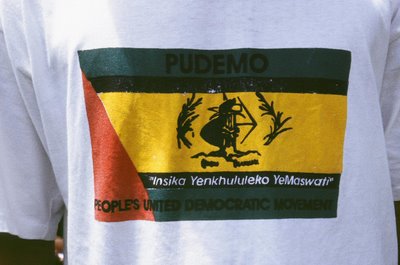

THE SLEEPING GRASS RE-AWAKENS
A SPEECH PRESENTED ON THE OCCASION OF THE COMMEMORATION OF THE ORGANIZATION'S FOUNDING DAY ON THE 5th JULY 2008 IN MANZINI
Introduction.
On behalf of the Central Executive Council, I wish to humbly recognise members of the National Executive Committee, all the Regional and Branch Structures, the Swaziland Youth Congress and the Women's Wing, Isibhejane. I also greet our deployees, the invited guests and my fellow beloved citizens of Swaziland. They are in far flung worlds, out of our sight, but we honor our comrades in exile in Europe, the Americas and in the African continent.
We have all gathered here today to mark a very significant step in our quest for the liberation of our country from the yoke of the royalist minority from decades, and even centuries of repression. The Peoples United Democratic Movement (PUDEMO) is in the centre stage of this process and leads in the democratic revolution of a kind that has boggled the minds of both the oppressed and the ruling classes locally and those in the global community.
Today marks the occasion for us to look back in the past 25 years of our struggle, a time to take stock of who we are, where we come from and where we are heading with the people's mandate to emancipate them from years of economic and class oppression that has relegated our masses to beggers in their own land. This regime has relegated our masses to be less than citizens and be subjects in their land.
2.0. Who is PUDEMO?
Swaziland had been handed independence by the British Empire in September 1968 after she had been a protectorate for years. The handing over was based on the Westminster type of legislature under a multiparty system, but this government, as expected was nonetheless under the 'nose' of the king Sobhuza II, and the ruling party, Imbokodvo National Movement had no opposition after winning all the seats in the 1967 national elections.
When the first term of government expired, the second national elections were again held in 1972 and, this time, there was an upset. The Ngwane National Liberatory Congress win three sits in the East Constituency which meant that there was to be opposition in this parliament for the first time. This did not go down well with the Swazi authorities, and they went to seek advice from one Broederbond legal advisor, a Van Wyk de Vries together with the then Attorney General, a Mr. D. Cohen, who advised the king to dissolve parliament and abrogate the independence constitution.
This was the saddest moment in the lives of the Swazi people as it is on the 12th of April 1973 that the king Sobhuza 'tore' the constitution and usurped all government powers and declared himself an absolute monarch in a speech in the cattle byre that day, saying:
"Now, therefore, I Sobhuza II, king of Swaziland, hereby declare that in collaboration with my cabinet ministers and supported by the whole nation, I have assumed power in the kingdom of Swaziland and that all legislative, executive and judicial power is vested in myself and shall, for the meantime, be exercised in collaboration with a council constituted by my cabinet ministers. I further declare that, to ensure the continued maintance of peace, order and good government, my armed forces in conjunction with the Swaziland Royal Police Force have been posted to all strategic places and have taken charge of all government and public services… All political parties and similar bodies that cultivate and bring about disturbances and ill-feelings within the nation are hereby dissolved and prohibited….no meetings of a political nature and no processions or demonstrations shall be held or take place in any public place…"
But this setup was not going to go unchallenged as people were starting to feel the effects of the repression, corruption, nepotism and misdirection in the country's governance. On top of this, our brothers and sisters who were fleeing racism and color based oppressive regimes in the neighboring states were further humiliated, and some some killed, by the collaboration of the royalist security forces with those of (mainly) the apartheid regime in South Africa. Those from Mocambique were 'gladly' handed over to the Salazar led Portuguese colonial regime and suffered similar fate as that of the South Africans.
The Swazi political pot was also at boiling point when the students and teachers staged county wide protest seeking for more participation in the decision making by the Prince Maphevu and Mabandla led governments. The university students, in particular at the Kwaluseni Campus also sprang up to have their voices heard, and as a result, more tertiary institutions joined in on this band wagon of civil rights.
The death of King Sobhuza II in 1982, in a way, propelled the wishes of the people as immediately after his demise there came blood thirsty wounds within the royal family and hangers-on who exchanged daggers for power. At this point there was the compromise of the rule of law and independence of justice. The executive was controlled by the traditional royalists and the legislature was never an independent organ as it was never representative of the masses. The crisis gave rise to the people's struggles for a voice to their freedom.
Twenty-five years ago this day, a team of daunting and selfless workers, students, intellectuals and politicians came together at the banks of the Mbuluzi River, North-East of Mbabane below the sacred Mantjolo pool to chart the way forward to a better life for all. At this meeting were people of differing ideologies, religious persuation, culture and social class but all with a common objective for the country. It was agreed that this vehicle be called the Peoples United Democratic Movement, *PUDEMO*.
At this meeting, the founding Heroes and Heroenes charted the Peoples Manifesto, a document that today identifies the organization from all others s a people centred and rooted mouth piece of the oppressed masses, and in particular the poorest of the poor. The vision of the Movement is centered around the Peoples Mission Statement, preambing the People's Manifesto, and states that:
.
"We are a Political Movement committed to the creation, protection and promotion of a Constitutional Multiparty Democracy, a transparent and accountable government, an environment conducive to economic growth, and economic empowerment and to the development of a culturally vibrant and tolerant society based on maximum participation and the respect of the will of the people".
The Peoples Manifesto.
From the onset, *PUDEMO* was never a reformist, but a massed based revolutionery and multiclass in its character. It is our belief that for the liberation of our country to be achieved, we have to eradicate the "tinkhundla" * system of government with all its legacies, and replace it with a people driven multiparty government with the respect of the will of the majority, though not suppressing the voice of the minority. We were, and are still tasked with the challenge of united the oppressed masses of the Swazi society towards one goal, that of transforming our country into a democratic multiparty government.
Immediately following the birth of the organisation, material highlighting the ills and crisis of the regime were seen in both rural and urban areas and this culminated in the protests at institutions of higher learning and strikes at work areas. Comrades were hunted down and some went into hiding or exile, and others lost their employment and places at the institutions of higher learning and elementary schools. The conscientisation program was intensified and the name *PUDEMO* was all over the country.
When the young king, Mswati III was enthroned in 1986, he realised that the country was burning on all corners as a result of dissatisfaction from the governed. He had promised to deal with all the people's demands, but had dismally failed to do so and his security forces intensified their clamp down on *PUDEMO* leaders and members. This move climaxed in 1989 when, later, 10 members of the organisation were rounded up and charged with high reason. All accused were acquitted of the main charge, and two were found guilty of 'organising' illegal meetings and received suspended sentences.
The people's organisation continued with consultation and meetings inside and outside the country until, in 1992, decided to unbann itself and defy all the *tinkhundla* government laws.It was during the 1992 General Congress at Ipelegkeng, Soweto where the organisation crafted the document called *The Way Forward To A Constituent Assembly Through a Negotiated Settlement,*calling for a national constitution.
It is also at this Congress that *PUDEMO* called for Free Education, Social Grants for the Elderly, Land Back to The People and others. At this Congress we also framed the campaign of One Country One Federation, and One Industry One Union.
From the early 1990s the state unleashed its royalist forces against the activists of the organisation, and from 1992 after the formation of our youth league, SWAYOCO more of our members were unsettled and went to exile. At the same time the revolution was intensified on all sectors of society, and the regime began to impliment some reforms like the Constitution Review Commission which were totally rejected by the organisation and other civic society members. The regime has always said free or subsidised education at lower grades was not possible, but there a change direction now.
We are a revolutionary organisation by character but we note that what we have been demanding in the last twenty-five years, the regime has agreed are deliverable and in some cases, it has used our ideology. That there was consideration on the constitution making process itself cannot be denied that it was due to our campaigns, though the process was flawed. *PUDEMO*called for the social grants for the elderly and lame, and this is now in place though insignificant. Food shortage and poverty have been part of our campaigns, and the government is still fighting a losing battle here.
We pride ourselves for the positive prospect of having the labor movement working closer to themselves, and we believe that our role has been pivotal there. Thee is no doubt that *PUDEMO* and its youth SWAYOCO possess a solid and highly politicised cadre, and this has created some of the most matured activists in the country. In these twenty-five years of struggle, *PUDEMO*can pride herself with high calibre documents and presentations on policy and positions.
We had the vision of a mass broad based democratic movement and lessons were learnt from the collapse of the Swaziland Democratic Alliance. As early as 2005, discussions on the formation of a loose front with a common object was debated within *PUDEMO* structures, and today we all must be proud that we now have the Swaziland United Democratic Front. Not only because it has been launched, but even more so that all members have agreed on the common founding principles of multi-party democracy in Swaziland; declaring the national elections as undemocratic and demanding for a more accountable and transperant economic policy.
In all these years, we have had our comrades imprisoned for their political beliefs and activity, some have skipped into exile in the Americas, the United Kingdom, Europe, Australia and the African continent. Some of our members' families are suffering from constant intimidation and threats by the regime. The length of the struggle cannot be determined but this has taken the toil from some of our dedicated comrades, and the struggle goes.
Any struggle, for its success and sustanance, needs various and specific resources from time to time, and without the human, financial and material resources the struggle gets crippled in some way. All the mentioned resource have to be mobilised without priority of one above the others – they are all a priority – and we need them.
The biggest blow that the organisation has experienced in this period is the loss of our members from various reasons, from that of Comrades Domini Lefty Mngometulu our founder General Secretary to that of Comrade Gabriel Mkhumane our founder member and recent Deputy President who was assassinated in March 2008. Besides these stalwarts, numerous high calibre cadres and leaders have gone to the land beyond, robbing us of their capabilities and skills in the struggle.
For the past forty years since attaining its 'independence', Swaziland is facing a deep-seated structural crisis, an all round crisis that afflicts every sphere of our society. The demon of royal supremacy and the hegemony of a corrupted and bankrupt morality permeates every part of our life. In Swaziland corruption and moral decay seem 'official' as the disease runs from the highest seat to the lowest, hence to eradicate it would require revolutionary approach.
In all these years it is embarrassing that the government still survives through loans from the Southern African Customs Union to, even, pay monthly wages to the civil servants. The country is in dire straits in as far as economic growth is concerned, and is experiencing less and less direct investment other than the Asian partners surviving on the AGOA facilities to the impoverishment of the already poor Swazi people. International observers have blamed this state of affairs to the extravagent monarchy who holds the keys of the national coffers, competes in the economic game and manipulates the national budget.
The regime not only manipulates the national coffers, but also dictates how much and how the resources are to be spent, and recently we have noted that there is widespread recruitment drive into the security forces and more and more is spent on the armament in the defence force. This is in the backdrop of poverty and want, poor health and welfare facilities for the poor masses, the HIV/AIDS pandemic, and high educational costs coupled with soaring unemployment.
The above crisis cannot be addressed without identifying their root political causes. As long as the monarchy plays the role of a 'referee and player' in the political field, the crisis in our country will go deeper and turn more violent, and the pillar to this state of affairs is the current royalist constitution which gives the king absolute powers as an executive.
The constitution was pushed through the back door and never was it approved by the masses, but by royal command. *PUDEMO* is still prepared to engage in a constructive national dialogue as mentioned before. A constitution worth its salt is one that transfers power to the majority from a minority, and our document *The Way Forward*, mentioned before clearly states as to what process has to be agreed towards a constituent assembly.
We are convinced that, currently, the conditions in the country do not facilitate proper national dialogue, in fact, they militate against negotiations, turning every claim to negotiations under the present climate into a joke or mockery, if not an outright insult to the dignity of the people. Our honest commitment to negotiations does not mean that it should be at any cost to the interests of the our people and the cause for their liberation. We are as much committed to negotiations as we are to finding a lasting solution to the problems of our country, therefore, we shall not allow ourselves to be drowned in the cauldron of political confusion and desperate measures in order to divert us from our core mission – to liberate our people and speedy turn the country into a democratic society.
We have maintained that the constitution entrenches royal supremacy, particularly the consolidation of the monarchy's hold onto power. It negates the essence of an advance towards democracy, which therefore, requires all our condemnation and rejection. But beyond rejections, we need to build and support the momentum towards an alternative process underpinned by inclusivity and legitimacy. We do believe that it is not too late for a genuine alternative process towards a lasting solution to the constitutional crisis we face. We want to maintain that we shall not and have been part of the regime's cosmetic dialogue, because we believe that we have a sacred duty to our people, which is to preserve the dignity of our struggle and restore the confidence of the people in the movement and the cause for democracy itself.
We shall not betray them, whatever the odds.
The issue at hand is a multiparty democracy and the creation of sufficient political space for all our people to participate with all the rights and responsibilities that all civilised beings enjoy everywhere in the world. But multiparty on its own will not resolve the decades long crisis, which means that it should only serve as a space for the intensification of a national effort against all the ills afflicting our society, poverty in particular. The regime is preparing for elections to be held under the directives of the royal constitution and under the current conditions that militate against the free, fair and full participation of all the people and we expect that the international community will be forthright in its condemnation of this abominable act.
We call upon the SADC, African Union and NEPAD and the Commonwealth to stand by their provisions and conventions which they have entered into with the Swaziland government to determine if the forthcoming elections are democratic, even before they are determined as free and fair. We must not only boycott these elections, but do all in our might to make their process
unworkable.
The situation in our country, comrades, will not change unless members within *PUDEMO* and the entire masses of our country rededicate themselves to their liberation from the royal regime. I remind all our cadres that the liberation of the people can only be the act of the people themselves, and nobody can do this for us.
In any struggle it is important to recognize the critical moment, the time when decisive action can propel the struggle into a new phase. We have used all the pillars of our struggle, but it calls on us to determine the strategy and tactic on how and when specific pillars can be used and at what time.
In conclusion, this is the year for our own liberation. We have nothing to lose except our own lives for the liberation, and I call on all our people play their role in the people's program of action.
In the 6th National Congress we boldly proclaimed our profound commitment to the implimentation of the Road Map To A New And Democratic Swaziland and core to the Plan are the following:
- Building *PUDEMO's* political capacity to organise, mobilize and lead the masses.
- Building and sustaining the institutions of democratic governance and social transformation to create a new culture of mass participation in public life and respect for human dignity at all levels of society.
- Building an economy that serves the needs of the people through growth and redistribution to improve the quality of life of our people and promote the ideals of human dignity.
- Democratising traditional leadership and the institution of the monarchy to be compatible with the democratic aspirations of our people and the foundation of the new society we are striving to build.
- Actively participate in building an international solidarity movement for democracy and sovereign development in Swaziland and the whole of Africa and for justice in global governance.
We are called to create an advanced political infrastructure or organisational machinery that is capable of reaching out to all our people and providing credible leadership at all time. This is also a time for us to build cadres who have the political capacity, ideological clarity and dynamic mobility to wage and sustain the struggle, and here, Political Education and development is paramount. We need to build a strong and focused underground structure comprised of well disciplined cadres. Our international mission has to have a well crafted campaign for our cause. The struggle has had knocks, and our finance resources have to be predictable to sustain the struggle. And, lastly, having the above in place, we need technical details of transformation and governance and have in place our policies ready.
Over and above the above tasks, specific Campaigns on Anti Elections, Anti 40/40, Free Education, Land Back To The People, Free Health And Social Services are integral part of our program to the eventual breakthrough.
Long live* PUDEMO*, long live,
I thank you.
Saturday, July 5, 2008

Wednesday, June 4, 2008
PUDEMO presentation to the European Union Ambassadors
A PAPER PRESENTED BY THE CENTRAL EXECUTIVE COUNCIL TO THE EMBASSADORS OF THE EUROPEANUNION IN SOUTHERN AFRICAAT MBABANE, 4TH JUNE 2008.
THE PEOPLE SHALL GOVERN.
___
SWAZILAND
SYSTEMATIC DEGENERATION FROM
CRISIS TO SOCIAL CONFLICT
A presentation to The European Union Embassadors
In Mbabane on the 4th June 2008.
Introduction.
The Peoples United Democratic Movement (PUDEMO) views this moment of consultation with the European Union Embassadors in this region as a great opportunity in which experiences and views will be shared between us on the socio economic and political landscape of our country, Swaziland . It is not only a great opportunity for us, but it is the only means available for us to express ourselves to the current government in Swaziland – an opportunity and right not availed us.
We realise, however, that we live in an abnormal society where we, in such a small country, as stake holders, are dismally far apart and are failing to solve our socio political and economic challenges in a conference situation as this ourselves. This, then, must be an indication to you as to what kind of environment we, the partners of the people of Europe and the member states live in.
The consultations have come at a time when we needed them most, when the country is undergoing various national expriences and functions which we will deal with at later stage of this presentation. It comes at a time when Swaziland, under the SADC is faced with a challenge to take more responsibilities that will reflect more of its internal operative character and be permeated in her discharge of the duties given her.
PUDEMO wish to give honor to the European Union, and in particular, the Head of Delegation, Mr. Peter Beck Christiansen for the unequivocal statement delivered on the occasion of the commemoration of European Union Day at the Mountain Inn, Mbabane on Monday the 2nd June 2008. Indeed, lack of good governance and constructive dialogue is certain brew for enxiety, mistrust and distabilization and unnecessary conflict within citizens and nations of this world.
Swaziland at this Conjuncture.
PUDEMO firmly associates and believe in the Declaration on Fundamental Human Rights as an international guide and convention for human equity and satisfaction. We also believe in the pledge by member states, including Swaziland, towards the Millenium Development Goals (MDGs), whose broader objective is to protect the peoples' fundamental human rights and to promote social and economic progress and better living standards within the larger freedoms of human kind
This pledge is a promisory note to each citizen of our countries, signed by those in authority, and we will not accept any 'bad cheques' as part of delivery or none of it under the promise. None of the MDGs is lesser important than the other, but the eradication of poverty and hunger, achievement of universal primary education, combatting HIV/AIDS, Malaria and other diseases and the reduction of child mortality determines the level of commitment, will and delivery by any member state on these goals.
The Swaziland government is failing to meet these demands as stated in their report in 2006. But the major reason for this failure is the lack of setting and planning on national priorities.
The central challenge, however, in the hardship is the role that is played or not played by the monarchy institution. PUDEMO identifies the root of the crisis in the main 'national question' – what and where is the problem in Swaziland? Any attempt towards resolving the crisis without adressing the national question would merely be attempting cosmetic reformism, dealing with the symptoms (so to speak) and not the root causes. In Swaziland we must identify as to who wields the power in decision making, despensing expenditure and on what – here the monarch is in total control and neither the legislative, cabinet nor the masses of our people.
The welfare of the people rests on the honesty or otherwise of those in authority in any country. National assets, wealth and executive authority is vested in those in authority which gives them the ability to divert or use same for their personal benefit.
That, in Swaziland, the Tibiyo TakaNgwane is controlled in the royallty and that ordinary Swazis are made to compete with the monarchy in the economic market rubs salt into the wound and places all aspiring small entrepreneurs and citizens in an unfair economic play field. The level of corruption has reached alarming proportions with the Minister of Finance announcing that there are millionaire cabinet ministers; that the country loses over E40million a month to corruption and cases involving corruption remaining unprocessed. The wanton expenditure by those in authority; the recruitment and expansion of the security forces and uncontrolled royal trips continue to drain the national coffers and push the majority poor Swazi citizen deeper into poverty and certain death, and on the other side fatten the minority even more.
All this happens at the backdrop of a shrinking economy; abject poverty, poor health policy, drought, high education and soaring food costs.
"The Swazi citizens are further given a flogging by higher service charges and more expensive public and private goods given that prices are not set by open market economy. A people centered economy demands that this 'evil hand' be removed from the market in order to allow both the costs of doing business and prices to converge at the optima".
Economic Justice Network Swaziland
World Social Forum, Nairobi, Kenya 20 – 25th January 2007.
The crisis facing the country are also remnants of a national constitution whose establishing process, contents and implications we have made known in the past consultations with yourselves. PUDEMO maintains her position that the constitutional making process was royally managed, and eventually produced a royal desired product, which is a document that 'constitutionally embraced' the 1973 King's Proclamation, and thus 'constitutionally' gave the monarch all executive powers that he exercises absolutely or through bodies appointed by him.
That the constitution is now supreme law in Swaziland does not render it a people driven and owned document, and we will do all means possible to make our justifiable reasons heard by those in power. In spite of these shortcomings, we are prepared to engage in constructive dialogue towards a true democratically established national constitution.
In 2007, the High Court ordered that the Prime Minister set in place a Commission of Inquiry into the tortures and illtreatment of our members in prisons in the country. These are PUDEMO members who were suspects in the bombing incidents way back in 2005. Firstly, it took the Prime Minister some six months to announce the commission, and by that time, of course, any physical evidence of torture would have naturally healed. Secondly, the Commissioners finished their investigations late in 2007 and delivered their findings to the Prime Minister but over six months later the report is gathering dust in his office.
We call on the Prime Minister to release this report immediately without without any further delay.
Court Cases.
PUDEMO, in association with other members of the civic movement, challenged the authenticity of the constitutional process, seeking for the courts to rule for a democratic process. It is history now that the Supreme Court of Apeal ruled against our prayer for various reasons. This does not mean, we wish to mention, that all is lost, the major battles are 'faught on the battle field' and not at conference rooms.
There is also a court case pending before the High Court on the interpretation of the constitution as regards the position on political parties. The Supreme Court of Apeal ruled that the High Court must hear this case before the end of June 2008 to allow for any apeals before the forth coming national elections are held.
We would have opted for an immediate hearing of this matter, but the regime has opted to proceed with the registration of voters in disregard of the possibility of the ruling.
National Elections.
The process towards national elections has already begun, as said ealier, under abnormal environment in that:-
This Commission was allowed to execute its duties before an Act of Parliament was tabled, debated and approved. The Minister of Justice, when queried on this, said that bringing the Act to parliament was a mere formality, and this is why we have always said that a legislative under the tinkhundla government is only a 'rubber-stamping' institution without its own independence and enjoys no power.
The regime has already invited the international community to bring in observers during the election process, and we believe that agreeing to this invitation means legitimizing an undemocratic and illigetimate process. We fully agree with what the Commonwealth Expert Team said of the 2003 similar elections, that:
"We do not regard the credibility of these National Elections as an issue: no elections can be credible when they are for a parliament which does not have power and when political parties are banned…"
The Team also observed that:
"The ban on political parties has damaged Swaziland. It denies the right to freedom of association and prevents the formulation of national manifestoes, programmes and platforms on which candidates – and a potential government – can be judged by the voters. It also removes the opportunity for the democracy and transparency in candate selection which party process can bring".
We believe, therefore, that before elections are examined as free or fair by any observer, one has to determine if they are, in the first place, democratic as stated above by the Commonwealth Secretariat Expert Team. We humbly urge the European Union Embassadors to make a decisive position of whether you wish to be part of an undemocratic process for the sake of legitimizing it.
Double Celebrations in Swaziland.
In September 2008, the king will be celebrating his 40th birthday, in conjunction with the country's 40th anniversary of 'independence'. PUDEMO has no problem with the king having his private birthday party, but we have reservations when these partys are politicised and put on the tax payers' account to the region of E100milion. These celebrations are held in a country experiencing the worst in poverty, need for primary health care and many other forms of want. Some of the members of the European Union are wtnesses to this as they are donors for a number of NGO's here.
We are aware that some of the world's leaders have been invited and will attend the celebrations with the king and his family members. Our plea to you and other would-be guests is that please note that while dining in those palaces and hotels, hundreds of Swazi people would have had no simple meal for days. Please also note that thousands of Swazi people are dying in unkept drugless health centres, and that many more children are rendered homeless orphans and are destitute.
PUDEMO believes that such occassions are extravagent, costly and unwarranted and, instead, these funds be diverted towards the poorest and disadvantaged our Swazi brothers and sisters.
Early last year, a world wide known commentator publication on the global politics, afrolNews, wrote about Swaziland as follows:
"The relatively small economic growth during the last six years has increasingly gone towards government spending. While in other countries this could have meant improved social services and wealth for the ordinary population, Swaziland is increasingly paralyzed by poor governance, corruption and the private spending of the authoritarian King Mswati 111 and his large royal family. The growing social crisis in the country and the lessening interest of donors to support King Mswati's regime has also created escalating needs for social services beyond the scale of national budgets".
afrolNews
April 2007
Our Positions on these Issues.
We have brought to the international community's attention these experiences of the people of Swaziland and we are aware and expect that the state will also present their own version of events. It is our belief that time is not on our side, the people get more frustrated by the day, and their patience will one day run out. After the court rulings on the human rights, we are, unfortunately pushed towards the wall with very limited alternatives in the quench for our freedom.
We are, never-the-less, still committed to a constructive national dialogue for the solutions of our problems.
PUDEMO unconditionally believes and respects the Declaration on Fundamental Human Rights and all the other continental and regional covenants aimed at giving people their liberties without repression. What is being done in Swaziland falls far too short of these conventions, though.
We are not about to forsake our principles and allow ourselves to legitimize an illegitimate regime and succumb to undemocratic practices of dictatorship. In this regard, the organization is in the process of mobilizing for protests and education on what democratic, free and fair national elections are in all the registration centres. This, we believe, is our right to express our opinion.
We are also embarking on the campaign against the double celebrations to take place later this year.
Our Broader Programme.
Although we have short term programmes of action towards our goal, we wish to state that the Road Map To A New and Democratic Swaziland charts the way forward on how we will achieve the major objective.
This document highlights the two main important parts as the Strategic Iliberation Plan and the other, the Democratic Governance and Social Transformation Plan. We also have, under this, the Implimentation Plan to guide us on how, when and who is key on the implimentation.
Expectations From The International Community.
We realize and respect the contribution that the European Union has done to the people of Africa, and Swaziland in particular in the economic development sector and other areas. We, however, believe that your contribution towards the socio political empowerment of the members of the civic society would go a long way towards capacitating the proponents of democracy, peace and dailogue in the country.
We also request the European Union to exercise its mutual commitments towards the ACP-EU Partnership Agreement signed in Cotonou, in particular Article 9. Without placing into effect the bounds to the objectives of an agreement, partners will see the other 'not doing good'.
Conclusion.
We are aware of the fact that only the people of Swaziland can liberate themselves, with of course the solidarity from same minded friends in the civilised community. PUDEMO is pleased that after a long time, the Swaziland United Democratic Front has taken up and we are all working towards achieving our common goal of a constitutional multiparty government in Swaziland, and believe that this is key to the achievement of a better life, peace economic growth and social stability for our people.
We, finally, wish to congratulate the people and member countries of the European Union for the commemoration of the European Day this past Monday. We agree that no country can or will remain unchanged, countries consist of dynamic people determined to ever move forward and it is our collective responsibility to manage these transitions towards a better world. Indeed, evil will prevail and triump only when good people and organizations do nothing.
We thank you.
[PUDEMO presentation made by President Mario Masuku and General Secretary Sphasha Dlamini.]
THE PEOPLE SHALL GOVERN.
___
SWAZILAND
SYSTEMATIC DEGENERATION FROM
CRISIS TO SOCIAL CONFLICT
A presentation to The European Union Embassadors
In Mbabane on the 4th June 2008.
Introduction.
The Peoples United Democratic Movement (PUDEMO) views this moment of consultation with the European Union Embassadors in this region as a great opportunity in which experiences and views will be shared between us on the socio economic and political landscape of our country, Swaziland . It is not only a great opportunity for us, but it is the only means available for us to express ourselves to the current government in Swaziland – an opportunity and right not availed us.
We realise, however, that we live in an abnormal society where we, in such a small country, as stake holders, are dismally far apart and are failing to solve our socio political and economic challenges in a conference situation as this ourselves. This, then, must be an indication to you as to what kind of environment we, the partners of the people of Europe and the member states live in.
The consultations have come at a time when we needed them most, when the country is undergoing various national expriences and functions which we will deal with at later stage of this presentation. It comes at a time when Swaziland, under the SADC is faced with a challenge to take more responsibilities that will reflect more of its internal operative character and be permeated in her discharge of the duties given her.
PUDEMO wish to give honor to the European Union, and in particular, the Head of Delegation, Mr. Peter Beck Christiansen for the unequivocal statement delivered on the occasion of the commemoration of European Union Day at the Mountain Inn, Mbabane on Monday the 2nd June 2008. Indeed, lack of good governance and constructive dialogue is certain brew for enxiety, mistrust and distabilization and unnecessary conflict within citizens and nations of this world.
Swaziland at this Conjuncture.
PUDEMO firmly associates and believe in the Declaration on Fundamental Human Rights as an international guide and convention for human equity and satisfaction. We also believe in the pledge by member states, including Swaziland, towards the Millenium Development Goals (MDGs), whose broader objective is to protect the peoples' fundamental human rights and to promote social and economic progress and better living standards within the larger freedoms of human kind
This pledge is a promisory note to each citizen of our countries, signed by those in authority, and we will not accept any 'bad cheques' as part of delivery or none of it under the promise. None of the MDGs is lesser important than the other, but the eradication of poverty and hunger, achievement of universal primary education, combatting HIV/AIDS, Malaria and other diseases and the reduction of child mortality determines the level of commitment, will and delivery by any member state on these goals.
The Swaziland government is failing to meet these demands as stated in their report in 2006. But the major reason for this failure is the lack of setting and planning on national priorities.
The central challenge, however, in the hardship is the role that is played or not played by the monarchy institution. PUDEMO identifies the root of the crisis in the main 'national question' – what and where is the problem in Swaziland? Any attempt towards resolving the crisis without adressing the national question would merely be attempting cosmetic reformism, dealing with the symptoms (so to speak) and not the root causes. In Swaziland we must identify as to who wields the power in decision making, despensing expenditure and on what – here the monarch is in total control and neither the legislative, cabinet nor the masses of our people.
The welfare of the people rests on the honesty or otherwise of those in authority in any country. National assets, wealth and executive authority is vested in those in authority which gives them the ability to divert or use same for their personal benefit.
That, in Swaziland, the Tibiyo TakaNgwane is controlled in the royallty and that ordinary Swazis are made to compete with the monarchy in the economic market rubs salt into the wound and places all aspiring small entrepreneurs and citizens in an unfair economic play field. The level of corruption has reached alarming proportions with the Minister of Finance announcing that there are millionaire cabinet ministers; that the country loses over E40million a month to corruption and cases involving corruption remaining unprocessed. The wanton expenditure by those in authority; the recruitment and expansion of the security forces and uncontrolled royal trips continue to drain the national coffers and push the majority poor Swazi citizen deeper into poverty and certain death, and on the other side fatten the minority even more.
All this happens at the backdrop of a shrinking economy; abject poverty, poor health policy, drought, high education and soaring food costs.
"The Swazi citizens are further given a flogging by higher service charges and more expensive public and private goods given that prices are not set by open market economy. A people centered economy demands that this 'evil hand' be removed from the market in order to allow both the costs of doing business and prices to converge at the optima".
Economic Justice Network Swaziland
World Social Forum, Nairobi, Kenya 20 – 25th January 2007.
The crisis facing the country are also remnants of a national constitution whose establishing process, contents and implications we have made known in the past consultations with yourselves. PUDEMO maintains her position that the constitutional making process was royally managed, and eventually produced a royal desired product, which is a document that 'constitutionally embraced' the 1973 King's Proclamation, and thus 'constitutionally' gave the monarch all executive powers that he exercises absolutely or through bodies appointed by him.
That the constitution is now supreme law in Swaziland does not render it a people driven and owned document, and we will do all means possible to make our justifiable reasons heard by those in power. In spite of these shortcomings, we are prepared to engage in constructive dialogue towards a true democratically established national constitution.
In 2007, the High Court ordered that the Prime Minister set in place a Commission of Inquiry into the tortures and illtreatment of our members in prisons in the country. These are PUDEMO members who were suspects in the bombing incidents way back in 2005. Firstly, it took the Prime Minister some six months to announce the commission, and by that time, of course, any physical evidence of torture would have naturally healed. Secondly, the Commissioners finished their investigations late in 2007 and delivered their findings to the Prime Minister but over six months later the report is gathering dust in his office.
We call on the Prime Minister to release this report immediately without without any further delay.
Court Cases.
PUDEMO, in association with other members of the civic movement, challenged the authenticity of the constitutional process, seeking for the courts to rule for a democratic process. It is history now that the Supreme Court of Apeal ruled against our prayer for various reasons. This does not mean, we wish to mention, that all is lost, the major battles are 'faught on the battle field' and not at conference rooms.
There is also a court case pending before the High Court on the interpretation of the constitution as regards the position on political parties. The Supreme Court of Apeal ruled that the High Court must hear this case before the end of June 2008 to allow for any apeals before the forth coming national elections are held.
We would have opted for an immediate hearing of this matter, but the regime has opted to proceed with the registration of voters in disregard of the possibility of the ruling.
National Elections.
The process towards national elections has already begun, as said ealier, under abnormal environment in that:-
- The process is based and underpinned by a constitution denying people their right to associate as espoused by the Declaration on Fundamental Human Rights, the Harare Declaration, the African Charter on Human and Peoples's Rights and the SADC Principles and Procedures on national elections. This is endorsed by a constitution that (firstly) acknowledges a Bill of Rights and (then), in Section 79, prohibits the same rights.
- The Pre-elections era is clouded in acute doubts and ill-preparedness as the expected voters still have basic questions on what they are voting for. There is supposed to have been an independent civic education to inform the public on what elections are for, what choices they have and what rights they have before putting their crosses. The appointment of the Elections and Border Commission has caused enxiety due to their legal standing, and their supposed independence.
- The process is managed from the throne as it is the king who issues orders through the traditional and other structures, and culturally, people do not question him.
- The media in the country is partisan and only stae aligned information is permitted time on the state electric media, in particular.
This Commission was allowed to execute its duties before an Act of Parliament was tabled, debated and approved. The Minister of Justice, when queried on this, said that bringing the Act to parliament was a mere formality, and this is why we have always said that a legislative under the tinkhundla government is only a 'rubber-stamping' institution without its own independence and enjoys no power.
The regime has already invited the international community to bring in observers during the election process, and we believe that agreeing to this invitation means legitimizing an undemocratic and illigetimate process. We fully agree with what the Commonwealth Expert Team said of the 2003 similar elections, that:
"We do not regard the credibility of these National Elections as an issue: no elections can be credible when they are for a parliament which does not have power and when political parties are banned…"
The Team also observed that:
"The ban on political parties has damaged Swaziland. It denies the right to freedom of association and prevents the formulation of national manifestoes, programmes and platforms on which candidates – and a potential government – can be judged by the voters. It also removes the opportunity for the democracy and transparency in candate selection which party process can bring".
We believe, therefore, that before elections are examined as free or fair by any observer, one has to determine if they are, in the first place, democratic as stated above by the Commonwealth Secretariat Expert Team. We humbly urge the European Union Embassadors to make a decisive position of whether you wish to be part of an undemocratic process for the sake of legitimizing it.
Double Celebrations in Swaziland.
In September 2008, the king will be celebrating his 40th birthday, in conjunction with the country's 40th anniversary of 'independence'. PUDEMO has no problem with the king having his private birthday party, but we have reservations when these partys are politicised and put on the tax payers' account to the region of E100milion. These celebrations are held in a country experiencing the worst in poverty, need for primary health care and many other forms of want. Some of the members of the European Union are wtnesses to this as they are donors for a number of NGO's here.
We are aware that some of the world's leaders have been invited and will attend the celebrations with the king and his family members. Our plea to you and other would-be guests is that please note that while dining in those palaces and hotels, hundreds of Swazi people would have had no simple meal for days. Please also note that thousands of Swazi people are dying in unkept drugless health centres, and that many more children are rendered homeless orphans and are destitute.
PUDEMO believes that such occassions are extravagent, costly and unwarranted and, instead, these funds be diverted towards the poorest and disadvantaged our Swazi brothers and sisters.
Early last year, a world wide known commentator publication on the global politics, afrolNews, wrote about Swaziland as follows:
"The relatively small economic growth during the last six years has increasingly gone towards government spending. While in other countries this could have meant improved social services and wealth for the ordinary population, Swaziland is increasingly paralyzed by poor governance, corruption and the private spending of the authoritarian King Mswati 111 and his large royal family. The growing social crisis in the country and the lessening interest of donors to support King Mswati's regime has also created escalating needs for social services beyond the scale of national budgets".
afrolNews
April 2007
Our Positions on these Issues.
We have brought to the international community's attention these experiences of the people of Swaziland and we are aware and expect that the state will also present their own version of events. It is our belief that time is not on our side, the people get more frustrated by the day, and their patience will one day run out. After the court rulings on the human rights, we are, unfortunately pushed towards the wall with very limited alternatives in the quench for our freedom.
We are, never-the-less, still committed to a constructive national dialogue for the solutions of our problems.
PUDEMO unconditionally believes and respects the Declaration on Fundamental Human Rights and all the other continental and regional covenants aimed at giving people their liberties without repression. What is being done in Swaziland falls far too short of these conventions, though.
We are not about to forsake our principles and allow ourselves to legitimize an illegitimate regime and succumb to undemocratic practices of dictatorship. In this regard, the organization is in the process of mobilizing for protests and education on what democratic, free and fair national elections are in all the registration centres. This, we believe, is our right to express our opinion.
We are also embarking on the campaign against the double celebrations to take place later this year.
Our Broader Programme.
Although we have short term programmes of action towards our goal, we wish to state that the Road Map To A New and Democratic Swaziland charts the way forward on how we will achieve the major objective.
This document highlights the two main important parts as the Strategic Iliberation Plan and the other, the Democratic Governance and Social Transformation Plan. We also have, under this, the Implimentation Plan to guide us on how, when and who is key on the implimentation.
Expectations From The International Community.
We realize and respect the contribution that the European Union has done to the people of Africa, and Swaziland in particular in the economic development sector and other areas. We, however, believe that your contribution towards the socio political empowerment of the members of the civic society would go a long way towards capacitating the proponents of democracy, peace and dailogue in the country.
We also request the European Union to exercise its mutual commitments towards the ACP-EU Partnership Agreement signed in Cotonou, in particular Article 9. Without placing into effect the bounds to the objectives of an agreement, partners will see the other 'not doing good'.
Conclusion.
We are aware of the fact that only the people of Swaziland can liberate themselves, with of course the solidarity from same minded friends in the civilised community. PUDEMO is pleased that after a long time, the Swaziland United Democratic Front has taken up and we are all working towards achieving our common goal of a constitutional multiparty government in Swaziland, and believe that this is key to the achievement of a better life, peace economic growth and social stability for our people.
We, finally, wish to congratulate the people and member countries of the European Union for the commemoration of the European Day this past Monday. We agree that no country can or will remain unchanged, countries consist of dynamic people determined to ever move forward and it is our collective responsibility to manage these transitions towards a better world. Indeed, evil will prevail and triump only when good people and organizations do nothing.
We thank you.
[PUDEMO presentation made by President Mario Masuku and General Secretary Sphasha Dlamini.]
Wednesday, April 9, 2008
PUDEMO Statement on the Assassination of Dr. G Mkhumane
THE STATEMENT
FROM THE PEOPLES UNITED DEMOCRATIC MOVEMENT
ON THE ASSASSINATION OF OUR DEPUTY PRESIDENT, COMRADE DR. GABRIEL THANDOKUHLE MKHUMANE.
09th APRIL 2008
The peoples President, comrade Mario T. Masuku and the entire National Executive Committee mourn the demise of the Movement's Deputy President, Comrade Dr. Gabriel Thandokuhle Mkhumane, who was assassinated a week ago in Nelspruit, the Republic of South Africa.
We extend our heartfelt condolences to the late comrade's wife, Zoraida, his two sons Lizwi and Lizo, to his mother, Gogo Shongwe, members of both families, members of staff at the Themba Hospital, PUDEMO and all her structures and all members of the mass democratic movement in Swaziland and beyond.
We have all lost a son, a father, husband, brother, a friend and companion, a humble and loving, hard working man that will be irreplaceable. PUDEMO has lost a father figure, a leader and a revolutionary of unequalled proportions. The Comrade was a down-to-earth people's man who had, as his second love, the liberation of the oppressed masses of our country, Swaziland. We have lost a committed visionary and strategic leader who feared nobody but the people he so honestly, loyally and constantly served all the time.
The comrade would still be alive had the royalist regime in Swaziland respected the political rights and determination of the country's citizens, and he would not have skipped the country into exile. PUDEMO condemns the callous, ruthless and self-centered cold blooded assassin who took away the life of a people's chosen leader in such a manner. We implore that the local Police Services to leave no stone unturned and track and apprehend this perpetrator and let the law take its course.
We are not deaf and blind to the visits in recent years to the deceased's home by the Swaziland secret police personnel, who confronted Gogo Shongwe, enquiring and intimidating her about the Comrade and eventually vowed that he would come back home only as a dead man. This wish by the state has now been fulfilled, and should members of the organization, the poor and helpless people of Swaziland sit down and lick the wounds?
In spite of this temporary setback, PUDEMO remains focused on the national democratic revolution and the liberation of the masses of our country from the quagmire and crisis into which the royalist tinkhundla regime has immersed our country. We now even owe to our fallen leader to take the torch with all our pillars of the struggle, for the tree of liberation has been watered by his blood.
PUDEMO humbly extends her comradely appreciation to those countries that have accepted and accommodated our members in exile, and we acknowledge the roles played by our allies particularly in the neighboring states. Their international solidarity is of necessity at this particular phase of our struggle as we intensify the call for a democratic Swaziland, and more of our members may seek political shelter in these countries in the not so distant future.
There will be a memorial service on Friday, the 11th April at 1300hrs at the Agricultural Hall, Nelspruit followed by a night vigil at the Rugby Stadium from 2100hrs until the early morning, the funeral commences from the stadium at 0700hrs and then we proceed to the Rocksdrift Cemetery in Nelspruit.
Building a Popular Movement for sustained liberation struggle.
Issued By the National Executive committee of [PUDEMO Swaziland]
For more information contact
Mario Masuku- PUDEMO-President
Cell: +268 608 3338 or
Sonkhe Dlamini [PUDEMO International Secretary Based in RSA]
Cell: 27-82 923 1401
FROM THE PEOPLES UNITED DEMOCRATIC MOVEMENT
ON THE ASSASSINATION OF OUR DEPUTY PRESIDENT, COMRADE DR. GABRIEL THANDOKUHLE MKHUMANE.
09th APRIL 2008
The peoples President, comrade Mario T. Masuku and the entire National Executive Committee mourn the demise of the Movement's Deputy President, Comrade Dr. Gabriel Thandokuhle Mkhumane, who was assassinated a week ago in Nelspruit, the Republic of South Africa.
We extend our heartfelt condolences to the late comrade's wife, Zoraida, his two sons Lizwi and Lizo, to his mother, Gogo Shongwe, members of both families, members of staff at the Themba Hospital, PUDEMO and all her structures and all members of the mass democratic movement in Swaziland and beyond.
We have all lost a son, a father, husband, brother, a friend and companion, a humble and loving, hard working man that will be irreplaceable. PUDEMO has lost a father figure, a leader and a revolutionary of unequalled proportions. The Comrade was a down-to-earth people's man who had, as his second love, the liberation of the oppressed masses of our country, Swaziland. We have lost a committed visionary and strategic leader who feared nobody but the people he so honestly, loyally and constantly served all the time.
The comrade would still be alive had the royalist regime in Swaziland respected the political rights and determination of the country's citizens, and he would not have skipped the country into exile. PUDEMO condemns the callous, ruthless and self-centered cold blooded assassin who took away the life of a people's chosen leader in such a manner. We implore that the local Police Services to leave no stone unturned and track and apprehend this perpetrator and let the law take its course.
We are not deaf and blind to the visits in recent years to the deceased's home by the Swaziland secret police personnel, who confronted Gogo Shongwe, enquiring and intimidating her about the Comrade and eventually vowed that he would come back home only as a dead man. This wish by the state has now been fulfilled, and should members of the organization, the poor and helpless people of Swaziland sit down and lick the wounds?
In spite of this temporary setback, PUDEMO remains focused on the national democratic revolution and the liberation of the masses of our country from the quagmire and crisis into which the royalist tinkhundla regime has immersed our country. We now even owe to our fallen leader to take the torch with all our pillars of the struggle, for the tree of liberation has been watered by his blood.
PUDEMO humbly extends her comradely appreciation to those countries that have accepted and accommodated our members in exile, and we acknowledge the roles played by our allies particularly in the neighboring states. Their international solidarity is of necessity at this particular phase of our struggle as we intensify the call for a democratic Swaziland, and more of our members may seek political shelter in these countries in the not so distant future.
There will be a memorial service on Friday, the 11th April at 1300hrs at the Agricultural Hall, Nelspruit followed by a night vigil at the Rugby Stadium from 2100hrs until the early morning, the funeral commences from the stadium at 0700hrs and then we proceed to the Rocksdrift Cemetery in Nelspruit.
Building a Popular Movement for sustained liberation struggle.
Issued By the National Executive committee of [PUDEMO Swaziland]
For more information contact
Mario Masuku- PUDEMO-President
Cell: +268 608 3338 or
Sonkhe Dlamini [PUDEMO International Secretary Based in RSA]
Cell: 27-82 923 1401
Monday, January 28, 2008
PUDEMO STATEMENT Dysfunctional leadership at the University of Swaziland: a symptom of a failing state
PUDEMO STATEMENT
Dysfunctional leadership at the University of Swaziland: a symptom of a failing state
Over the past weeks there have been numerous reports about the conflict between students and the administration at the University of Swaziland (UNISWA). This conflict stems from the so-called semisterisation or academic restructuring designed from the ivory tower and imposed on students. When students expressed concerns about these changes, the university authority responded, as it always has done, with threats, intimidation and violence. Regrettably, these hostile tactics have arrested development at the university.
In December 2006, the administration closed down the university after a student protest against the contentious academic structure. When the university reopened on January 2007, the administration failed to provide leadership and resolve the impasse. Instead, it insisted on implementing the restructuring program through threats, intimidation and violent tactics. Reminiscent of the township siege during the apartheid reign of terror in South Africa, the administration called in armed paramilitary police units to occupy university grounds. Members of the academic staff were threatened with dismissal from their jobs when they protested against the presence of armed paramilitary units.
Such behaviour by a university administration is abhorrent. Resorting to the barrel of a gun and threats rather than appealing to intellectual reasoning reflects a serious failure of leadership. It clearly demonstrates the dysfunction in this bureaucracy and its extreme irresponsibility. The way in which the administration has handled this situation has done serious harm to the reputation of the university as an institution responsible for producing the country's intellectual resources. If the people at the helm of the institution are incapable of providing role models, how does the university hope to achieve its mission?
It is obvious that there is widespread dissatisfaction with the restructuring process and that these changes have not been thought through by the university administration. The current conflict suggests that the administration does not have an effective plan to manage the restructuring process, but instead relies heavily on bullying tactics. There are strong indications that the administration did not endeavour to effectively communicate and negotiate the reasons for the structuring process and its implementation with students. For example, did the administration consider other means of achieving its goals? A staged implementation programme allowing a smooth transition from the current to the new structure would have avoided the conflict. Under this approach, the restructuring process could have been introduced to first year academic programmes allowing students in current programmes to continue uninterrupted. A well-thought through restructuring process would have an inbuilt sunset clause. In this case it would mean that schools across the university will continue to offer the old programme to current students and the new programme to a fresh intake. The old programme would then be phased out after the last cohort of current students had graduated.
We wonder if the administration has a plan to evaluate the impact of the changes on teaching, learning and academic outcomes. If the changes are implanted along the dual academic structuring process, it would require the development of a compatible evaluation programme with clearly established performance indicators. We would suggest a two-staged evaluation process - internal evaluation and external evaluation. The internal evaluation will assess the effectiveness of the changes on different areas of scholarship and will require a high level of leadership capable of responding to periodic evaluation outcomes. Evaluation should be conducted at the end of each semester, focusing mainly on student and academic staff assessment of teaching and learning under the new programme. One would assume that under the new programme, the university and different schools will develop new graduate attributes. The external evaluation should therefore, as a principle, measure the benefits of the programme to society after its first "birthday". It should cover graduate and industry evaluation. For example, to what extent has the new academic programme improved employment opportunities for graduates and how has it contributed to better outcomes in various industries and public service? That is, are graduates of this programme more or less equipped to offer the human resources the country needs for future development?
As an organisation committed to good governance, democracy, service delivery and effective leadership, we call upon the university authority to reconsider its approach to the administration of this very important institution. PUDEMO supports calls from student and academic staff bodies for the withdrawal of armed paramilitary units from university grounds. Whilst we welcome the suspension of the implementation of the restructuring process pending the court outcome, we remain concerned about the failure of the university administration and the ministry of education to deal with the situation. This is a shambled job characteristic of bad management. Bad managers are incapable of managing conflicts without resorting to heavy-handed tactics. A functioning leadership would think carefully about the implications of restructuring processes and it would endeavour to discuss and negotiate aspects of these processes with all stakeholders. Conflicts are inevitable in processes of change and they can be constructive or destructive depending on the way in which they are managed.
While the university's behaviour is indubitably appalling, it is unfortunately little more than the latest visible lesion in the diseased body of Swaziland's administration. The university's heavy-handed approach reveals the poverty of its leadership and it is utterly consistent with the way business is usually conducted at the highest levels of authority in Swaziland. Unfortunately, the royal family has entrenched a culture of dictatorship in which peaceful debate is responded to with state violence against citizens. The national administration has a well-established record of incompetence and aggression which has brought Swaziland into the realms of failing statehood. Year by year, we see severe crises in the core social institutions of the country. The administration of law and order, of health care and of education is never far from collapse in Swaziland and lurches from crisis to crisis. The ongoing marginal functioning of these institutions and the recurrent crises are due to poor leadership and the dictatorial way of doing business in Swaziland.
The university has, regrettably, become the latest visible symptom of this political malaise, but it has always aped and aided the monarchy's dictatorial practices. From the days of the notorious Liqoqo regime in the early 1980s to the current period, the university has had no visionary leadership independent of the ruling royal family's political influence. Over the years, the administration has established a strong McCarthyist culture determined to purge the state's "enemies" from the university. From the early 1980s, generations of university students have opposed the authoritarian royal family rule and called for the introduction of a democratic system of governance. Consequently, the administration and the government see students as a hostile constituency. In many ways, this has contributed to the failure of leadership at the university to respond effectively to genuine concerns of students.
In our view, the way in which the university is managed has rendered the institution dysfunctional. This is an old fashioned style of higher education management and has generated disharmony between the student body and the administration. In the 21st century, universities around the world have pensioned off the authoritarian ivory tower management style and crafted a new identity as student-centred institutions. Serving the interests of the student population is a primary goal of 21st century universities. Swaziland University is profoundly outdated and this compromises the international standing of its educational programmes and devalues the qualifications of its students. If students are to be fit to take their place as intellectuals and society leaders, the university will have to teach them something beyond bully tactics and intimidation. Why should students bother to attend a university which has nothing to offer beyond bullying – this kind of knowledge will not help them to influence society in a positive way although it might of course prepare them well for a high-ranking government post under the current regime. Students might well ask themselves whether an institution which acts as a dictatorship and uses paramilitary forces to silence peaceful debate is really a university at all. It is a failing institution in a failing state and has little to offer students who wish to make a difference in Swaziland and beyond. Thus, there is an urgent need for far-sweeping changes in this deeply dysfunctional culture at the University of Swaziland and other Swazi institutions.
Signed:
Dr. Jabulane Matsebula
PUDEMO Representative
Australia, Asia and the South Pacific Region
Dysfunctional leadership at the University of Swaziland: a symptom of a failing state
Over the past weeks there have been numerous reports about the conflict between students and the administration at the University of Swaziland (UNISWA). This conflict stems from the so-called semisterisation or academic restructuring designed from the ivory tower and imposed on students. When students expressed concerns about these changes, the university authority responded, as it always has done, with threats, intimidation and violence. Regrettably, these hostile tactics have arrested development at the university.
In December 2006, the administration closed down the university after a student protest against the contentious academic structure. When the university reopened on January 2007, the administration failed to provide leadership and resolve the impasse. Instead, it insisted on implementing the restructuring program through threats, intimidation and violent tactics. Reminiscent of the township siege during the apartheid reign of terror in South Africa, the administration called in armed paramilitary police units to occupy university grounds. Members of the academic staff were threatened with dismissal from their jobs when they protested against the presence of armed paramilitary units.
Such behaviour by a university administration is abhorrent. Resorting to the barrel of a gun and threats rather than appealing to intellectual reasoning reflects a serious failure of leadership. It clearly demonstrates the dysfunction in this bureaucracy and its extreme irresponsibility. The way in which the administration has handled this situation has done serious harm to the reputation of the university as an institution responsible for producing the country's intellectual resources. If the people at the helm of the institution are incapable of providing role models, how does the university hope to achieve its mission?
It is obvious that there is widespread dissatisfaction with the restructuring process and that these changes have not been thought through by the university administration. The current conflict suggests that the administration does not have an effective plan to manage the restructuring process, but instead relies heavily on bullying tactics. There are strong indications that the administration did not endeavour to effectively communicate and negotiate the reasons for the structuring process and its implementation with students. For example, did the administration consider other means of achieving its goals? A staged implementation programme allowing a smooth transition from the current to the new structure would have avoided the conflict. Under this approach, the restructuring process could have been introduced to first year academic programmes allowing students in current programmes to continue uninterrupted. A well-thought through restructuring process would have an inbuilt sunset clause. In this case it would mean that schools across the university will continue to offer the old programme to current students and the new programme to a fresh intake. The old programme would then be phased out after the last cohort of current students had graduated.
We wonder if the administration has a plan to evaluate the impact of the changes on teaching, learning and academic outcomes. If the changes are implanted along the dual academic structuring process, it would require the development of a compatible evaluation programme with clearly established performance indicators. We would suggest a two-staged evaluation process - internal evaluation and external evaluation. The internal evaluation will assess the effectiveness of the changes on different areas of scholarship and will require a high level of leadership capable of responding to periodic evaluation outcomes. Evaluation should be conducted at the end of each semester, focusing mainly on student and academic staff assessment of teaching and learning under the new programme. One would assume that under the new programme, the university and different schools will develop new graduate attributes. The external evaluation should therefore, as a principle, measure the benefits of the programme to society after its first "birthday". It should cover graduate and industry evaluation. For example, to what extent has the new academic programme improved employment opportunities for graduates and how has it contributed to better outcomes in various industries and public service? That is, are graduates of this programme more or less equipped to offer the human resources the country needs for future development?
As an organisation committed to good governance, democracy, service delivery and effective leadership, we call upon the university authority to reconsider its approach to the administration of this very important institution. PUDEMO supports calls from student and academic staff bodies for the withdrawal of armed paramilitary units from university grounds. Whilst we welcome the suspension of the implementation of the restructuring process pending the court outcome, we remain concerned about the failure of the university administration and the ministry of education to deal with the situation. This is a shambled job characteristic of bad management. Bad managers are incapable of managing conflicts without resorting to heavy-handed tactics. A functioning leadership would think carefully about the implications of restructuring processes and it would endeavour to discuss and negotiate aspects of these processes with all stakeholders. Conflicts are inevitable in processes of change and they can be constructive or destructive depending on the way in which they are managed.
While the university's behaviour is indubitably appalling, it is unfortunately little more than the latest visible lesion in the diseased body of Swaziland's administration. The university's heavy-handed approach reveals the poverty of its leadership and it is utterly consistent with the way business is usually conducted at the highest levels of authority in Swaziland. Unfortunately, the royal family has entrenched a culture of dictatorship in which peaceful debate is responded to with state violence against citizens. The national administration has a well-established record of incompetence and aggression which has brought Swaziland into the realms of failing statehood. Year by year, we see severe crises in the core social institutions of the country. The administration of law and order, of health care and of education is never far from collapse in Swaziland and lurches from crisis to crisis. The ongoing marginal functioning of these institutions and the recurrent crises are due to poor leadership and the dictatorial way of doing business in Swaziland.
The university has, regrettably, become the latest visible symptom of this political malaise, but it has always aped and aided the monarchy's dictatorial practices. From the days of the notorious Liqoqo regime in the early 1980s to the current period, the university has had no visionary leadership independent of the ruling royal family's political influence. Over the years, the administration has established a strong McCarthyist culture determined to purge the state's "enemies" from the university. From the early 1980s, generations of university students have opposed the authoritarian royal family rule and called for the introduction of a democratic system of governance. Consequently, the administration and the government see students as a hostile constituency. In many ways, this has contributed to the failure of leadership at the university to respond effectively to genuine concerns of students.
In our view, the way in which the university is managed has rendered the institution dysfunctional. This is an old fashioned style of higher education management and has generated disharmony between the student body and the administration. In the 21st century, universities around the world have pensioned off the authoritarian ivory tower management style and crafted a new identity as student-centred institutions. Serving the interests of the student population is a primary goal of 21st century universities. Swaziland University is profoundly outdated and this compromises the international standing of its educational programmes and devalues the qualifications of its students. If students are to be fit to take their place as intellectuals and society leaders, the university will have to teach them something beyond bully tactics and intimidation. Why should students bother to attend a university which has nothing to offer beyond bullying – this kind of knowledge will not help them to influence society in a positive way although it might of course prepare them well for a high-ranking government post under the current regime. Students might well ask themselves whether an institution which acts as a dictatorship and uses paramilitary forces to silence peaceful debate is really a university at all. It is a failing institution in a failing state and has little to offer students who wish to make a difference in Swaziland and beyond. Thus, there is an urgent need for far-sweeping changes in this deeply dysfunctional culture at the University of Swaziland and other Swazi institutions.
Signed:
Dr. Jabulane Matsebula
PUDEMO Representative
Australia, Asia and the South Pacific Region
Monday, January 7, 2008
PUDEMO STATEMENT Protecting the Integrity of the African Unity (AU): Swaziland Forced to Withdraw Candidate from the AU Election
Protecting the Integrity of the African Unity (AU): Swaziland Forced to Withdraw Candidate from the AU Election
International Office
Date: January 7, 2008
Behind the scenes protest against the nomination of the former Prime Minister of Swaziland for the AU leadership election has yielded results. The Government of Swaziland has now withdrawn Dlamini's nomination for the Chairperson of the AU election due in January, 2007.
Unfortunately, the Swazi government has not been honest about its decision to withdraw Dlamini's nomination. It has promoted the story that it took this decision in support of a unified Southern African Development Community (SADC) campaign to present one candidate from the region. However, this explanation is not consistent with the Swazi government's behaviour. For example, why did it wait until the last minute before withdrawing its nomination of Dlamini? Furthermore, if the government believed that Dlamini was a strong candidate for the position, it should have been promoting him as the consensus candidate for Southern Africa and lobbying for regional support. Instead, the government pulled him out of the election race altogether.
The government's story is thus at odds with its behaviour and highly dubious. However, to most observers, the reason for its action is obvious. The Swazi government withdrew its nomination of Dlamini because it was unable to attract support for his campaign. The SADC and AU are organisations committed to democratic governance. If they had supported Dlamini's candidacy, the integrity and credibility of these organisations would have been severely undermined because of his terrible record in office and the refusal by Swaziland's dictatorship to adhere to SADC and AU principles of democracy.
Since his appointment as Swazi Prime Minister in 1996, Dlamini presided over some of the worst political crises in Swazi history and his government was marred by controversies and bad judgements. From 1996 to 2003, he led the authoritarian regime and he is currently a member of King Mswati III's Advisory Council, a body that has vigorously opposed the transition from royal authoritarianism to democracy. Selected from the royal family inner circles, the Advisory Council is the monarchy's eye of power making sure that public institutions and citizens conform to the royal authoritarian system. As a result, the Advisory Council exercises enormous political
influence in Swaziland's politics and is well known for its ruthless intolerance of political dissent. Dlamini also served in previous governments as Minister of Finance (1983-1992) including the notorious Liqoqo regime known for its brutality against government critics, corruption and disregard for the rule of law. Human rights abuses under the Liqoqo regime between 1983 and 1986 are well documented by various international human rights organisations such as Amnesty International. As Minister of Finance, Dlamini was responsible for the growth of a culture of corruption in government and lavish royal spending with dire economic consequences. Today, this culture is well entrenched and continues to paralyse the economy and government services.
In his term as Prime Minister, he was known for extravagant spending on royal luxuries. In 2002, the local and international communities were horrified by Dlamini's secret authorisation of the purchase of a private jet for the royal family at a cost of E450 million (US$45 million). This was a morally bankrupt decision which clearly demonstrated the government's insensibility to the effects of the drought conditions and the HIV epidemic on the general population.
However, Dlamini is probably most infamous for his exercise of naked power in 2000 and 2002 when he ruthlessly suppressed freedom of the press, political freedom and judicial independence. On February 17, 2000 the government closed down the state-owned newspaper, The Swazi Observer, for refusing to reveal sources of articles relating to the Royal Swaziland Police secret activities. A year later, on May 4, 2001, Dlamini's government closed down two independent media groups, The Nation and Guardian of Swaziland, for publishing stories criticising human rights abuses and lavish spending by the government and royal family. In September 1999, the government charged the Times Sunday Editor, Bheki Makhubu, with criminal defamation for publishing an article in which he described King Mswati III's fiancée as a high school drop-out.
As Prime Minister, Dlamini was the architect of the infamous Decree No.2, 2001, a law designed to strengthen the authoritarian position of the absolute monarchy government. Under this Decree, publication of materials containing criticisms of the system of government and its leadership were prohibited. Even the production and publication of satirical materials relating to the royal family such as impersonating the king were declared to be criminal offences punishable with a 10-year jail term. The Decree also gave the Minister of Information the power to unilaterally proscribe media organisations which failed to observe these prohibitions. Thus Decree No.2 reflects the ambition of an over zealous dictatorial regime to rule by fear. To all intents and purposes, the Decree was designed to renew the climate of fear generated by the King's Proclamation of 1973 which had been significantly weakened by the democratic movement led by PUDEMO. Hence Decree No.2 bears all the hallmarks of the 1973 Proclamation which made it a criminal offence to exercise freedom of thought in Swaziland. Ultimately, Decree No.2 was withdrawn because of sustained local and international condemnation. However, parts of this Decree such as the controversial Non-Bailable Order were incorporated into Decree No.3, 2001 which, in 2002 to 2004, was one of the key issues at the centre of the rule of law crisis. As the then Prime Minister, Dlamini must be held directly responsible for this crisis.
From 2002 to 2004, the rule of law in Swaziland was severely harmed when the former Prime Minister abandoned all judicial procedures in preference to brute political force. In what can best be described as a ruthless assault on the integrity of the judiciary, Dlamini declared on November 28, 2002 that the Government of His Majesty would not respect the Court of Appeal judgements relating to three cases – the Non-Bailable Offences Order, the mass eviction of families from Kamkhweli and Macetjeni areas and the committal of senior police officers to imprisonment for contempt of court. In his public address to the nation on November 28, 2002, the former Prime Minister ordered all law enforcement sectors to disobey the Court of Appeals rulings, creating a crisis in the rule of law hitherto unseen in Swaziland's judicial history. All judges of the Court of Appeal resigned in protest against this display of brute political attack on the independence of the judiciary. For two years, Swaziland had no functioning Court of Appeal. Details of these cases can be found in the Amnesty International Report (AFR 55/004/2004) and PUDEMO Report (September 28, 2004).
Clearly, Dlamini is not a suitable candidate for the AU position given his disastrous record in government. This record renders him completely unfit for public office and he should have not been recommended in the first place. Africa, particularly SADC, must be congratulated for its commitment to protecting the AU's integrity by refusing to endorse this tin-pot dictator to take the reins of the organisation.
As an organisation committed to democratic governance and political transparency, we are obliged to expose Dlamini's record and make sure that he is quarantined from international leadership responsibilities. We have an obligation to the people of Africa to protect the integrity of the AU as a forward looking organisation committed to political, economic and social progress. The quality of leaders at the helm of the AU is crucial to achieving the organisation's goals and building its global credibility.
Signed:
Dr. Jabulane Matsebula
PUDEMO Representative
Australia, Asia and the South Pacific Region
International Office
Date: January 7, 2008
Behind the scenes protest against the nomination of the former Prime Minister of Swaziland for the AU leadership election has yielded results. The Government of Swaziland has now withdrawn Dlamini's nomination for the Chairperson of the AU election due in January, 2007.
Unfortunately, the Swazi government has not been honest about its decision to withdraw Dlamini's nomination. It has promoted the story that it took this decision in support of a unified Southern African Development Community (SADC) campaign to present one candidate from the region. However, this explanation is not consistent with the Swazi government's behaviour. For example, why did it wait until the last minute before withdrawing its nomination of Dlamini? Furthermore, if the government believed that Dlamini was a strong candidate for the position, it should have been promoting him as the consensus candidate for Southern Africa and lobbying for regional support. Instead, the government pulled him out of the election race altogether.
The government's story is thus at odds with its behaviour and highly dubious. However, to most observers, the reason for its action is obvious. The Swazi government withdrew its nomination of Dlamini because it was unable to attract support for his campaign. The SADC and AU are organisations committed to democratic governance. If they had supported Dlamini's candidacy, the integrity and credibility of these organisations would have been severely undermined because of his terrible record in office and the refusal by Swaziland's dictatorship to adhere to SADC and AU principles of democracy.
Since his appointment as Swazi Prime Minister in 1996, Dlamini presided over some of the worst political crises in Swazi history and his government was marred by controversies and bad judgements. From 1996 to 2003, he led the authoritarian regime and he is currently a member of King Mswati III's Advisory Council, a body that has vigorously opposed the transition from royal authoritarianism to democracy. Selected from the royal family inner circles, the Advisory Council is the monarchy's eye of power making sure that public institutions and citizens conform to the royal authoritarian system. As a result, the Advisory Council exercises enormous political
influence in Swaziland's politics and is well known for its ruthless intolerance of political dissent. Dlamini also served in previous governments as Minister of Finance (1983-1992) including the notorious Liqoqo regime known for its brutality against government critics, corruption and disregard for the rule of law. Human rights abuses under the Liqoqo regime between 1983 and 1986 are well documented by various international human rights organisations such as Amnesty International. As Minister of Finance, Dlamini was responsible for the growth of a culture of corruption in government and lavish royal spending with dire economic consequences. Today, this culture is well entrenched and continues to paralyse the economy and government services.
In his term as Prime Minister, he was known for extravagant spending on royal luxuries. In 2002, the local and international communities were horrified by Dlamini's secret authorisation of the purchase of a private jet for the royal family at a cost of E450 million (US$45 million). This was a morally bankrupt decision which clearly demonstrated the government's insensibility to the effects of the drought conditions and the HIV epidemic on the general population.
However, Dlamini is probably most infamous for his exercise of naked power in 2000 and 2002 when he ruthlessly suppressed freedom of the press, political freedom and judicial independence. On February 17, 2000 the government closed down the state-owned newspaper, The Swazi Observer, for refusing to reveal sources of articles relating to the Royal Swaziland Police secret activities. A year later, on May 4, 2001, Dlamini's government closed down two independent media groups, The Nation and Guardian of Swaziland, for publishing stories criticising human rights abuses and lavish spending by the government and royal family. In September 1999, the government charged the Times Sunday Editor, Bheki Makhubu, with criminal defamation for publishing an article in which he described King Mswati III's fiancée as a high school drop-out.
As Prime Minister, Dlamini was the architect of the infamous Decree No.2, 2001, a law designed to strengthen the authoritarian position of the absolute monarchy government. Under this Decree, publication of materials containing criticisms of the system of government and its leadership were prohibited. Even the production and publication of satirical materials relating to the royal family such as impersonating the king were declared to be criminal offences punishable with a 10-year jail term. The Decree also gave the Minister of Information the power to unilaterally proscribe media organisations which failed to observe these prohibitions. Thus Decree No.2 reflects the ambition of an over zealous dictatorial regime to rule by fear. To all intents and purposes, the Decree was designed to renew the climate of fear generated by the King's Proclamation of 1973 which had been significantly weakened by the democratic movement led by PUDEMO. Hence Decree No.2 bears all the hallmarks of the 1973 Proclamation which made it a criminal offence to exercise freedom of thought in Swaziland. Ultimately, Decree No.2 was withdrawn because of sustained local and international condemnation. However, parts of this Decree such as the controversial Non-Bailable Order were incorporated into Decree No.3, 2001 which, in 2002 to 2004, was one of the key issues at the centre of the rule of law crisis. As the then Prime Minister, Dlamini must be held directly responsible for this crisis.
From 2002 to 2004, the rule of law in Swaziland was severely harmed when the former Prime Minister abandoned all judicial procedures in preference to brute political force. In what can best be described as a ruthless assault on the integrity of the judiciary, Dlamini declared on November 28, 2002 that the Government of His Majesty would not respect the Court of Appeal judgements relating to three cases – the Non-Bailable Offences Order, the mass eviction of families from Kamkhweli and Macetjeni areas and the committal of senior police officers to imprisonment for contempt of court. In his public address to the nation on November 28, 2002, the former Prime Minister ordered all law enforcement sectors to disobey the Court of Appeals rulings, creating a crisis in the rule of law hitherto unseen in Swaziland's judicial history. All judges of the Court of Appeal resigned in protest against this display of brute political attack on the independence of the judiciary. For two years, Swaziland had no functioning Court of Appeal. Details of these cases can be found in the Amnesty International Report (AFR 55/004/2004) and PUDEMO Report (September 28, 2004).
Clearly, Dlamini is not a suitable candidate for the AU position given his disastrous record in government. This record renders him completely unfit for public office and he should have not been recommended in the first place. Africa, particularly SADC, must be congratulated for its commitment to protecting the AU's integrity by refusing to endorse this tin-pot dictator to take the reins of the organisation.
As an organisation committed to democratic governance and political transparency, we are obliged to expose Dlamini's record and make sure that he is quarantined from international leadership responsibilities. We have an obligation to the people of Africa to protect the integrity of the AU as a forward looking organisation committed to political, economic and social progress. The quality of leaders at the helm of the AU is crucial to achieving the organisation's goals and building its global credibility.
Signed:
Dr. Jabulane Matsebula
PUDEMO Representative
Australia, Asia and the South Pacific Region
Wednesday, July 25, 2007
AISA Presentation
PUDEMO
“Insika Yenkhululeko YeMaswati”
PEOPLE’S UNITED DEMOCRATIC MOVEMENT
P.O.BOX 8389, NELSPRUIT, 1200
PHONE 082 92 31 401.
FAX 013 778 9784.
2007-07-25
AISA PRESENTATION.
THE PATH TO A PEACEFUL RESOLUTION OF THE POLITICAL IMPASSE IN SWAZILAND:
A. BACKGROUND
Since that chilly afternoon of the 13 July 1983, on the banks of the Umbuluzi river some 10kms north-east of Mbabane- hidden by the reeds and over-shadowed by the mighty beauty of the pre-historic Sibebe rock, where fine sons and daughters of the Swazi soil met and formed PUDEMO ; yes since that day PUDEMO has been ready to meet and negotiate the future of our country. We have been ready for the past 24 years for the peaceful resolution of the political impasse in Swaziland . What has changed is the urgency and impatience with which we lust for this noble objective and the now razor sharp clarity of our thoughts as to the processes that must be followed for the transfer of government to the people.
We are not interested in the delaying tactics, and in many useless summits. These have become a specialty for the royal family regime. The royal regime sent their emissaries to meet us when we were part of National Constituent Assembly (NCA) , but their servants had neither agenda nor terms of reference from their masters. From the word go, PUDEMO could see that this is a time wasting exercise. We were criticized by the other parties in the NCA , labeled as rebels and extremists , but at the end the truth was laid bare for all to see . The empty negotiations crumbled , the repressive brutality of the regime was stepped up . Whilst their political darlings Sibahle Sinje (meaning Swaziland is ok as it is) a pseudo-cultural group serving as a training ground for young political servants of the status-qou, had an uninterrupted relaunch of themselves as a political party, our SWAYOCO members were being brutalized by the royal police a spitting distance away from the Sibahle Sinje meeting. We are not interested in meeting the regime for drinking traditional marula (buganu) and cracking jokes like the Ngwane National Limbo Congress (NNLC) that says they will bring change from within. A thousand years of collaboration and soft reprimand will never change the regime. One cannot cross a river on the back of a crocodile.
Now the question that begs to be asked is…. Who shall champion the truth ?!Who shall marshal the agenda of democracy and champion the cause of the poor and downtrodden in Swaziland. No organization can crown itself as the flag bearer of the masses, only the masses can give such a status to an organization.
The only organization that has earned the title of “ the peoples leader” “the peoples vanguard” is none other than PUDEMO. Our historic document “the road map to a new and democratic Swaziland” remains the critical analyses of the political impasse in Swaziland. The road map is not a romantic fantasy, it remains the compass, thermometer and barometer of the path we shall beat as we march to seize power for the people and seek their mandate to govern.
Democracy is like beauty; all people, even ugly ones, want to be told that they are beautiful. If they are not told this, they create praise songs that describe themselves as being beautiful. They create illusions of beauty. Just like all regimes want to be associated with democracy, no matter how undemocratic they are!! Similarly, the royal family regime of Swaziland has become experts in the creation of illusions. These illusions can fool the politically young, the naïve, those who suffer from infantile political diseases like the political measles of tribalism, sexism and narrow nationalism and those who are just too eager to be fooled. As already mentioned:
a. Multi-party democracy
b. Separation of the powers and systems of government
c. An independent judiciary
d. A legitimate bill of rights
e. Accountability and transparency
f. Regular free and fair electionsh.
g. Institutions protecting constitutional democracy
h. Fair and reasonable procedure for amendment
(adapted from OSISA)
2. The so-called negotiations that took place in the recent past were an outright mockery of those who yearn for freedom in our lifetime. Various sectors had called for negotiations and as predicted the government ignored them. (see narrative). When the event of border blockade was announced in April, for the 12th April again the regime accepted to negotiate. Predictable the pre-condition was a withdrawal of the border blockade. PUDEMO did not accept these pre-condition, but unfortunately other components of the NCA did- again mocking us as extremists. But that was just shallow and short-lived opportunism. April 12 blockades came and were a huge success. The fake negotiations were still born.
3. Other such illusions are those of an election; illusions of the rule of law; illusions of the separation of powers and illusions of pliability in the constitution.
B. THE WAY FORWARD-------- A PUDEMO DOCUMENT
1. The Preamble
2. The Preliminary negotiations
These are talks about talks. We are acutely aware to the growing divide and lack of trust amongst the protagonists. So we need a session for finding each other and allaying prejudices and natural fears, ( kutselelana emanti ). More importantly this is where we shall discuss how we shall carry on the business of negotiations. Most importantly this will be the moments where PUDEMO shall seek agreement on the Memorandum of Intent.
3.The Memorandum of Intent
The King must after the preliminary negotiations issue a statement to the nation called the Memorandum of Intent, that as of then, there exists a genuine desire to negotiate the future of our country. He is the person most suited to make this pronouncement, as he remains the single biggest impediment to the peaceful resolution of the political conflict in Swaziland. Inter-alia he shall announce the following:
4. The National Convention
A national convention shall be a forum where-in all political parties, political organizations, labour organizations, youth and women’s organizations, traditional institutions, NGO’s and other interest groups would come together to work out the details of the democratization process and lay down acceptable parameters on the modalities leading to a constituent assembly.
The national convention will constitute and form an interim government, based on proportional representation or some other democratic criteria. The position of the King will be in sharp focus here. The King has unwittingly (despite our age old warnings) allowed himself to be a player, referee, linesman, match official and sporting federation all at the same time in the political football of Swaziland. What will be his position then at this stage? Will he be part of a certain political party/ movement? What if this party losses the first democratic elections? It would be too late for him to take the position of impartial referee at this stage. It is my considered opinion that the King must at the stage of the interim government recluse himself and be led to a place of safety outside Swaziland and a caretaker head of state be appointed; probably an elder statesman of Southern Africa, an AU nominee or similar person of wisdom.
This interim government must be balanced and impartial, with clearly defined functions and limited powers and must ensure fairness without bias in favour of one group and most importantly secure the task of the constituent assembly. It shall have a term not exceeding two years.
An interim government will need an interim set of governance rules and regulations; an interim constitution. The royal expedition constitution of 2005 is a definite no-no. The King Sobhuza proclamation of 1973 will be already in the dustbin of history. I find the 1968 independence constitution also unacceptable, due to it’s many similarities to the current 2005 constitution, especially as it pertains to the powers of the King. Therefore it is my considered opinion that the national convention shall have to come up with an interim constitution, one that will satisfy the relevant parts of the eight point criteria.
4. The Constituent Assembly
Under the guidance of the interim government, a constituent assembly, will be formed and constituted. The constituent assembly would be a body elected by all the people, whose main responsibility is to draw up the new constitution for the democratic Swaziland.
We are at pains to ensure that the democratization process is itself democratic. Only a properly constituted constituent assembly will have the legitimate mandate to carry on the task of creating a new democratic dispensation. The electoral process of the constituent assembly will be defined at the national convention. This dispensation will be inclusive and include the monarchy, as the historic congress of PUDEMO of December 2006 articulated the movement’s desire for a constitutional monarchy.
5. Outcomes
Once the people of Swaziland have adopted a new constitution for Swaziland, the following will result:
Dr Sonke Dlamini
PUDEMO
“Insika Yenkhululeko YeMaswati”
PEOPLE’S UNITED DEMOCRATIC MOVEMENT
OFFICE OF THE CHIEF REPRESENTATIVE
OFFICE OF THE SECRETARY FOR INTERNATIONAL AFFAIRSP.O.BOX 8389, NELSPRUIT, 1200
PHONE 082 92 31 401.
FAX 013 778 9784.
2007-07-25
AISA PRESENTATION.
THE PATH TO A PEACEFUL RESOLUTION OF THE POLITICAL IMPASSE IN SWAZILAND:
A. BACKGROUND
Since that chilly afternoon of the 13 July 1983, on the banks of the Umbuluzi river some 10kms north-east of Mbabane- hidden by the reeds and over-shadowed by the mighty beauty of the pre-historic Sibebe rock, where fine sons and daughters of the Swazi soil met and formed PUDEMO ; yes since that day PUDEMO has been ready to meet and negotiate the future of our country. We have been ready for the past 24 years for the peaceful resolution of the political impasse in Swaziland . What has changed is the urgency and impatience with which we lust for this noble objective and the now razor sharp clarity of our thoughts as to the processes that must be followed for the transfer of government to the people.
We are not interested in the delaying tactics, and in many useless summits. These have become a specialty for the royal family regime. The royal regime sent their emissaries to meet us when we were part of National Constituent Assembly (NCA) , but their servants had neither agenda nor terms of reference from their masters. From the word go, PUDEMO could see that this is a time wasting exercise. We were criticized by the other parties in the NCA , labeled as rebels and extremists , but at the end the truth was laid bare for all to see . The empty negotiations crumbled , the repressive brutality of the regime was stepped up . Whilst their political darlings Sibahle Sinje (meaning Swaziland is ok as it is) a pseudo-cultural group serving as a training ground for young political servants of the status-qou, had an uninterrupted relaunch of themselves as a political party, our SWAYOCO members were being brutalized by the royal police a spitting distance away from the Sibahle Sinje meeting. We are not interested in meeting the regime for drinking traditional marula (buganu) and cracking jokes like the Ngwane National Limbo Congress (NNLC) that says they will bring change from within. A thousand years of collaboration and soft reprimand will never change the regime. One cannot cross a river on the back of a crocodile.
Now the question that begs to be asked is…. Who shall champion the truth ?!Who shall marshal the agenda of democracy and champion the cause of the poor and downtrodden in Swaziland. No organization can crown itself as the flag bearer of the masses, only the masses can give such a status to an organization.
The only organization that has earned the title of “ the peoples leader” “the peoples vanguard” is none other than PUDEMO. Our historic document “the road map to a new and democratic Swaziland” remains the critical analyses of the political impasse in Swaziland. The road map is not a romantic fantasy, it remains the compass, thermometer and barometer of the path we shall beat as we march to seize power for the people and seek their mandate to govern.
Democracy is like beauty; all people, even ugly ones, want to be told that they are beautiful. If they are not told this, they create praise songs that describe themselves as being beautiful. They create illusions of beauty. Just like all regimes want to be associated with democracy, no matter how undemocratic they are!! Similarly, the royal family regime of Swaziland has become experts in the creation of illusions. These illusions can fool the politically young, the naïve, those who suffer from infantile political diseases like the political measles of tribalism, sexism and narrow nationalism and those who are just too eager to be fooled. As already mentioned:
- They create delaying tactics. It took the royal mafia regime almost ten years to create a constitution of just over a million of people in a country of just over 17000 square miles with the largest distance from border to border being under 200 kms. The royal constitution is riddled with contradictions. What it gives with the left-hand it takes away with the right–hand. The preparatory events to the constitution fail the test: It was not inclusive, it was not transparent, it was not participatory and it was not accountable. The constitution itself fails the eight point test; it does not guarantee
a. Multi-party democracy
b. Separation of the powers and systems of government
c. An independent judiciary
d. A legitimate bill of rights
e. Accountability and transparency
f. Regular free and fair electionsh.
g. Institutions protecting constitutional democracy
h. Fair and reasonable procedure for amendment
(adapted from OSISA)
2. The so-called negotiations that took place in the recent past were an outright mockery of those who yearn for freedom in our lifetime. Various sectors had called for negotiations and as predicted the government ignored them. (see narrative). When the event of border blockade was announced in April, for the 12th April again the regime accepted to negotiate. Predictable the pre-condition was a withdrawal of the border blockade. PUDEMO did not accept these pre-condition, but unfortunately other components of the NCA did- again mocking us as extremists. But that was just shallow and short-lived opportunism. April 12 blockades came and were a huge success. The fake negotiations were still born.
3. Other such illusions are those of an election; illusions of the rule of law; illusions of the separation of powers and illusions of pliability in the constitution.
B. THE WAY FORWARD-------- A PUDEMO DOCUMENT
1. The Preamble
2. The Preliminary negotiations
These are talks about talks. We are acutely aware to the growing divide and lack of trust amongst the protagonists. So we need a session for finding each other and allaying prejudices and natural fears, ( kutselelana emanti ). More importantly this is where we shall discuss how we shall carry on the business of negotiations. Most importantly this will be the moments where PUDEMO shall seek agreement on the Memorandum of Intent.
3.The Memorandum of Intent
The King must after the preliminary negotiations issue a statement to the nation called the Memorandum of Intent, that as of then, there exists a genuine desire to negotiate the future of our country. He is the person most suited to make this pronouncement, as he remains the single biggest impediment to the peaceful resolution of the political conflict in Swaziland. Inter-alia he shall announce the following:
- The unbanning of political parties. The truth is that political parties remain banned in Swaziland (see Hilary’s letter). Only conservative parties are allowed to operate albeit unofficially. Political parties were expressly banned in 1973 and therefore it stands only to reason if not anything else that they should be officially expressly unbanned. The International Bar Association on their critique to the current royal constitution further stressed this point.
- Create instruments for political parties to operate e.g. a registering office, a framework of registration regulations and possible financial resources for at least the major political players already in existence at the time.
- Pronounce on the unconditional return and indemnification of all political exiles.
- Make a specific pronouncement on the freedom of association as in section 25 of the royal constitution this freedom is deliberately vague and the onus of this freedom is placed on the royal police commissioner (see Hilary’s letter). The right to association, assembly and freedom of speech must be clearly re-pronounced. And that these freedoms shall be enjoyed without undue pressure and threat from the police save for the maintainance of legitimate politically neutral law and order.
- Depending on the character of the conflict at that stage, the MoI may include a ceasefire agreement.
- The MoI must of necessity be a legal document, agreed to by all parties especially the major adversaries PUDEMO and the royal mafia regime, and must have clear time frames for implementation of the next crucial step – the national convention.
4. The National Convention
A national convention shall be a forum where-in all political parties, political organizations, labour organizations, youth and women’s organizations, traditional institutions, NGO’s and other interest groups would come together to work out the details of the democratization process and lay down acceptable parameters on the modalities leading to a constituent assembly.
The national convention will constitute and form an interim government, based on proportional representation or some other democratic criteria. The position of the King will be in sharp focus here. The King has unwittingly (despite our age old warnings) allowed himself to be a player, referee, linesman, match official and sporting federation all at the same time in the political football of Swaziland. What will be his position then at this stage? Will he be part of a certain political party/ movement? What if this party losses the first democratic elections? It would be too late for him to take the position of impartial referee at this stage. It is my considered opinion that the King must at the stage of the interim government recluse himself and be led to a place of safety outside Swaziland and a caretaker head of state be appointed; probably an elder statesman of Southern Africa, an AU nominee or similar person of wisdom.
This interim government must be balanced and impartial, with clearly defined functions and limited powers and must ensure fairness without bias in favour of one group and most importantly secure the task of the constituent assembly. It shall have a term not exceeding two years.
An interim government will need an interim set of governance rules and regulations; an interim constitution. The royal expedition constitution of 2005 is a definite no-no. The King Sobhuza proclamation of 1973 will be already in the dustbin of history. I find the 1968 independence constitution also unacceptable, due to it’s many similarities to the current 2005 constitution, especially as it pertains to the powers of the King. Therefore it is my considered opinion that the national convention shall have to come up with an interim constitution, one that will satisfy the relevant parts of the eight point criteria.
4. The Constituent Assembly
Under the guidance of the interim government, a constituent assembly, will be formed and constituted. The constituent assembly would be a body elected by all the people, whose main responsibility is to draw up the new constitution for the democratic Swaziland.
We are at pains to ensure that the democratization process is itself democratic. Only a properly constituted constituent assembly will have the legitimate mandate to carry on the task of creating a new democratic dispensation. The electoral process of the constituent assembly will be defined at the national convention. This dispensation will be inclusive and include the monarchy, as the historic congress of PUDEMO of December 2006 articulated the movement’s desire for a constitutional monarchy.
5. Outcomes
Once the people of Swaziland have adopted a new constitution for Swaziland, the following will result:
- The dissolution of the constituent assembly.
- Elections for a democratic legislature, of the people, by the people and for the people in a multi party democracy.
- Repeal of all previous constitutions,proclamations, amendments and the like.
- The formation of a new government, filling the other arms of government i.e. the executive and the judiciary.
- The dissolution of the interim government.
Dr Sonke Dlamini
PUDEMO
Thursday, June 14, 2007
PUDEMO President address to the EU delegation
People’s United Democratic Movement - Swaziland
The people of Swaziland are Speaking
…….Is the world listening?
Address to the EU delegation on the 14th June 2007 in Mbabane, Swaziland
PUDEMO since its inception in 1983 has always made it clear that, “the pride of our sovereignty is the guaranteed respect of the will of the people” (People’s manifesto of PUDEMO). This principally means that the process of developing a legitimate national constitution can only come about as a result of a consciously inclusive, participatory and popular process. There can be no substitute for the people, because history has proven that no outcome can be sustainable unless the people themselves have determined it.
We have also watched in dismay, the cold or at best lukewarm attitude of the international community towards Swaziland, though we do appreciate the efforts from certain quarters of the international community to really pay attention to the long-standing demands and concerns of the people of Swaziland. However, there are those sectors within the international community who have chosen to stand, openly, on the side of the regime and its attempts to impose undemocratic processes down the throats of the Swazi people, key amongst them is the commonwealth.
However, we take comfort in the knowledge that the world community of civilised people are fully behind us, key amongst them are the mass of the people of South Africa under the leadership of the tripartite alliance, who have stood by us even in the midst of insults and false accusations by the royal family regime and its patrons. We salute them and vw never to let down their genuine support for democracy and people-centred development in the whole continent, Swaziland included.
Finally, we are proud of our record and consistent struggles with the full support of all Swazi patriots who have refused to be massaged by the evil system. Towards this end, we are also very proud that we have clarified our wayforward as profoundly articulated by the popular Road Map towards a new and democratic Swaziland programme of the movement adopted by the 6th General Congress recently.
We are confident that we have demonstrated without apology our profound commitment to a practical and lasting solution to the crisis facing our country. We have clarified the route from the situation of today and the struggles we seek to wage, to the transition process towards the creation of a new and democratic society, with the core elements of the new society we are struggling to build, being firmly put in place. None can ever doubt PUDEMO’s proven commitment to a real, sustainable and legitimate solution to the problems tinkhundla has plunged our country into.
We seek no short-cuts that will be reversible or avoid the foundation of the problem, but at the same time, we seek to do all within our powers to bring about a speedy solution that is inclusive, sustainable and democratic, yet anchored in fundamentally progressive traditions that civilised humanity has yet evolved.
The Swazi economy is at a serious crisis point and drastic measures are required to save it from ultimate collapse. Growth rate indicators point to a bleak situation as unemployment, poverty, skills and brain drain, rates of investment and general returns on investment are always pointing to a bleak picture. PUDEMO is working on a framework to begin engaging the process of how to return our economy to its rightful place, but not in isolation to, but as part of the general effort to make our country viable in all ways possible, ranging from political governance to economic performance.
Generation after generation have been subjected to the most vicious form of institutionalised subjugation. This explains why despite the massive and simmering anger, people are still sceptical of taking direct action to attack the evil system from its roots, all sorts of excuses and reasons are being put forward for lack of action. However, part of the blame should be apportioned to us as the progressive movement, surely, we could do more to organise the masses of the people to take action now. This is not to undermine the extent to which we are also facing a well-armed and finally well-resourced system, with no or bare minimum resources.
This, we believe is related to the point of the fact that the international community has not yet demonstrated their practical commitment to supporting the seeds of democracy in our country and nurturing the institutionalisation of a culture of organisation, mass participation and vibrant engagement.
On the political front, we have noted a deliberate attempt to downplay the extent of the crisis in the country by the ruling regime, with the full support of some sectors of the international community and media. They have under-recorded the significance of the numerous arrests, mass activities against the state, political statements against the regime and all the efforts of the people to expose the rottenness of the system and begin the road to a new and better society.
Most recently, we have also noted the regime’s political games to fool the world and the people through its negotiations and dialogue projects that are only meant to create an impression of engagement and open space for inclusivity in the political life of the system. It is also an attempt to buy time and renew the system’s lease of life. We have stated very clearly that the necessary climate for negotiations must be created before any meaningful process can begin. We believe that the onus is on the shoulders of the regime, they must prove they are now serious about the process of creating the necessary climate and momentum for change. The Road Map had this to say, “The removal of all laws that prohibit free political activity and the unbanning of political parties in Swaziland shall constitute a strategic victory for the movement, leading to the creation of political conditions which shall make it possible to pursue the objectives of the transfer of political power to the people through negotiations”.
We are convinced that the conditions in the country do not facilitate proper dialogue, in fact, they militate against negotiations, turning every claim to negotiations under the present climate into a joke or mockery, if not an outright insult to the dignity of the people. Our honest commitment to negotiations does not mean it should be at any cost to the interests of our people and the cause for their liberation. We are as much committed to negotiations as we are to finding a lasting solution to the problems of our country, therefore, we shall not allow ourselves to be drowned in the couldron of political confusion and desperate measures in order to divert us from our core mission – to liberate our people and speedily turn the country into a democratic society.
We have maintained that the constitution entrenches royal supremacy, particularly the consolidation of the monarchy’s hold onto power. It negates the essence of an advance towards democracy, which therefore requires all our condemnation and rejection. But beyond rejections, we need to build and support the momentum towards an alternative process underpinned by inclusivity and legitimacy. We do believe that it is not too late for a genuine alternative process towards a lasting solution to the constitutional crisis we face. We want to maintain that we shall not and have been part of the regime’s cosmetic dialogue, because we believe we have a sacred duty to our people, which is to preserve the dignity of our struggle and restore the confidence of the people in the movement and the cause for democracy itself. We shall not betray them, whatever the odds.
The intensified arrests of our members and activists indicate the growing intransigence and arrogance of the royal regime and calls for intensified political action and international focus on Swaziland. The recent border blockade brutality and the on-going attack on our movement, with the most deafening silence on the part of the international community says volumes about the character of the international community and we are sure, this meeting should mark a new era in how the international community responds to the urgencies arising out of the crisis in our country and beyond.
We call for the unconditional release of all our comrades who are on bail, the creation of conducive conditions for the unconditional return of our exiles and the immediate cessation of all political hostilities, with the security forces behaving as a professional, rather than the private royal army that they are.
The issue at hand is a multiparty democracy and the creation of sufficient political space for all our people to participate with all the rights and responsibilities that all civilised beings enjoy everywhere in the world. But multiparty on its own will not resolve the decades long crisis, which means it should only serve as a space for the intensification of a national effort against all the ills afflicting our society, poverty in particular. The regime is preparing for elections to be held under the directives of the royal constitution and under the current conditions that militate against the free and full participation of all the people and we expect that the EU will be forthright in its condemnation of this abominable act.
SADC protocol, AU and NEPAD provisions, the Harare Declaration of the Commonwealth and several other international instruments call for multiparty democracy and adequate pluralistic space for the full and effective participation of all people as a necessary condition for sustainable and legitimate electoral systems and the deepening of democracy in Africa. It is in this context that we are surprised by the behaviour of the Commonwealth that has assisted the regime to draft a constitution that bars political parties and free political activity in the name of culture, we condemn this act of hypocrisy with all the energies at our disposal. We call upon all these multilateral institutions to enforce their conventions in defence of the dignity of our people and their own dignity as institutions, whose relevance to the people of Africa is yet to be affirmed in many instances.
We are glad to realise the amount of interest and enthusiasm it has generated throughout the length and breadth of our society, in particularly amongst all progressive organisations and patriots of our beloved country. We have dedicated significant energy and time to this noble effort and we hope with the momentum already generated, we are not turning back, but are looking forward to a new impetus on the Swazi political front.
There are basic fundamentals required to generate and sustain the momentum towards a genuine and legitimate alternative to the deepening crisis in our country;
However, we need to make it clear in no uncertain terms that we do believe the EU can do more to assist the people of Swaziland than it has been so far willing to do. The most immediate task that we would like to put forward to you in firmer terms is the issue of smart sanctions against the Mswati regime, particularly the royal family as clearly articulated in our 6th National Congress document, entitled, “Targeted sanctions against the ruling regime of Swaziland”. Towards this end, we specifically call upon you to ensure that in the coming EU-AU summit in Portugal in October, the Swazi regime is not invited, as is the case with other non-complying states where you have openly pronounced yourselves. We shall be glad to work with you, as well as measure your renewed commitment and determination to take Swaziland on a new road to sustainable change through this very small and humble quest on our side.
In all these, the international community shall be expected to support in all possible ways, the efforts of the Swazi people to create a new society. This requires more than just political and moral support, but essentially, material and financial support too. If political parties are the key elements of any democratic society, then they must be prepared and supported to play their part effectively. They must be capacitated to fully undertake their historic assignments of mobilising the people to act as their own liberators and custodians of their own destiny. We are alive to the reality that not all political parties represent the future of the country, some represent the past and the very essence of the current system in crisis, which indicates the fact that even the political parties themselves will not necessarily have a smooth sailing, but will have their own challenges to address about the kind of society we are struggling to build.
However, we do believe that the Swazi regime has been let off the international human rights radar for far too long and the international community is guilty for that. It has pretended not to see what is happening in this country and has remained silent in the midst of conspicuous degeneration and royal shame. We cannot allow that any more, we commit to play our own part, but also call upon the world community of democracy loving people to play theirs fully.
We also take this opportunity to warn that patience is desirable, but patience has a limit and would not want to be accused of having not warned that time is not on our side, our people’s suffering is daily becoming a threat to national security, if we seek to use the words of the regime. But in our own view, it is a threat to the selfish desires of the royal family.
Swaziland is the only country we have and would like to see the best come out of it, however, we are worried by the attitude displayed by the regime and the lack of urgency in attending to matters of national interest.
We have always affirmed that we are ready and willing to enter into serious dialogue with the regime, but only once the proper conditions are created and that is the challenge we are putting on the doorstep of the regime. It is not too late to save our country, but it is too late to entertain delaying tactics.
The people of Swaziland are Speaking
…….Is the world listening?
Mario Masuku – PUDEMO President
Address to the EU delegation on the 14th June 2007 in Mbabane, Swaziland
Introduction
In the past few days the world was made to observe the consolidation of royal monopoly over power in the country through a royal constitutional process, which was exclusively designed by the royal regime to serve its narrow undemocratic interests and in the process, exclude the rest of the people in such an important national process.PUDEMO since its inception in 1983 has always made it clear that, “the pride of our sovereignty is the guaranteed respect of the will of the people” (People’s manifesto of PUDEMO). This principally means that the process of developing a legitimate national constitution can only come about as a result of a consciously inclusive, participatory and popular process. There can be no substitute for the people, because history has proven that no outcome can be sustainable unless the people themselves have determined it.
We have also watched in dismay, the cold or at best lukewarm attitude of the international community towards Swaziland, though we do appreciate the efforts from certain quarters of the international community to really pay attention to the long-standing demands and concerns of the people of Swaziland. However, there are those sectors within the international community who have chosen to stand, openly, on the side of the regime and its attempts to impose undemocratic processes down the throats of the Swazi people, key amongst them is the commonwealth.
However, we take comfort in the knowledge that the world community of civilised people are fully behind us, key amongst them are the mass of the people of South Africa under the leadership of the tripartite alliance, who have stood by us even in the midst of insults and false accusations by the royal family regime and its patrons. We salute them and vw never to let down their genuine support for democracy and people-centred development in the whole continent, Swaziland included.
Finally, we are proud of our record and consistent struggles with the full support of all Swazi patriots who have refused to be massaged by the evil system. Towards this end, we are also very proud that we have clarified our wayforward as profoundly articulated by the popular Road Map towards a new and democratic Swaziland programme of the movement adopted by the 6th General Congress recently.
We are confident that we have demonstrated without apology our profound commitment to a practical and lasting solution to the crisis facing our country. We have clarified the route from the situation of today and the struggles we seek to wage, to the transition process towards the creation of a new and democratic society, with the core elements of the new society we are struggling to build, being firmly put in place. None can ever doubt PUDEMO’s proven commitment to a real, sustainable and legitimate solution to the problems tinkhundla has plunged our country into.
We seek no short-cuts that will be reversible or avoid the foundation of the problem, but at the same time, we seek to do all within our powers to bring about a speedy solution that is inclusive, sustainable and democratic, yet anchored in fundamentally progressive traditions that civilised humanity has yet evolved.
The situation in Swaziland today
Our country is facing a deep-seated structural crisis. It al an all-round crisis that afflicts every sphere of our society. The demon of royal supremacy and the hegemony of a corrupted and bankrupt morality permeates every part of our life. It has become so normal to be corrupt that anyone questioning it, instantly has his/her mental state questioned. What kind of a society fears to challenge such terrifying levels of corruption, women and children abuse, soaring unemployment and grinding poverty levels.The Swazi economy is at a serious crisis point and drastic measures are required to save it from ultimate collapse. Growth rate indicators point to a bleak situation as unemployment, poverty, skills and brain drain, rates of investment and general returns on investment are always pointing to a bleak picture. PUDEMO is working on a framework to begin engaging the process of how to return our economy to its rightful place, but not in isolation to, but as part of the general effort to make our country viable in all ways possible, ranging from political governance to economic performance.
Generation after generation have been subjected to the most vicious form of institutionalised subjugation. This explains why despite the massive and simmering anger, people are still sceptical of taking direct action to attack the evil system from its roots, all sorts of excuses and reasons are being put forward for lack of action. However, part of the blame should be apportioned to us as the progressive movement, surely, we could do more to organise the masses of the people to take action now. This is not to undermine the extent to which we are also facing a well-armed and finally well-resourced system, with no or bare minimum resources.
This, we believe is related to the point of the fact that the international community has not yet demonstrated their practical commitment to supporting the seeds of democracy in our country and nurturing the institutionalisation of a culture of organisation, mass participation and vibrant engagement.
On the political front, we have noted a deliberate attempt to downplay the extent of the crisis in the country by the ruling regime, with the full support of some sectors of the international community and media. They have under-recorded the significance of the numerous arrests, mass activities against the state, political statements against the regime and all the efforts of the people to expose the rottenness of the system and begin the road to a new and better society.
Most recently, we have also noted the regime’s political games to fool the world and the people through its negotiations and dialogue projects that are only meant to create an impression of engagement and open space for inclusivity in the political life of the system. It is also an attempt to buy time and renew the system’s lease of life. We have stated very clearly that the necessary climate for negotiations must be created before any meaningful process can begin. We believe that the onus is on the shoulders of the regime, they must prove they are now serious about the process of creating the necessary climate and momentum for change. The Road Map had this to say, “The removal of all laws that prohibit free political activity and the unbanning of political parties in Swaziland shall constitute a strategic victory for the movement, leading to the creation of political conditions which shall make it possible to pursue the objectives of the transfer of political power to the people through negotiations”.
We are convinced that the conditions in the country do not facilitate proper dialogue, in fact, they militate against negotiations, turning every claim to negotiations under the present climate into a joke or mockery, if not an outright insult to the dignity of the people. Our honest commitment to negotiations does not mean it should be at any cost to the interests of our people and the cause for their liberation. We are as much committed to negotiations as we are to finding a lasting solution to the problems of our country, therefore, we shall not allow ourselves to be drowned in the couldron of political confusion and desperate measures in order to divert us from our core mission – to liberate our people and speedily turn the country into a democratic society.
We have maintained that the constitution entrenches royal supremacy, particularly the consolidation of the monarchy’s hold onto power. It negates the essence of an advance towards democracy, which therefore requires all our condemnation and rejection. But beyond rejections, we need to build and support the momentum towards an alternative process underpinned by inclusivity and legitimacy. We do believe that it is not too late for a genuine alternative process towards a lasting solution to the constitutional crisis we face. We want to maintain that we shall not and have been part of the regime’s cosmetic dialogue, because we believe we have a sacred duty to our people, which is to preserve the dignity of our struggle and restore the confidence of the people in the movement and the cause for democracy itself. We shall not betray them, whatever the odds.
The intensified arrests of our members and activists indicate the growing intransigence and arrogance of the royal regime and calls for intensified political action and international focus on Swaziland. The recent border blockade brutality and the on-going attack on our movement, with the most deafening silence on the part of the international community says volumes about the character of the international community and we are sure, this meeting should mark a new era in how the international community responds to the urgencies arising out of the crisis in our country and beyond.
We call for the unconditional release of all our comrades who are on bail, the creation of conducive conditions for the unconditional return of our exiles and the immediate cessation of all political hostilities, with the security forces behaving as a professional, rather than the private royal army that they are.
The issue at hand is a multiparty democracy and the creation of sufficient political space for all our people to participate with all the rights and responsibilities that all civilised beings enjoy everywhere in the world. But multiparty on its own will not resolve the decades long crisis, which means it should only serve as a space for the intensification of a national effort against all the ills afflicting our society, poverty in particular. The regime is preparing for elections to be held under the directives of the royal constitution and under the current conditions that militate against the free and full participation of all the people and we expect that the EU will be forthright in its condemnation of this abominable act.
SADC protocol, AU and NEPAD provisions, the Harare Declaration of the Commonwealth and several other international instruments call for multiparty democracy and adequate pluralistic space for the full and effective participation of all people as a necessary condition for sustainable and legitimate electoral systems and the deepening of democracy in Africa. It is in this context that we are surprised by the behaviour of the Commonwealth that has assisted the regime to draft a constitution that bars political parties and free political activity in the name of culture, we condemn this act of hypocrisy with all the energies at our disposal. We call upon all these multilateral institutions to enforce their conventions in defence of the dignity of our people and their own dignity as institutions, whose relevance to the people of Africa is yet to be affirmed in many instances.
On the Road to a new and democratic Swaziland - the future belongs to the people!
In our 6th National Congress we boldly proclaimed our profound commitment to the unity of all progressive forces in Swaziland and we saw ourselves as key, yet humble players in forging close working ties with our comrades and patriots in the mass democratic movement towards what Congress called the National Democratic Front.We are glad to realise the amount of interest and enthusiasm it has generated throughout the length and breadth of our society, in particularly amongst all progressive organisations and patriots of our beloved country. We have dedicated significant energy and time to this noble effort and we hope with the momentum already generated, we are not turning back, but are looking forward to a new impetus on the Swazi political front.
There are basic fundamentals required to generate and sustain the momentum towards a genuine and legitimate alternative to the deepening crisis in our country;
- Support for the efforts of civil society towards a National Democratic Front which shall be the collective expression of all the oppressed and their united desire to build a new and democratic society
- A preliminary engagement process between the state and organs of civil society, particularly political parties to lay the basis for a broad and all-inclusive process of negotiations. This shall also clear all obstacles to real negotiations and remove all impediments towards that end. International multilateral instruments to safeguard it from the regime’s attack and diversion must leverage this process.
- The creation of a legitimate, popular and progressive constitution with the full participation of all stakeholders, in conditions conducive to the process, which could be a product of the above process of broad engagement
However, we need to make it clear in no uncertain terms that we do believe the EU can do more to assist the people of Swaziland than it has been so far willing to do. The most immediate task that we would like to put forward to you in firmer terms is the issue of smart sanctions against the Mswati regime, particularly the royal family as clearly articulated in our 6th National Congress document, entitled, “Targeted sanctions against the ruling regime of Swaziland”. Towards this end, we specifically call upon you to ensure that in the coming EU-AU summit in Portugal in October, the Swazi regime is not invited, as is the case with other non-complying states where you have openly pronounced yourselves. We shall be glad to work with you, as well as measure your renewed commitment and determination to take Swaziland on a new road to sustainable change through this very small and humble quest on our side.
In all these, the international community shall be expected to support in all possible ways, the efforts of the Swazi people to create a new society. This requires more than just political and moral support, but essentially, material and financial support too. If political parties are the key elements of any democratic society, then they must be prepared and supported to play their part effectively. They must be capacitated to fully undertake their historic assignments of mobilising the people to act as their own liberators and custodians of their own destiny. We are alive to the reality that not all political parties represent the future of the country, some represent the past and the very essence of the current system in crisis, which indicates the fact that even the political parties themselves will not necessarily have a smooth sailing, but will have their own challenges to address about the kind of society we are struggling to build.
However, we do believe that the Swazi regime has been let off the international human rights radar for far too long and the international community is guilty for that. It has pretended not to see what is happening in this country and has remained silent in the midst of conspicuous degeneration and royal shame. We cannot allow that any more, we commit to play our own part, but also call upon the world community of democracy loving people to play theirs fully.
Conclusion
We take this opportunity to appreciate the opportunity to reflect on the challenges we face with yourselves and would be glad to count on you as our partners in the winding, yet determined march to democracy in Swaziland.We also take this opportunity to warn that patience is desirable, but patience has a limit and would not want to be accused of having not warned that time is not on our side, our people’s suffering is daily becoming a threat to national security, if we seek to use the words of the regime. But in our own view, it is a threat to the selfish desires of the royal family.
Swaziland is the only country we have and would like to see the best come out of it, however, we are worried by the attitude displayed by the regime and the lack of urgency in attending to matters of national interest.
We have always affirmed that we are ready and willing to enter into serious dialogue with the regime, but only once the proper conditions are created and that is the challenge we are putting on the doorstep of the regime. It is not too late to save our country, but it is too late to entertain delaying tactics.
Subscribe to:
Posts (Atom)