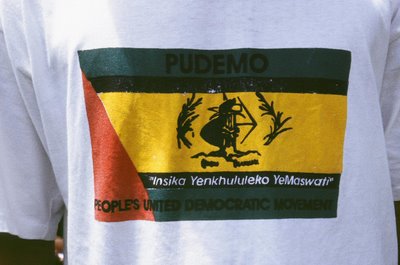

PUDEMO EXTERNAL REGION
PRESS STATEMENT
18th November 2008
On the Arrest of PUDEMO President Cde. Mario Masuku on 15th November 2008 and on the re banning of PUDEMO and its leagues
The PUDEMO External Region Membership condemn with disgust the arrest of the Peoples President Cde. Mario Masuku on the 15th November 2008 and calls for his immediate release. It is our firm belief that this is a desperate attempt by a terrified regime which is hearing the loudly echoing and approaching marching sounds of freedom approaching in the nearest horizon and the loud calls of the People of Swaziland shouting "Enough is Enough we demand our democracy now "
The Peoples United Democratic Movement (PUDEM0) and all its leagues and strategic partners is not intimidated nor fazed by the recent pronouncements by the thick head chief gate keeper Sibusiso Dlamini who parades as a prime minister and his family affair run injustice system run by a family coalition of the royal page bow majahenkaba Dlamini masquerading as the attorney general and his emotionally charged and law illiterate wife mumcy dlamini who has forever been acting ( due to her incompetence) as the royal director of public persecution. Their intimidatory wailing of more arrests of the Movement's Cadres does not faze us since the Peoples President declared, we shall fight on!
We call upon all disciplined Cadres of our Movement to stand firm and never denounce their membership in PUDEMO and all its leagues.
We further call upon the Swazi people not to be deceived by the royal regime by branding our Movement and its members as terrorists as we are only fighting for our democracitic right to self rule and determination. Who is / are the real terrorist(s).............. ?
1. Mswati . He terrorised the nation and declared war on a defenceless unarmed Swazi nation in his family cattle kraal way back in the 80s' when he branded Civil Servants as "......people who are SNAACKs (DISGUSTING!!!) while they engaged on a strike action demanding better conditions of service,
2. In the mid 90s' at his family's' cattle kraal he terrorised the people when he declared war by telling "emabutfo" to be "ready for war" against Swazi workers who had engaged on strike action for better working conditions and an alternative political climate in Swaziland.
3. Most recently he terrorised by declaring war on proponents of democratic change, their families, friends, associates the list is endless. By extension had declared war against the whole nation as we are a tightly knit and related nation.
4. Deliberately and by design he allows the Swazi people to be ravaged by poverty, starvation, HIV & AIDS, underdevelopment while he loots millions of Swazi money to deposit in personal bank accounts in the east oversees.
5. He takes his wives on a R45million shopping spree oversees with the costs borne by the struggling Swazi people, which continues unabated waste Swazi money on his lavish life style and birthdays annually .
6. He continues to enjoy a three months holiday overseas every end of year spending millions of dollars, while he "tries to fool" the Swazi nation to believing he is in seclusion. On return from holiday continues to bewitch the Swazi nation with his family's ritual called incwala. Let the Church and true Man and Women of the living God condemn this.
This behaviour has to be brought to an end now, mswati is only "king" through the people as he tries to eliminate and subdue the nation through strategic poverty and disease affliction , the nation must collectively stand up and fight for its survival. Let the people of Swaziland remember that no one is immune from this madness.
Lastly, we call upon Regional Bodies like the Southern African Development Community (SADC) and the African Union (AU) to proactively swiftly address through constituting a dialogue process to avert the political situation from boiling over.
Issued by PUDEMO external region
For more information contact
Vusi Shongwe- PUDEMO EXTERNAL Regional Secretary
072 717 1225
Tuesday, November 18, 2008

Wednesday, September 3, 2008
PUDEMO External Region REC Call for full Support and Participation at the Planned Protests
PUDEMO External Region REC Call for full Support and Participation at the Planned Protests
Following the planned protest action organised by the Swaziland Solidarity Network against the wasteful regime of king mswati III’s King’s Birthday/ Independence “40/40 Celebrations” and sham elections, the PUDEMO External Region REC calls upon all Swazi Comrades, Allies and Friends of the Swazi people to support these all important protest action by participating in both marches . The Swazi struggle is at a very crucial and decisive juncture and this is the time for all true compatriots of our country and Allies to put combine all our efforts and force the mswati royal regime to commit and open a process for democratic change in Swaziland.
Let the prevailing injustice in Zimbabwe and the recent xenophobic attacks in South Africa remind us of the words of Martin Luther King Jr. “Injustice anywhere is a threat to justice everywhere…”
The marches are scheduled to take place as follows;
1. Protest 1: Against the King Birthday/ Independence Celebration
Date: 6 Sept. 2008
Venue: Swazi Embassy, cnr 715 Government Avenue and Blackwood Street, Arcadia, Pretoria
Time: 10am to 1pm
2. Protest 2: Against the sham elections
Date: 19 Sept 2008
Venue: Swazi Embassy, cnr 715 Government Avenue and Blackwood Street, Arcadia, Pretoria
Contacts: Tell: 011 339 3621 or Cell: 082 792 3165
Comradely,
Vusi Shongwe
Secretary
Following the planned protest action organised by the Swaziland Solidarity Network against the wasteful regime of king mswati III’s King’s Birthday/ Independence “40/40 Celebrations” and sham elections, the PUDEMO External Region REC calls upon all Swazi Comrades, Allies and Friends of the Swazi people to support these all important protest action by participating in both marches . The Swazi struggle is at a very crucial and decisive juncture and this is the time for all true compatriots of our country and Allies to put combine all our efforts and force the mswati royal regime to commit and open a process for democratic change in Swaziland.
Let the prevailing injustice in Zimbabwe and the recent xenophobic attacks in South Africa remind us of the words of Martin Luther King Jr. “Injustice anywhere is a threat to justice everywhere…”
The marches are scheduled to take place as follows;
1. Protest 1: Against the King Birthday/ Independence Celebration
Date: 6 Sept. 2008
Venue: Swazi Embassy, cnr 715 Government Avenue and Blackwood Street, Arcadia, Pretoria
Time: 10am to 1pm
2. Protest 2: Against the sham elections
Date: 19 Sept 2008
Venue: Swazi Embassy, cnr 715 Government Avenue and Blackwood Street, Arcadia, Pretoria
Contacts: Tell: 011 339 3621 or Cell: 082 792 3165
Comradely,
Vusi Shongwe
Secretary
Sunday, August 24, 2008
PUDEMO Extra – Ordinary Congress Declaration
PUDEMO Extra – Ordinary Congress
held at
Elijah Mango College of Education,
Nelspruit, Republic of South Africa
22nd – 24th August 2008
Declaration
- 1. The Peoples fighting organ and the trusted fighters and defenders of our People have met here in the Republic of South Africa, Elijah Manago Collage of Education to reflect on the political situation in Swaziland and accordingly position the Movement to meet the challenges of the time , adopt a correct mode of doing work and usher our freedom.
- 2. The conditions under which our people are living requires us to double our efforts in the fight against the parasitic tinkhundla royal ruling regime. We can not as a People's Movement allow the calculated killing of our People though starvation with acute food shortages, a poor health care system which has become genocidal with hospitals being slaughter houses, the rise in the cost of food and other commodities making life unbearable, the HIV & AIDS pandemic which has spiraled to uncontrollable levels and the regime being arrogant to the needs of the people.
- 3. Understanding and acknowledging the attack by the regime on the Peoples resources through the extravagance as displayed by the regime's high appetite for leisure and in the process sending the country's economy into the doldrums. The poor people of our country continue living on hand outs and literally scavenging in dustbins.
- 4. The Peoples fighting spirit for self emancipation and determination has been demonstrated in the mass action activities undertaken by the organs of the people as a demonstration of unity against a common enemy and their determination to end the many years of royal oppression and exploitation .
- 5. We are inspired by the determination and combat radical action of the woman of our country , which must be built as a foundation towards the National Women's Movement "Nsondonzima" to fight the arrogant plundering of the national resources and monies by the royal family.
- 6. It must be understood from now on that this display of arrogance in handling national resources forces us to target all tinkhundla activities as an expression by the Peoples United Democratic Movement's and the poor's anger at the the manner in which we are being governed.
- 7. The regime desires to remain in power and its total refusal to facilitate genuine democratic processes towards transition into a free and democratic Swaziland has resulted in its adopting a military offensive toward the Peoples Movement and the Poor.
- 8. We undertake to ensure that Mswati comes to his sense and stops the joke called national elections and in this regard to raise the level of struggle by turning every community into a site of struggle against elections towards a free and democratic Swaziland whose primary mandate is to make the lives of the People better through free and democratic elections.
- 9. We declare to the world that the regime will not be allowed to monopolize violence against the Peoples Movement, its Leadership, Cadres and their families. The Peoples Movement has also noted that our People and Comrades are no longer safe both inside and outside the country's borders.
- 10. We therefore declare that we are taking a decisive action to protect our People and Comrades . We declare that PUDEMO is embarking on the highest form of struggle and sacrifice of military and combat action against the Mswati regime and all its structures and extensions.
- 11. We further declare and embrace the existence of the PUDEMO military organ, the Swaziland Peoples Liberation Army. The Peoples Army shall protect the People of Swaziland , our Leadership and our Cadres. The Peoples Army shall embark on a total military onslaught against the enemy.
- 12. The struggle will be advanced through the political, military and combat action, the action will be a) a military strategy for the attainment of the Peoples power for the poor and the oppressed and b) specific responses to enemy attacks.
- 13. We take this opportunity to salute the People of Swaziland for having stood by the Peoples Movement under the prevailing trying conditions over the years. PUDEMO, its Leagues and the Peoples Army want to assure the People of Swaziland even at this late hour that we shall execute this task and noble cause with utmost discipline, dedication and respect of life.
- 14. We shall never abandon the course of the People until the People of Swaziland are free. We declare to the world that we will not rest until there is freedom and democracy in the country which will be a product of a free and democratic elections.
- 15. We welcome the Peoples resolve to move in unison towards a free and democratic Swaziland and the birth of the Swaziland United Democratic Front (SUDF) hails a historic moment in the struggle of the People of Swaziland and we declare to work with and support this mass of organ of the People of Swaziland.
- 16. The year 2008 presents an opportunity for the People of Swaziland to take decisive action against the ruling royal regime and end the 40 years of royal slavery.
FORWARD TO REVOLUTIONARY VIOLENCE FOR FREEDOM, FORWARD !!!!!!
LONG LIVE PUDEMO LONG LIVE!!!!!
LONG LIVE SWAYOCO LONG LIVE!!!!!!
LONG LIVE SBHEJANE LONG LIVE!!!!!
LONG LIVE NSONDONZIMA LONG LIVE!!!!!!
LONG LIVE THE SWAZILAND PEOPLES LIBERATION ARMY (SWAPLA) LONG LIVE!!!!!!
Sunday, August 10, 2008
THE HISTORICAL AND CURRENT POLITICAL SITUATION OF SWAZILAND
THE HISTORICAL AND CURRENT POLITICAL SITUATION OF SWAZILAND: WHAT HAS BEEN DONE AND WHAT REMAINS TO BE DONE?
A Paper Presented by the Peoples United Democratic Movement (PUDEMO) President, Mario Masuku at the Zimbabwe - Swaziland Solidarity Conference organised by COSATU held at the St. George Hotel, South Africa on the 10th – 11 August 2008.
Introduction
COSATU General Secretary, Cde Zwelinzima Vavi
The entire leadership of COSATU,
SACP and ANC leadership,
International guests and friends.
Dear Comrades,
On behalf of the fighting people of Swaziland, dear comrades, please receive warm and fraternal greetings from the oppressed masses of our country. Our country stands on the brink of disaster, a catastrophe that has become accepted by some as beyond redemption, for its magnitude runs deeper than the source of the mighty volcanic eruptions.
This revolutionary gathering is a fitting tribute to the great work and contribution of our assassinated stalwart, leader and outstanding cadre of PUDEMO, the late Dr Gabriel T. Mkhumane. From where I am, I can already see where he could be seated were he amongst us today, a seat that is still not occupied, for few amongst us would dare fit the shoes of such a great legend.
Background to the crisis in Swaziland
The more things change, the more they remain the same, words of wisdom have always echoed. Since 1973, so many things have happened to the lives of the people of Swaziland, but all those things have not changed the quality of life of the people for the better.
With these provocative words, PUDEMO appreciates this opportunity to interact with you all dear comrades on a subject matter so close to all our hearts, how far have we come and how far are we to the promised land.
We do not seek to speak narrowly on behalf of our own selves, but to acknowledge the massive contribution we have made together as progressive forces in our country, including all our comrades from Swaziland present here today.
We also appreciate unreservedly the support from our South African comrades, particularly from the alliance, who have done all in their power to raise the issue of Swaziland, much to the annoyance of certain forces who believe that Swaziland should still belong to some 17th century archive or political museum, which must be a source of tourist attraction and academic interest for European anthropologists keen on studying how 17th century Africa looked like, a classical example of backwardness and primitive social relations of the worst order, with no regard for human dignity, women in particular.
Since the first march and blockade against the Swazi regime, we have made great strides, but have also suffered setbacks and no moment than this one provides such a great space for deeper reflection on all these for a renewed momentum forward.
Should it not be of interest to all of us that in our region we have a country that has evaded the powerful media screens, academic freedom train of political scientists and all the world’s watchdogs who should be ashamed of their witting or unwitting silence and failure to uncover more than 35 years of legalised political fraud in the name of Swazi culture and tradition.
But why should a fast evolving world of information highways and super governance systems on a global scale, afford to tolerate the longest state of emergence in the region and most probably on the continent as a whole. These are the questions we should pose to our governments, multilateral institutions of governance in our region and continent, as well as beyond. But even more uncomfortably, we must also pose them to ourselves. Should we be pardoned, for we did not know, or we did not see or we just chose silence, for it is golden sometimes and very convenient than the sacrifice that comes with challenging things.
Swaziland was a British colony until 1968 when an arrangement of convenience was made between the colonialists and the local traditional leadership under the monarchy for a settlement that would comfortably accommodate both forces in some form of partnership, that would not upset the conditions designed by colonialism, but only integrate a few amongst the historically oppressed in the form of the monarchy and its appendages. This is what is usually referred to as independence, which in less than a month from now will be costing the taxpayer millions to “celebrate” together with the birthday of the king, popularly known as the 40/40, as both are marking their 40th anniversary.
In 1973, the king proclaimed a decree that banned political parties and criminalised all forms of political activity, which paved the way for the monopoly over public affairs and politics by the royal family and their friends, a case that holds to date. We have a royal family that regards all of us as mere objects of exploitation, oppression and the satisfaction of its greedy interests, disguised as our national pride and culture.
The luxury of elections is too far fetched for our people. Since 1973 the whole nation has never seen what it is like to participate in free and democratic elections, where you can openly contest, freely persuade people, be openly scrutinised and finally, be held accountable for your promises other than singing royal praises and automatically landing a juicy position.
Even when SADC adopted the protocol of guidelines on the conduct of democratic elections, we raised our eyebrows that a new glimmer of hope is emerging on the horizon, guess what, we were to yet learn the mechanics of reality that, the nearer we get, the further we move away from our final destination.
Having considered all the factors above and seeking to characterise the ruling system in Swaziland, we can safely say, despite resistance from some quarters, the tinkhundla system is and remains a neo-colonial and semi-feudal system, founded on the premise of the exclusion of the overwhelming majority of our people, because of a royal regime that failed to transform society and the economy to serve the interests of the people, but instead integrated itself as an extension and corrupt elite into the well-oiled system of accumulation already in place then.
A brief balance sheet of the socio-economic profile of Swaziland
• Swaziland has the highest HIV/AIDS prevalence in the world, which is now at 38 % from around 40%.
• Swaziland has one of the highest levels of inequality between the rich and poor, with the wealth being so unevenly distributed.
• The economy is no longer growing, but has stagnated and has, in fact been going down every year since around 2000.
• Women abuse is dressed in nice gowns, called Swazi tradition and culture, which undermines the rich heritage in our culture, thus serving the narrow selfish interests of a royal minority.
• About 70% of the population live below the $1 a day and over 300,000 of the around 1 million citizens depend on food aid, as means for survival and livelihood have been crushed by a failing economy.
• The bulk of the economy is now based on the informal sector, casual and contractual labour which are all, very insecure jobs and pay very low, thus creating a further crisis for decent livelihoods.
• It is common knowledge that more than 52% of the total income of the government is derived from the Southern African Customs Union pool, and were this not so, and our reliance on the South African Rand (to which the Swazi currency is pegged), inflation would be in the double digit
figures.
Like all other undemocratic regimes the world over, the economy of Swaziland is centred around the royal family and their friends. Cabinet dance to whatever tune sang by the master; recently the royal family receive funds and aid and distributes as it wishes through the king, queen mother, princes and princesses, to be perceived as benevolent and caring for the poor and suffering, whilst they are the primary cause of the hunger experienced by our people. Balancing these hand-outs with the extravagant expenditures by this family on itself is like chasing a wild goose.
A new constitution or a revised 1973 king’s draconian decree
In his proclamation to the nation, the monarchy on the 12th April, 1973 said,
"Now, therefore I, Sobhuza II, King of Swaziland, hereby declare that, in collaboration with my cabinet ministers and supported by the whole nation, I have assumed supreme power in the kingdom of Swaziland and that all legislative, executive and judicial powers is now vested in myself and shall, for the meantime be exercised in collaboration with my cabinet ministers. I further declare that to ensure the continued maintenance of peace, order and good government, my armed forces have been posted to all strategic places and have taken charge of all government places and all public services. All political parties and similar bodies that cultivate and bring about disturbances and ill-feelings within the nation are hereby dissolved and prohibited."
Many speculators have convinced themselves that this decree has ceased to be the foundation of the ruling political architecture of our country. Our view is that, it still continues to be the force behind the establishment. The new constitution is rather a reinforcement and further entrenchment of this decree and its fundamental provisions.
The royal regime, in response to the pressures of our people’s struggles, tried a hasty constitutional review process in which it was the player, the referee and the match commissioner at the same time and all we were privileged to be, was being spectators in a game we were supposed to be the players.
This is why we rejected the process and its outcomes with the contempt it deserved and still maintain that no short-cuts will take Swaziland to the promised land of milk and honey, but a protracted, honest and all-inclusive process leading to a multiparty democratic constitutional dispensation will deliver us to the land of our dreams.
That is why the constitution reaffirms the fundamental perspectives of banning political parties and all forms of political activity, frustrating the popular aspirations of the whole population and
undermining the supremacy of the rule of law. Such an arrangement will not take us forward.
Undemocratic elections or elections without democracy
In the obtaining circumstances in Swaziland, what are the possibilities of holding free, fair and democratic elections that should constitute the basis of a legitimately acceptable outcome and whose product could be the express will of the people.
We have, time and again, affirmed the centrality of a process that will lead to a democratic outcome for our country, in many documents, such as the “Way Forward to a Constituent Assembly Through a Negotiated Settlement” and the “Road Map to a New and Democratic Swaziland”, which fundamentally outlines the essence of our alternative route out of the mess tinkhundla has plunged our country into.
The regime has, once again, as expected, defied all logic and organised an electoral process that lacks even the most basic semblance of democratic participation. To test its authenticity and claims for a free democratic space, as PUDEMO we held our rally to commemorate our 25th anniversary in Manzini on the 6th July, 2008 and about four of our leaders were arrested and brutalised, whilst other comrades were hospitalised as a result of police brutality. Further, it has been made clear beyond doubt that, political parties remain banned and illegal, which means they cannot contest the coming elections.
The following conditions obtain as regards elections;
• Political parties remain banned.
• The media, judiciary and all public institutions remain tightly in the monopoly of the royal family and its friends and is used to criminalise political parties as divisive, fomenting war and is described as unSwazi.
• Traditional institutions and structures continue to be vehicles of intimidation and abuse, agitated against democratic practices.
• Parliament has no powers, but a mere rubber stamp of the royal family.
• The constitution remains illegitimate and does not have fundamental guarantees for the creation of a conducive environment to conduct democratic elections.
We also note that various international organisations have clearly refused to condemn Mswati, at best preferring to play hide and seek around words like, “not sufficiently democratic for proper elections”.
We further note the hypocrisy of the UN in encouraging women to participate in undemocratic elections much against the progressive movement’s call for a boycott of the elections, which is seen as an attempt to use a very legitimate issue, which is the dehumanisation and under-representation of women in decision-making processes to support an undemocratic, highly patriarchal and oppressive system, which shall turn a few women in parliament into stooges or agents of patriarchy and political tools of oppression.
We condemn this in the same way that we condemn the Commonwealth which designed the current constitution, supported tinkhundla oppression and is now turning against the product of its own failures, the royal elections, because it has been exposed for its hypocrisy and opportunism and is shying away from associating with the mess of its own making, which unfortunately is costing our country, people and the struggle in general.
The same Commonwealth of Nations dressed down the last national elections in 2003, and ran short of calling them a sham, elections that elect a legislature which does not have political power, where power is entrusted to one person, and where political parties are banned.
The EU has romanticised the tinkhundla system, politely calling for some changes and failing to act with the decisiveness required or known of it in other instances. It is not assisting the process in any way. We did call for smart sanctions against the royal family, specifically, but the EU played its games, and preferred to passively raise concerns and not confront the evil system directly.
The regime back home prides itself on the hope that there would be various observers who would declare, at the end, that the elections were free and fair since there was no violence. In this case we ask ourselves if it is indeed worth the trouble of going to watch a basically undemocratic election process – would these observers be (actually) legitimising an illegitimate process.
As mentioned earlier in my presentation, we believe that for the process to be worth its salt, it must embrace broader democratic participation, clear constitutional safeguards and the respect of all the international human rights principles and conventions, including the Declaration On Human Rights, the African Charter on People’s and Human Rights, the Harare Declaration of the Commonwealth of Nations and the SADC Principles on National Elections.
The Swaziland United Democratic Front (SUDF) is the way forward to a new and democratic Swaziland
We are proud to be members of the newly formed Swaziland United Democratic Front, an initiative of the struggling people of Swaziland collectively. It is their united voice against the tinkhundla system, in their quest to establish a truly united and democratic Swaziland.
Indeed the history of the struggle for democracy all over the world provides one key lesson, and that is, it matters not how deep the oppression may be or whether the captain of the oppressive rule is a military junta or a traditional despot, foreign or local – Unity is a fundamental pre-condition for democratic victory!.
It has always been the collective and individual desire of the struggling forces of Swaziland to act in unity against a divisive system that always plays one against the other, sometimes infiltrating forces of progress to drive even deeper wedges between the people and their organisations and between organisations themselves. In our address to the workers in May 2005, PUDEMO clearly and articulately called for the forces of change to unite and speak in one cohesive voice, and we are, therefore, proud that this call has been achieved.
It has been our constant call for the unification of the labour movement in the country under the call for “One Country One Federation, and One Industry One Union”. This year, the workers commemorated their day together as one, and not a fragmented movement. This is a positive step towards a united mass democratic movement.
We are proud to be amongst those who have refused to be bullied by the system into the sham elections or any of its fraudulent constitutional schemes, despite massive pressures, patronage and corrupt material temptations. We have refused to be second class citizens in our own country, but continue to demand our rightful place as full citizens and not objects of royal pity and subjugation. We stand tall, in the midst of a cold world that conveniently pretends not to see what our people are going through daily, with all the indicators of a terrifying political and socio-economic crisis.
Tasks of the Swazi revolution in the current phase
We are called upon to act with renewed urgency, to arrest a deepening feeling of hopelessness, in which both local and international organisations are beginning to feel that nothing can be done to change things in Swaziland. It is a country ‘cursed by the gods’, with a monarchy that is determined to go to any lengths to destroy every element of democracy and decency in our society.
The following tasks are central to what must be done;
• Strengthening of the mass democratic forces to root themselves amongst the masses of our people, which is the core anchor of any claim to being progressive and democratic.
• Deepening of Strategic thinking and deeper ideas backed by solid and scientific facts around all the issues affecting our people in order to develop popular, workable and viable alternatives to the crisis of the system. In our Road Map Document, we were beginning to do just that as PUDEMO.
• Restructuring and broadening of the international solidarity movement, as well as strengthening all solidarity efforts in order to enhance, deepen and unite all attempts to expose tinkhundla, raise the profile of the Swazi people’s struggle and mobilise resources for the struggle of the people. In this case, we must ensure that structures of this nature are led by our international friends as we Swazis are actively involved in the frontline trenches of our struggle, which they are acting in solidarity with.
• We need to deepen political education for all-round ideological and political development of the forces of struggle, in which case, clarity around core perspectives of the struggle and its evolving line of march shall be better enhanced. In this case, we know that our South African comrades are very much advanced here, and their expertise would be useful for us.
• Uniting all the forces under the banner of the SUDF around the issue of multiparty constitutional elections, which should be able to offer a decisive Way Forward, though this does not mean undermining the individual programmes of different organisations within the front, but it is supposed to be a means to build cohesion and unity in action
Finally, we would not have done justice if we do not also add our voice, once again, to the call for speedy democratisation, stability and success in the negotiations process in Zimbabwe, which is a factor the region has felt so heavily these past days. We are encouraged by the democratic breeze seemingly emerging from the negotiation table lately, and is proof that Africa is indeed capable of resolving her own challenges amicably, for we are all and our ‘brother’s keeper’.
Our call for democracy in Swaziland is a call for democracy all over the region and continent. We believe that without a firm and revolutionary movement for the deepening of democracy all over Africa, there will be no democracy or at least, sustainable democracy in Swaziland.
“Let all who love our country join the march to a new and democratic Swaziland! All life has no meaning outside the life-affirming struggle for human dignity”.
Quote - The Road Map to A New and Democratic Swaziland.
I thank you.
A Paper Presented by the Peoples United Democratic Movement (PUDEMO) President, Mario Masuku at the Zimbabwe - Swaziland Solidarity Conference organised by COSATU held at the St. George Hotel, South Africa on the 10th – 11 August 2008.
Introduction
COSATU General Secretary, Cde Zwelinzima Vavi
The entire leadership of COSATU,
SACP and ANC leadership,
International guests and friends.
Dear Comrades,
On behalf of the fighting people of Swaziland, dear comrades, please receive warm and fraternal greetings from the oppressed masses of our country. Our country stands on the brink of disaster, a catastrophe that has become accepted by some as beyond redemption, for its magnitude runs deeper than the source of the mighty volcanic eruptions.
This revolutionary gathering is a fitting tribute to the great work and contribution of our assassinated stalwart, leader and outstanding cadre of PUDEMO, the late Dr Gabriel T. Mkhumane. From where I am, I can already see where he could be seated were he amongst us today, a seat that is still not occupied, for few amongst us would dare fit the shoes of such a great legend.
Background to the crisis in Swaziland
The more things change, the more they remain the same, words of wisdom have always echoed. Since 1973, so many things have happened to the lives of the people of Swaziland, but all those things have not changed the quality of life of the people for the better.
With these provocative words, PUDEMO appreciates this opportunity to interact with you all dear comrades on a subject matter so close to all our hearts, how far have we come and how far are we to the promised land.
We do not seek to speak narrowly on behalf of our own selves, but to acknowledge the massive contribution we have made together as progressive forces in our country, including all our comrades from Swaziland present here today.
We also appreciate unreservedly the support from our South African comrades, particularly from the alliance, who have done all in their power to raise the issue of Swaziland, much to the annoyance of certain forces who believe that Swaziland should still belong to some 17th century archive or political museum, which must be a source of tourist attraction and academic interest for European anthropologists keen on studying how 17th century Africa looked like, a classical example of backwardness and primitive social relations of the worst order, with no regard for human dignity, women in particular.
Since the first march and blockade against the Swazi regime, we have made great strides, but have also suffered setbacks and no moment than this one provides such a great space for deeper reflection on all these for a renewed momentum forward.
Should it not be of interest to all of us that in our region we have a country that has evaded the powerful media screens, academic freedom train of political scientists and all the world’s watchdogs who should be ashamed of their witting or unwitting silence and failure to uncover more than 35 years of legalised political fraud in the name of Swazi culture and tradition.
But why should a fast evolving world of information highways and super governance systems on a global scale, afford to tolerate the longest state of emergence in the region and most probably on the continent as a whole. These are the questions we should pose to our governments, multilateral institutions of governance in our region and continent, as well as beyond. But even more uncomfortably, we must also pose them to ourselves. Should we be pardoned, for we did not know, or we did not see or we just chose silence, for it is golden sometimes and very convenient than the sacrifice that comes with challenging things.
Swaziland was a British colony until 1968 when an arrangement of convenience was made between the colonialists and the local traditional leadership under the monarchy for a settlement that would comfortably accommodate both forces in some form of partnership, that would not upset the conditions designed by colonialism, but only integrate a few amongst the historically oppressed in the form of the monarchy and its appendages. This is what is usually referred to as independence, which in less than a month from now will be costing the taxpayer millions to “celebrate” together with the birthday of the king, popularly known as the 40/40, as both are marking their 40th anniversary.
In 1973, the king proclaimed a decree that banned political parties and criminalised all forms of political activity, which paved the way for the monopoly over public affairs and politics by the royal family and their friends, a case that holds to date. We have a royal family that regards all of us as mere objects of exploitation, oppression and the satisfaction of its greedy interests, disguised as our national pride and culture.
The luxury of elections is too far fetched for our people. Since 1973 the whole nation has never seen what it is like to participate in free and democratic elections, where you can openly contest, freely persuade people, be openly scrutinised and finally, be held accountable for your promises other than singing royal praises and automatically landing a juicy position.
Even when SADC adopted the protocol of guidelines on the conduct of democratic elections, we raised our eyebrows that a new glimmer of hope is emerging on the horizon, guess what, we were to yet learn the mechanics of reality that, the nearer we get, the further we move away from our final destination.
Having considered all the factors above and seeking to characterise the ruling system in Swaziland, we can safely say, despite resistance from some quarters, the tinkhundla system is and remains a neo-colonial and semi-feudal system, founded on the premise of the exclusion of the overwhelming majority of our people, because of a royal regime that failed to transform society and the economy to serve the interests of the people, but instead integrated itself as an extension and corrupt elite into the well-oiled system of accumulation already in place then.
A brief balance sheet of the socio-economic profile of Swaziland
• Swaziland has the highest HIV/AIDS prevalence in the world, which is now at 38 % from around 40%.
• Swaziland has one of the highest levels of inequality between the rich and poor, with the wealth being so unevenly distributed.
• The economy is no longer growing, but has stagnated and has, in fact been going down every year since around 2000.
• Women abuse is dressed in nice gowns, called Swazi tradition and culture, which undermines the rich heritage in our culture, thus serving the narrow selfish interests of a royal minority.
• About 70% of the population live below the $1 a day and over 300,000 of the around 1 million citizens depend on food aid, as means for survival and livelihood have been crushed by a failing economy.
• The bulk of the economy is now based on the informal sector, casual and contractual labour which are all, very insecure jobs and pay very low, thus creating a further crisis for decent livelihoods.
• It is common knowledge that more than 52% of the total income of the government is derived from the Southern African Customs Union pool, and were this not so, and our reliance on the South African Rand (to which the Swazi currency is pegged), inflation would be in the double digit
figures.
Like all other undemocratic regimes the world over, the economy of Swaziland is centred around the royal family and their friends. Cabinet dance to whatever tune sang by the master; recently the royal family receive funds and aid and distributes as it wishes through the king, queen mother, princes and princesses, to be perceived as benevolent and caring for the poor and suffering, whilst they are the primary cause of the hunger experienced by our people. Balancing these hand-outs with the extravagant expenditures by this family on itself is like chasing a wild goose.
A new constitution or a revised 1973 king’s draconian decree
In his proclamation to the nation, the monarchy on the 12th April, 1973 said,
"Now, therefore I, Sobhuza II, King of Swaziland, hereby declare that, in collaboration with my cabinet ministers and supported by the whole nation, I have assumed supreme power in the kingdom of Swaziland and that all legislative, executive and judicial powers is now vested in myself and shall, for the meantime be exercised in collaboration with my cabinet ministers. I further declare that to ensure the continued maintenance of peace, order and good government, my armed forces have been posted to all strategic places and have taken charge of all government places and all public services. All political parties and similar bodies that cultivate and bring about disturbances and ill-feelings within the nation are hereby dissolved and prohibited."
Many speculators have convinced themselves that this decree has ceased to be the foundation of the ruling political architecture of our country. Our view is that, it still continues to be the force behind the establishment. The new constitution is rather a reinforcement and further entrenchment of this decree and its fundamental provisions.
The royal regime, in response to the pressures of our people’s struggles, tried a hasty constitutional review process in which it was the player, the referee and the match commissioner at the same time and all we were privileged to be, was being spectators in a game we were supposed to be the players.
This is why we rejected the process and its outcomes with the contempt it deserved and still maintain that no short-cuts will take Swaziland to the promised land of milk and honey, but a protracted, honest and all-inclusive process leading to a multiparty democratic constitutional dispensation will deliver us to the land of our dreams.
That is why the constitution reaffirms the fundamental perspectives of banning political parties and all forms of political activity, frustrating the popular aspirations of the whole population and
undermining the supremacy of the rule of law. Such an arrangement will not take us forward.
Undemocratic elections or elections without democracy
In the obtaining circumstances in Swaziland, what are the possibilities of holding free, fair and democratic elections that should constitute the basis of a legitimately acceptable outcome and whose product could be the express will of the people.
We have, time and again, affirmed the centrality of a process that will lead to a democratic outcome for our country, in many documents, such as the “Way Forward to a Constituent Assembly Through a Negotiated Settlement” and the “Road Map to a New and Democratic Swaziland”, which fundamentally outlines the essence of our alternative route out of the mess tinkhundla has plunged our country into.
The regime has, once again, as expected, defied all logic and organised an electoral process that lacks even the most basic semblance of democratic participation. To test its authenticity and claims for a free democratic space, as PUDEMO we held our rally to commemorate our 25th anniversary in Manzini on the 6th July, 2008 and about four of our leaders were arrested and brutalised, whilst other comrades were hospitalised as a result of police brutality. Further, it has been made clear beyond doubt that, political parties remain banned and illegal, which means they cannot contest the coming elections.
The following conditions obtain as regards elections;
• Political parties remain banned.
• The media, judiciary and all public institutions remain tightly in the monopoly of the royal family and its friends and is used to criminalise political parties as divisive, fomenting war and is described as unSwazi.
• Traditional institutions and structures continue to be vehicles of intimidation and abuse, agitated against democratic practices.
• Parliament has no powers, but a mere rubber stamp of the royal family.
• The constitution remains illegitimate and does not have fundamental guarantees for the creation of a conducive environment to conduct democratic elections.
We also note that various international organisations have clearly refused to condemn Mswati, at best preferring to play hide and seek around words like, “not sufficiently democratic for proper elections”.
We further note the hypocrisy of the UN in encouraging women to participate in undemocratic elections much against the progressive movement’s call for a boycott of the elections, which is seen as an attempt to use a very legitimate issue, which is the dehumanisation and under-representation of women in decision-making processes to support an undemocratic, highly patriarchal and oppressive system, which shall turn a few women in parliament into stooges or agents of patriarchy and political tools of oppression.
We condemn this in the same way that we condemn the Commonwealth which designed the current constitution, supported tinkhundla oppression and is now turning against the product of its own failures, the royal elections, because it has been exposed for its hypocrisy and opportunism and is shying away from associating with the mess of its own making, which unfortunately is costing our country, people and the struggle in general.
The same Commonwealth of Nations dressed down the last national elections in 2003, and ran short of calling them a sham, elections that elect a legislature which does not have political power, where power is entrusted to one person, and where political parties are banned.
The EU has romanticised the tinkhundla system, politely calling for some changes and failing to act with the decisiveness required or known of it in other instances. It is not assisting the process in any way. We did call for smart sanctions against the royal family, specifically, but the EU played its games, and preferred to passively raise concerns and not confront the evil system directly.
The regime back home prides itself on the hope that there would be various observers who would declare, at the end, that the elections were free and fair since there was no violence. In this case we ask ourselves if it is indeed worth the trouble of going to watch a basically undemocratic election process – would these observers be (actually) legitimising an illegitimate process.
As mentioned earlier in my presentation, we believe that for the process to be worth its salt, it must embrace broader democratic participation, clear constitutional safeguards and the respect of all the international human rights principles and conventions, including the Declaration On Human Rights, the African Charter on People’s and Human Rights, the Harare Declaration of the Commonwealth of Nations and the SADC Principles on National Elections.
The Swaziland United Democratic Front (SUDF) is the way forward to a new and democratic Swaziland
We are proud to be members of the newly formed Swaziland United Democratic Front, an initiative of the struggling people of Swaziland collectively. It is their united voice against the tinkhundla system, in their quest to establish a truly united and democratic Swaziland.
Indeed the history of the struggle for democracy all over the world provides one key lesson, and that is, it matters not how deep the oppression may be or whether the captain of the oppressive rule is a military junta or a traditional despot, foreign or local – Unity is a fundamental pre-condition for democratic victory!.
It has always been the collective and individual desire of the struggling forces of Swaziland to act in unity against a divisive system that always plays one against the other, sometimes infiltrating forces of progress to drive even deeper wedges between the people and their organisations and between organisations themselves. In our address to the workers in May 2005, PUDEMO clearly and articulately called for the forces of change to unite and speak in one cohesive voice, and we are, therefore, proud that this call has been achieved.
It has been our constant call for the unification of the labour movement in the country under the call for “One Country One Federation, and One Industry One Union”. This year, the workers commemorated their day together as one, and not a fragmented movement. This is a positive step towards a united mass democratic movement.
We are proud to be amongst those who have refused to be bullied by the system into the sham elections or any of its fraudulent constitutional schemes, despite massive pressures, patronage and corrupt material temptations. We have refused to be second class citizens in our own country, but continue to demand our rightful place as full citizens and not objects of royal pity and subjugation. We stand tall, in the midst of a cold world that conveniently pretends not to see what our people are going through daily, with all the indicators of a terrifying political and socio-economic crisis.
Tasks of the Swazi revolution in the current phase
We are called upon to act with renewed urgency, to arrest a deepening feeling of hopelessness, in which both local and international organisations are beginning to feel that nothing can be done to change things in Swaziland. It is a country ‘cursed by the gods’, with a monarchy that is determined to go to any lengths to destroy every element of democracy and decency in our society.
The following tasks are central to what must be done;
• Strengthening of the mass democratic forces to root themselves amongst the masses of our people, which is the core anchor of any claim to being progressive and democratic.
• Deepening of Strategic thinking and deeper ideas backed by solid and scientific facts around all the issues affecting our people in order to develop popular, workable and viable alternatives to the crisis of the system. In our Road Map Document, we were beginning to do just that as PUDEMO.
• Restructuring and broadening of the international solidarity movement, as well as strengthening all solidarity efforts in order to enhance, deepen and unite all attempts to expose tinkhundla, raise the profile of the Swazi people’s struggle and mobilise resources for the struggle of the people. In this case, we must ensure that structures of this nature are led by our international friends as we Swazis are actively involved in the frontline trenches of our struggle, which they are acting in solidarity with.
• We need to deepen political education for all-round ideological and political development of the forces of struggle, in which case, clarity around core perspectives of the struggle and its evolving line of march shall be better enhanced. In this case, we know that our South African comrades are very much advanced here, and their expertise would be useful for us.
• Uniting all the forces under the banner of the SUDF around the issue of multiparty constitutional elections, which should be able to offer a decisive Way Forward, though this does not mean undermining the individual programmes of different organisations within the front, but it is supposed to be a means to build cohesion and unity in action
Finally, we would not have done justice if we do not also add our voice, once again, to the call for speedy democratisation, stability and success in the negotiations process in Zimbabwe, which is a factor the region has felt so heavily these past days. We are encouraged by the democratic breeze seemingly emerging from the negotiation table lately, and is proof that Africa is indeed capable of resolving her own challenges amicably, for we are all and our ‘brother’s keeper’.
Our call for democracy in Swaziland is a call for democracy all over the region and continent. We believe that without a firm and revolutionary movement for the deepening of democracy all over Africa, there will be no democracy or at least, sustainable democracy in Swaziland.
“Let all who love our country join the march to a new and democratic Swaziland! All life has no meaning outside the life-affirming struggle for human dignity”.
Quote - The Road Map to A New and Democratic Swaziland.
I thank you.
Friday, July 11, 2008
When PUDEMO was born
When PUDEMO was born
Letter to the Editor
Zakhele Mabuza
Information and Publicity-PUDEMO
Swazi Times July 11, 2008
Sir,
The month of July is a significant period for it marks the birth of the Peoples United Democratic Movement (PUDEMO) founded in 1983-a few months after the death of King Sobhuza II.
This was followed by heightened repression in the country orchestrated by the Supreme Council of State, Liqoqo. There was infighting in the palace, xenophobia and collusion with apartheid South Africa that resulted in detention without trial and police brutality. It was against such a background that some patriotic Swazis, including university students and workers, resolved to form this organisation with the broad aim of challenging the oppression and iron rule meted by the Liqoqo on the people of this country.
PUDEMO seeks to unite the people of this country in the struggle for constitutional multiparty democracy. The conditions of poor governance that existed in the inception of PUDEMO still exit in the present context. Swaziland is still run as a private entity (farm).
Committed
Corruption has become part of our culture and the government cannot do anything as they are part of the whole mix. Very little resources are committed on health, agriculture and education. Education has become very expensive, the country has gone hungry and the health system has virtually collapsed.
The provision of social services is very poor and at times is done as a favour to the governed. The elderly grant is so low and meaningless. The challenges faced by the people under the Tinkhundla System of Governance are countless and are by deliberate human design.
The status quo and people threatened by PUDEMO’s call for constitutional multiparty democracy have spread a lot of misinformation about the organisation. They have said that PUDEMO is anti-monarchy and anti-tradition.
All that PUDEMO seeks is a just political system under constitutional multiparty democracy that will guarantee the people of this country democracy, accountability, transparency and social security. We so much want to see Swaziland become a giant of democracy in the global stage.
PUDEMO is not anti tradition, but does not take kindly to the trend that sees culture being used as a political tool to oppress and indoctrinate the people of this country.
PUDEMO has always called for the drafting of a national constitution that will guarantee proper mechanisms for governance and a bill of rights with the involvement of all stakeholders. A very viable, transparent and all inclusive process was put forward by PUDEMO to the government of the day as early as 1992. However, being anti political pluralism the government deliberately refused to adopt the proposed strategy.
Entrenchment
Instead they short circuited this process and went the vusela, CRC and CDC route that ensured the end product would guarantee the entrenchment of the status quo in the form of the present document that is called a national constitution.
We reject this document for it does not truly represent the aspirations for a future Swaziland that is governed democratically and transparently.
The election structure under the existing status quo is deliberately designed to produce a legislature and an executive that does not have powers to independently and honestly discharge their duties.
These officers are then rewarded for agreeing to play politics, be errand boys and girls.
PUDEMO wants an election process that will provide people with real power and be able to formulate policies and implement them. This is the constitutional multiparty democracy we are calling for.
We believe the Tinkhu-ndla System of Governance and its election process is meant to promote individualism as opposed to collectivism (a clear divide and rule strategy). What can an individual without a political constituency do in Parliament and in the executive to promote good governance?
Individuals will be forever grateful to the masters of the political system for allowing them time to continue receiving benefits and privileges which are very scarce for the ordinary Swazi in the streets, slums and rural areas.
Zakhele Mabuza
Information and Publicity-PUDEMO
Letter to the Editor
Zakhele Mabuza
Information and Publicity-PUDEMO
Swazi Times July 11, 2008
Sir,
The month of July is a significant period for it marks the birth of the Peoples United Democratic Movement (PUDEMO) founded in 1983-a few months after the death of King Sobhuza II.
This was followed by heightened repression in the country orchestrated by the Supreme Council of State, Liqoqo. There was infighting in the palace, xenophobia and collusion with apartheid South Africa that resulted in detention without trial and police brutality. It was against such a background that some patriotic Swazis, including university students and workers, resolved to form this organisation with the broad aim of challenging the oppression and iron rule meted by the Liqoqo on the people of this country.
PUDEMO seeks to unite the people of this country in the struggle for constitutional multiparty democracy. The conditions of poor governance that existed in the inception of PUDEMO still exit in the present context. Swaziland is still run as a private entity (farm).
Committed
Corruption has become part of our culture and the government cannot do anything as they are part of the whole mix. Very little resources are committed on health, agriculture and education. Education has become very expensive, the country has gone hungry and the health system has virtually collapsed.
The provision of social services is very poor and at times is done as a favour to the governed. The elderly grant is so low and meaningless. The challenges faced by the people under the Tinkhundla System of Governance are countless and are by deliberate human design.
The status quo and people threatened by PUDEMO’s call for constitutional multiparty democracy have spread a lot of misinformation about the organisation. They have said that PUDEMO is anti-monarchy and anti-tradition.
All that PUDEMO seeks is a just political system under constitutional multiparty democracy that will guarantee the people of this country democracy, accountability, transparency and social security. We so much want to see Swaziland become a giant of democracy in the global stage.
PUDEMO is not anti tradition, but does not take kindly to the trend that sees culture being used as a political tool to oppress and indoctrinate the people of this country.
PUDEMO has always called for the drafting of a national constitution that will guarantee proper mechanisms for governance and a bill of rights with the involvement of all stakeholders. A very viable, transparent and all inclusive process was put forward by PUDEMO to the government of the day as early as 1992. However, being anti political pluralism the government deliberately refused to adopt the proposed strategy.
Entrenchment
Instead they short circuited this process and went the vusela, CRC and CDC route that ensured the end product would guarantee the entrenchment of the status quo in the form of the present document that is called a national constitution.
We reject this document for it does not truly represent the aspirations for a future Swaziland that is governed democratically and transparently.
The election structure under the existing status quo is deliberately designed to produce a legislature and an executive that does not have powers to independently and honestly discharge their duties.
These officers are then rewarded for agreeing to play politics, be errand boys and girls.
PUDEMO wants an election process that will provide people with real power and be able to formulate policies and implement them. This is the constitutional multiparty democracy we are calling for.
We believe the Tinkhu-ndla System of Governance and its election process is meant to promote individualism as opposed to collectivism (a clear divide and rule strategy). What can an individual without a political constituency do in Parliament and in the executive to promote good governance?
Individuals will be forever grateful to the masters of the political system for allowing them time to continue receiving benefits and privileges which are very scarce for the ordinary Swazi in the streets, slums and rural areas.
Zakhele Mabuza
Information and Publicity-PUDEMO
Saturday, July 5, 2008
THE SLEEPING GRASS RE-AWAKENS
THE SLEEPING GRASS RE-AWAKENS
A SPEECH PRESENTED ON THE OCCASION OF THE COMMEMORATION OF THE ORGANIZATION'S FOUNDING DAY ON THE 5th JULY 2008 IN MANZINI
Introduction.
On behalf of the Central Executive Council, I wish to humbly recognise members of the National Executive Committee, all the Regional and Branch Structures, the Swaziland Youth Congress and the Women's Wing, Isibhejane. I also greet our deployees, the invited guests and my fellow beloved citizens of Swaziland. They are in far flung worlds, out of our sight, but we honor our comrades in exile in Europe, the Americas and in the African continent.
We have all gathered here today to mark a very significant step in our quest for the liberation of our country from the yoke of the royalist minority from decades, and even centuries of repression. The Peoples United Democratic Movement (PUDEMO) is in the centre stage of this process and leads in the democratic revolution of a kind that has boggled the minds of both the oppressed and the ruling classes locally and those in the global community.
Today marks the occasion for us to look back in the past 25 years of our struggle, a time to take stock of who we are, where we come from and where we are heading with the people's mandate to emancipate them from years of economic and class oppression that has relegated our masses to beggers in their own land. This regime has relegated our masses to be less than citizens and be subjects in their land.
2.0. Who is PUDEMO?
Swaziland had been handed independence by the British Empire in September 1968 after she had been a protectorate for years. The handing over was based on the Westminster type of legislature under a multiparty system, but this government, as expected was nonetheless under the 'nose' of the king Sobhuza II, and the ruling party, Imbokodvo National Movement had no opposition after winning all the seats in the 1967 national elections.
When the first term of government expired, the second national elections were again held in 1972 and, this time, there was an upset. The Ngwane National Liberatory Congress win three sits in the East Constituency which meant that there was to be opposition in this parliament for the first time. This did not go down well with the Swazi authorities, and they went to seek advice from one Broederbond legal advisor, a Van Wyk de Vries together with the then Attorney General, a Mr. D. Cohen, who advised the king to dissolve parliament and abrogate the independence constitution.
This was the saddest moment in the lives of the Swazi people as it is on the 12th of April 1973 that the king Sobhuza 'tore' the constitution and usurped all government powers and declared himself an absolute monarch in a speech in the cattle byre that day, saying:
"Now, therefore, I Sobhuza II, king of Swaziland, hereby declare that in collaboration with my cabinet ministers and supported by the whole nation, I have assumed power in the kingdom of Swaziland and that all legislative, executive and judicial power is vested in myself and shall, for the meantime, be exercised in collaboration with a council constituted by my cabinet ministers. I further declare that, to ensure the continued maintance of peace, order and good government, my armed forces in conjunction with the Swaziland Royal Police Force have been posted to all strategic places and have taken charge of all government and public services… All political parties and similar bodies that cultivate and bring about disturbances and ill-feelings within the nation are hereby dissolved and prohibited….no meetings of a political nature and no processions or demonstrations shall be held or take place in any public place…"
But this setup was not going to go unchallenged as people were starting to feel the effects of the repression, corruption, nepotism and misdirection in the country's governance. On top of this, our brothers and sisters who were fleeing racism and color based oppressive regimes in the neighboring states were further humiliated, and some some killed, by the collaboration of the royalist security forces with those of (mainly) the apartheid regime in South Africa. Those from Mocambique were 'gladly' handed over to the Salazar led Portuguese colonial regime and suffered similar fate as that of the South Africans.
The Swazi political pot was also at boiling point when the students and teachers staged county wide protest seeking for more participation in the decision making by the Prince Maphevu and Mabandla led governments. The university students, in particular at the Kwaluseni Campus also sprang up to have their voices heard, and as a result, more tertiary institutions joined in on this band wagon of civil rights.
The death of King Sobhuza II in 1982, in a way, propelled the wishes of the people as immediately after his demise there came blood thirsty wounds within the royal family and hangers-on who exchanged daggers for power. At this point there was the compromise of the rule of law and independence of justice. The executive was controlled by the traditional royalists and the legislature was never an independent organ as it was never representative of the masses. The crisis gave rise to the people's struggles for a voice to their freedom.
Twenty-five years ago this day, a team of daunting and selfless workers, students, intellectuals and politicians came together at the banks of the Mbuluzi River, North-East of Mbabane below the sacred Mantjolo pool to chart the way forward to a better life for all. At this meeting were people of differing ideologies, religious persuation, culture and social class but all with a common objective for the country. It was agreed that this vehicle be called the Peoples United Democratic Movement, *PUDEMO*.
At this meeting, the founding Heroes and Heroenes charted the Peoples Manifesto, a document that today identifies the organization from all others s a people centred and rooted mouth piece of the oppressed masses, and in particular the poorest of the poor. The vision of the Movement is centered around the Peoples Mission Statement, preambing the People's Manifesto, and states that:
.
"We are a Political Movement committed to the creation, protection and promotion of a Constitutional Multiparty Democracy, a transparent and accountable government, an environment conducive to economic growth, and economic empowerment and to the development of a culturally vibrant and tolerant society based on maximum participation and the respect of the will of the people".
The Peoples Manifesto.
From the onset, *PUDEMO* was never a reformist, but a massed based revolutionery and multiclass in its character. It is our belief that for the liberation of our country to be achieved, we have to eradicate the "tinkhundla" * system of government with all its legacies, and replace it with a people driven multiparty government with the respect of the will of the majority, though not suppressing the voice of the minority. We were, and are still tasked with the challenge of united the oppressed masses of the Swazi society towards one goal, that of transforming our country into a democratic multiparty government.
Immediately following the birth of the organisation, material highlighting the ills and crisis of the regime were seen in both rural and urban areas and this culminated in the protests at institutions of higher learning and strikes at work areas. Comrades were hunted down and some went into hiding or exile, and others lost their employment and places at the institutions of higher learning and elementary schools. The conscientisation program was intensified and the name *PUDEMO* was all over the country.
When the young king, Mswati III was enthroned in 1986, he realised that the country was burning on all corners as a result of dissatisfaction from the governed. He had promised to deal with all the people's demands, but had dismally failed to do so and his security forces intensified their clamp down on *PUDEMO* leaders and members. This move climaxed in 1989 when, later, 10 members of the organisation were rounded up and charged with high reason. All accused were acquitted of the main charge, and two were found guilty of 'organising' illegal meetings and received suspended sentences.
The people's organisation continued with consultation and meetings inside and outside the country until, in 1992, decided to unbann itself and defy all the *tinkhundla* government laws.It was during the 1992 General Congress at Ipelegkeng, Soweto where the organisation crafted the document called *The Way Forward To A Constituent Assembly Through a Negotiated Settlement,*calling for a national constitution.
It is also at this Congress that *PUDEMO* called for Free Education, Social Grants for the Elderly, Land Back to The People and others. At this Congress we also framed the campaign of One Country One Federation, and One Industry One Union.
From the early 1990s the state unleashed its royalist forces against the activists of the organisation, and from 1992 after the formation of our youth league, SWAYOCO more of our members were unsettled and went to exile. At the same time the revolution was intensified on all sectors of society, and the regime began to impliment some reforms like the Constitution Review Commission which were totally rejected by the organisation and other civic society members. The regime has always said free or subsidised education at lower grades was not possible, but there a change direction now.
We are a revolutionary organisation by character but we note that what we have been demanding in the last twenty-five years, the regime has agreed are deliverable and in some cases, it has used our ideology. That there was consideration on the constitution making process itself cannot be denied that it was due to our campaigns, though the process was flawed. *PUDEMO*called for the social grants for the elderly and lame, and this is now in place though insignificant. Food shortage and poverty have been part of our campaigns, and the government is still fighting a losing battle here.
We pride ourselves for the positive prospect of having the labor movement working closer to themselves, and we believe that our role has been pivotal there. Thee is no doubt that *PUDEMO* and its youth SWAYOCO possess a solid and highly politicised cadre, and this has created some of the most matured activists in the country. In these twenty-five years of struggle, *PUDEMO*can pride herself with high calibre documents and presentations on policy and positions.
We had the vision of a mass broad based democratic movement and lessons were learnt from the collapse of the Swaziland Democratic Alliance. As early as 2005, discussions on the formation of a loose front with a common object was debated within *PUDEMO* structures, and today we all must be proud that we now have the Swaziland United Democratic Front. Not only because it has been launched, but even more so that all members have agreed on the common founding principles of multi-party democracy in Swaziland; declaring the national elections as undemocratic and demanding for a more accountable and transperant economic policy.
In all these years, we have had our comrades imprisoned for their political beliefs and activity, some have skipped into exile in the Americas, the United Kingdom, Europe, Australia and the African continent. Some of our members' families are suffering from constant intimidation and threats by the regime. The length of the struggle cannot be determined but this has taken the toil from some of our dedicated comrades, and the struggle goes.
Any struggle, for its success and sustanance, needs various and specific resources from time to time, and without the human, financial and material resources the struggle gets crippled in some way. All the mentioned resource have to be mobilised without priority of one above the others – they are all a priority – and we need them.
The biggest blow that the organisation has experienced in this period is the loss of our members from various reasons, from that of Comrades Domini Lefty Mngometulu our founder General Secretary to that of Comrade Gabriel Mkhumane our founder member and recent Deputy President who was assassinated in March 2008. Besides these stalwarts, numerous high calibre cadres and leaders have gone to the land beyond, robbing us of their capabilities and skills in the struggle.
For the past forty years since attaining its 'independence', Swaziland is facing a deep-seated structural crisis, an all round crisis that afflicts every sphere of our society. The demon of royal supremacy and the hegemony of a corrupted and bankrupt morality permeates every part of our life. In Swaziland corruption and moral decay seem 'official' as the disease runs from the highest seat to the lowest, hence to eradicate it would require revolutionary approach.
In all these years it is embarrassing that the government still survives through loans from the Southern African Customs Union to, even, pay monthly wages to the civil servants. The country is in dire straits in as far as economic growth is concerned, and is experiencing less and less direct investment other than the Asian partners surviving on the AGOA facilities to the impoverishment of the already poor Swazi people. International observers have blamed this state of affairs to the extravagent monarchy who holds the keys of the national coffers, competes in the economic game and manipulates the national budget.
The regime not only manipulates the national coffers, but also dictates how much and how the resources are to be spent, and recently we have noted that there is widespread recruitment drive into the security forces and more and more is spent on the armament in the defence force. This is in the backdrop of poverty and want, poor health and welfare facilities for the poor masses, the HIV/AIDS pandemic, and high educational costs coupled with soaring unemployment.
The above crisis cannot be addressed without identifying their root political causes. As long as the monarchy plays the role of a 'referee and player' in the political field, the crisis in our country will go deeper and turn more violent, and the pillar to this state of affairs is the current royalist constitution which gives the king absolute powers as an executive.
The constitution was pushed through the back door and never was it approved by the masses, but by royal command. *PUDEMO* is still prepared to engage in a constructive national dialogue as mentioned before. A constitution worth its salt is one that transfers power to the majority from a minority, and our document *The Way Forward*, mentioned before clearly states as to what process has to be agreed towards a constituent assembly.
We are convinced that, currently, the conditions in the country do not facilitate proper national dialogue, in fact, they militate against negotiations, turning every claim to negotiations under the present climate into a joke or mockery, if not an outright insult to the dignity of the people. Our honest commitment to negotiations does not mean that it should be at any cost to the interests of the our people and the cause for their liberation. We are as much committed to negotiations as we are to finding a lasting solution to the problems of our country, therefore, we shall not allow ourselves to be drowned in the cauldron of political confusion and desperate measures in order to divert us from our core mission – to liberate our people and speedy turn the country into a democratic society.
We have maintained that the constitution entrenches royal supremacy, particularly the consolidation of the monarchy's hold onto power. It negates the essence of an advance towards democracy, which therefore, requires all our condemnation and rejection. But beyond rejections, we need to build and support the momentum towards an alternative process underpinned by inclusivity and legitimacy. We do believe that it is not too late for a genuine alternative process towards a lasting solution to the constitutional crisis we face. We want to maintain that we shall not and have been part of the regime's cosmetic dialogue, because we believe that we have a sacred duty to our people, which is to preserve the dignity of our struggle and restore the confidence of the people in the movement and the cause for democracy itself.
We shall not betray them, whatever the odds.
The issue at hand is a multiparty democracy and the creation of sufficient political space for all our people to participate with all the rights and responsibilities that all civilised beings enjoy everywhere in the world. But multiparty on its own will not resolve the decades long crisis, which means that it should only serve as a space for the intensification of a national effort against all the ills afflicting our society, poverty in particular. The regime is preparing for elections to be held under the directives of the royal constitution and under the current conditions that militate against the free, fair and full participation of all the people and we expect that the international community will be forthright in its condemnation of this abominable act.
We call upon the SADC, African Union and NEPAD and the Commonwealth to stand by their provisions and conventions which they have entered into with the Swaziland government to determine if the forthcoming elections are democratic, even before they are determined as free and fair. We must not only boycott these elections, but do all in our might to make their process
unworkable.
The situation in our country, comrades, will not change unless members within *PUDEMO* and the entire masses of our country rededicate themselves to their liberation from the royal regime. I remind all our cadres that the liberation of the people can only be the act of the people themselves, and nobody can do this for us.
In any struggle it is important to recognize the critical moment, the time when decisive action can propel the struggle into a new phase. We have used all the pillars of our struggle, but it calls on us to determine the strategy and tactic on how and when specific pillars can be used and at what time.
In conclusion, this is the year for our own liberation. We have nothing to lose except our own lives for the liberation, and I call on all our people play their role in the people's program of action.
In the 6th National Congress we boldly proclaimed our profound commitment to the implimentation of the Road Map To A New And Democratic Swaziland and core to the Plan are the following:
- Building *PUDEMO's* political capacity to organise, mobilize and lead the masses.
- Building and sustaining the institutions of democratic governance and social transformation to create a new culture of mass participation in public life and respect for human dignity at all levels of society.
- Building an economy that serves the needs of the people through growth and redistribution to improve the quality of life of our people and promote the ideals of human dignity.
- Democratising traditional leadership and the institution of the monarchy to be compatible with the democratic aspirations of our people and the foundation of the new society we are striving to build.
- Actively participate in building an international solidarity movement for democracy and sovereign development in Swaziland and the whole of Africa and for justice in global governance.
We are called to create an advanced political infrastructure or organisational machinery that is capable of reaching out to all our people and providing credible leadership at all time. This is also a time for us to build cadres who have the political capacity, ideological clarity and dynamic mobility to wage and sustain the struggle, and here, Political Education and development is paramount. We need to build a strong and focused underground structure comprised of well disciplined cadres. Our international mission has to have a well crafted campaign for our cause. The struggle has had knocks, and our finance resources have to be predictable to sustain the struggle. And, lastly, having the above in place, we need technical details of transformation and governance and have in place our policies ready.
Over and above the above tasks, specific Campaigns on Anti Elections, Anti 40/40, Free Education, Land Back To The People, Free Health And Social Services are integral part of our program to the eventual breakthrough.
Long live* PUDEMO*, long live,
I thank you.
A SPEECH PRESENTED ON THE OCCASION OF THE COMMEMORATION OF THE ORGANIZATION'S FOUNDING DAY ON THE 5th JULY 2008 IN MANZINI
Introduction.
On behalf of the Central Executive Council, I wish to humbly recognise members of the National Executive Committee, all the Regional and Branch Structures, the Swaziland Youth Congress and the Women's Wing, Isibhejane. I also greet our deployees, the invited guests and my fellow beloved citizens of Swaziland. They are in far flung worlds, out of our sight, but we honor our comrades in exile in Europe, the Americas and in the African continent.
We have all gathered here today to mark a very significant step in our quest for the liberation of our country from the yoke of the royalist minority from decades, and even centuries of repression. The Peoples United Democratic Movement (PUDEMO) is in the centre stage of this process and leads in the democratic revolution of a kind that has boggled the minds of both the oppressed and the ruling classes locally and those in the global community.
Today marks the occasion for us to look back in the past 25 years of our struggle, a time to take stock of who we are, where we come from and where we are heading with the people's mandate to emancipate them from years of economic and class oppression that has relegated our masses to beggers in their own land. This regime has relegated our masses to be less than citizens and be subjects in their land.
2.0. Who is PUDEMO?
Swaziland had been handed independence by the British Empire in September 1968 after she had been a protectorate for years. The handing over was based on the Westminster type of legislature under a multiparty system, but this government, as expected was nonetheless under the 'nose' of the king Sobhuza II, and the ruling party, Imbokodvo National Movement had no opposition after winning all the seats in the 1967 national elections.
When the first term of government expired, the second national elections were again held in 1972 and, this time, there was an upset. The Ngwane National Liberatory Congress win three sits in the East Constituency which meant that there was to be opposition in this parliament for the first time. This did not go down well with the Swazi authorities, and they went to seek advice from one Broederbond legal advisor, a Van Wyk de Vries together with the then Attorney General, a Mr. D. Cohen, who advised the king to dissolve parliament and abrogate the independence constitution.
This was the saddest moment in the lives of the Swazi people as it is on the 12th of April 1973 that the king Sobhuza 'tore' the constitution and usurped all government powers and declared himself an absolute monarch in a speech in the cattle byre that day, saying:
"Now, therefore, I Sobhuza II, king of Swaziland, hereby declare that in collaboration with my cabinet ministers and supported by the whole nation, I have assumed power in the kingdom of Swaziland and that all legislative, executive and judicial power is vested in myself and shall, for the meantime, be exercised in collaboration with a council constituted by my cabinet ministers. I further declare that, to ensure the continued maintance of peace, order and good government, my armed forces in conjunction with the Swaziland Royal Police Force have been posted to all strategic places and have taken charge of all government and public services… All political parties and similar bodies that cultivate and bring about disturbances and ill-feelings within the nation are hereby dissolved and prohibited….no meetings of a political nature and no processions or demonstrations shall be held or take place in any public place…"
But this setup was not going to go unchallenged as people were starting to feel the effects of the repression, corruption, nepotism and misdirection in the country's governance. On top of this, our brothers and sisters who were fleeing racism and color based oppressive regimes in the neighboring states were further humiliated, and some some killed, by the collaboration of the royalist security forces with those of (mainly) the apartheid regime in South Africa. Those from Mocambique were 'gladly' handed over to the Salazar led Portuguese colonial regime and suffered similar fate as that of the South Africans.
The Swazi political pot was also at boiling point when the students and teachers staged county wide protest seeking for more participation in the decision making by the Prince Maphevu and Mabandla led governments. The university students, in particular at the Kwaluseni Campus also sprang up to have their voices heard, and as a result, more tertiary institutions joined in on this band wagon of civil rights.
The death of King Sobhuza II in 1982, in a way, propelled the wishes of the people as immediately after his demise there came blood thirsty wounds within the royal family and hangers-on who exchanged daggers for power. At this point there was the compromise of the rule of law and independence of justice. The executive was controlled by the traditional royalists and the legislature was never an independent organ as it was never representative of the masses. The crisis gave rise to the people's struggles for a voice to their freedom.
Twenty-five years ago this day, a team of daunting and selfless workers, students, intellectuals and politicians came together at the banks of the Mbuluzi River, North-East of Mbabane below the sacred Mantjolo pool to chart the way forward to a better life for all. At this meeting were people of differing ideologies, religious persuation, culture and social class but all with a common objective for the country. It was agreed that this vehicle be called the Peoples United Democratic Movement, *PUDEMO*.
At this meeting, the founding Heroes and Heroenes charted the Peoples Manifesto, a document that today identifies the organization from all others s a people centred and rooted mouth piece of the oppressed masses, and in particular the poorest of the poor. The vision of the Movement is centered around the Peoples Mission Statement, preambing the People's Manifesto, and states that:
.
"We are a Political Movement committed to the creation, protection and promotion of a Constitutional Multiparty Democracy, a transparent and accountable government, an environment conducive to economic growth, and economic empowerment and to the development of a culturally vibrant and tolerant society based on maximum participation and the respect of the will of the people".
The Peoples Manifesto.
From the onset, *PUDEMO* was never a reformist, but a massed based revolutionery and multiclass in its character. It is our belief that for the liberation of our country to be achieved, we have to eradicate the "tinkhundla" * system of government with all its legacies, and replace it with a people driven multiparty government with the respect of the will of the majority, though not suppressing the voice of the minority. We were, and are still tasked with the challenge of united the oppressed masses of the Swazi society towards one goal, that of transforming our country into a democratic multiparty government.
Immediately following the birth of the organisation, material highlighting the ills and crisis of the regime were seen in both rural and urban areas and this culminated in the protests at institutions of higher learning and strikes at work areas. Comrades were hunted down and some went into hiding or exile, and others lost their employment and places at the institutions of higher learning and elementary schools. The conscientisation program was intensified and the name *PUDEMO* was all over the country.
When the young king, Mswati III was enthroned in 1986, he realised that the country was burning on all corners as a result of dissatisfaction from the governed. He had promised to deal with all the people's demands, but had dismally failed to do so and his security forces intensified their clamp down on *PUDEMO* leaders and members. This move climaxed in 1989 when, later, 10 members of the organisation were rounded up and charged with high reason. All accused were acquitted of the main charge, and two were found guilty of 'organising' illegal meetings and received suspended sentences.
The people's organisation continued with consultation and meetings inside and outside the country until, in 1992, decided to unbann itself and defy all the *tinkhundla* government laws.It was during the 1992 General Congress at Ipelegkeng, Soweto where the organisation crafted the document called *The Way Forward To A Constituent Assembly Through a Negotiated Settlement,*calling for a national constitution.
It is also at this Congress that *PUDEMO* called for Free Education, Social Grants for the Elderly, Land Back to The People and others. At this Congress we also framed the campaign of One Country One Federation, and One Industry One Union.
From the early 1990s the state unleashed its royalist forces against the activists of the organisation, and from 1992 after the formation of our youth league, SWAYOCO more of our members were unsettled and went to exile. At the same time the revolution was intensified on all sectors of society, and the regime began to impliment some reforms like the Constitution Review Commission which were totally rejected by the organisation and other civic society members. The regime has always said free or subsidised education at lower grades was not possible, but there a change direction now.
We are a revolutionary organisation by character but we note that what we have been demanding in the last twenty-five years, the regime has agreed are deliverable and in some cases, it has used our ideology. That there was consideration on the constitution making process itself cannot be denied that it was due to our campaigns, though the process was flawed. *PUDEMO*called for the social grants for the elderly and lame, and this is now in place though insignificant. Food shortage and poverty have been part of our campaigns, and the government is still fighting a losing battle here.
We pride ourselves for the positive prospect of having the labor movement working closer to themselves, and we believe that our role has been pivotal there. Thee is no doubt that *PUDEMO* and its youth SWAYOCO possess a solid and highly politicised cadre, and this has created some of the most matured activists in the country. In these twenty-five years of struggle, *PUDEMO*can pride herself with high calibre documents and presentations on policy and positions.
We had the vision of a mass broad based democratic movement and lessons were learnt from the collapse of the Swaziland Democratic Alliance. As early as 2005, discussions on the formation of a loose front with a common object was debated within *PUDEMO* structures, and today we all must be proud that we now have the Swaziland United Democratic Front. Not only because it has been launched, but even more so that all members have agreed on the common founding principles of multi-party democracy in Swaziland; declaring the national elections as undemocratic and demanding for a more accountable and transperant economic policy.
In all these years, we have had our comrades imprisoned for their political beliefs and activity, some have skipped into exile in the Americas, the United Kingdom, Europe, Australia and the African continent. Some of our members' families are suffering from constant intimidation and threats by the regime. The length of the struggle cannot be determined but this has taken the toil from some of our dedicated comrades, and the struggle goes.
Any struggle, for its success and sustanance, needs various and specific resources from time to time, and without the human, financial and material resources the struggle gets crippled in some way. All the mentioned resource have to be mobilised without priority of one above the others – they are all a priority – and we need them.
The biggest blow that the organisation has experienced in this period is the loss of our members from various reasons, from that of Comrades Domini Lefty Mngometulu our founder General Secretary to that of Comrade Gabriel Mkhumane our founder member and recent Deputy President who was assassinated in March 2008. Besides these stalwarts, numerous high calibre cadres and leaders have gone to the land beyond, robbing us of their capabilities and skills in the struggle.
For the past forty years since attaining its 'independence', Swaziland is facing a deep-seated structural crisis, an all round crisis that afflicts every sphere of our society. The demon of royal supremacy and the hegemony of a corrupted and bankrupt morality permeates every part of our life. In Swaziland corruption and moral decay seem 'official' as the disease runs from the highest seat to the lowest, hence to eradicate it would require revolutionary approach.
In all these years it is embarrassing that the government still survives through loans from the Southern African Customs Union to, even, pay monthly wages to the civil servants. The country is in dire straits in as far as economic growth is concerned, and is experiencing less and less direct investment other than the Asian partners surviving on the AGOA facilities to the impoverishment of the already poor Swazi people. International observers have blamed this state of affairs to the extravagent monarchy who holds the keys of the national coffers, competes in the economic game and manipulates the national budget.
The regime not only manipulates the national coffers, but also dictates how much and how the resources are to be spent, and recently we have noted that there is widespread recruitment drive into the security forces and more and more is spent on the armament in the defence force. This is in the backdrop of poverty and want, poor health and welfare facilities for the poor masses, the HIV/AIDS pandemic, and high educational costs coupled with soaring unemployment.
The above crisis cannot be addressed without identifying their root political causes. As long as the monarchy plays the role of a 'referee and player' in the political field, the crisis in our country will go deeper and turn more violent, and the pillar to this state of affairs is the current royalist constitution which gives the king absolute powers as an executive.
The constitution was pushed through the back door and never was it approved by the masses, but by royal command. *PUDEMO* is still prepared to engage in a constructive national dialogue as mentioned before. A constitution worth its salt is one that transfers power to the majority from a minority, and our document *The Way Forward*, mentioned before clearly states as to what process has to be agreed towards a constituent assembly.
We are convinced that, currently, the conditions in the country do not facilitate proper national dialogue, in fact, they militate against negotiations, turning every claim to negotiations under the present climate into a joke or mockery, if not an outright insult to the dignity of the people. Our honest commitment to negotiations does not mean that it should be at any cost to the interests of the our people and the cause for their liberation. We are as much committed to negotiations as we are to finding a lasting solution to the problems of our country, therefore, we shall not allow ourselves to be drowned in the cauldron of political confusion and desperate measures in order to divert us from our core mission – to liberate our people and speedy turn the country into a democratic society.
We have maintained that the constitution entrenches royal supremacy, particularly the consolidation of the monarchy's hold onto power. It negates the essence of an advance towards democracy, which therefore, requires all our condemnation and rejection. But beyond rejections, we need to build and support the momentum towards an alternative process underpinned by inclusivity and legitimacy. We do believe that it is not too late for a genuine alternative process towards a lasting solution to the constitutional crisis we face. We want to maintain that we shall not and have been part of the regime's cosmetic dialogue, because we believe that we have a sacred duty to our people, which is to preserve the dignity of our struggle and restore the confidence of the people in the movement and the cause for democracy itself.
We shall not betray them, whatever the odds.
The issue at hand is a multiparty democracy and the creation of sufficient political space for all our people to participate with all the rights and responsibilities that all civilised beings enjoy everywhere in the world. But multiparty on its own will not resolve the decades long crisis, which means that it should only serve as a space for the intensification of a national effort against all the ills afflicting our society, poverty in particular. The regime is preparing for elections to be held under the directives of the royal constitution and under the current conditions that militate against the free, fair and full participation of all the people and we expect that the international community will be forthright in its condemnation of this abominable act.
We call upon the SADC, African Union and NEPAD and the Commonwealth to stand by their provisions and conventions which they have entered into with the Swaziland government to determine if the forthcoming elections are democratic, even before they are determined as free and fair. We must not only boycott these elections, but do all in our might to make their process
unworkable.
The situation in our country, comrades, will not change unless members within *PUDEMO* and the entire masses of our country rededicate themselves to their liberation from the royal regime. I remind all our cadres that the liberation of the people can only be the act of the people themselves, and nobody can do this for us.
In any struggle it is important to recognize the critical moment, the time when decisive action can propel the struggle into a new phase. We have used all the pillars of our struggle, but it calls on us to determine the strategy and tactic on how and when specific pillars can be used and at what time.
In conclusion, this is the year for our own liberation. We have nothing to lose except our own lives for the liberation, and I call on all our people play their role in the people's program of action.
In the 6th National Congress we boldly proclaimed our profound commitment to the implimentation of the Road Map To A New And Democratic Swaziland and core to the Plan are the following:
- Building *PUDEMO's* political capacity to organise, mobilize and lead the masses.
- Building and sustaining the institutions of democratic governance and social transformation to create a new culture of mass participation in public life and respect for human dignity at all levels of society.
- Building an economy that serves the needs of the people through growth and redistribution to improve the quality of life of our people and promote the ideals of human dignity.
- Democratising traditional leadership and the institution of the monarchy to be compatible with the democratic aspirations of our people and the foundation of the new society we are striving to build.
- Actively participate in building an international solidarity movement for democracy and sovereign development in Swaziland and the whole of Africa and for justice in global governance.
We are called to create an advanced political infrastructure or organisational machinery that is capable of reaching out to all our people and providing credible leadership at all time. This is also a time for us to build cadres who have the political capacity, ideological clarity and dynamic mobility to wage and sustain the struggle, and here, Political Education and development is paramount. We need to build a strong and focused underground structure comprised of well disciplined cadres. Our international mission has to have a well crafted campaign for our cause. The struggle has had knocks, and our finance resources have to be predictable to sustain the struggle. And, lastly, having the above in place, we need technical details of transformation and governance and have in place our policies ready.
Over and above the above tasks, specific Campaigns on Anti Elections, Anti 40/40, Free Education, Land Back To The People, Free Health And Social Services are integral part of our program to the eventual breakthrough.
Long live* PUDEMO*, long live,
I thank you.
Wednesday, June 4, 2008
PUDEMO presentation to the European Union Ambassadors
A PAPER PRESENTED BY THE CENTRAL EXECUTIVE COUNCIL TO THE EMBASSADORS OF THE EUROPEANUNION IN SOUTHERN AFRICAAT MBABANE, 4TH JUNE 2008.
THE PEOPLE SHALL GOVERN.
___
SWAZILAND
SYSTEMATIC DEGENERATION FROM
CRISIS TO SOCIAL CONFLICT
A presentation to The European Union Embassadors
In Mbabane on the 4th June 2008.
Introduction.
The Peoples United Democratic Movement (PUDEMO) views this moment of consultation with the European Union Embassadors in this region as a great opportunity in which experiences and views will be shared between us on the socio economic and political landscape of our country, Swaziland . It is not only a great opportunity for us, but it is the only means available for us to express ourselves to the current government in Swaziland – an opportunity and right not availed us.
We realise, however, that we live in an abnormal society where we, in such a small country, as stake holders, are dismally far apart and are failing to solve our socio political and economic challenges in a conference situation as this ourselves. This, then, must be an indication to you as to what kind of environment we, the partners of the people of Europe and the member states live in.
The consultations have come at a time when we needed them most, when the country is undergoing various national expriences and functions which we will deal with at later stage of this presentation. It comes at a time when Swaziland, under the SADC is faced with a challenge to take more responsibilities that will reflect more of its internal operative character and be permeated in her discharge of the duties given her.
PUDEMO wish to give honor to the European Union, and in particular, the Head of Delegation, Mr. Peter Beck Christiansen for the unequivocal statement delivered on the occasion of the commemoration of European Union Day at the Mountain Inn, Mbabane on Monday the 2nd June 2008. Indeed, lack of good governance and constructive dialogue is certain brew for enxiety, mistrust and distabilization and unnecessary conflict within citizens and nations of this world.
Swaziland at this Conjuncture.
PUDEMO firmly associates and believe in the Declaration on Fundamental Human Rights as an international guide and convention for human equity and satisfaction. We also believe in the pledge by member states, including Swaziland, towards the Millenium Development Goals (MDGs), whose broader objective is to protect the peoples' fundamental human rights and to promote social and economic progress and better living standards within the larger freedoms of human kind
This pledge is a promisory note to each citizen of our countries, signed by those in authority, and we will not accept any 'bad cheques' as part of delivery or none of it under the promise. None of the MDGs is lesser important than the other, but the eradication of poverty and hunger, achievement of universal primary education, combatting HIV/AIDS, Malaria and other diseases and the reduction of child mortality determines the level of commitment, will and delivery by any member state on these goals.
The Swaziland government is failing to meet these demands as stated in their report in 2006. But the major reason for this failure is the lack of setting and planning on national priorities.
The central challenge, however, in the hardship is the role that is played or not played by the monarchy institution. PUDEMO identifies the root of the crisis in the main 'national question' – what and where is the problem in Swaziland? Any attempt towards resolving the crisis without adressing the national question would merely be attempting cosmetic reformism, dealing with the symptoms (so to speak) and not the root causes. In Swaziland we must identify as to who wields the power in decision making, despensing expenditure and on what – here the monarch is in total control and neither the legislative, cabinet nor the masses of our people.
The welfare of the people rests on the honesty or otherwise of those in authority in any country. National assets, wealth and executive authority is vested in those in authority which gives them the ability to divert or use same for their personal benefit.
That, in Swaziland, the Tibiyo TakaNgwane is controlled in the royallty and that ordinary Swazis are made to compete with the monarchy in the economic market rubs salt into the wound and places all aspiring small entrepreneurs and citizens in an unfair economic play field. The level of corruption has reached alarming proportions with the Minister of Finance announcing that there are millionaire cabinet ministers; that the country loses over E40million a month to corruption and cases involving corruption remaining unprocessed. The wanton expenditure by those in authority; the recruitment and expansion of the security forces and uncontrolled royal trips continue to drain the national coffers and push the majority poor Swazi citizen deeper into poverty and certain death, and on the other side fatten the minority even more.
All this happens at the backdrop of a shrinking economy; abject poverty, poor health policy, drought, high education and soaring food costs.
"The Swazi citizens are further given a flogging by higher service charges and more expensive public and private goods given that prices are not set by open market economy. A people centered economy demands that this 'evil hand' be removed from the market in order to allow both the costs of doing business and prices to converge at the optima".
Economic Justice Network Swaziland
World Social Forum, Nairobi, Kenya 20 – 25th January 2007.
The crisis facing the country are also remnants of a national constitution whose establishing process, contents and implications we have made known in the past consultations with yourselves. PUDEMO maintains her position that the constitutional making process was royally managed, and eventually produced a royal desired product, which is a document that 'constitutionally embraced' the 1973 King's Proclamation, and thus 'constitutionally' gave the monarch all executive powers that he exercises absolutely or through bodies appointed by him.
That the constitution is now supreme law in Swaziland does not render it a people driven and owned document, and we will do all means possible to make our justifiable reasons heard by those in power. In spite of these shortcomings, we are prepared to engage in constructive dialogue towards a true democratically established national constitution.
In 2007, the High Court ordered that the Prime Minister set in place a Commission of Inquiry into the tortures and illtreatment of our members in prisons in the country. These are PUDEMO members who were suspects in the bombing incidents way back in 2005. Firstly, it took the Prime Minister some six months to announce the commission, and by that time, of course, any physical evidence of torture would have naturally healed. Secondly, the Commissioners finished their investigations late in 2007 and delivered their findings to the Prime Minister but over six months later the report is gathering dust in his office.
We call on the Prime Minister to release this report immediately without without any further delay.
Court Cases.
PUDEMO, in association with other members of the civic movement, challenged the authenticity of the constitutional process, seeking for the courts to rule for a democratic process. It is history now that the Supreme Court of Apeal ruled against our prayer for various reasons. This does not mean, we wish to mention, that all is lost, the major battles are 'faught on the battle field' and not at conference rooms.
There is also a court case pending before the High Court on the interpretation of the constitution as regards the position on political parties. The Supreme Court of Apeal ruled that the High Court must hear this case before the end of June 2008 to allow for any apeals before the forth coming national elections are held.
We would have opted for an immediate hearing of this matter, but the regime has opted to proceed with the registration of voters in disregard of the possibility of the ruling.
National Elections.
The process towards national elections has already begun, as said ealier, under abnormal environment in that:-
This Commission was allowed to execute its duties before an Act of Parliament was tabled, debated and approved. The Minister of Justice, when queried on this, said that bringing the Act to parliament was a mere formality, and this is why we have always said that a legislative under the tinkhundla government is only a 'rubber-stamping' institution without its own independence and enjoys no power.
The regime has already invited the international community to bring in observers during the election process, and we believe that agreeing to this invitation means legitimizing an undemocratic and illigetimate process. We fully agree with what the Commonwealth Expert Team said of the 2003 similar elections, that:
"We do not regard the credibility of these National Elections as an issue: no elections can be credible when they are for a parliament which does not have power and when political parties are banned…"
The Team also observed that:
"The ban on political parties has damaged Swaziland. It denies the right to freedom of association and prevents the formulation of national manifestoes, programmes and platforms on which candidates – and a potential government – can be judged by the voters. It also removes the opportunity for the democracy and transparency in candate selection which party process can bring".
We believe, therefore, that before elections are examined as free or fair by any observer, one has to determine if they are, in the first place, democratic as stated above by the Commonwealth Secretariat Expert Team. We humbly urge the European Union Embassadors to make a decisive position of whether you wish to be part of an undemocratic process for the sake of legitimizing it.
Double Celebrations in Swaziland.
In September 2008, the king will be celebrating his 40th birthday, in conjunction with the country's 40th anniversary of 'independence'. PUDEMO has no problem with the king having his private birthday party, but we have reservations when these partys are politicised and put on the tax payers' account to the region of E100milion. These celebrations are held in a country experiencing the worst in poverty, need for primary health care and many other forms of want. Some of the members of the European Union are wtnesses to this as they are donors for a number of NGO's here.
We are aware that some of the world's leaders have been invited and will attend the celebrations with the king and his family members. Our plea to you and other would-be guests is that please note that while dining in those palaces and hotels, hundreds of Swazi people would have had no simple meal for days. Please also note that thousands of Swazi people are dying in unkept drugless health centres, and that many more children are rendered homeless orphans and are destitute.
PUDEMO believes that such occassions are extravagent, costly and unwarranted and, instead, these funds be diverted towards the poorest and disadvantaged our Swazi brothers and sisters.
Early last year, a world wide known commentator publication on the global politics, afrolNews, wrote about Swaziland as follows:
"The relatively small economic growth during the last six years has increasingly gone towards government spending. While in other countries this could have meant improved social services and wealth for the ordinary population, Swaziland is increasingly paralyzed by poor governance, corruption and the private spending of the authoritarian King Mswati 111 and his large royal family. The growing social crisis in the country and the lessening interest of donors to support King Mswati's regime has also created escalating needs for social services beyond the scale of national budgets".
afrolNews
April 2007
Our Positions on these Issues.
We have brought to the international community's attention these experiences of the people of Swaziland and we are aware and expect that the state will also present their own version of events. It is our belief that time is not on our side, the people get more frustrated by the day, and their patience will one day run out. After the court rulings on the human rights, we are, unfortunately pushed towards the wall with very limited alternatives in the quench for our freedom.
We are, never-the-less, still committed to a constructive national dialogue for the solutions of our problems.
PUDEMO unconditionally believes and respects the Declaration on Fundamental Human Rights and all the other continental and regional covenants aimed at giving people their liberties without repression. What is being done in Swaziland falls far too short of these conventions, though.
We are not about to forsake our principles and allow ourselves to legitimize an illegitimate regime and succumb to undemocratic practices of dictatorship. In this regard, the organization is in the process of mobilizing for protests and education on what democratic, free and fair national elections are in all the registration centres. This, we believe, is our right to express our opinion.
We are also embarking on the campaign against the double celebrations to take place later this year.
Our Broader Programme.
Although we have short term programmes of action towards our goal, we wish to state that the Road Map To A New and Democratic Swaziland charts the way forward on how we will achieve the major objective.
This document highlights the two main important parts as the Strategic Iliberation Plan and the other, the Democratic Governance and Social Transformation Plan. We also have, under this, the Implimentation Plan to guide us on how, when and who is key on the implimentation.
Expectations From The International Community.
We realize and respect the contribution that the European Union has done to the people of Africa, and Swaziland in particular in the economic development sector and other areas. We, however, believe that your contribution towards the socio political empowerment of the members of the civic society would go a long way towards capacitating the proponents of democracy, peace and dailogue in the country.
We also request the European Union to exercise its mutual commitments towards the ACP-EU Partnership Agreement signed in Cotonou, in particular Article 9. Without placing into effect the bounds to the objectives of an agreement, partners will see the other 'not doing good'.
Conclusion.
We are aware of the fact that only the people of Swaziland can liberate themselves, with of course the solidarity from same minded friends in the civilised community. PUDEMO is pleased that after a long time, the Swaziland United Democratic Front has taken up and we are all working towards achieving our common goal of a constitutional multiparty government in Swaziland, and believe that this is key to the achievement of a better life, peace economic growth and social stability for our people.
We, finally, wish to congratulate the people and member countries of the European Union for the commemoration of the European Day this past Monday. We agree that no country can or will remain unchanged, countries consist of dynamic people determined to ever move forward and it is our collective responsibility to manage these transitions towards a better world. Indeed, evil will prevail and triump only when good people and organizations do nothing.
We thank you.
[PUDEMO presentation made by President Mario Masuku and General Secretary Sphasha Dlamini.]
THE PEOPLE SHALL GOVERN.
___
SWAZILAND
SYSTEMATIC DEGENERATION FROM
CRISIS TO SOCIAL CONFLICT
A presentation to The European Union Embassadors
In Mbabane on the 4th June 2008.
Introduction.
The Peoples United Democratic Movement (PUDEMO) views this moment of consultation with the European Union Embassadors in this region as a great opportunity in which experiences and views will be shared between us on the socio economic and political landscape of our country, Swaziland . It is not only a great opportunity for us, but it is the only means available for us to express ourselves to the current government in Swaziland – an opportunity and right not availed us.
We realise, however, that we live in an abnormal society where we, in such a small country, as stake holders, are dismally far apart and are failing to solve our socio political and economic challenges in a conference situation as this ourselves. This, then, must be an indication to you as to what kind of environment we, the partners of the people of Europe and the member states live in.
The consultations have come at a time when we needed them most, when the country is undergoing various national expriences and functions which we will deal with at later stage of this presentation. It comes at a time when Swaziland, under the SADC is faced with a challenge to take more responsibilities that will reflect more of its internal operative character and be permeated in her discharge of the duties given her.
PUDEMO wish to give honor to the European Union, and in particular, the Head of Delegation, Mr. Peter Beck Christiansen for the unequivocal statement delivered on the occasion of the commemoration of European Union Day at the Mountain Inn, Mbabane on Monday the 2nd June 2008. Indeed, lack of good governance and constructive dialogue is certain brew for enxiety, mistrust and distabilization and unnecessary conflict within citizens and nations of this world.
Swaziland at this Conjuncture.
PUDEMO firmly associates and believe in the Declaration on Fundamental Human Rights as an international guide and convention for human equity and satisfaction. We also believe in the pledge by member states, including Swaziland, towards the Millenium Development Goals (MDGs), whose broader objective is to protect the peoples' fundamental human rights and to promote social and economic progress and better living standards within the larger freedoms of human kind
This pledge is a promisory note to each citizen of our countries, signed by those in authority, and we will not accept any 'bad cheques' as part of delivery or none of it under the promise. None of the MDGs is lesser important than the other, but the eradication of poverty and hunger, achievement of universal primary education, combatting HIV/AIDS, Malaria and other diseases and the reduction of child mortality determines the level of commitment, will and delivery by any member state on these goals.
The Swaziland government is failing to meet these demands as stated in their report in 2006. But the major reason for this failure is the lack of setting and planning on national priorities.
The central challenge, however, in the hardship is the role that is played or not played by the monarchy institution. PUDEMO identifies the root of the crisis in the main 'national question' – what and where is the problem in Swaziland? Any attempt towards resolving the crisis without adressing the national question would merely be attempting cosmetic reformism, dealing with the symptoms (so to speak) and not the root causes. In Swaziland we must identify as to who wields the power in decision making, despensing expenditure and on what – here the monarch is in total control and neither the legislative, cabinet nor the masses of our people.
The welfare of the people rests on the honesty or otherwise of those in authority in any country. National assets, wealth and executive authority is vested in those in authority which gives them the ability to divert or use same for their personal benefit.
That, in Swaziland, the Tibiyo TakaNgwane is controlled in the royallty and that ordinary Swazis are made to compete with the monarchy in the economic market rubs salt into the wound and places all aspiring small entrepreneurs and citizens in an unfair economic play field. The level of corruption has reached alarming proportions with the Minister of Finance announcing that there are millionaire cabinet ministers; that the country loses over E40million a month to corruption and cases involving corruption remaining unprocessed. The wanton expenditure by those in authority; the recruitment and expansion of the security forces and uncontrolled royal trips continue to drain the national coffers and push the majority poor Swazi citizen deeper into poverty and certain death, and on the other side fatten the minority even more.
All this happens at the backdrop of a shrinking economy; abject poverty, poor health policy, drought, high education and soaring food costs.
"The Swazi citizens are further given a flogging by higher service charges and more expensive public and private goods given that prices are not set by open market economy. A people centered economy demands that this 'evil hand' be removed from the market in order to allow both the costs of doing business and prices to converge at the optima".
Economic Justice Network Swaziland
World Social Forum, Nairobi, Kenya 20 – 25th January 2007.
The crisis facing the country are also remnants of a national constitution whose establishing process, contents and implications we have made known in the past consultations with yourselves. PUDEMO maintains her position that the constitutional making process was royally managed, and eventually produced a royal desired product, which is a document that 'constitutionally embraced' the 1973 King's Proclamation, and thus 'constitutionally' gave the monarch all executive powers that he exercises absolutely or through bodies appointed by him.
That the constitution is now supreme law in Swaziland does not render it a people driven and owned document, and we will do all means possible to make our justifiable reasons heard by those in power. In spite of these shortcomings, we are prepared to engage in constructive dialogue towards a true democratically established national constitution.
In 2007, the High Court ordered that the Prime Minister set in place a Commission of Inquiry into the tortures and illtreatment of our members in prisons in the country. These are PUDEMO members who were suspects in the bombing incidents way back in 2005. Firstly, it took the Prime Minister some six months to announce the commission, and by that time, of course, any physical evidence of torture would have naturally healed. Secondly, the Commissioners finished their investigations late in 2007 and delivered their findings to the Prime Minister but over six months later the report is gathering dust in his office.
We call on the Prime Minister to release this report immediately without without any further delay.
Court Cases.
PUDEMO, in association with other members of the civic movement, challenged the authenticity of the constitutional process, seeking for the courts to rule for a democratic process. It is history now that the Supreme Court of Apeal ruled against our prayer for various reasons. This does not mean, we wish to mention, that all is lost, the major battles are 'faught on the battle field' and not at conference rooms.
There is also a court case pending before the High Court on the interpretation of the constitution as regards the position on political parties. The Supreme Court of Apeal ruled that the High Court must hear this case before the end of June 2008 to allow for any apeals before the forth coming national elections are held.
We would have opted for an immediate hearing of this matter, but the regime has opted to proceed with the registration of voters in disregard of the possibility of the ruling.
National Elections.
The process towards national elections has already begun, as said ealier, under abnormal environment in that:-
- The process is based and underpinned by a constitution denying people their right to associate as espoused by the Declaration on Fundamental Human Rights, the Harare Declaration, the African Charter on Human and Peoples's Rights and the SADC Principles and Procedures on national elections. This is endorsed by a constitution that (firstly) acknowledges a Bill of Rights and (then), in Section 79, prohibits the same rights.
- The Pre-elections era is clouded in acute doubts and ill-preparedness as the expected voters still have basic questions on what they are voting for. There is supposed to have been an independent civic education to inform the public on what elections are for, what choices they have and what rights they have before putting their crosses. The appointment of the Elections and Border Commission has caused enxiety due to their legal standing, and their supposed independence.
- The process is managed from the throne as it is the king who issues orders through the traditional and other structures, and culturally, people do not question him.
- The media in the country is partisan and only stae aligned information is permitted time on the state electric media, in particular.
This Commission was allowed to execute its duties before an Act of Parliament was tabled, debated and approved. The Minister of Justice, when queried on this, said that bringing the Act to parliament was a mere formality, and this is why we have always said that a legislative under the tinkhundla government is only a 'rubber-stamping' institution without its own independence and enjoys no power.
The regime has already invited the international community to bring in observers during the election process, and we believe that agreeing to this invitation means legitimizing an undemocratic and illigetimate process. We fully agree with what the Commonwealth Expert Team said of the 2003 similar elections, that:
"We do not regard the credibility of these National Elections as an issue: no elections can be credible when they are for a parliament which does not have power and when political parties are banned…"
The Team also observed that:
"The ban on political parties has damaged Swaziland. It denies the right to freedom of association and prevents the formulation of national manifestoes, programmes and platforms on which candidates – and a potential government – can be judged by the voters. It also removes the opportunity for the democracy and transparency in candate selection which party process can bring".
We believe, therefore, that before elections are examined as free or fair by any observer, one has to determine if they are, in the first place, democratic as stated above by the Commonwealth Secretariat Expert Team. We humbly urge the European Union Embassadors to make a decisive position of whether you wish to be part of an undemocratic process for the sake of legitimizing it.
Double Celebrations in Swaziland.
In September 2008, the king will be celebrating his 40th birthday, in conjunction with the country's 40th anniversary of 'independence'. PUDEMO has no problem with the king having his private birthday party, but we have reservations when these partys are politicised and put on the tax payers' account to the region of E100milion. These celebrations are held in a country experiencing the worst in poverty, need for primary health care and many other forms of want. Some of the members of the European Union are wtnesses to this as they are donors for a number of NGO's here.
We are aware that some of the world's leaders have been invited and will attend the celebrations with the king and his family members. Our plea to you and other would-be guests is that please note that while dining in those palaces and hotels, hundreds of Swazi people would have had no simple meal for days. Please also note that thousands of Swazi people are dying in unkept drugless health centres, and that many more children are rendered homeless orphans and are destitute.
PUDEMO believes that such occassions are extravagent, costly and unwarranted and, instead, these funds be diverted towards the poorest and disadvantaged our Swazi brothers and sisters.
Early last year, a world wide known commentator publication on the global politics, afrolNews, wrote about Swaziland as follows:
"The relatively small economic growth during the last six years has increasingly gone towards government spending. While in other countries this could have meant improved social services and wealth for the ordinary population, Swaziland is increasingly paralyzed by poor governance, corruption and the private spending of the authoritarian King Mswati 111 and his large royal family. The growing social crisis in the country and the lessening interest of donors to support King Mswati's regime has also created escalating needs for social services beyond the scale of national budgets".
afrolNews
April 2007
Our Positions on these Issues.
We have brought to the international community's attention these experiences of the people of Swaziland and we are aware and expect that the state will also present their own version of events. It is our belief that time is not on our side, the people get more frustrated by the day, and their patience will one day run out. After the court rulings on the human rights, we are, unfortunately pushed towards the wall with very limited alternatives in the quench for our freedom.
We are, never-the-less, still committed to a constructive national dialogue for the solutions of our problems.
PUDEMO unconditionally believes and respects the Declaration on Fundamental Human Rights and all the other continental and regional covenants aimed at giving people their liberties without repression. What is being done in Swaziland falls far too short of these conventions, though.
We are not about to forsake our principles and allow ourselves to legitimize an illegitimate regime and succumb to undemocratic practices of dictatorship. In this regard, the organization is in the process of mobilizing for protests and education on what democratic, free and fair national elections are in all the registration centres. This, we believe, is our right to express our opinion.
We are also embarking on the campaign against the double celebrations to take place later this year.
Our Broader Programme.
Although we have short term programmes of action towards our goal, we wish to state that the Road Map To A New and Democratic Swaziland charts the way forward on how we will achieve the major objective.
This document highlights the two main important parts as the Strategic Iliberation Plan and the other, the Democratic Governance and Social Transformation Plan. We also have, under this, the Implimentation Plan to guide us on how, when and who is key on the implimentation.
Expectations From The International Community.
We realize and respect the contribution that the European Union has done to the people of Africa, and Swaziland in particular in the economic development sector and other areas. We, however, believe that your contribution towards the socio political empowerment of the members of the civic society would go a long way towards capacitating the proponents of democracy, peace and dailogue in the country.
We also request the European Union to exercise its mutual commitments towards the ACP-EU Partnership Agreement signed in Cotonou, in particular Article 9. Without placing into effect the bounds to the objectives of an agreement, partners will see the other 'not doing good'.
Conclusion.
We are aware of the fact that only the people of Swaziland can liberate themselves, with of course the solidarity from same minded friends in the civilised community. PUDEMO is pleased that after a long time, the Swaziland United Democratic Front has taken up and we are all working towards achieving our common goal of a constitutional multiparty government in Swaziland, and believe that this is key to the achievement of a better life, peace economic growth and social stability for our people.
We, finally, wish to congratulate the people and member countries of the European Union for the commemoration of the European Day this past Monday. We agree that no country can or will remain unchanged, countries consist of dynamic people determined to ever move forward and it is our collective responsibility to manage these transitions towards a better world. Indeed, evil will prevail and triump only when good people and organizations do nothing.
We thank you.
[PUDEMO presentation made by President Mario Masuku and General Secretary Sphasha Dlamini.]
Subscribe to:
Posts (Atom)